
✎ ANSWER ONLINE · EVERY MISTAKE LINKS BACK TO THE CONCEPT
Some Basic Concepts of Chemistry · Practice Worksheet
Answer each question here and it marks straight away, with the derivation and a link to the exact micro-concept to revisit.
// CONCEPT AUDIT RESULT
Everything you missed has been added to your Error Arena — retest them blind there, and a concept clears once you get it right.
QUESTION 1
Some Basic Concepts of Chemistry
SECTION B · NUMERICAL (+4, 0)
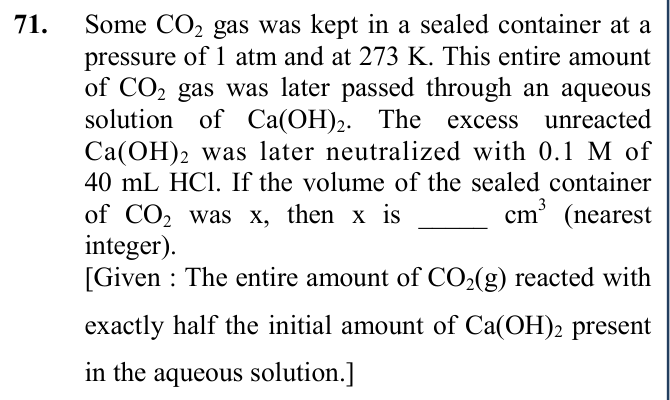
Let moles of CO2 = n
moles of Ca(OH)2 total initially = 2n
excess Ca(OH)2 = n
gm equivalent of Ca(OH)2 = gm equivalent of HCl
n × 2 = 0.1 × 40
1000 × 1
n = 2 × 10⁻³
Volume of CO2 = 2 × 10–3 × 22400 = 44.8 cm3
QUESTION 2
Some Basic Concepts of Chemistry
SECTION A · MCQ (+4, -1)
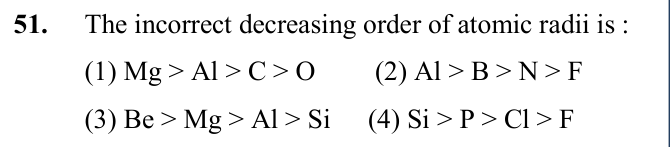
(1) Mg > Al > C > O
(2) Al > B > N > F
(3) Be > Mg > Al > Si
(4) Si > P > Cl > F
Correct order of atomic radii : Be < Mg > Al > Si
QUESTION 3
Some Basic Concepts of Chemistry
SECTION A · MCQ (+4, -1)
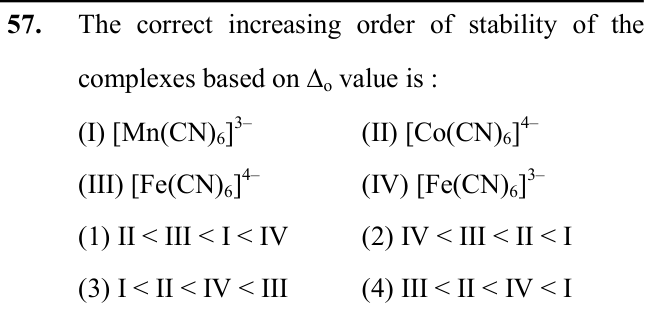
(1) II < III < I < IV
(2) IV < III < II < I
(3) I < II < IV < III
(4) III < II < IV < I
(I) [Mn(CN)6]3–
–1.6 Δo
(II) [Co(CN)6]4–
–1.8 Δo
(III) [Fe(CN)6]4–
–2.4 Δo
(IV) [Fe(CN)6]3–
–2.0 Δo
I < II < IV < III
QUESTION 4
Some Basic Concepts of Chemistry
SECTION A · MCQ (+4, -1)
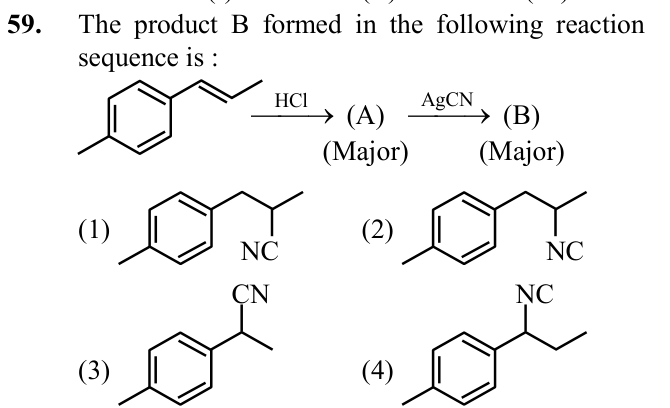
(1) NC
(2) NC
(3) CN
(4) NC
——→
HCl
Cl
NC
H
(Major)
(Major)
AgCN
QUESTION 5
Some Basic Concepts of Chemistry
SECTION A · MCQ (+4, -1)
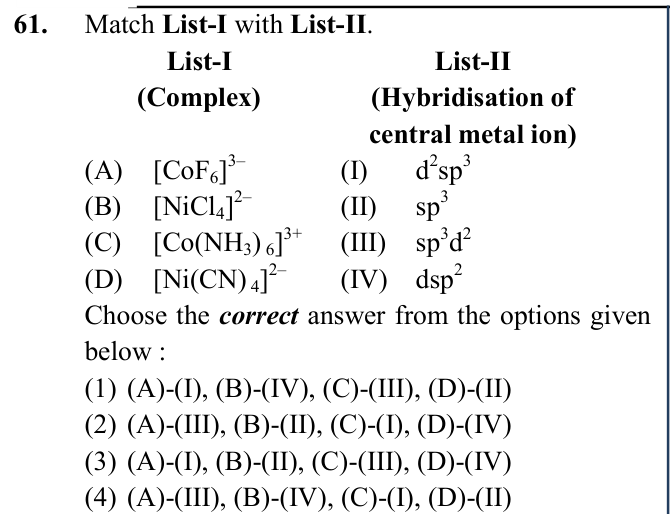
(1) (A)-(I), (B)-(IV), (C)-(III), (D)-(II)
(2) (A)-(III), (B)-(II), (C)-(I), (D)-(IV)
(3) (A)-(I), (B)-(II), (C)-(III), (D)-(IV)
(4) (A)-(III), (B)-(IV), (C)-(I), (D)-(II)
(A) [CoF6]–3
Co3+ → 3d6
3d
4s
4p
4d
sp
3d
2
(B) [NiCl4]2–
Ni2+ → 3d8
3d
4s
4p
sp
3
(C) [Co(NH3)6]3+
Co3+ → 3d6
3d
4s
4p
d
2sp
3
(D) [Ni (CN)4]2–
Ni2+ → 3d8
3d
4s
4p
dsp
2
QUESTION 6
Some Basic Concepts of Chemistry
SECTION A · MCQ (+4, -1)
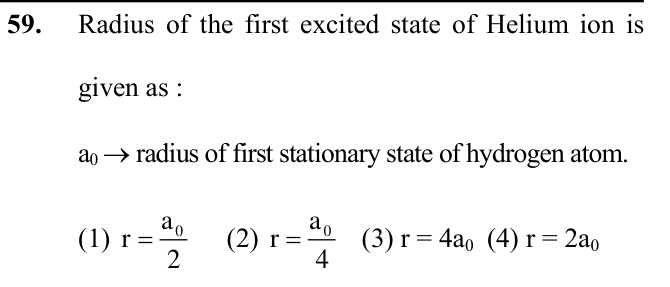
(1) 0
a
r
2
=
(2) 0
a
r
4
=
(3) r = 4a0
(4) r = 2a0
r = a0
2
n
Z
= a0 .
2
(2)
2
= 2a0.
QUESTION 7
Some Basic Concepts of Chemistry
SECTION A · MCQ (+4, -1)
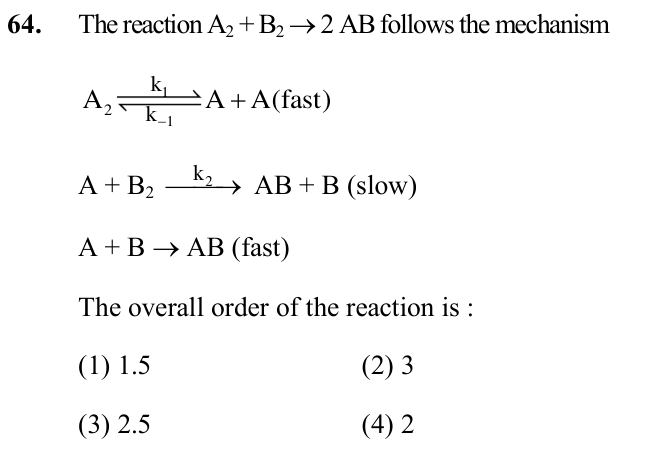
(1) 1.5
(2) 3
(3) 2.5
(4) 2
rate = k2[A][B2] …….(1)
1
–1
k
k
)
(
[
)
= []
[
]
2
2
A
A
)
(
(
[
)
⇒ [Α] =
[
]
1
2
–1
k .
A
k
Substituting in (1) ; we get
Rate = k2
1
–1
k
k
. [
]
1
2
2
A
. [B2]
∴order =
3
2
)
(
[
)
= 1.5
QUESTION 8
Some Basic Concepts of Chemistry
SECTION A · MCQ (+4, -1)
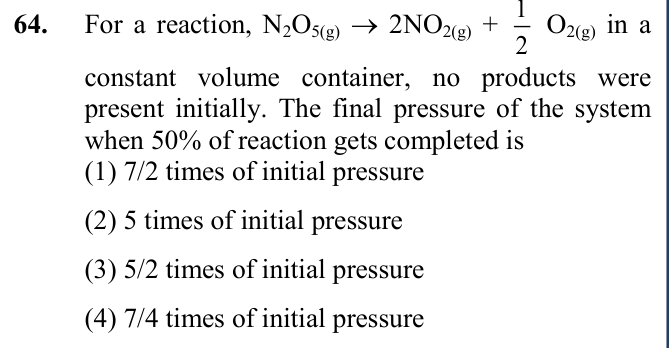
(1) 7/2 times of initial pressure
(2) 5 times of initial pressure
(3) 5/2 times of initial pressure
(4) 7/4 times of initial pressure
QUESTION 9
Some Basic Concepts of Chemistry
SECTION A · MCQ (+4, -1)
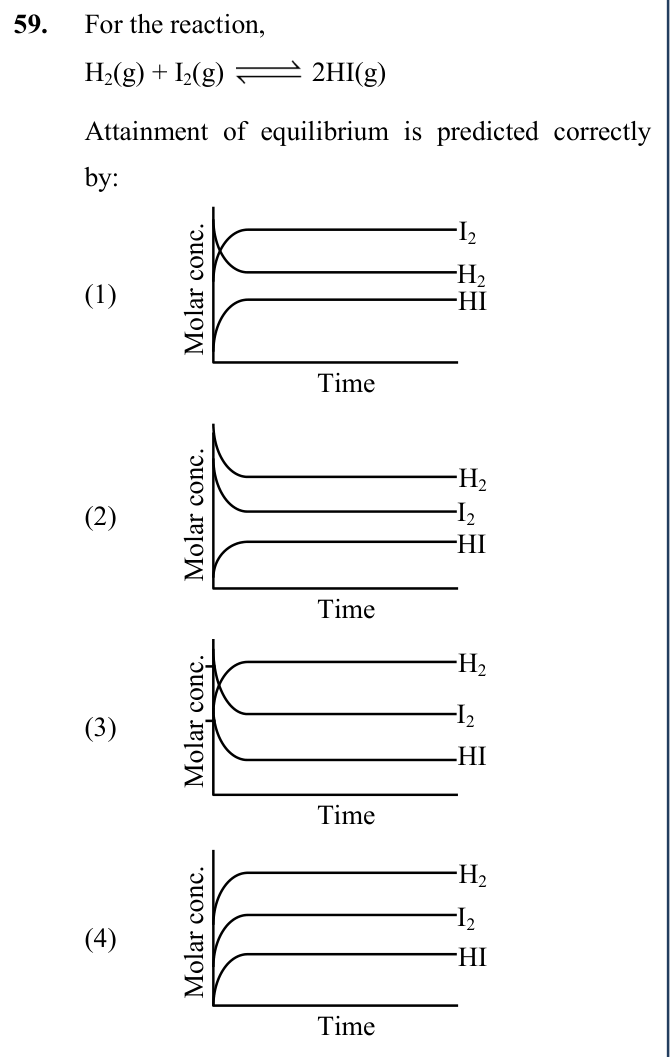
(1) I2
H2
HI
Molar conc.
Time
(2) H2
I2
HI
Molar conc.
Time
(3) H2
I2
HI
Molar conc.
Time
(4) H2
I2
HI
Molar conc.
Time
2
2
H
I
2HI + Concentration of H2 and I2 decreases untill
equilibrium condition and concentration of HI
increases till equilibrium condition and after
equilibrium concentration of all the reactant and
products remain constant.
Correct option (2)
QUESTION 10
Some Basic Concepts of Chemistry
SECTION A · MCQ (+4, -1)
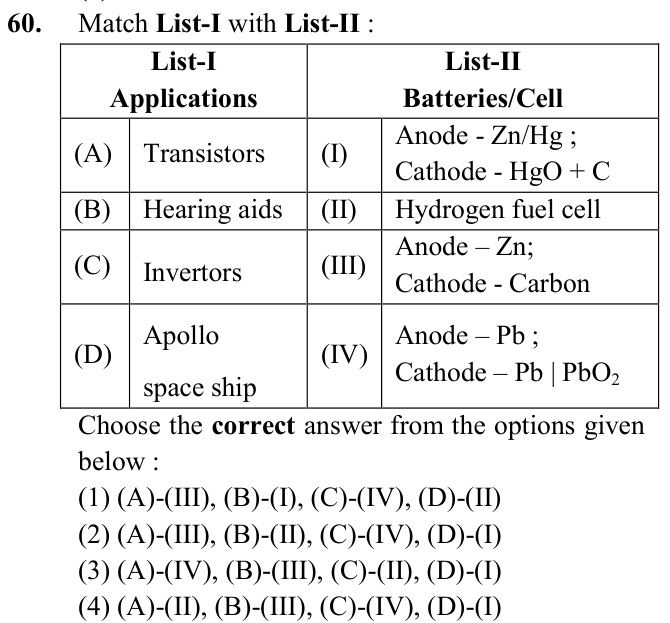
(1) (A)-(III), (B)-(I), (C)-(IV), (D)-(II)
(2) (A)-(III), (B)-(II), (C)-(IV), (D)-(I)
(3) (A)-(IV), (B)-(III), (C)-(II), (D)-(I)
(4) (A)-(II), (B)-(III), (C)-(IV), (D)-(I)
QUESTION 11
Some Basic Concepts of Chemistry
SECTION B · NUMERICAL (+4, 0)
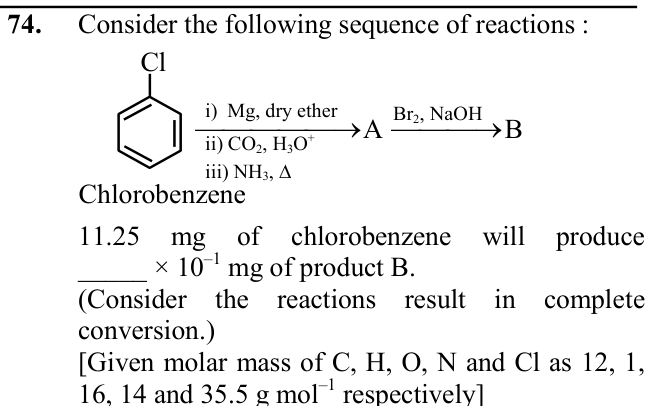
—————→
Cl
Mg / dry ether
MgCl
i) Co2
ii) H⊕
O
←——
NH3 / Δ
NH2
COOH
←———
Br2+NaOH
Hofmann‟s
Bromamide
degradation
NH2
(B)
(A)
No. of moles of
Cl
= No. of moles of
NH2
3
1
3
11.25 10
x 10
10
112.5
93 - - - × × × = x × 10–1 = 93 × 0.1
x = 93 mg
QUESTION 12
Some Basic Concepts of Chemistry
SECTION A · MCQ (+4, -1)
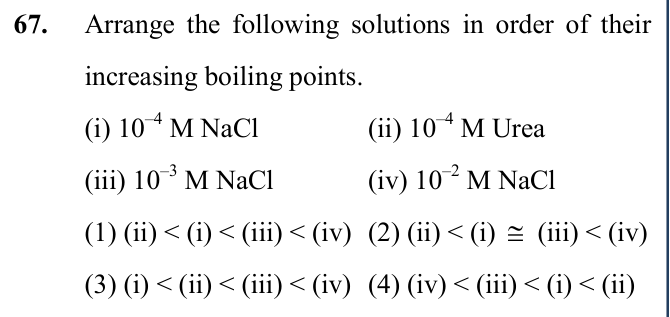
(1) (ii) < (i) < (iii) < (iv)
(2) (ii) < (i) ≅ (iii) < (iv)
(3) (i) < (ii) < (iii) < (iv)
(4) (iv) < (iii) < (i) < (ii)
ΔTb = i Kb . m . ∝ i.C.
where C = concentration
Options
i.C.
(i)
2 × 10⁻⁴
(ii)
1 × 10⁻⁴
(iii)
2 × 10⁻³
(iv)
2 × 10⁻²
B.P. order :
(ii) < (i) < (iii) < (iv)
QUESTION 13
Some Basic Concepts of Chemistry
SECTION A · MCQ (+4, -1)
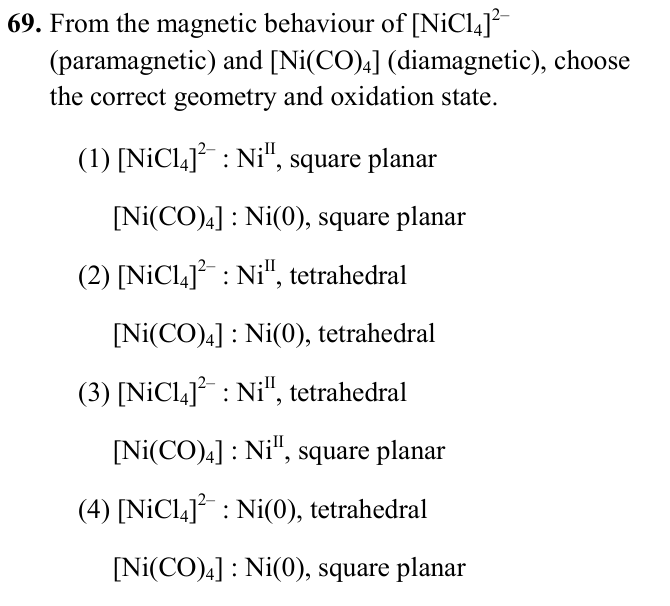
(1) [NiCl4]2– : NiII, square planar
[Ni(CO)4] : Ni(0), square planar
(2) [NiCl4]2– : NiII, tetrahedral
[Ni(CO)4] : Ni(0), tetrahedral
(3) [NiCl4]2– : NiII, tetrahedral
[Ni(CO)4] : NiII, square planar
(4) [NiCl4]2– : Ni(0), tetrahedral
[Ni(CO)4] : Ni(0), square planar
[NiCl4]2–
Ni+2 – [Ar] 3d8 4s0 → sp3, Tetrahedral
Number of unpaired electron = 2 paramagentic
[Ni(CO)4],
Ni(0) → [Ar] 3d10 4s0 (After rearrangement)
No unpaired electron
sp3, Tetrahedral, Diamagnetic
QUESTION 14
Some Basic Concepts of Chemistry
SECTION A · MCQ (+4, -1)
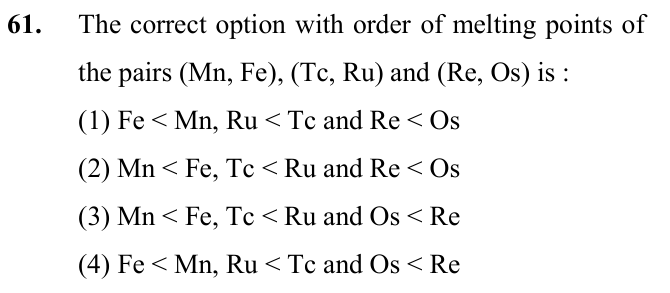
(1) Fe < Mn, Ru < Tc and Re < Os
(2) Mn < Fe, Tc < Ru and Re < Os
(3) Mn < Fe, Tc < Ru and Os < Re
(4) Fe < Mn, Ru < Tc and Os < Re
M.P. ⇒ Mn < Fe, Tc < Ru, Os < Re
NCERT based
QUESTION 15
Some Basic Concepts of Chemistry
SECTION A · MCQ (+4, -1)
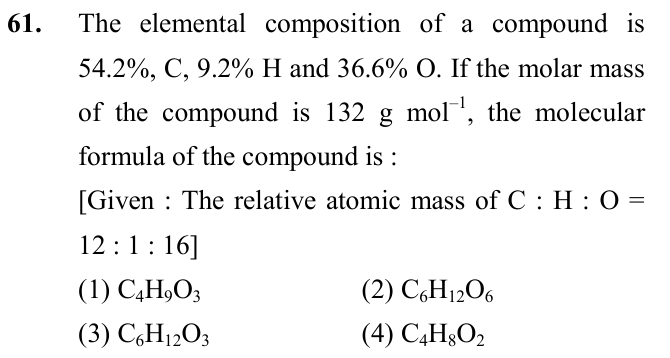
(1) C4H9O3
(2) C6H12O6
(3) C6H12O3
(4) C4H8O2
C
:
H
:
O
54.2
12
:
9.2
:
36.6
16
4.516
:
9.2
:
2.287
4.516
2.287
:
9.2
2.287
:
2.287
2.287
1.97
:
4.02
:
1
C2H4O ⇒ Empirical formula
E.F. mass = 24 + 4 + 16 = 44
and molar mass = 132
Hence molecular formula = (C2H4O)3
= C6H12O3
Correct Option (3)
4
QUESTION 16
Some Basic Concepts of Chemistry
SECTION A · MCQ (+4, -1)
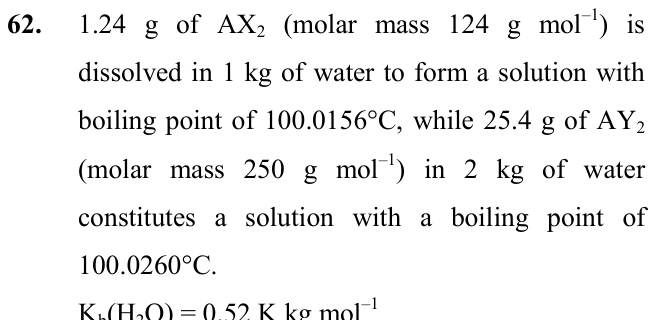
(1) AX2 and AY2 (both) are completely unionised.
(2) AX2 and AY2 (both) are fully ionised.
(3) AX2 is completely unionised while AY2 is fully
ionised.
(4) AX2 is fully ionised while AY2 is completely
unionised.
For AX2 :- ΔTb = Kb × m × i
0.0156 = 0.52 × 0.01
1 × 2
AX
i
⇒
2
AX
i
= 3 ⇒ complete ionisation
For AY2 :- ΔTb = Kb × m × i
0.026 = 0.52 × 0.0508 ×
2
AY
i
⇒
2
AY
i
1 ∴ complete unionisation
QUESTION 17
Some Basic Concepts of Chemistry
SECTION B · NUMERICAL (+4, 0)

In NO2- (nitrite ion):
• Valence electrons: N(5) + 2×O(6) + 1 (charge) = 18 electrons.
• Bonding electrons: 1 N=O double bond (4 e-) + 1 N-O single bond (2 e-) = 6 bonding electrons (3 bond pairs).
• Non-bonding (lone pair) electrons:
- Singly-bonded oxygen: 3 lone pairs = 6 electrons
- Doubly-bonded oxygen: 2 lone pairs = 4 electrons
- Central nitrogen atom: 1 lone pair = 2 electrons
• Total non-bonded electrons = 6 + 4 + 2 = 12 non-bonded electrons.
QUESTION 18
Some Basic Concepts of Chemistry
SECTION B · NUMERICAL (+4, 0)

[Ni(dmg)2]
CH3–C=N
CH3–C=N
Ni
O–H--------O–
O–-------H–O
N=C–CH3
N=C–CH3
Number of H-atom = 14
QUESTION 19
Some Basic Concepts of Chemistry
SECTION B · NUMERICAL (+4, 0)
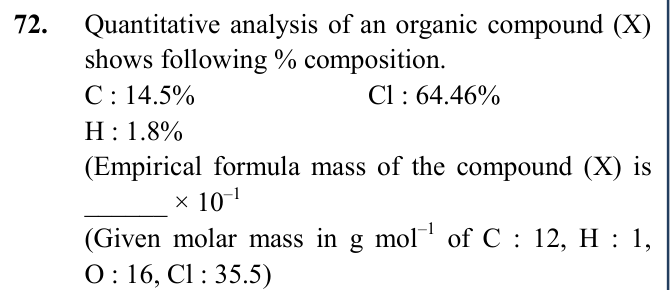
C : Cl : H : O
%mass 14.5 64.46 1.8 19.24
Molar ratio 14.5 64.46
1.8
19.24
12
35.5
1
16
1.2 1.8 1.8 1.2
Minimum 2 3 3 2
integral ratio
Empiricial formula = C2H3Cl3O2
Mass = 165.5
Mass = 1655 × 10–1
QUESTION 20
Some Basic Concepts of Chemistry
SECTION A · MCQ (+4, -1)
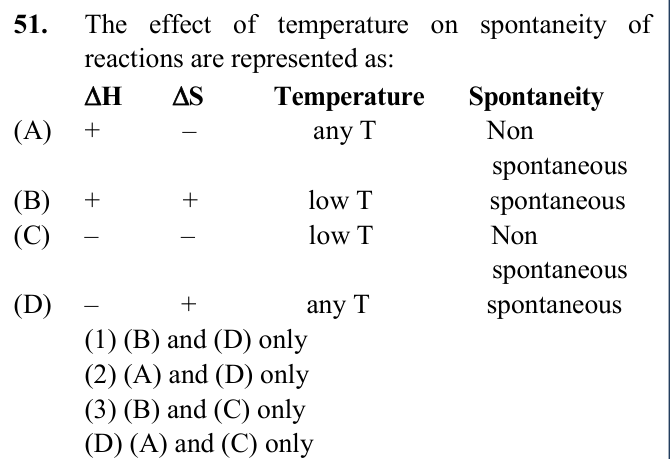
(1) (B) and (D) only
(2) (A) and (D) only
(3) (B) and (C) only
(4) (A) and (C) only
ΔG = ΔH – TΔS
For spontaneity of reaction : ΔG = –ve
QUESTION 21
Some Basic Concepts of Chemistry
SECTION A · MCQ (+4, -1)
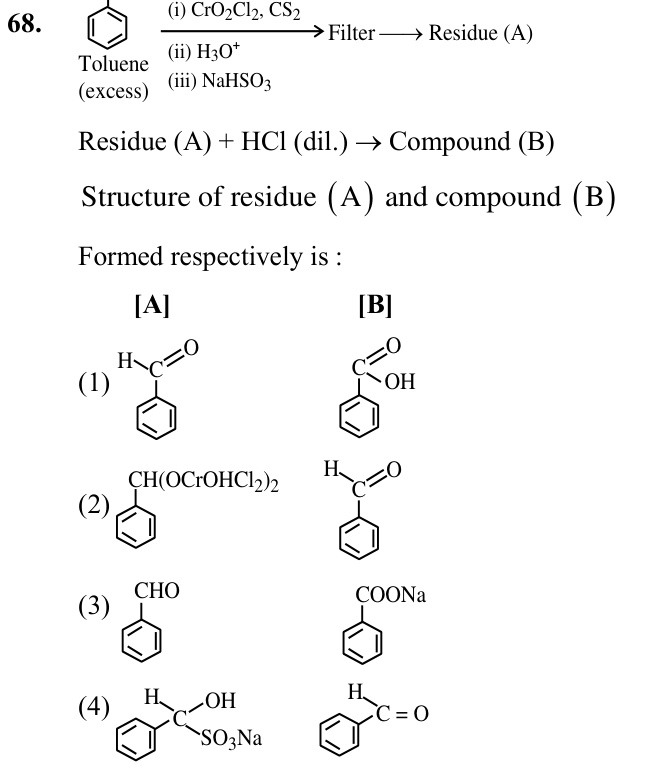
(1) O
C
H
O
C OH
(2) CH(OCrOHCl2)2
O
C
H
(3) CHO
COONa
(4) C
OH
SO3Na
H
C = O
H
CH3
CrO2Cl2, CS2
H3O⊕
CHO
NaHSO3
CH
OH
SO3Na
(Residue)
(A)
dil. HCl
CHO
(B)
QUESTION 22
Some Basic Concepts of Chemistry
SECTION A · MCQ (+4, -1)
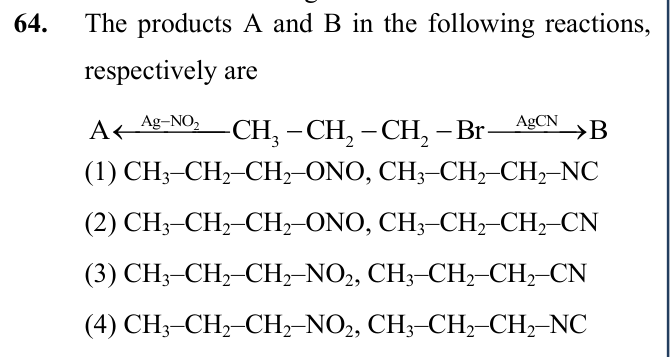
(1) CH3–CH2–CH2–ONO, CH3–CH2–CH2–NC
(2) CH3–CH2–CH2–ONO, CH3–CH2–CH2–CN
(3) CH3–CH2–CH2–NO2, CH3–CH2–CH2–CN
(4) CH3–CH2–CH2–NO2, CH3–CH2–CH2–NC
CH3–CH2–CH2–NO2
2
Ag NO - ←———
—CH3–CH2–CH2–Br
(A)
AgCN
———→CH3–CH2–CH2–NC
(B)
QUESTION 23
Some Basic Concepts of Chemistry
SECTION A · MCQ (+4, -1)
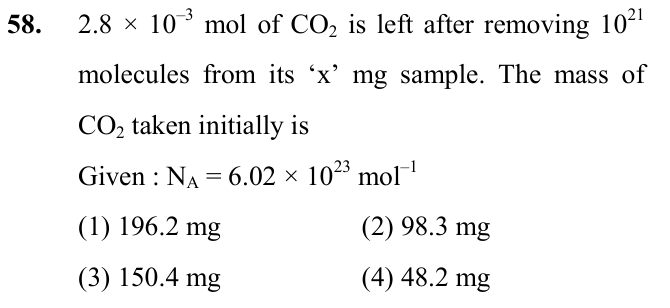
(1) 196.2 mg
(2) 98.3 mg
(3) 150.4 mg
(4) 48.2 mg
(1)
3
initial
x 10
(moles)
44 - × = 21
removal
23
10
(moles)
6.02 10 = ×
left
initial
removed
(moles)
(moles)
(moles) = -
3
21
3
23
x 10
10
2.8 10
44
6.02 10 - - × × = - × ⇒x = 196.2 mg
3
QUESTION 24
Some Basic Concepts of Chemistry
SECTION A · MCQ (+4, -1)
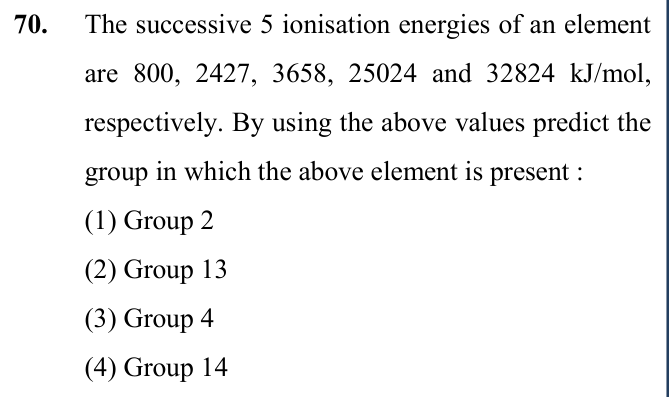
(1) Group 2
(2) Group 13
(3) Group 4
(4) Group 14
The IE4 is suddenly very high therefore element
must have 3 valence e–(s) and it belong to group
13
SECTION-B
QUESTION 25
Some Basic Concepts of Chemistry
SECTION A · MCQ (+4, -1)
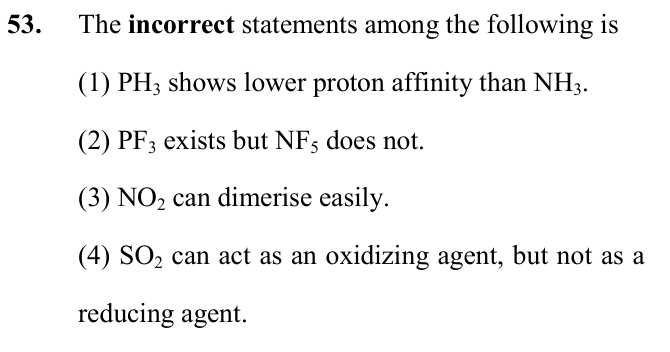
(1) PH3 shows lower proton affinity than NH3.
(2) PF3 exists but NF5 does not.
(3) NO2 can dimerise easily.
(4) SO2 can act as an oxidizing agent, but not as a
reducing agent.
(4)
SO2 can oxidise as well as reduce.
Hence it can act as both oxidising and reducing
agent.