
✎ ANSWER ONLINE · EVERY MISTAKE LINKS BACK TO THE CONCEPT
Structure of Atom · Practice Worksheet
Answer each question here and it marks straight away, with the derivation and a link to the exact micro-concept to revisit.
// CONCEPT AUDIT RESULT
Everything you missed has been added to your Error Arena — retest them blind there, and a concept clears once you get it right.
QUESTION 1
Structure of Atom
SECTION A · MCQ (+4, -1)
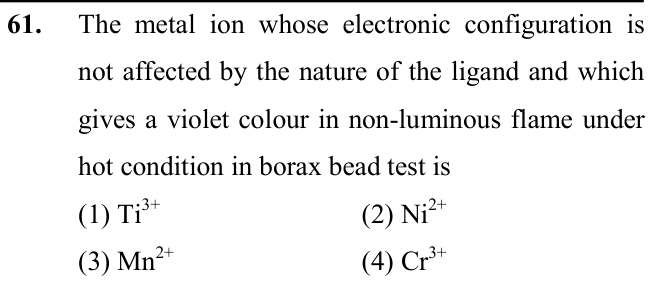
(1) Ti3+
(2) Ni2+
(3) Mn2+
(4) Cr3+
Ni+2 gives violet coloured bead in non-luminous
flame
under
hot
conditions.
Ni+2
has
d8
configuration which does not depend on nature of
ligand present in octahedral complex.
Ni+2 : t2g
6 eg
2
QUESTION 2
Structure of Atom
SECTION A · MCQ (+4, -1)
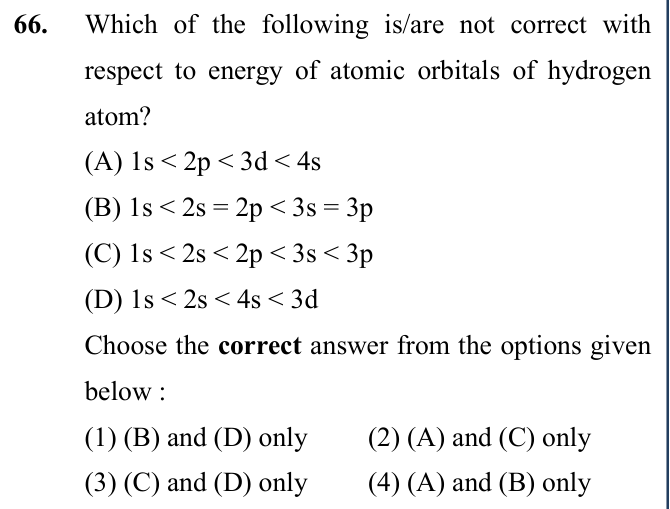
(1) (B) and (D) only
(2) (A) and (C) only
(3) (C) and (D) only
(4) (A) and (B) only
For single electron species energy only depends on
'n' (principal quantum number)
So energy of 2s = 2p
and energy of 3d < 4s
QUESTION 3
Structure of Atom
SECTION A · MCQ (+4, -1)
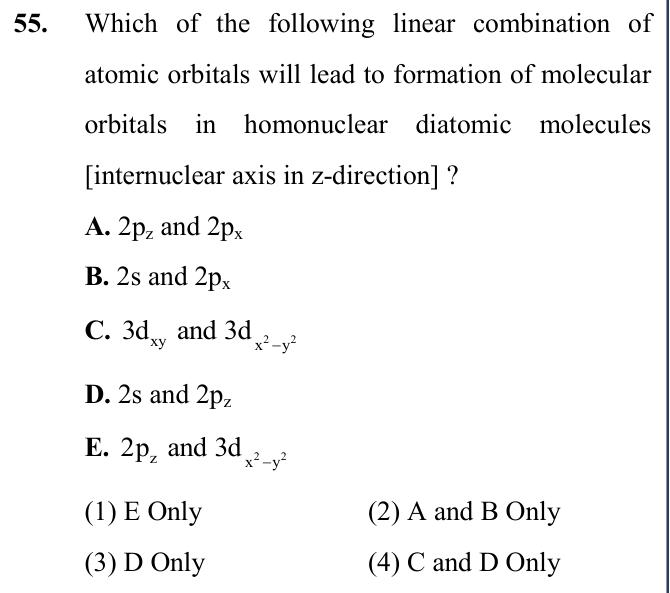
(1) E Only
(2) A and B Only
(3) D Only
(4) C and D Only
A : + X
pz
Z
X
px
Z
⇒ no molecular orbital
B : + Z
s
X
Z
px
X
⇒ no molecular orbital
C : + dxy
X
Y
dx – y
X
Y
2
2
⇒ no molecular orbital
D : + Z
s
X
Z
pz
X + + + –
Sigma molecular
orbital
⇒
E : + pz
X
Y
dx – y
X
Z
2
2
⇒ no molecular orbital
QUESTION 4
Structure of Atom
SECTION A · MCQ (+4, -1)
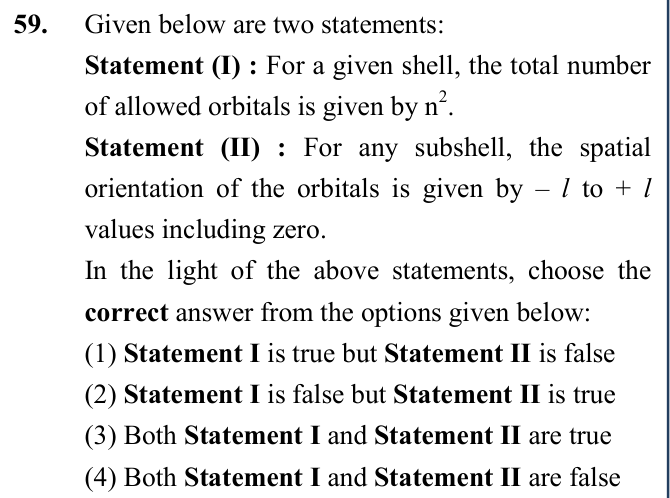
(1) Statement I is true but Statement II is false
(2) Statement I is false but Statement II is true
(3) Both Statement I and Statement II are true
(4) Both Statement I and Statement II are false
For a shell total number of orbitals = n2
Magnetic quantum number have values (–λ to +λ)
including 0.
QUESTION 5
Structure of Atom
SECTION A · MCQ (+4, -1)
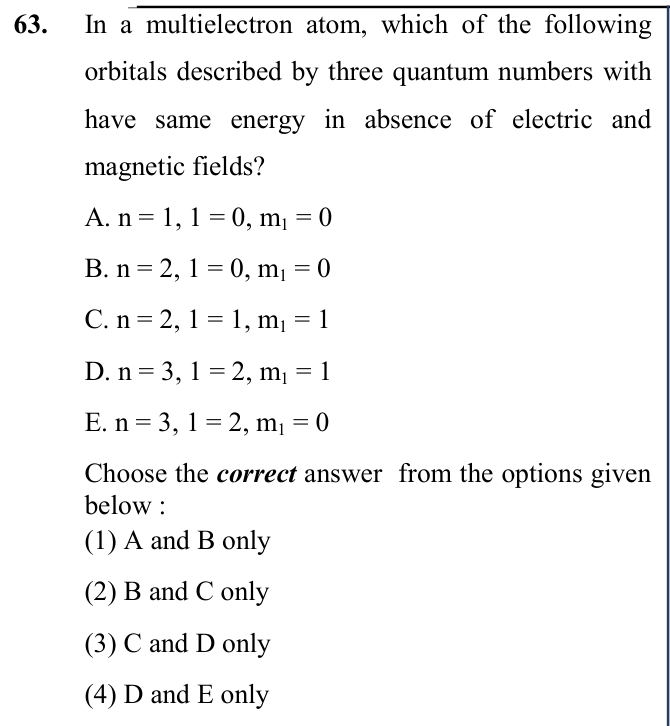
(1) A and B only
(2) B and C only
(3) C and D only
(4) D and E only
orbital
A : n = 1, λ = 0, mλ = 0
1s
B : n = 2, λ = 0, mλ = 0
2s
C : n = 3, λ = 1, mλ = 1
3p
D : n = 3, λ = 2, mλ = 1
3d
E : n = 3, λ = 2, mλ = 0
3d
In absence of electric and magnetic fields, all
orbitals of 3d are degenerate
QUESTION 6
Structure of Atom
SECTION A · MCQ (+4, -1)
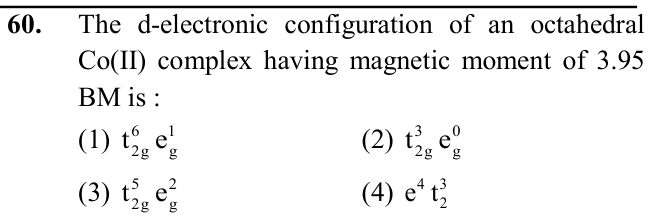
(1) 6
1
2g
g
t
e
(2) 3
0
2g
g
t
e
(3) 5
2
2g
g
t
e
(4) 4
3
2
e t
(3)
Co+2 = (Ar)18 3d7 4s°
QUESTION 7
Structure of Atom
SECTION A · MCQ (+4, -1)
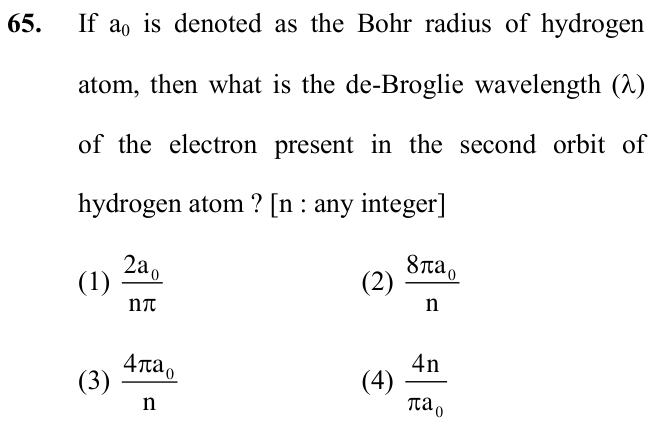
(1) 0
2a
nπ
(2) 0
8 a
n
π
(3) 0
4 a
n
π
(4) 0
4n
a
π
2πrn = nλ
2π .(4a0) = nλ
= λ =
0
8 a
n
π
5
QUESTION 8
Structure of Atom
SECTION B · NUMERICAL (+4, 0)

Z = 41 → Nb (Niobium) : [Kr]36 4d4 5s1
Number of electron in 4d = 4 = x
Z = 44 → Ru (Ruthenium) [Kr]36 4d7 5s1
Number of electron in 4d = 7 = y
x + y = 11
QUESTION 9
Structure of Atom
SECTION A · MCQ (+4, -1)
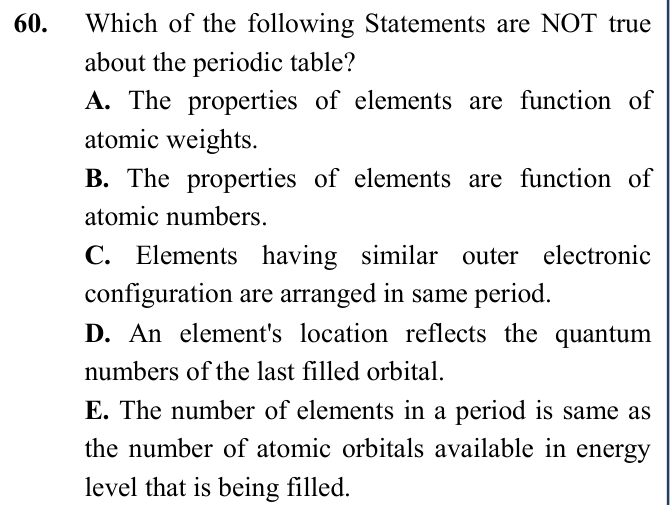
(1) A, C and E Only
(2) D and E Only
(3) A and E Only
(4) B, C and E Only
Properties of elements are periodic function of
their atomic number. Elements having similar
outer electronic configuration are arranged in same
group. Number of elements in a period is not equal
to number of atomic orbitals available in energy
level that is being filled.
Hence, A, C & E are incorrect
QUESTION 10
Structure of Atom
SECTION A · MCQ (+4, -1)
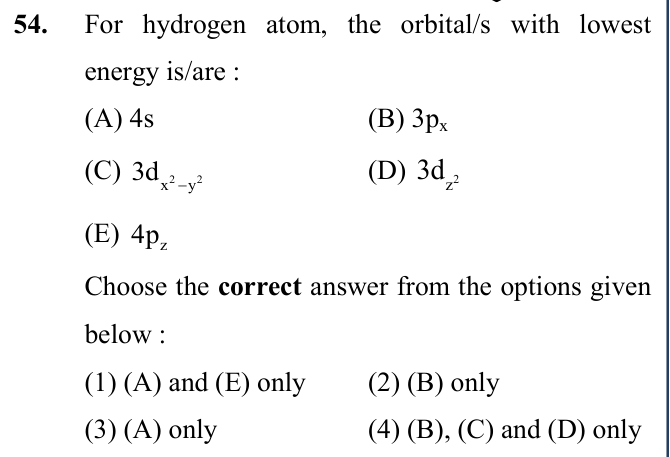
(1) (A) and (E) only
(2) (B) only
(3) (A) only
(4) (B), (C) and (D) only
In hydrogen atom the orbitals in a shell are
degenerate means energy depends only on ‘n’
∴
x
2
2
2
x
y
z
3p
3d
3d
E
E
E - =
=
QUESTION 11
Structure of Atom
SECTION A · MCQ (+4, -1)
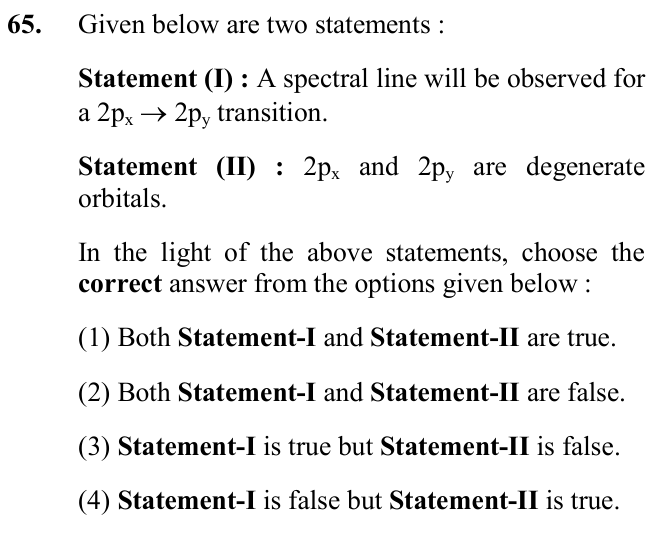
(1) Both Statement-I and Statement-II are true.
(2) Both Statement-I and Statement-II are false.
(3) Statement-I is true but Statement-II is false.
(4) Statement-I is false but Statement-II is true.
No spectral line will be observed for a 2px → 2py
transition because 2px and 2py orbitals are
degenerate orbitals.
5
QUESTION 12
Structure of Atom
SECTION A · MCQ (+4, -1)
Cathode rays consist of a stream of...
(1) Alpha particles
(2) Electrons
(3) Neutrons
(4) Protons
Cathode rays are streams of electrons.
QUESTION 13
Structure of Atom
SECTION A · MCQ (+4, -1)
According to Planck, radiant energy is emitted or absorbed discontinuously as small packets called...
(1) Orbits
(2) Quanta
(3) Waves
(4) Electrons
Planck proposed energy is transferred in discrete quanta.
QUESTION 14
Structure of Atom
SECTION A · MCQ (+4, -1)
Which spectral series of the hydrogen atom lies in the visible region?
(1) Lyman series
(2) Balmer series
(3) Brackett series
(4) Paschen series
The Balmer series (n → 2) falls in the visible region.
QUESTION 15
Structure of Atom
SECTION A · MCQ (+4, -1)
What is the spin-only magnetic moment of the Fe3+ ion (Z = 26)?
(1) 3.87 BM
(2) 4.90 BM
(3) 5.92 BM
(4) 6.93 BM
Fe3+ has the configuration [Ar] 3d⁵ with 5 unpaired electrons. The spin-only magnetic moment is μ = sqrt[n(n + 2)] = sqrt[5 x 7] = √(35) = 5.92 BM.