
✎ ANSWER ONLINE · EVERY MISTAKE LINKS BACK TO THE CONCEPT
Classification of Elements and Periodicity in Properties · Practice Worksheet
Answer each question here and it marks straight away, with the derivation and a link to the exact micro-concept to revisit.
// CONCEPT AUDIT RESULT
Everything you missed has been added to your Error Arena — retest them blind there, and a concept clears once you get it right.
QUESTION 1
Classification of Elements
SECTION A · MCQ (+4, -1)
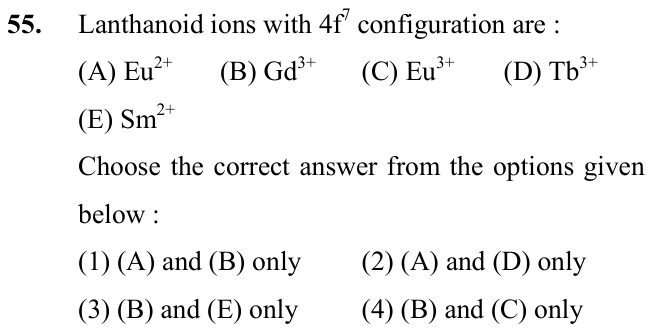
(1) (A) and (B) only
(2) (A) and (D) only
(3) (B) and (E) only
(4) (B) and (C) only
63Eu2+ – [Xe] 4f76s0
64Gd3+ – [Xe] 4f7 5d06s0
63Eu3+ – [Xe] 4f6 6s0
65Tb3+ – [Xe] 4f8 6s0
62Sm2+ – [Xe] 4f6 6s0
Eu2+ & Gd3+
2
QUESTION 2
Classification of Elements
SECTION A · MCQ (+4, -1)
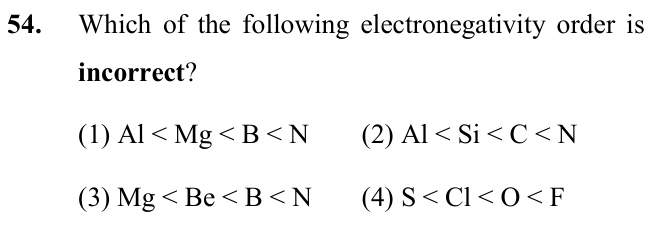
(1) Al < Mg < B < N
(2) Al < Si < C < N
(3) Mg < Be < B < N
(4) S < Cl < O < F
Li
Be
B
C
N
O
F
(E.N.)=
On
pauling
scale
1
1.5
2
2.5
3
3.5
4.0
Na
Mg
Al
Si
P
S
Cl
(E.N.)= 0.9
1.2
1.5
1.8
2.1
2.5
3.0
Correct order Mg < Al < B < N
QUESTION 3
Classification of Elements
SECTION A · MCQ (+4, -1)
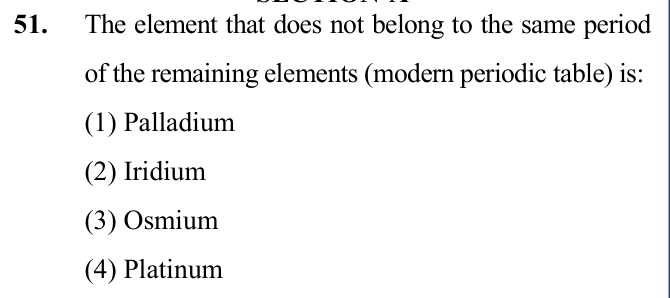
(1) Palladium
(2) Iridium
(3) Osmium
(4) Platinum
(1)
Palladium ⇒ 5th period
Iridium, Osmium, Platinum ⇒ 6th Period
QUESTION 4
Classification of Elements
SECTION A · MCQ (+4, -1)
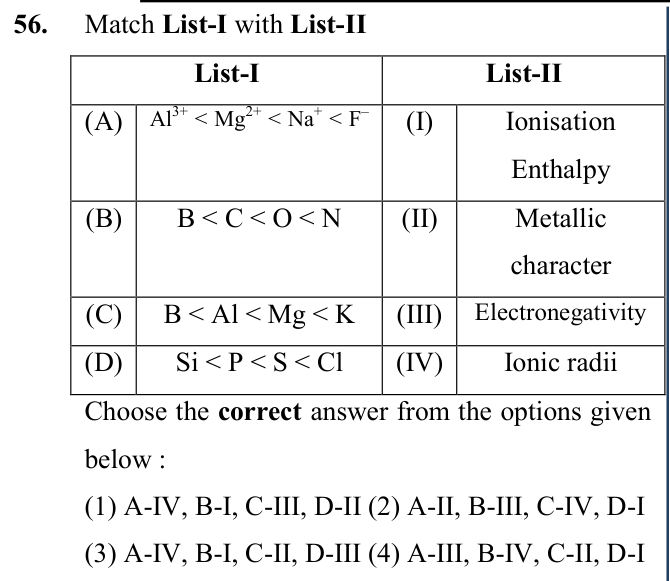
(1) A-IV, B-I, C-III, D-II
(2) A-II, B-III, C-IV, D-I
(3) A-IV, B-I, C-II, D-III
(4) A-III, B-IV, C-II, D-I
Ionic radii – Al3+ < Mg2+ < Na+ < F–
Ionisation energy – B < C < O < N
Metallic character – B < Al < Mg < K
Electron negativity – Si < P < S < Cl
QUESTION 5
Classification of Elements
SECTION A · MCQ (+4, -1)
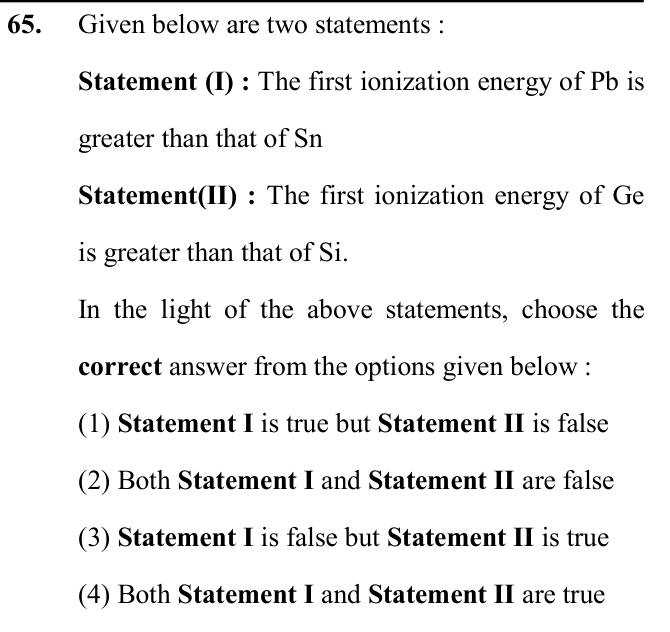
(1) Statement I is true but Statement II is false
(2) Both Statement I and Statement II are false
(3) Statement I is false but Statement II is true
(4) Both Statement I and Statement II are true
Order of I.E. (in KJ/mol) :
C > Si > Ge > Sn < Pb
1086 786 761 708 715
QUESTION 6
Classification of Elements
SECTION A · MCQ (+4, -1)
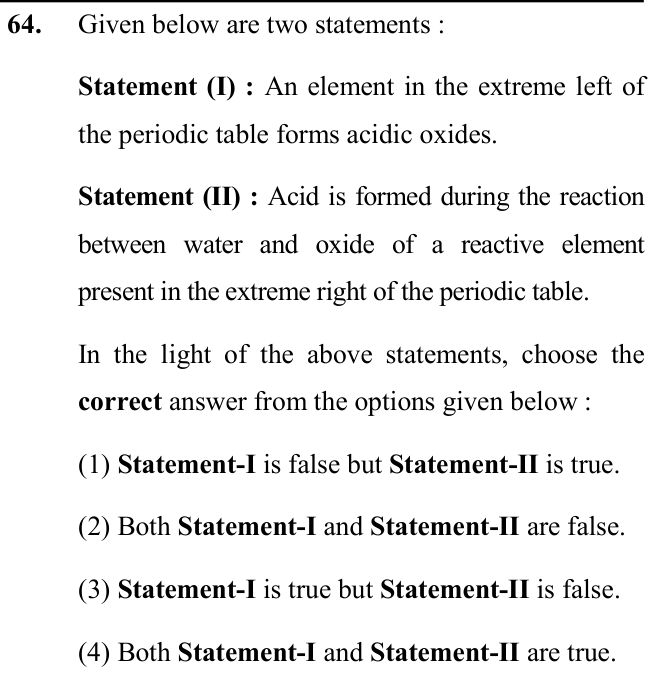
(1) Statement-I is false but Statement-II is true.
(2) Both Statement-I and Statement-II are false.
(3) Statement-I is true but Statement-II is false.
(4) Both Statement-I and Statement-II are true.
Statement-I : False but Statement-II is true.
On moving left to right in periodic table non-
metallic character increases and we know that non-
metal oxides are acidc in nature.
Non metallic character ↑ Acidic strength of oxide↑
QUESTION 7
Classification of Elements
SECTION A · MCQ (+4, -1)
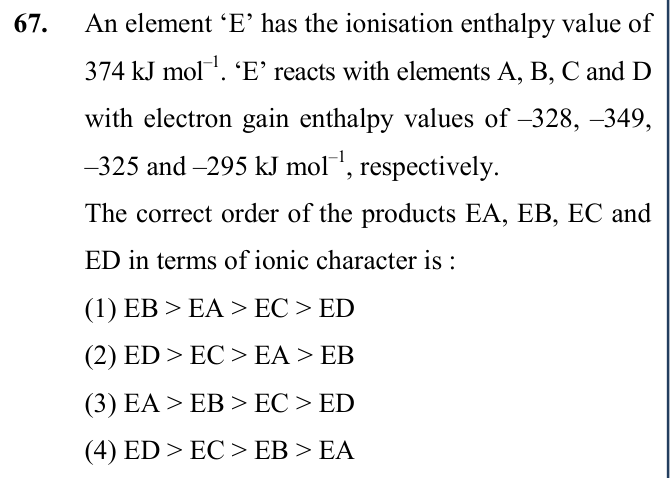
(1) EB > EA > EC > ED
(2) ED > EC > EA > EB
(3) EA > EB > EC > ED
(4) ED > EC > EB > EA
Difference between I.E. & E.G.E increases, ionic
character increases.
QUESTION 8
Classification of Elements and Periodicity in Properties
SECTION A · MCQ (+4, -1)
For a given atom, which type of radius is the largest?
(1) van der Waals radius
(2) covalent radius
(3) metallic radius
(4) ionic radius
The van der Waals radius (non-bonded contact) is larger than the covalent or metallic radius.
QUESTION 9
Classification of Elements and Periodicity in Properties
SECTION A · MCQ (+4, -1)
Which of the following oxides is amphoteric?
(1) Na₂O
(2) Al₂O₃
(3) SO₂
(4) CaO
Aluminium oxide reacts with both acids and bases: Al₂O₃ + 6HCl -> 2AlCl₃ + 3H₂O (as a base) and Al₂O₃ + 2NaOH + 3H₂O -> 2Na[Al(OH)₄] (as an acid). Na₂O and CaO are basic; SO₂ is acidic.
QUESTION 10
Classification of Elements and Periodicity in Properties
SECTION A · MCQ (+4, -1)
An element has IE₁ = 738 kJ/mol, IE₂ = 1451 kJ/mol, and IE₃ = 7733 kJ/mol. What is the formula of its chloride?
(1) MCl
(2) MCl₂
(3) MCl₃
(4) MCl₄
The huge jump between IE₂ and IE₃ means the first two electrons are valence electrons and the third comes from a stable noble-gas core. Hence the element has 2 valence electrons (magnesium) and forms MCl₂.