
✎ ANSWER ONLINE · EVERY MISTAKE LINKS BACK TO THE CONCEPT
Chemical Thermodynamics · Practice Worksheet
Answer each question here and it marks straight away, with the derivation and a link to the exact micro-concept to revisit.
// CONCEPT AUDIT RESULT
Everything you missed has been added to your Error Arena — retest them blind there, and a concept clears once you get it right.
QUESTION 1
Thermodynamics
SECTION B · NUMERICAL (+4, 0)
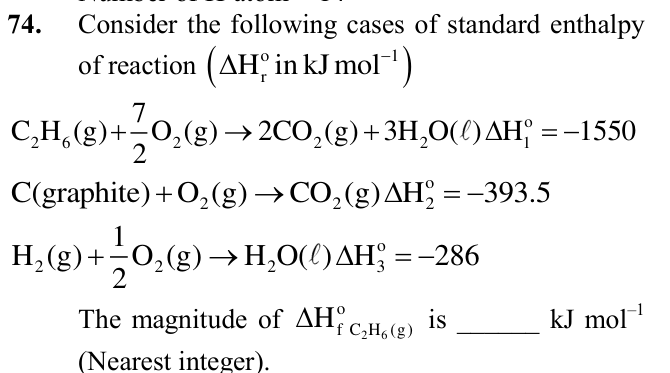
2C(graphite) + 3H2(g) → C2H6(g) ΔHf = ?
C2H6(g) + 7
2 O2(g) → 2CO2(g) + 3H2O(l)
ΔH1 = – 1550
C(graphite) + O2(g) → CO2(g) ΔH2 = – 393.5
H2(g) + 1
2 O2(g) → H2O(/) ΔH3 = – 286
ΔHf = 2ΔH2 + 3ΔH3 – ΔH1
= 95 kJ/mole.
QUESTION 2
Thermodynamics
SECTION B · NUMERICAL (+4, 0)
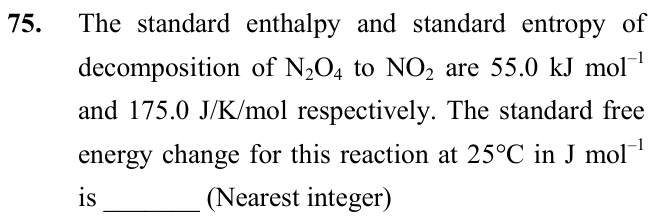
(2850)
o
rxn
H
Δ
= 55 kJ/mol,
T = 298 K
o
rxn
S
Δ
= 175 J/mol
o
o
o
rxn
rxn
rxn
G
H
T S
Δ
=Δ
-Δ
⇒
o
rxn
G
Δ
= 55000 J/mol – 298 × 175 J/mol
⇒
o
rxn
G
Δ
= 55000 – 52150
⇒
o
rxn
G
Δ
= 2850 J/mol
QUESTION 3
Thermodynamics
SECTION A · MCQ (+4, -1)
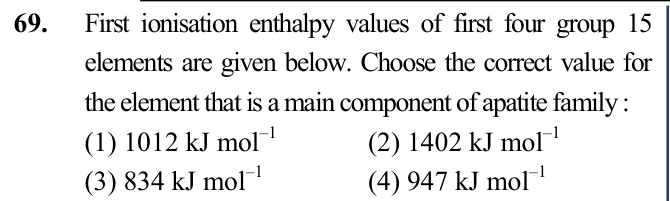
(1) 1012 kJ mol–1
(2) 1402 kJ mol–1
(3) 834 kJ mol–1
(4) 947 kJ mol–1
QUESTION 4
Thermodynamics
SECTION A · MCQ (+4, -1)
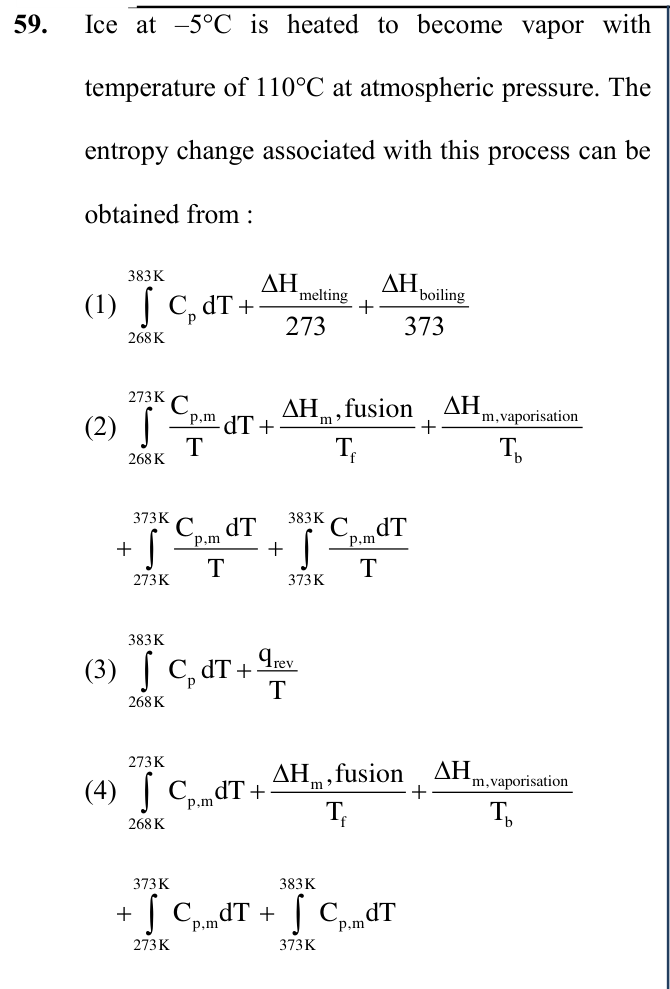
(1) 383K
melting
boiling
p
268K
H
H
C dT
273
373
Δ
Δ + +
∫
(2) 273K
p,m
m,vaporisation
m
f
b
268K
C
H
H ,fusion
dT
T
T
T
Δ
Δ + +
∫
373K
383K
p,m
p,m
273K
373K
C
dT
C
dT
T
T + +
∫
∫
(3) 383K
rev
p
268K
q
C dT
T + ∫
(4) 273K
m,vaporisation
m
p,m
f
b
268K
H
H ,fusion
C
dT
T
T
Δ
Δ + +
∫
373K
383K
p,m
p,m
273K
373K
C
dT
C
dT + +
∫
∫
(2)
Ice → Ice
Water → Water
Water → Water
vapour
vapour
268 K 273 K
273 K
273 K
373 K
383 K
(1)
(2)
(3)
(4)
(5)
ΔSoverall = ΔS1 + ΔS2 + ΔS3 + ΔS4 + ΔS5
m fusion
2
H
S
273
Δ
Δ = Tf = 273 'K'
373
p,m
3
273
C
dT
S
T
Δ
=∫
m vaporisation
4
H
S
373
Δ
Δ = Tb = 373 'K'
383
p,m
5
373
C
dT
S
T
Δ
=∫
Answer = (2)
QUESTION 5
Thermodynamics
SECTION A · MCQ (+4, -1)
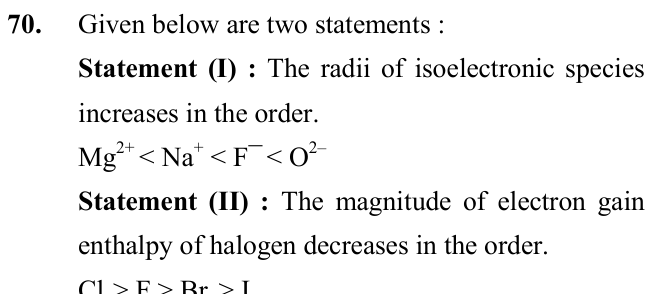
(1) Statement I is incorrect but Statement II is correct
(2) Both Statement I and Statement II are incorrect
(3) Statement I is correct but Statement II is incorrect
(4) Both Statement I and Statement II are correct
(i) For isoelectronic species –ve charge increases,
radii increases.
(ii) Magnitude of E.G.E : Cl > F > Br > I
SECTION-B
QUESTION 6
Thermodynamics
SECTION B · NUMERICAL (+4, 0)
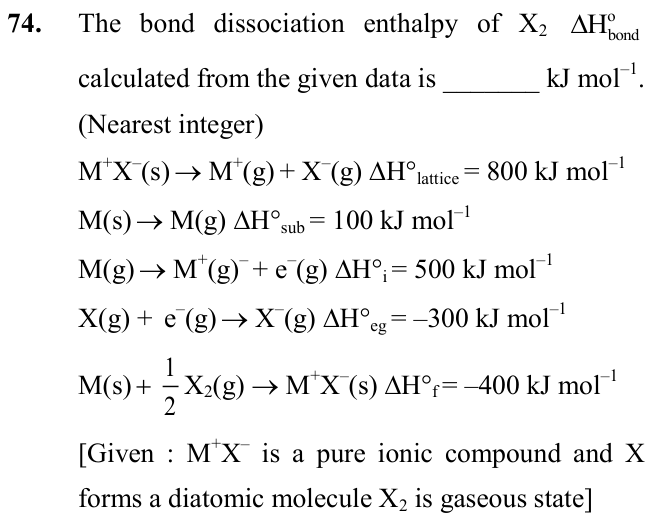
M(s) + X2(g) —→ M⊕Xψ(s)
1
2
→
→
M(g)
X(g)
→
→
M+
(g)
X–
(g) + ∴
f
sub
1
H (MX)
H
(M)
I.E.(M)
[B.E.(X – X)]
2
Δ
=Δ + +
+ EG(X) + L.E.(MX)
– 400 = (100) + (500) + 1
2 (B.E.) + (–300) + (–800)
∴B.E. = 200 kJ mole–1
7
QUESTION 7
Thermodynamics
SECTION B · NUMERICAL (+4, 0)
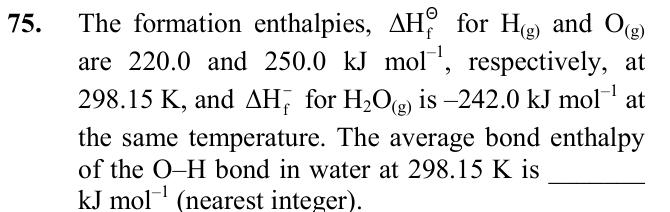
→
2(g)
1 H
H(g)
2
; ΔfH(H(g)) = 220 KJ/mol
→
2(g)
1 O
O(g)
2
; ΔfH(O(g)) = 250 KJ/mol
ΔfH(H2O(g)) = –242 KJ/mol
2H(g) + O(g)
250
2×220
–2(BE(O–H)
ΔHf (H2O(l)) = –242 = 440 + 250 – 2(B.E.(O–H)) = BE(O – H)
466 KJ / mol
QUESTION 8
Thermodynamics
SECTION A · MCQ (+4, -1)
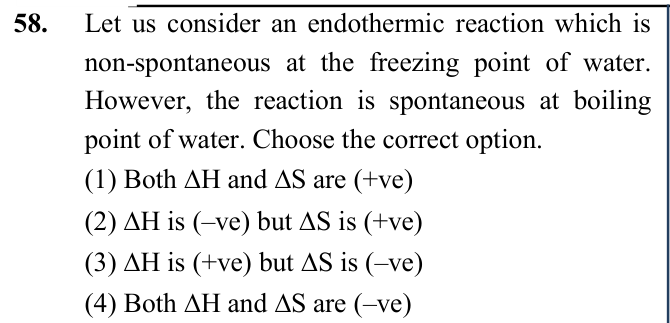
(1) Both ΔH and ΔS are (+ve)
(2) ΔH is (–ve) but ΔS is (+ve)
(3) ΔH is (+ve) but ΔS is (–ve)
(4) Both ΔH and ΔS are (–ve)
Reaction is spontaneous at relatively high
temperature
and
non-spontaneous
at
low
temperature ΔG = ΔH – TΔS
It is only possible when ΔH and ΔS both are
positive.
Option (1)
QUESTION 9
Chemical Thermodynamics
SECTION A · MCQ (+4, -1)
Which of the following is a path function?
(1) entropy
(2) internal energy
(3) work
(4) enthalpy
Work (like heat) depends on the path, unlike state functions such as U, H, and S.
QUESTION 10
Chemical Thermodynamics
SECTION A · MCQ (+4, -1)
The enthalpy of fusion of ice is 6.0 kJ/mol at its melting point, 273.15 K. What is the entropy of fusion?
(1) 0.022 J mol⁻¹ K⁻¹
(2) 88 J mol⁻¹ K⁻¹
(3) 21.97 J mol⁻¹ K⁻¹
(4) 45.5 J mol⁻¹ K⁻¹
At the equilibrium phase-transition temperature ΔS_trans = ΔH_trans / T_trans. ΔS_fus = 6000 J / 273.15 K = 21.97 J mol⁻¹ K⁻¹.