
⚡ OFFICIAL NTA ASSESSMENT GENERATOR & WORD (.DOCX) EXPORTER
Chemical Thermodynamics · Practice Worksheet
JEE Main Chemistry · Curated Assessment Set Print directly or export as a beautifully formatted Microsoft Word document with embedded 180-DPI mathematical prompt clips and step-by-step derivations.
EDUPROD JEE MAIN TEST SERIES · NTA PATTERN
Chemical Thermodynamics · Practice Worksheet
JEE Main Chemistry · Curated Assessment Set · Assessment Code: JEE-101
Total Marks: 60
Marking: +4 / -1 (Sec A) · +4 / 0 (Sec B)
QUESTION 1
CHEMISTRY · Thermodynamics
SECTION B · NUMERICAL (+4, 0)
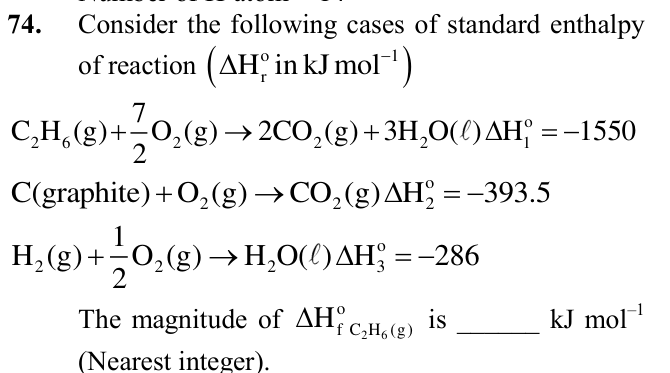
Numerical Value:
[ ]
QUESTION 2
CHEMISTRY · Thermodynamics
SECTION B · NUMERICAL (+4, 0)
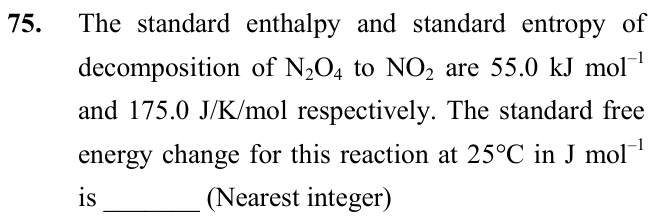
Numerical Value:
[ ]
QUESTION 3
CHEMISTRY · Thermodynamics
SECTION A · MCQ (+4, -1)
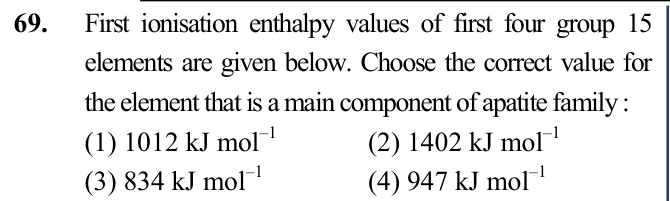
Candidate Response:
(1) (2) (3) (4)
QUESTION 4
CHEMISTRY · Thermodynamics
SECTION A · MCQ (+4, -1)
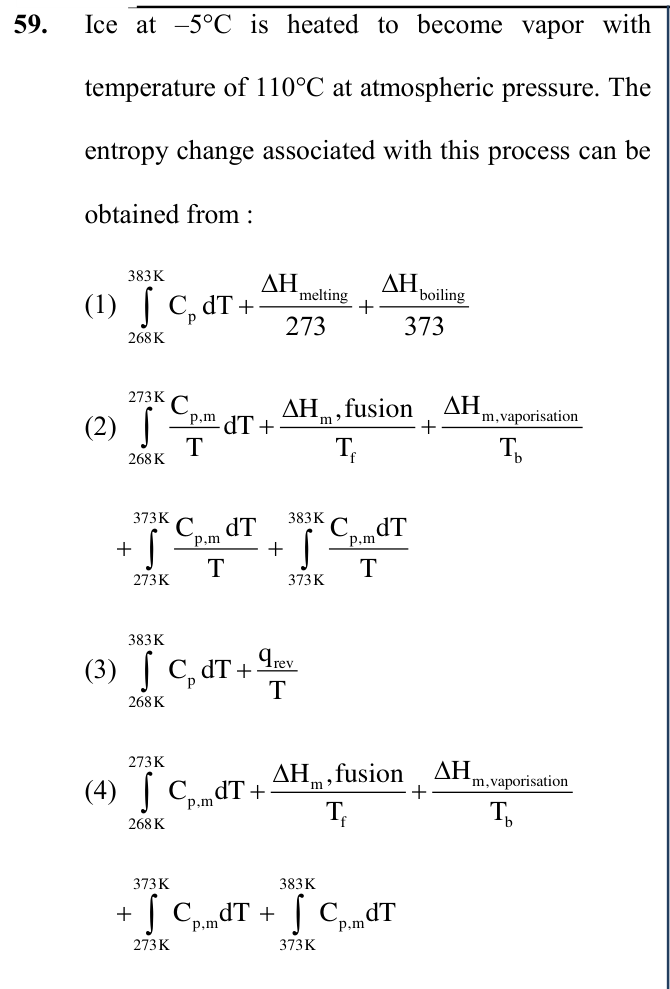
Candidate Response:
(1) (2) (3) (4)
QUESTION 5
CHEMISTRY · Thermodynamics
SECTION A · MCQ (+4, -1)
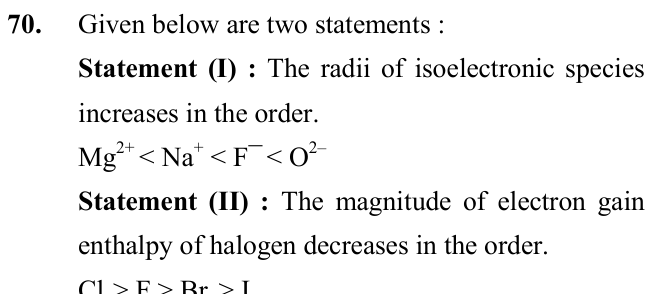
Candidate Response:
(1) (2) (3) (4)
QUESTION 6
CHEMISTRY · Thermodynamics
SECTION B · NUMERICAL (+4, 0)
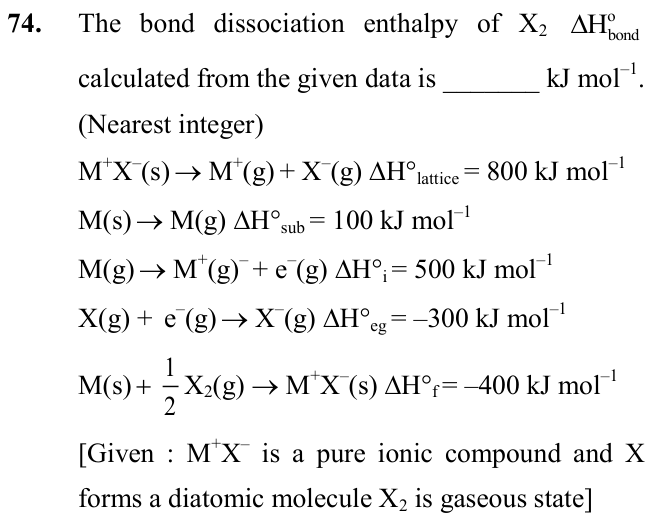
Numerical Value:
[ ]
QUESTION 7
CHEMISTRY · Thermodynamics
SECTION B · NUMERICAL (+4, 0)
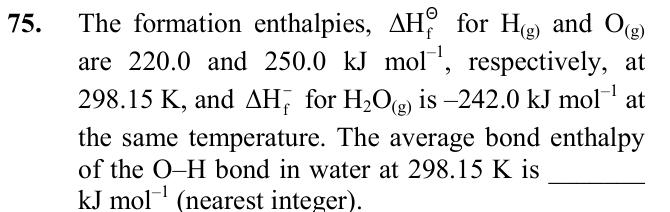
Numerical Value:
[ ]
QUESTION 8
CHEMISTRY · Thermodynamics
SECTION A · MCQ (+4, -1)
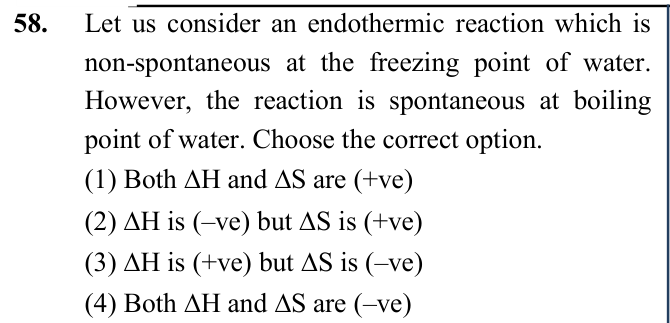
Candidate Response:
(1) (2) (3) (4)
QUESTION 9
CHEMISTRY · Chemical Thermodynamics
SECTION A · MCQ (+4, -1)
Which of the following is a path function?
(1) entropy
(2) internal energy
(3) work
(4) enthalpy
Candidate Response:
(1) (2) (3) (4)
QUESTION 10
CHEMISTRY · Chemical Thermodynamics
SECTION A · MCQ (+4, -1)
The enthalpy of fusion of ice is 6.0 kJ/mol at its melting point, 273.15 K. What is the entropy of fusion?
(1) 0.022 J mol⁻¹ K⁻¹
(2) 88 J mol⁻¹ K⁻¹
(3) 21.97 J mol⁻¹ K⁻¹
(4) 45.5 J mol⁻¹ K⁻¹
Candidate Response:
(1) (2) (3) (4)
QUESTION 11
CHEMISTRY · Chemical Thermodynamics
SECTION A · MCQ (+4, -1)
For a gaseous reaction, the relation between enthalpy change and internal energy change is
(1) ΔH = ΔU - ΔngRT
(2) ΔH = ΔU/ΔngRT
(3) ΔU = ΔH + ΔngRT
(4) ΔH = ΔU + ΔngRT
Candidate Response:
(1) (2) (3) (4)
QUESTION 12
CHEMISTRY · Chemical Thermodynamics
SECTION A · MCQ (+4, -1)
The calculated (localized Kekulé) heat of formation of benzene is +230 kJ/mol, while its experimental heat of formation is +83 kJ/mol. What is the resonance energy of benzene?
(1) −147 kJ/mol
(2) 147 kJ/mol
(3) 313 kJ/mol
(4) −313 kJ/mol
Candidate Response:
(1) (2) (3) (4)
QUESTION 13
CHEMISTRY · Chemical Thermodynamics
SECTION A · MCQ (+4, -1)
At 300 K, the equilibrium constant of a reaction is K = 1. What is Δ_r G°?
(1) Cannot be determined without ΔH
(2) 0 kJ/mol
(3) −8.314 kJ/mol
(4) +8.314 kJ/mol
Candidate Response:
(1) (2) (3) (4)
QUESTION 14
CHEMISTRY · Chemical Thermodynamics
SECTION A · MCQ (+4, -1)
The enthalpy of neutralisation of a weak acid with a strong base is less negative than -57.1 kJ/mol because some energy is used for
(1) dilution
(2) ionisation of the weak acid
(3) hydration of ions
(4) bond formation
Candidate Response:
(1) (2) (3) (4)
QUESTION 15
CHEMISTRY · Chemical Thermodynamics
SECTION A · MCQ (+4, -1)
Using mean bond enthalpies, the reaction enthalpy is calculated as
(1) the average of bonds broken and formed
(2) (bonds broken) - (bonds formed)
(3) the sum of all bond enthalpies
(4) (bonds formed) - (bonds broken)
Candidate Response:
(1) (2) (3) (4)