
✎ ANSWER ONLINE · EVERY MISTAKE LINKS BACK TO THE CONCEPT
Equilibrium · Practice Worksheet
Answer each question here and it marks straight away, with the derivation and a link to the exact micro-concept to revisit.
// CONCEPT AUDIT RESULT
Everything you missed has been added to your Error Arena — retest them blind there, and a concept clears once you get it right.
QUESTION 1
Equilibrium
SECTION A · MCQ (+4, -1)
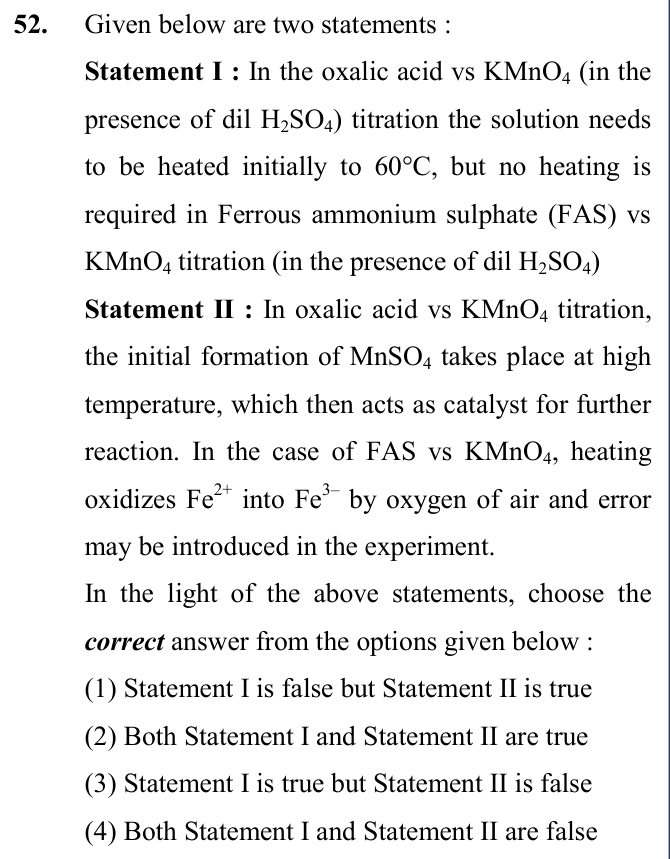
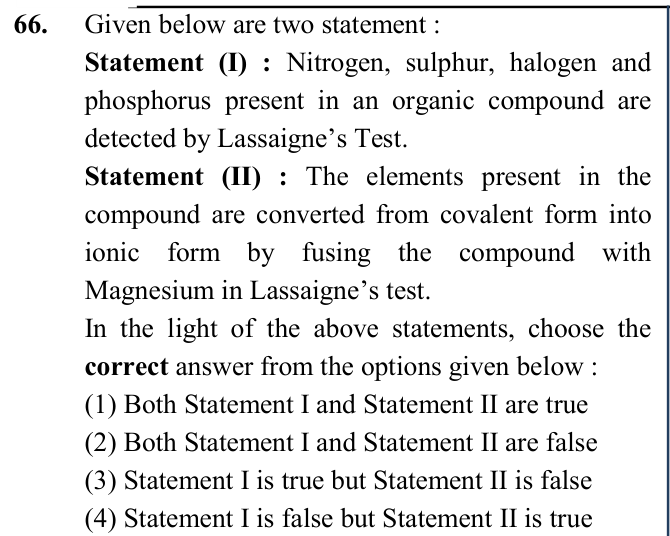
(1) Statement I is false but Statement II is true
(2) Both Statement I and Statement II are true
(3) Statement I is true but Statement II is false
(4) Both Statement I and Statement II are false
For the titration : Oxalic acid v/s KMnO4
2
4
2
2MnO
5(COO)
16H - - + + + →
2
2
2
10CO
2Mn
8H O + + + This reaction is slow at room temperature, but
becomes fast at 60°C. Manganese(II) ions catalyse
the reaction; thus, the reaction is autocatalytic;
once manganese(II) ions are formed, it becomes
faster and faster.
The titration of FAS v/s KMnO4 do not require
heating because at higher temperature the
oxidation of Fe+2 to Fe+3 by atmospheric O2 will be
prominent.
QUESTION 2
Equilibrium
SECTION A · MCQ (+4, -1)
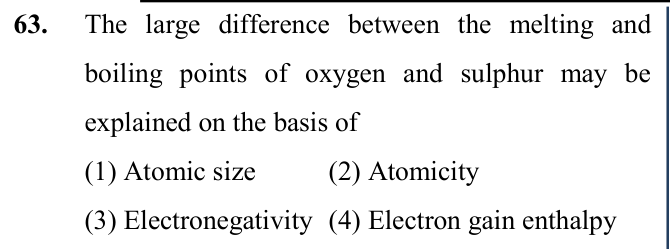
(1) Atomic size
(2) Atomicity
(3) Electronegativity
(4) Electron gain enthalpy
Oxygen exists as O2 (Atomicity = 2)
Sulphur exists as S8 (Atomicity = 8)
Hence, Melting point & Boiling point of sulphur
are significantly large compared to oxygen.
QUESTION 3
Equilibrium
SECTION A · MCQ (+4, -1)
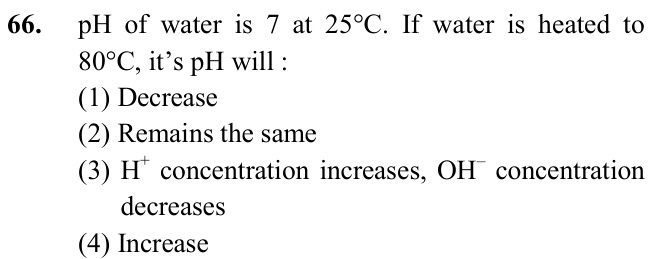
(1) Decrease
(2) Remains the same
(3) H+ concentration increases, OH– concentration
decreases
(4) Increase
With increase in temperature, Kw of water increases
So, degree of dissociation of water increase
∴pH as well as pOH of water decrease.
5
QUESTION 4
Equilibrium
SECTION A · MCQ (+4, -1)
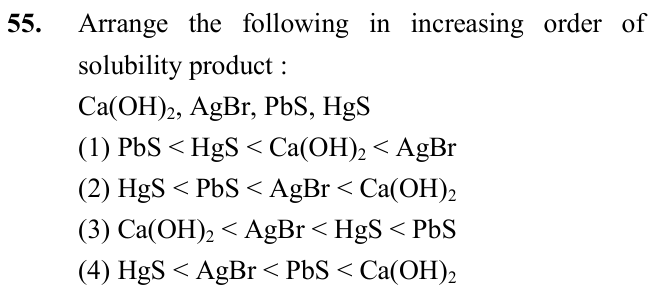
(1) PbS < HgS < Ca(OH)2 < AgBr
(2) HgS < PbS < AgBr < Ca(OH)2
(3) Ca(OH)2 < AgBr < HgS < PbS
(4) HgS < AgBr < PbS < Ca(OH)2
Based on the Ksp values and salt analysis cation
identification, we can say that order of Ksp value
is:
HgS < PbS < AgBr < Ca(OH)2
Ksp values
HgS → 4 × 10–53
PbS → 8 × 10–28
AgBr → 5 × 10–13
Ca(OH)2 → 5.5 × 10⁻⁶
2
QUESTION 5
Equilibrium
SECTION A · MCQ (+4, -1)
(1) Both Statement I and Statement II are true
(2) Both Statement I and Statement II are false
(3) Statement I is true but Statement II is false
(4) Statement I is false but Statement II is true
The elements present in the compound are
converted from covalent form into ionic form by
fusing the compound with sodium in Lassigne’s
test
QUESTION 6
Equilibrium
SECTION A · MCQ (+4, -1)
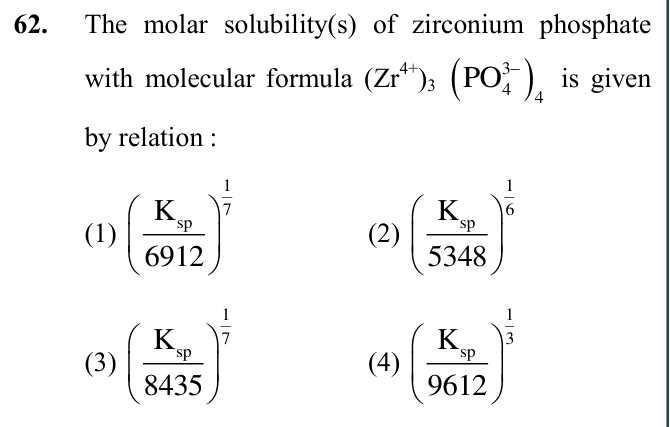
(1) 1
7
sp
K
6912
)
(
[
)
(2) 1
6
sp
K
5348
)
(
[
)
(3) 1
7
sp
K
8435
)
(
[
)
(4) 1
3
sp
K
9612
)
(
[
)
Zr3(PO4)4(s)
3Zr+4(aq) + 4PO4
–3(aq)
–
3s
4s
Ksp = (3s)3 (4s)4 = 6912 s7
s =
1/7
sp
K
6912
)
(
[
)
QUESTION 7
Equilibrium
SECTION A · MCQ (+4, -1)
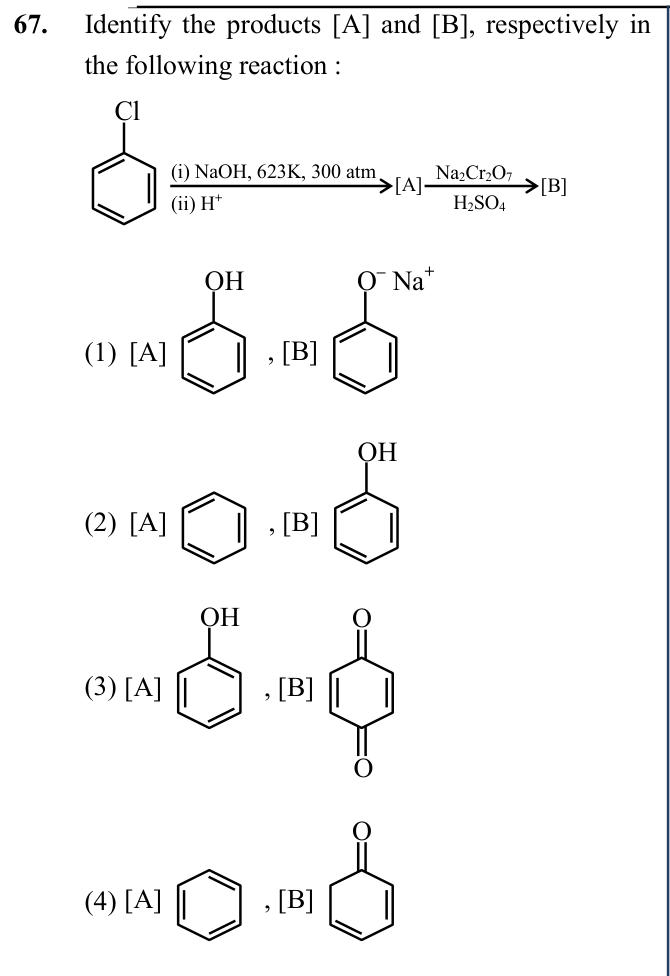
(1) OH
[A]
, [B]
O– Na+
(2) [A]
, [B]
OH
(3) OH
[A]
, [B]
O
O
(4) [A]
, [B]
O
A is phenol and B is para benzoquinone.
QUESTION 8
Equilibrium
SECTION A · MCQ (+4, -1)
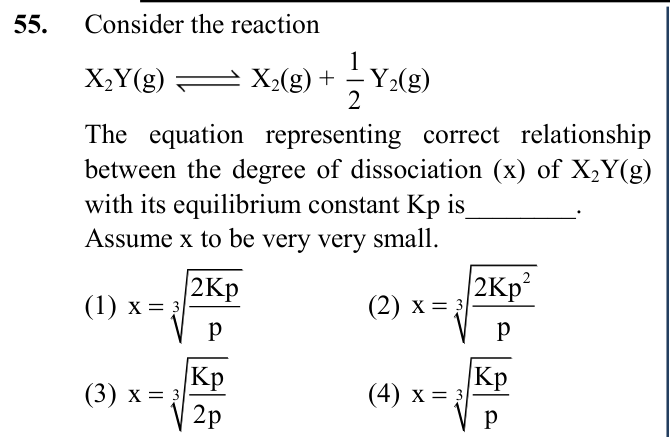
(1) =3 2Kp
x
p
(2) =
2
3 2Kp
x
p
(3) =3 Kp
x
2p
(4) =3 Kp
x
p
1 mole
X2Y(g)
X2(g) +
2(g)
1 Y
2
1-x mole x mole x mole
2
∴
2
X Y
1
x
P
P
x
1
2 - = × +
2
X
x
P
P
x
1
2 = × + 2
Y
x / 2
P
P
x
1
2 = × + ∴
1
2
p
x
x
1
x
K
P
P
P
x
x
x
1
1
2 1
2
2
2
)
)
)
(
(
( - ( = ×
(
(
)
(
(
( + + + (
(
[
)
[
)
[
)
[
)
∴Kp =
1
2
1
2
x
x
p
x
1
x
2 1
2
)
(
)( × ( - )
(
[
) + (
(
[
)
[
)
x to be very very small
∴
3/2
2
p
1
2
x
K
P
(2)
1 = ×
∴
1
3
2
p
2
2
K
2
x
P
1 × =
∴
2
p
3
K
2
x
P × =
1
2
3
p
K
2
x
P
) × =(
(
[
)
QUESTION 9
Equilibrium
SECTION A · MCQ (+4, -1)
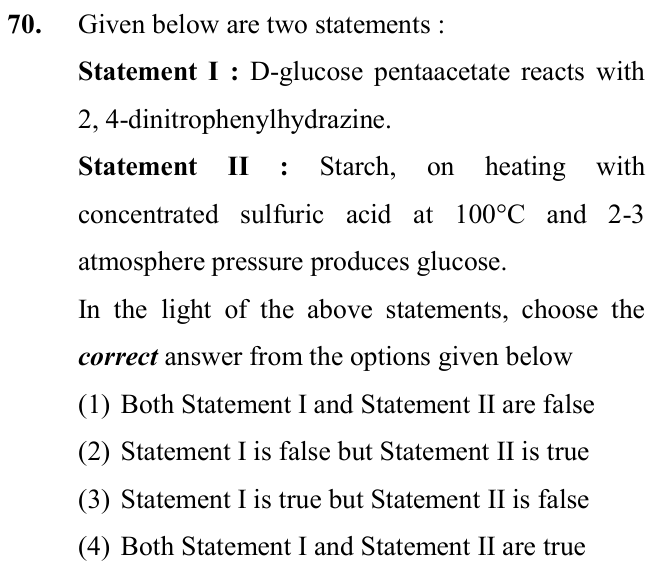
(1) Both Statement I and Statement II are false
(2) Statement I is false but Statement II is true
(3) Statement I is true but Statement II is false
(4) Both Statement I and Statement II are true
SECTION-B
QUESTION 10
Equilibrium
SECTION A · MCQ (+4, -1)
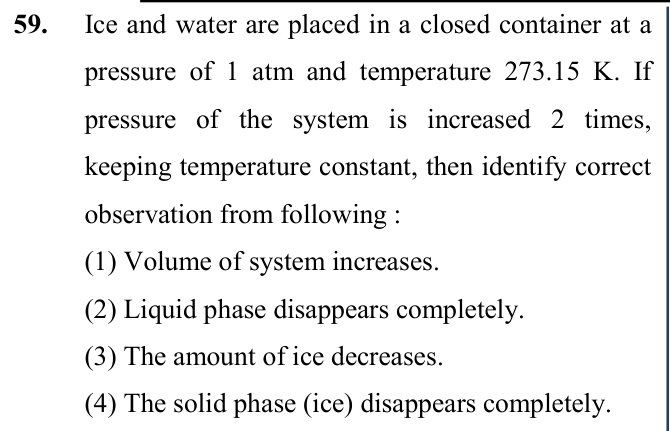
(1) Volume of system increases.
(2) Liquid phase disappears completely.
(3) The amount of ice decreases.
(4) The solid phase (ice) disappears completely.
273.15K
T
L
S
P
1atm
G
Phase diagram of H2O
2 atm
If pressure is made two time then mixture of ice
and water will completely convert into water
(liquid) form.
QUESTION 11
Equilibrium
SECTION B · NUMERICAL (+4, 0)
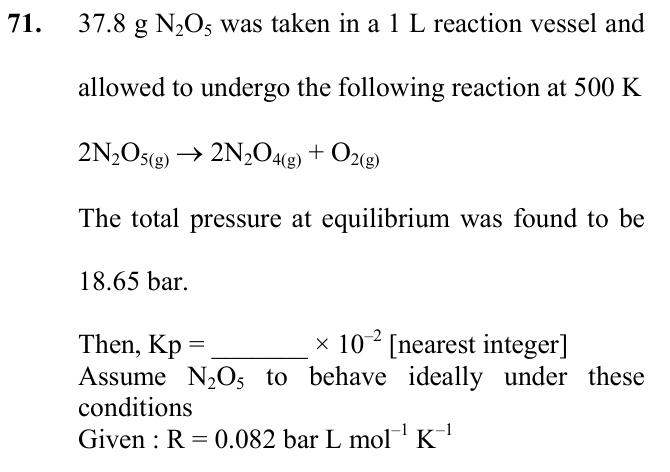
Initial pressure of N2O5
37.8
0.082 500
108
14.35bar
1 × × = =
2
5
2
4
2
2N O
2N O
O + t = 0
14.35
t = eq
14.35 –2P 2P
P
PTotal at eqb = 14.35 + P = 18.65
P = 4.3
2
5
N O
P
5.75bar = 2
4
N O
P
8.6bar = 2
O
P
4.3bar = 2
2
p
2
(8.6)
(4.3)
k
9.619
x 10
(5.75) - × = = = ×
x
961.9
962 = ≈
Ans. 962
QUESTION 12
Equilibrium
SECTION A · MCQ (+4, -1)
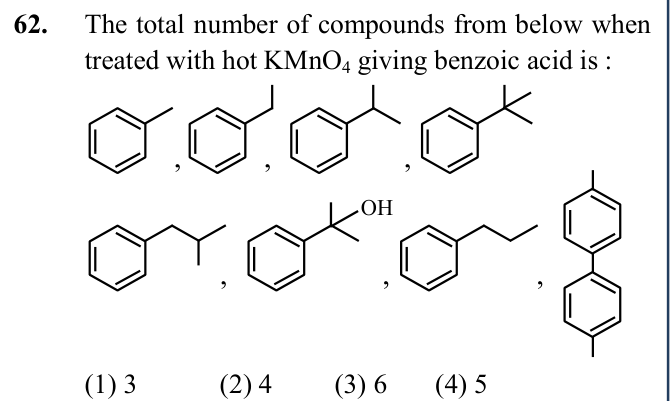
(1) 3
(2) 4
(3) 6
(4) 5
Compounds having at least 1 α–H will react with
KMnO4 and give benzoic acid.
Total 5 compounds
QUESTION 13
Equilibrium
SECTION A · MCQ (+4, -1)
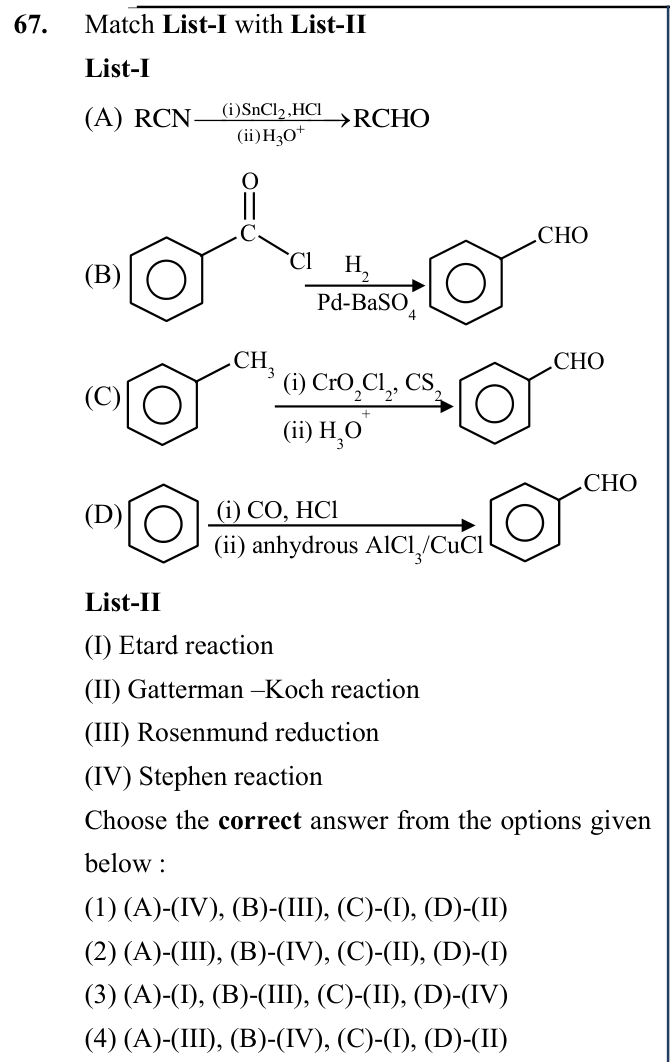
(1) (A)-(IV), (B)-(III), (C)-(I), (D)-(II)
(2) (A)-(III), (B)-(IV), (C)-(II), (D)-(I)
(3) (A)-(I), (B)-(III), (C)-(II), (D)-(IV)
(4) (A)-(III), (B)-(IV), (C)-(I), (D)-(II)
List-I
(A)
2
3
(i)SnCl ,HCl
(ii)H O
RCN
RCHO + —————
→
Stephen reaction
(B)
C
O
Cl
Pd-BaSO4
H2
CHO
Rosenmund reduction
(C)
CH3
(ii)H3O + (i)CrO2Cl2, CS2
CHO
Etard reaction
(D)
(ii)anhydrous AlCl3/CuCl
(i)CO, HCl
CHO
Gatterman –Koch reaction
QUESTION 14
Equilibrium
SECTION A · MCQ (+4, -1)
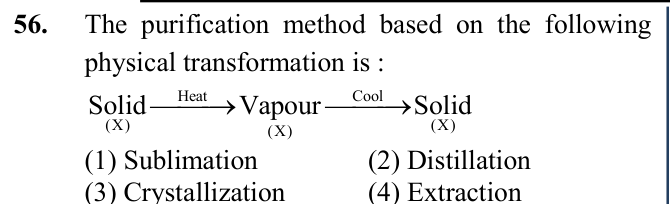
(1) Sublimation
(2) Distillation
(3) Crystallization
(4) Extraction
Theory base
QUESTION 15
Equilibrium
SECTION A · MCQ (+4, -1)
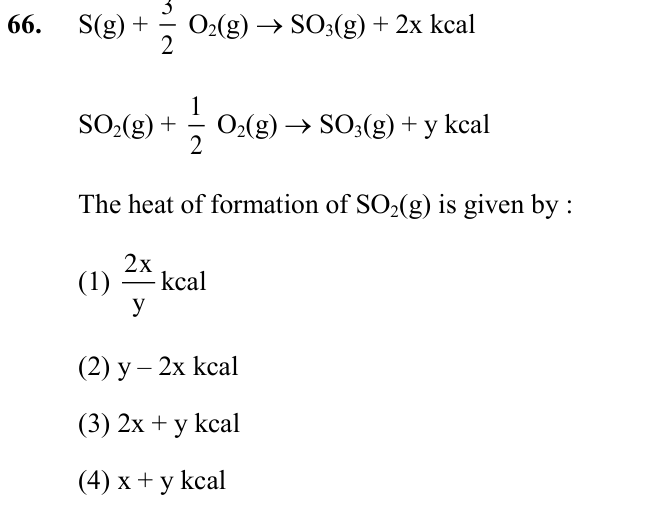
(1) 2x
y kcal
(2) y – 2x kcal
(3) 2x + y kcal
(4) x + y kcal
2
2
3
(g)
(g)
(g)
1
SO
O
SO
2 + ——→
ΔH = –y
3
2
r
f
SO
f
SO
H
( H )
( H )
Δ
=Δ
-Δ
2
f
SO
–y
2x
( H )
=-
-Δ
2
f
SO
( H )
y
2x
Δ = -
Option (2)
5