
✎ ANSWER ONLINE · EVERY MISTAKE LINKS BACK TO THE CONCEPT
Equilibrium · Practice Worksheet
Answer each question here and it marks straight away, with the derivation and a link to the exact micro-concept to revisit.
// CONCEPT AUDIT RESULT
Everything you missed has been added to your Error Arena — retest them blind there, and a concept clears once you get it right.
QUESTION 1
Equilibrium
SECTION A · MCQ (+4, -1)
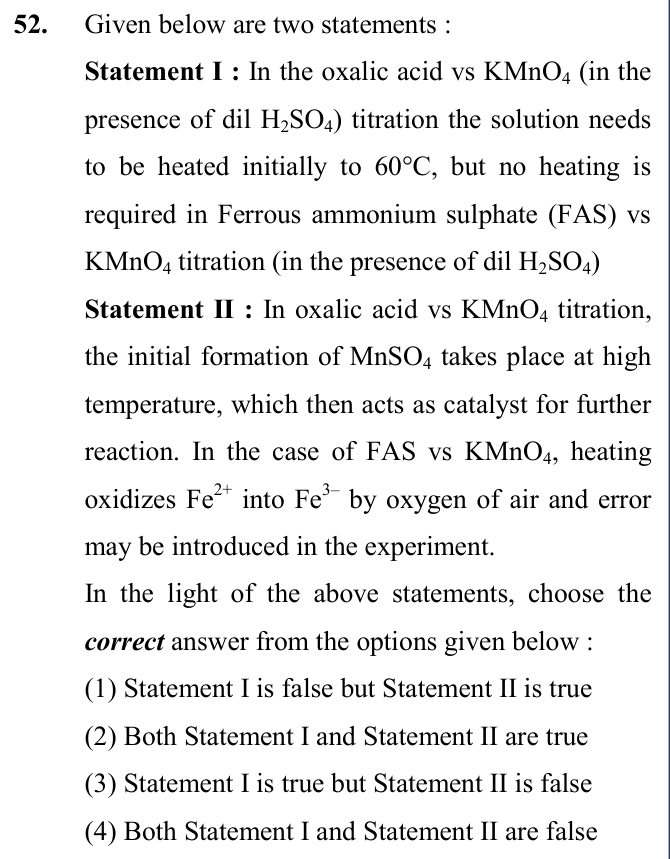
(1) Statement I is false but Statement II is true
(2) Both Statement I and Statement II are true
(3) Statement I is true but Statement II is false
(4) Both Statement I and Statement II are false
For the titration : Oxalic acid v/s KMnO4
2
4
2
2MnO
5(COO)
16H - - + + + →
2
2
2
10CO
2Mn
8H O + + + This reaction is slow at room temperature, but
becomes fast at 60°C. Manganese(II) ions catalyse
the reaction; thus, the reaction is autocatalytic;
once manganese(II) ions are formed, it becomes
faster and faster.
The titration of FAS v/s KMnO4 do not require
heating because at higher temperature the
oxidation of Fe+2 to Fe+3 by atmospheric O2 will be
prominent.
QUESTION 2
Equilibrium
SECTION A · MCQ (+4, -1)
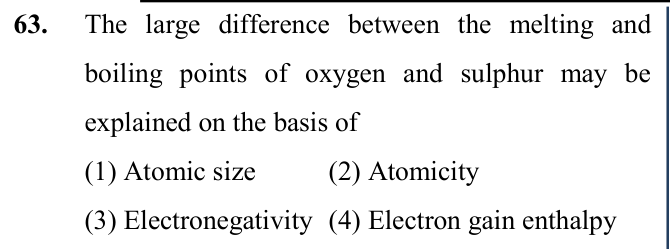
(1) Atomic size
(2) Atomicity
(3) Electronegativity
(4) Electron gain enthalpy
Oxygen exists as O2 (Atomicity = 2)
Sulphur exists as S8 (Atomicity = 8)
Hence, Melting point & Boiling point of sulphur
are significantly large compared to oxygen.
QUESTION 3
Equilibrium
SECTION A · MCQ (+4, -1)
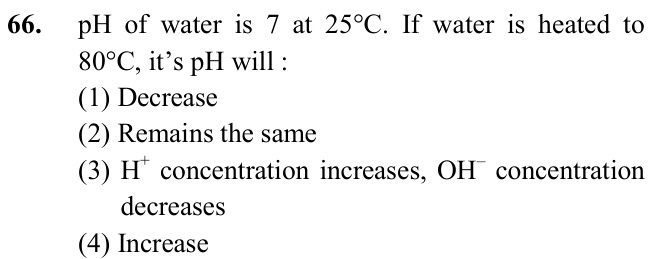
(1) Decrease
(2) Remains the same
(3) H+ concentration increases, OH– concentration
decreases
(4) Increase
With increase in temperature, Kw of water increases
So, degree of dissociation of water increase
∴pH as well as pOH of water decrease.
5
QUESTION 4
Equilibrium
SECTION A · MCQ (+4, -1)
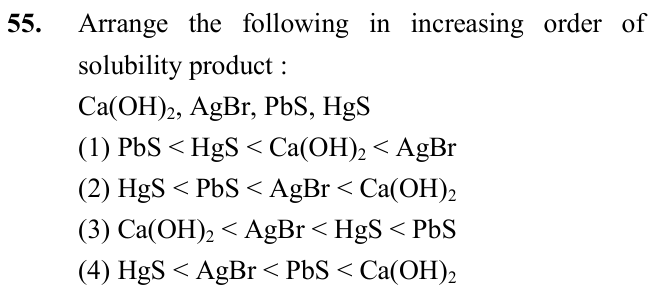
(1) PbS < HgS < Ca(OH)2 < AgBr
(2) HgS < PbS < AgBr < Ca(OH)2
(3) Ca(OH)2 < AgBr < HgS < PbS
(4) HgS < AgBr < PbS < Ca(OH)2
Based on the Ksp values and salt analysis cation
identification, we can say that order of Ksp value
is:
HgS < PbS < AgBr < Ca(OH)2
Ksp values
HgS → 4 × 10–53
PbS → 8 × 10–28
AgBr → 5 × 10–13
Ca(OH)2 → 5.5 × 10⁻⁶
2
QUESTION 5
Equilibrium
SECTION A · MCQ (+4, -1)
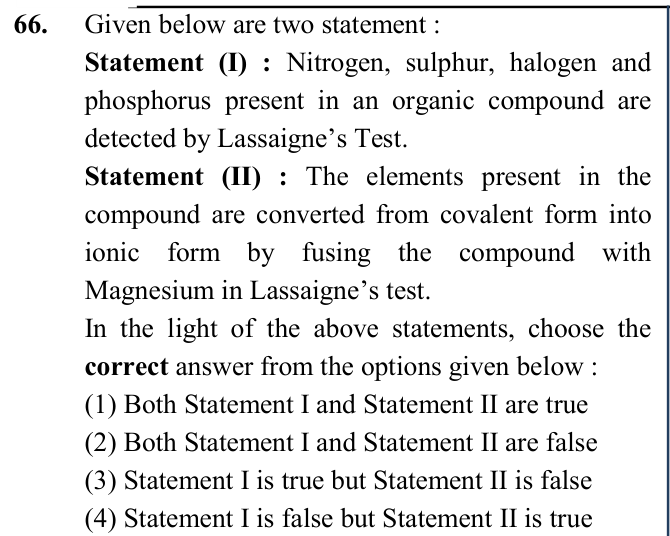
(1) Both Statement I and Statement II are true
(2) Both Statement I and Statement II are false
(3) Statement I is true but Statement II is false
(4) Statement I is false but Statement II is true
The elements present in the compound are
converted from covalent form into ionic form by
fusing the compound with sodium in Lassigne’s
test
QUESTION 6
Equilibrium
SECTION A · MCQ (+4, -1)
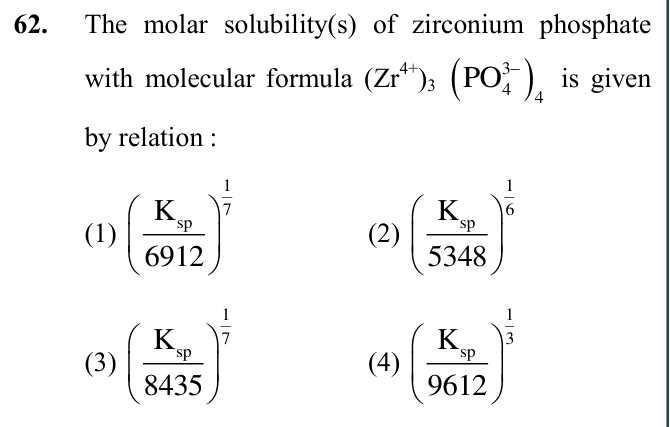
(1) 1
7
sp
K
6912
)
(
[
)
(2) 1
6
sp
K
5348
)
(
[
)
(3) 1
7
sp
K
8435
)
(
[
)
(4) 1
3
sp
K
9612
)
(
[
)
Zr3(PO4)4(s)
3Zr+4(aq) + 4PO4
–3(aq)
–
3s
4s
Ksp = (3s)3 (4s)4 = 6912 s7
s =
1/7
sp
K
6912
)
(
[
)
QUESTION 7
Equilibrium
SECTION A · MCQ (+4, -1)
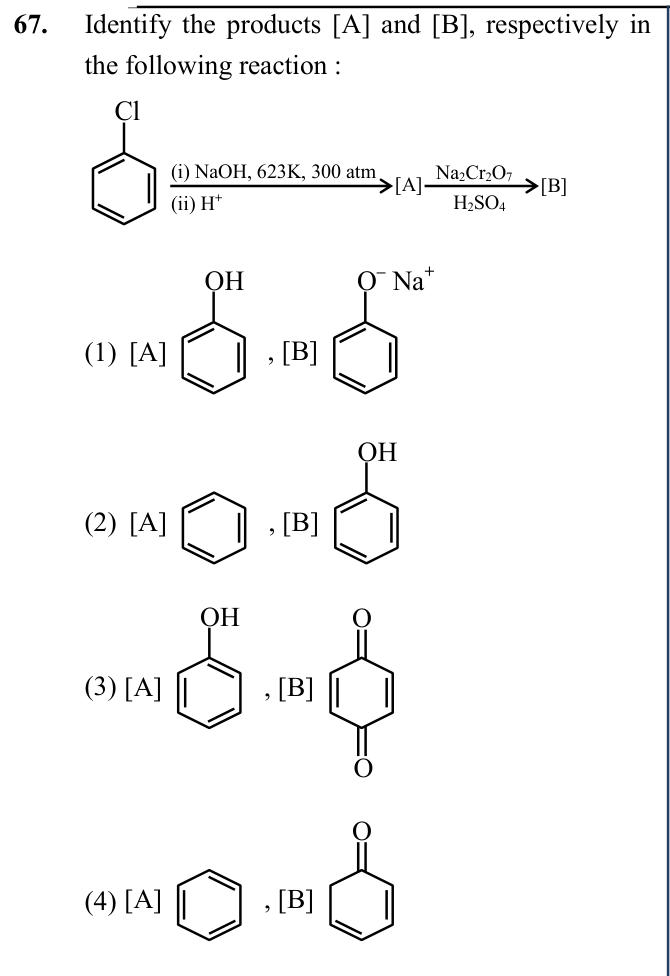
(1) OH
[A]
, [B]
O– Na+
(2) [A]
, [B]
OH
(3) OH
[A]
, [B]
O
O
(4) [A]
, [B]
O
A is phenol and B is para benzoquinone.
QUESTION 8
Equilibrium
SECTION A · MCQ (+4, -1)
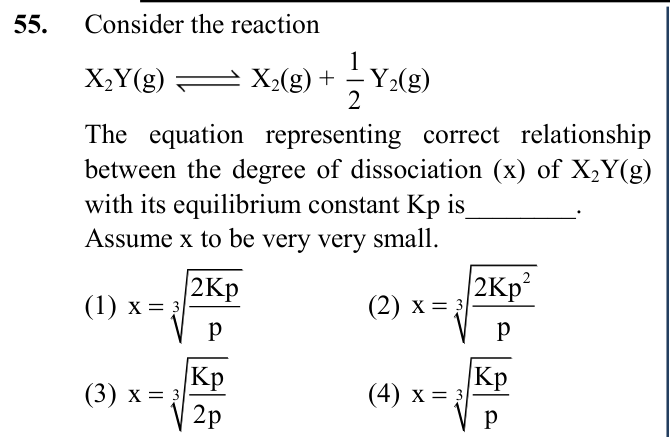
(1) =3 2Kp
x
p
(2) =
2
3 2Kp
x
p
(3) =3 Kp
x
2p
(4) =3 Kp
x
p
1 mole
X2Y(g)
X2(g) +
2(g)
1 Y
2
1-x mole x mole x mole
2
∴
2
X Y
1
x
P
P
x
1
2 - = × +
2
X
x
P
P
x
1
2 = × + 2
Y
x / 2
P
P
x
1
2 = × + ∴
1
2
p
x
x
1
x
K
P
P
P
x
x
x
1
1
2 1
2
2
2
)
)
)
(
(
( - ( = ×
(
(
)
(
(
( + + + (
(
[
)
[
)
[
)
[
)
∴Kp =
1
2
1
2
x
x
p
x
1
x
2 1
2
)
(
)( × ( - )
(
[
) + (
(
[
)
[
)
x to be very very small
∴
3/2
2
p
1
2
x
K
P
(2)
1 = ×
∴
1
3
2
p
2
2
K
2
x
P
1 × =
∴
2
p
3
K
2
x
P × =
1
2
3
p
K
2
x
P
) × =(
(
[
)
QUESTION 9
Equilibrium
SECTION A · MCQ (+4, -1)
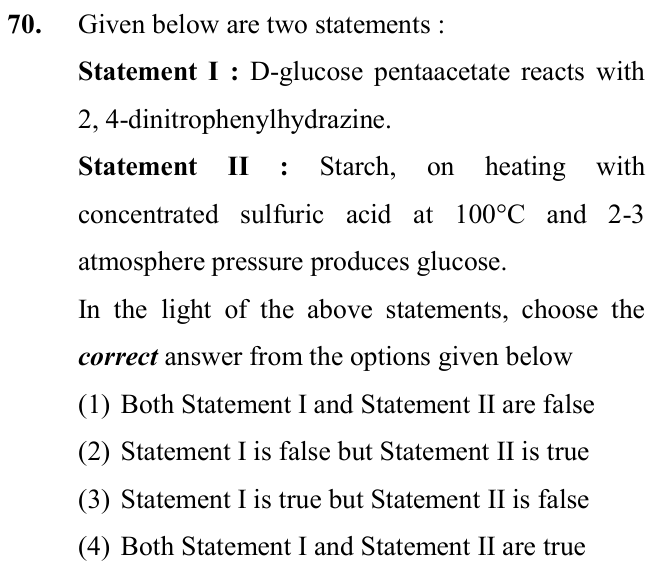
(1) Both Statement I and Statement II are false
(2) Statement I is false but Statement II is true
(3) Statement I is true but Statement II is false
(4) Both Statement I and Statement II are true
SECTION-B
QUESTION 10
Equilibrium
SECTION A · MCQ (+4, -1)
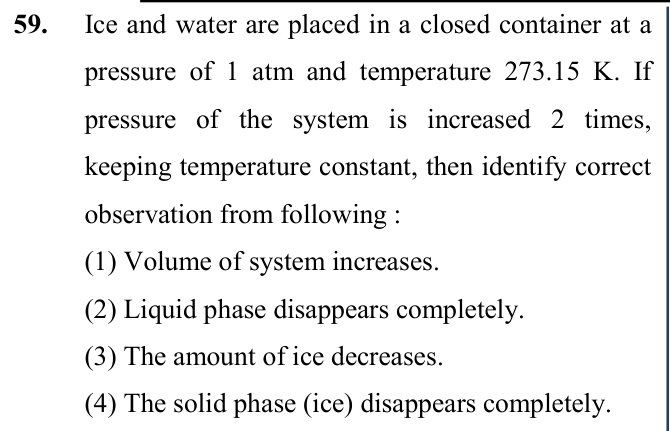
(1) Volume of system increases.
(2) Liquid phase disappears completely.
(3) The amount of ice decreases.
(4) The solid phase (ice) disappears completely.
273.15K
T
L
S
P
1atm
G
Phase diagram of H2O
2 atm
If pressure is made two time then mixture of ice
and water will completely convert into water
(liquid) form.
QUESTION 11
Equilibrium
SECTION B · NUMERICAL (+4, 0)
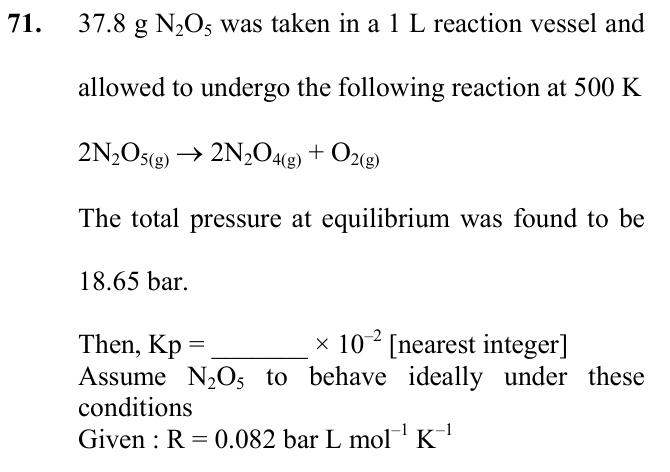
Initial pressure of N2O5
37.8
0.082 500
108
14.35bar
1 × × = =
2
5
2
4
2
2N O
2N O
O + t = 0
14.35
t = eq
14.35 –2P 2P
P
PTotal at eqb = 14.35 + P = 18.65
P = 4.3
2
5
N O
P
5.75bar = 2
4
N O
P
8.6bar = 2
O
P
4.3bar = 2
2
p
2
(8.6)
(4.3)
k
9.619
x 10
(5.75) - × = = = ×
x
961.9
962 = ≈
Ans. 962
QUESTION 12
Equilibrium
SECTION A · MCQ (+4, -1)
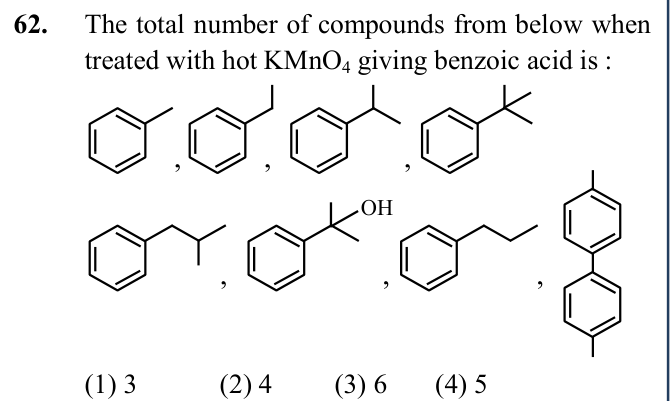
(1) 3
(2) 4
(3) 6
(4) 5
Compounds having at least 1 α–H will react with
KMnO4 and give benzoic acid.
Total 5 compounds
QUESTION 13
Equilibrium
SECTION A · MCQ (+4, -1)
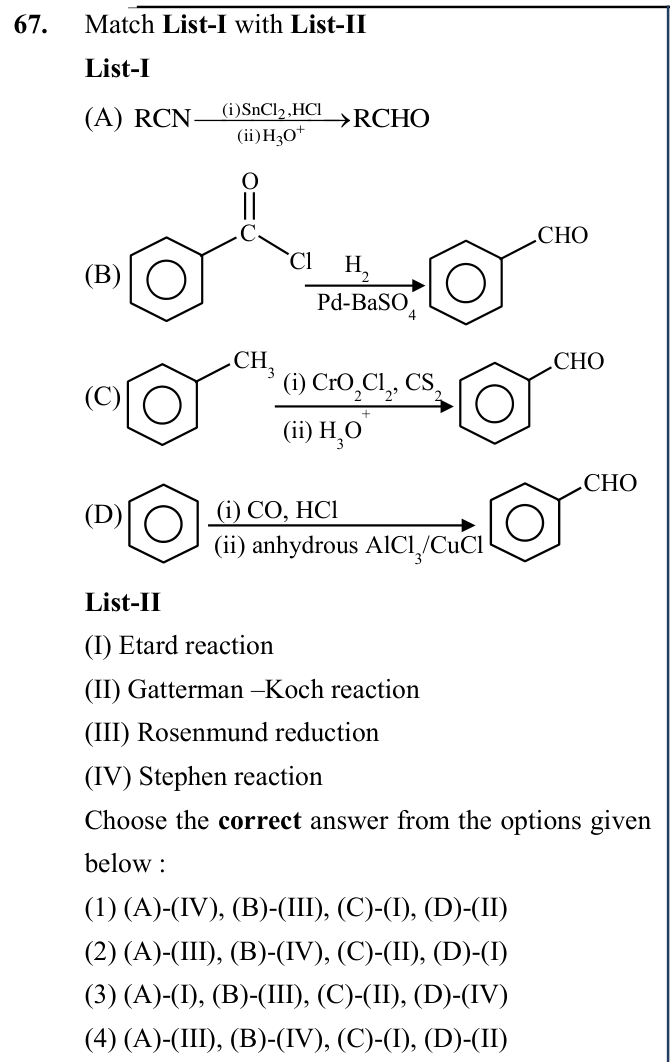
(1) (A)-(IV), (B)-(III), (C)-(I), (D)-(II)
(2) (A)-(III), (B)-(IV), (C)-(II), (D)-(I)
(3) (A)-(I), (B)-(III), (C)-(II), (D)-(IV)
(4) (A)-(III), (B)-(IV), (C)-(I), (D)-(II)
List-I
(A)
2
3
(i)SnCl ,HCl
(ii)H O
RCN
RCHO + —————
→
Stephen reaction
(B)
C
O
Cl
Pd-BaSO4
H2
CHO
Rosenmund reduction
(C)
CH3
(ii)H3O + (i)CrO2Cl2, CS2
CHO
Etard reaction
(D)
(ii)anhydrous AlCl3/CuCl
(i)CO, HCl
CHO
Gatterman –Koch reaction
QUESTION 14
Equilibrium
SECTION A · MCQ (+4, -1)
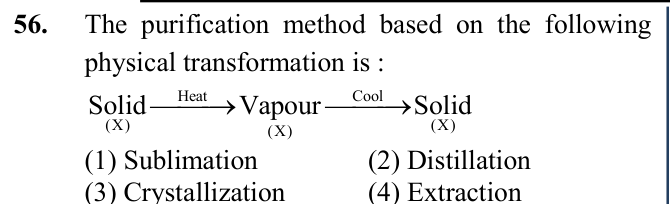
(1) Sublimation
(2) Distillation
(3) Crystallization
(4) Extraction
Theory base
QUESTION 15
Equilibrium
SECTION A · MCQ (+4, -1)
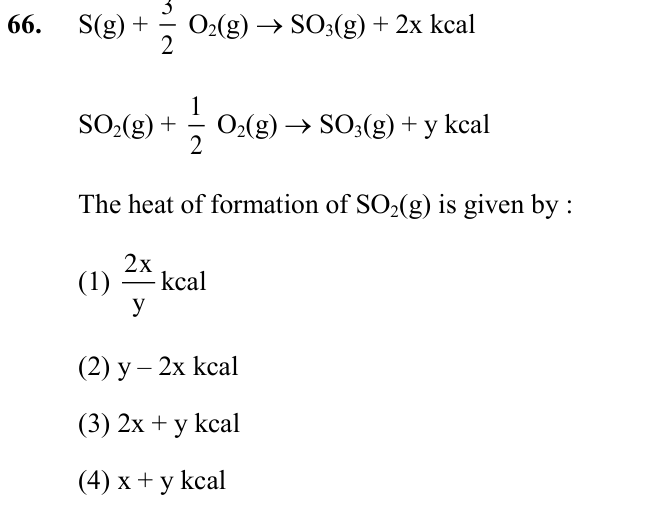
(1) 2x
y kcal
(2) y – 2x kcal
(3) 2x + y kcal
(4) x + y kcal
2
2
3
(g)
(g)
(g)
1
SO
O
SO
2 + ——→
ΔH = –y
3
2
r
f
SO
f
SO
H
( H )
( H )
Δ
=Δ
-Δ
2
f
SO
–y
2x
( H )
=-
-Δ
2
f
SO
( H )
y
2x
Δ = -
Option (2)
5
QUESTION 16
Equilibrium
SECTION B · NUMERICAL (+4, 0)
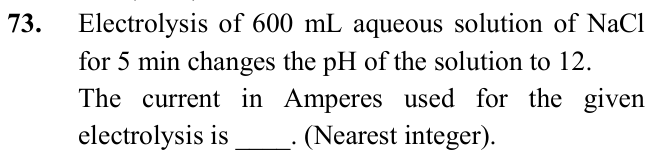
Electrolysis of NaCl is
NaCl + H2O (aq) → NaOH (aq) + + 2
2
1
1
Cl (g)
H (g)
2
2
Since during electrolysis pH changes to 12
So [OH!] = 10–2 and [H+] = 10–12
So by Faraday law
Gram amount of substance deposited =
Amount of electricity passed
-× × = × 2
600
10
96500
I
t
1000
-× × =××
2
10
600
96500
I 5 60
1000
I =
-× × ××
2
10
600 96500
1000 5 60
I = 1.93 ampere
So, I = 2 ampere (nearest integer)
QUESTION 17
Equilibrium
SECTION A · MCQ (+4, -1)
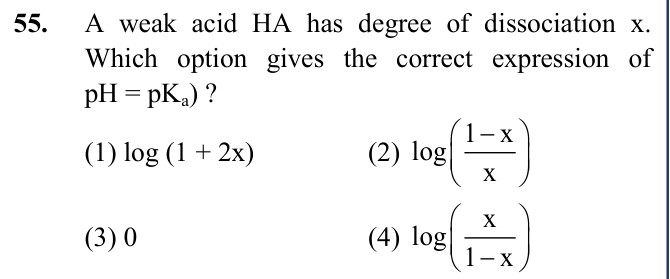
(1) log (1 + 2x)
(2) -
)
(
[
)
1
x
log
x
(3) 0
(4) )
( - [
)
x
log 1
x
HA
H⊕ + AΘ
t=0 a
t = t a(1–x) ax ax
Ka =
+= - (x)
(ax)
; [H ]
ax
1
x
–log (Ka) = –log (ax) – log
)
( - [
)
x
1
x
pKa = pH –
)
( - [
)
x
log 1
x
pH – pKa =
)
( - [
)
x
log 1
x
QUESTION 18
Equilibrium
SECTION B · NUMERICAL (+4, 0)
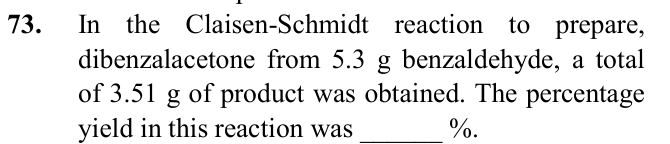
Strong
base
2 Ph–C–H
O
O + Benzaldehyde
5.3 gm
⇓
Ph
Ph
Dibenzalacetone
(Product)
3.51 gm
⇓
(Actual)
O
Theoretical = 1 Mol
40
% yield = 0.015 100
1/ 40 ×
⇒ 60%
QUESTION 19
Equilibrium
SECTION A · MCQ (+4, -1)
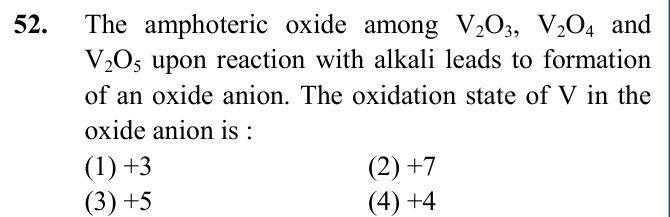
(1) +3
(2) +7
(3) +5
(4) +4
V2O5 + alkali →
3
4
VO -
In
3
4
VO -ion, vanadium is in +5 oxidation state
QUESTION 20
Equilibrium
SECTION A · MCQ (+4, -1)
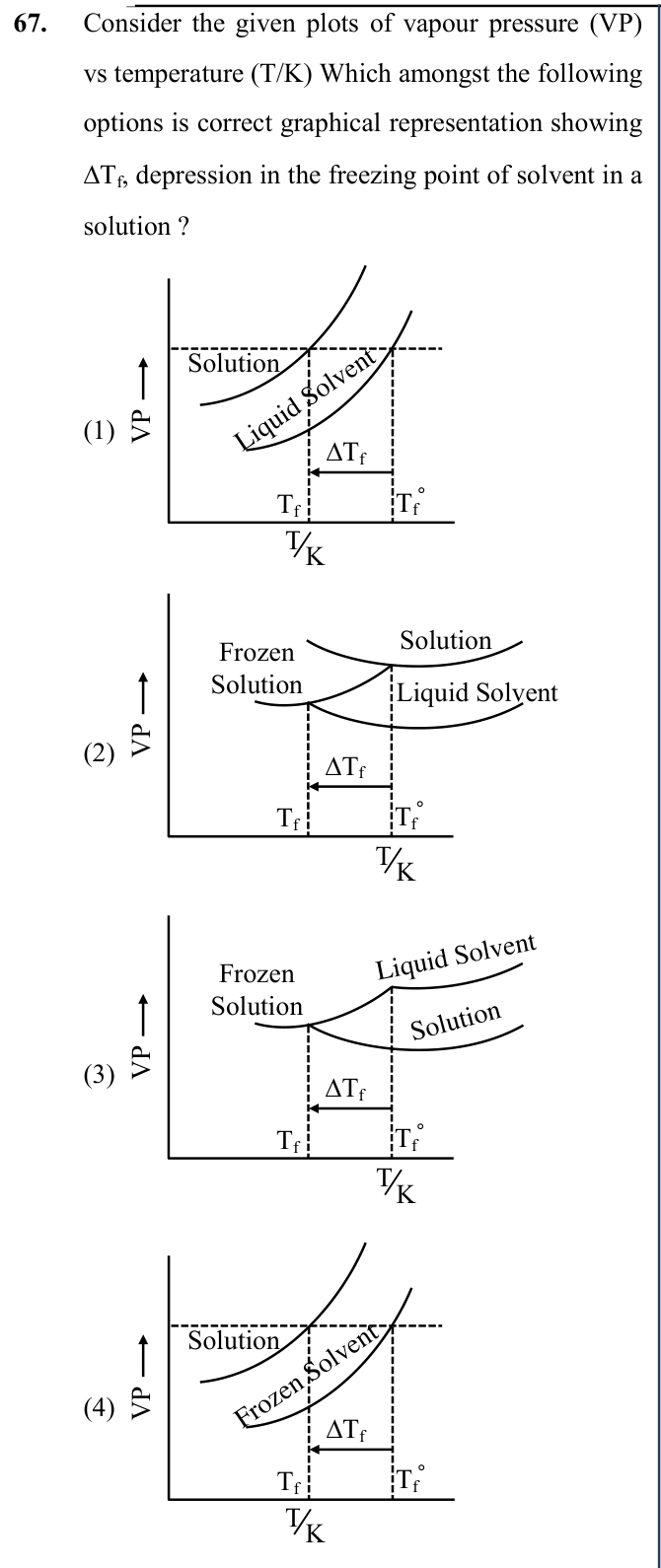
(1) ΔTf
Solution
Tf
Tf
°
T
VP
K
(2) ΔTf
Liquid Solvent
Solution
Tf
Tf
°
T
VP
K
Frozen
Solution
(3) ΔTf
Tf
Tf
°
T
VP
K
Frozen
Solution
(4) ΔTf
Solution
Tf
Tf
°
T
VP
K
On adding non-volatile solute in a solvent, the
freezing point of solution decreases.
0
f
f
T
T
<
F.P. of solution < F.P. of pure solvent
Also V.P. of solution decreases on adding non-
volatile solute in a solvent.
ΔTf
Tf
Tf
°
T
VP
K
Frozen
Solution
QUESTION 21
Equilibrium
SECTION A · MCQ (+4, -1)
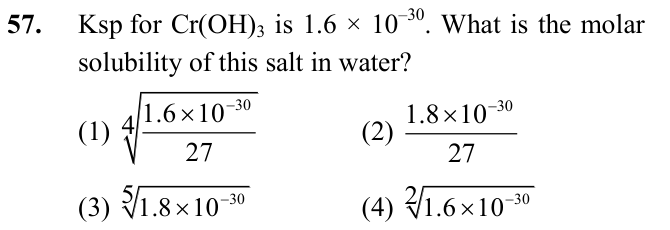
(1) 30
1.6 10
4
27 - ×
(2) 30
1.8 10
27 - ×
(3) 30
51.8 10-
×
(4) 30
21.6 10-
×
3
3 (s)
(aq)
(aq)
Cr(OH)
Cr
3OH + - + At eq :
s
3s
Ksp = (s).(3s)3 = 27s4
27s4 = 1.6 × 10⁻³⁰
1/4
–30
1.6
s
10
27
) = ×
(
[
)
Option (1)
3
QUESTION 22
Equilibrium
SECTION A · MCQ (+4, -1)
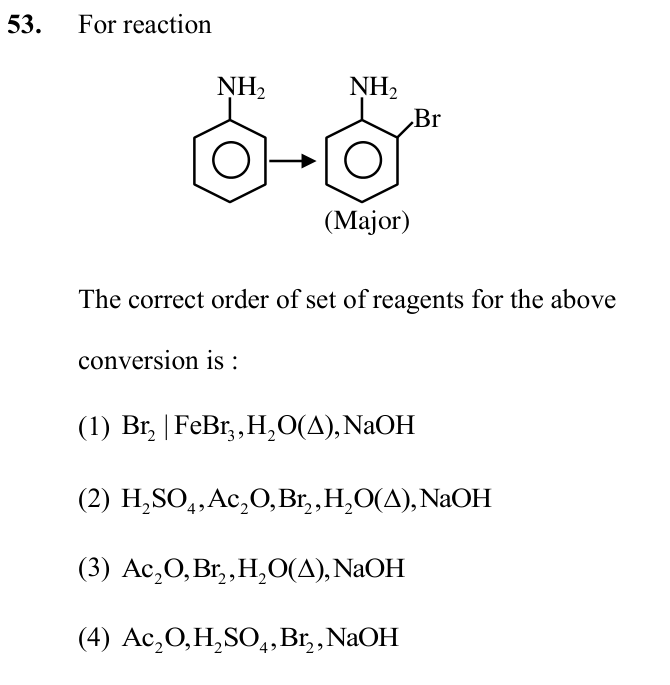
(1) 2
3
2
Br | FeBr ,H O( ),NaOH
Δ
(2) 2
4
2
2
2
H SO ,Ac O,Br ,H O( ),NaOH
Δ
(3) 2
2
2
Ac O,Br ,H O( ),NaOH
Δ
(4) 2
2
4
2
Ac O,H SO ,Br ,NaOH
j
NH2
conc.H2SO4
NH3 HSO4– + 453 – 473 K
Anilium hydrogen
Suphate [intermediate]
NH2
Ac2O
SO3H
NH–C–CH3
SO3H
O
Br2
H2O/Δ
NH–C–CH3
NaOH
O
Br
Br
NH2
QUESTION 23
Equilibrium
SECTION A · MCQ (+4, -1)
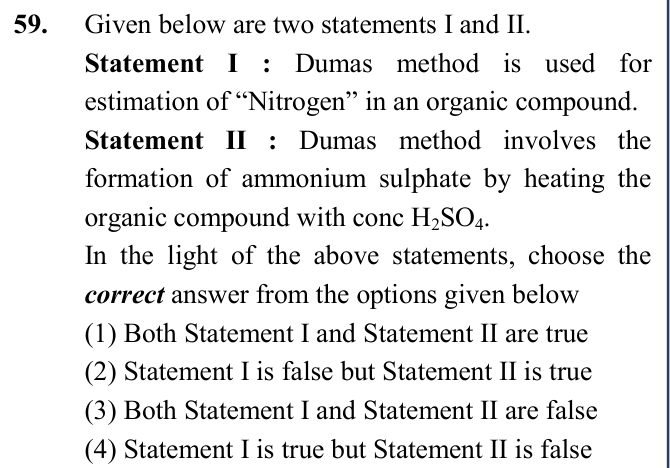
(1) Both Statement I and Statement II are true
(2) Statement I is false but Statement II is true
(3) Both Statement I and Statement II are false
(4) Statement I is true but Statement II is false
In Dumas method nitrogen present in organic
compound is converted into N2 gas whose
volumetric analysis gives the percentage of
nitrogen atom in the organic compound.
QUESTION 24
Equilibrium
SECTION A · MCQ (+4, -1)
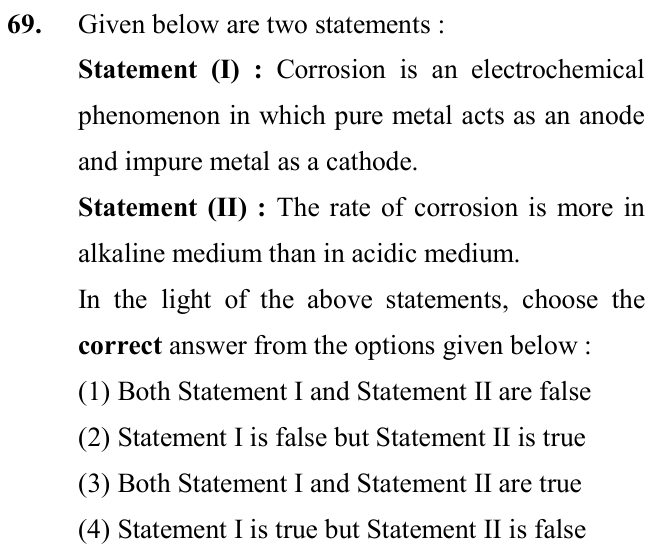
(1) Both Statement I and Statement II are false
(2) Statement I is false but Statement II is true
(3) Both Statement I and Statement II are true
(4) Statement I is true but Statement II is false
Statement I :
Corrosion is an example of electrochemical
phenomenon
In which pure metal act as anode and impure metal
(rusted metal) act as cathode.
Statement II :
Corrosion is more favourable in acid medium than
alkaline so rate of corrosion is high is acid medium
then alkaline.
QUESTION 25
Equilibrium
SECTION A · MCQ (+4, -1)
(1) Statement I true but Statement II is false
(2) Both Statement I and Statement II are true
(3) Statement I is false but Statement II is true
(4) Both Statement I and Statement II are false
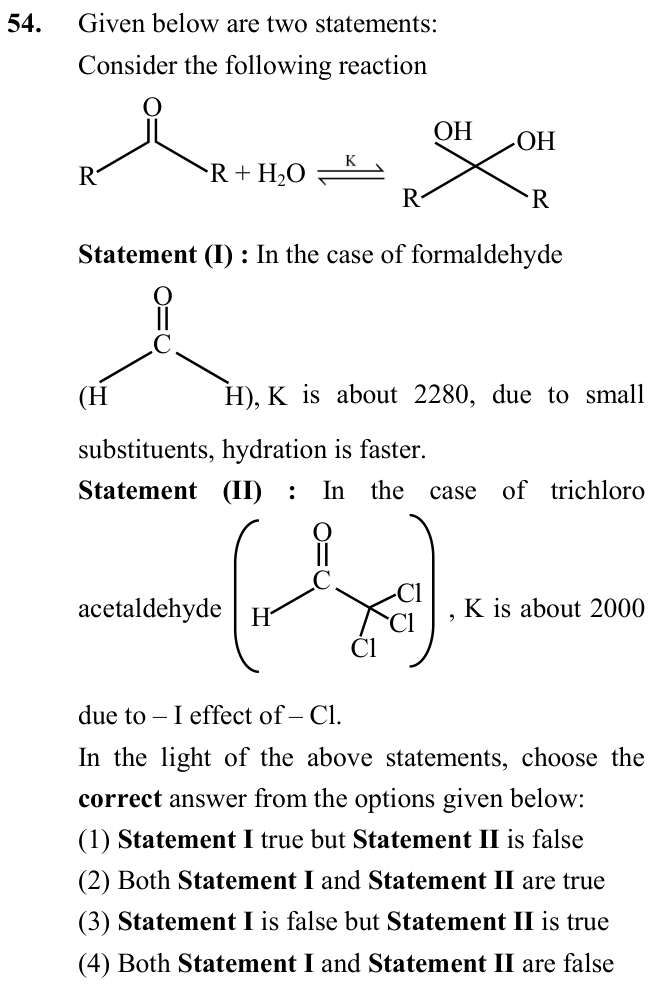
keq = 2280 is for HCHO
keq = 2000 is for chloral
Both data is given in clayden and warren book.
keq > 1 because HCHO and chloral are more
electrophilic.
2
QUESTION 26
Equilibrium
SECTION A · MCQ (+4, -1)
(1) B(OH)3 will precipitate before A(OH)2
(2) A(OH)2 and B(OH)3 will precipitate together
(3) A(OH)2 will precipitate before B(OH)3
(4) Both A(OH)2 and B(OH)3 do not show
precipitation with NH4OH
5
(1)
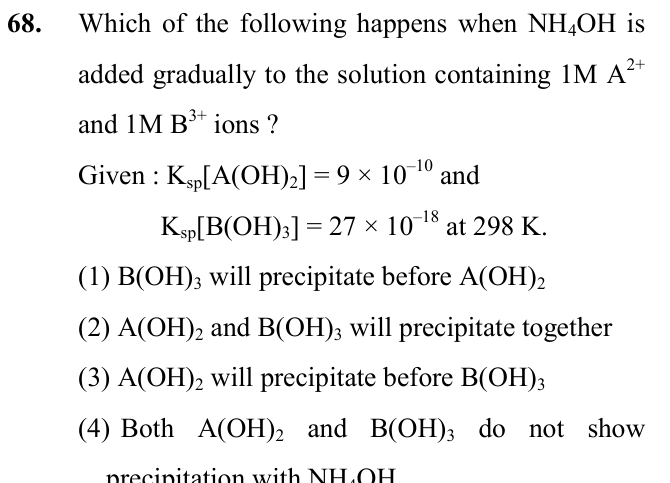
Condition for precipitation Qip > Ksp
For [A(OH)2]
[A2+] [OH–]2 > 9 × 10⁻¹⁰
[A+2] = 1 M
⇒[OH–] > 3 × 10⁻⁵ M
For [B(OH)3]
[B3+][OH–]3 > 27 × 10–18
[B3+] = 1M
⇒[OH–] > 3 × 10⁻⁶ M
So, B(OH)3 will precipitate before A(OH)2
QUESTION 27
Equilibrium
SECTION A · MCQ (+4, -1)
(1) Ammonium
acetate
(2) Acetic acid
(3) K2CrO4
C
Yellow ppt
(1) PbCl2, PbSO4, PbCrO4
(2) PbS, PbSO4, PbCrO4
(3) PbS, PbSO4, Pb(CH3COO)2
(4) PbCl2, Pb(SO4)2, PbCrO4
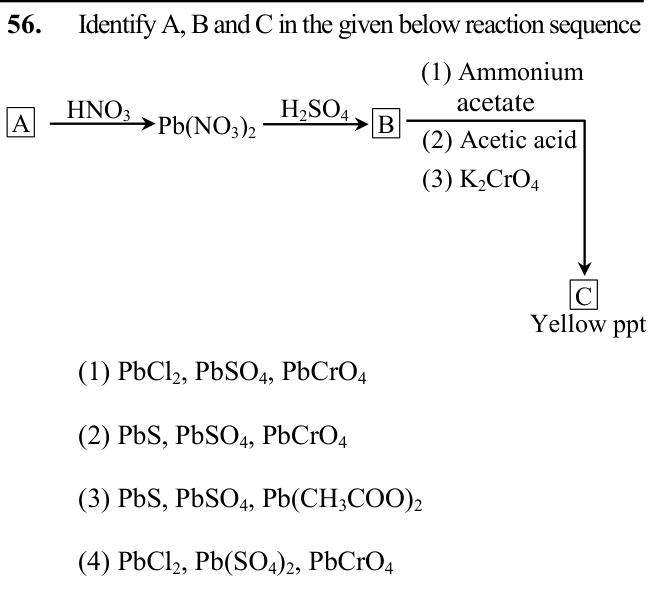
PbS
HNO3
Pb(NO3)2
H2SO4
B
(1) Ammonium
acetate
(2) Acetic acid
(3) K2CrO4
C
Yellow ppt
PbSO4
A
PbCrO4
QUESTION 28
Equilibrium
SECTION A · MCQ (+4, -1)
(1) X = Y + Z
(2) –X = Y + Z
(3) X = –Y + Z
(4) X = Y – Z
QUESTION 29
Equilibrium
SECTION A · MCQ (+4, -1)
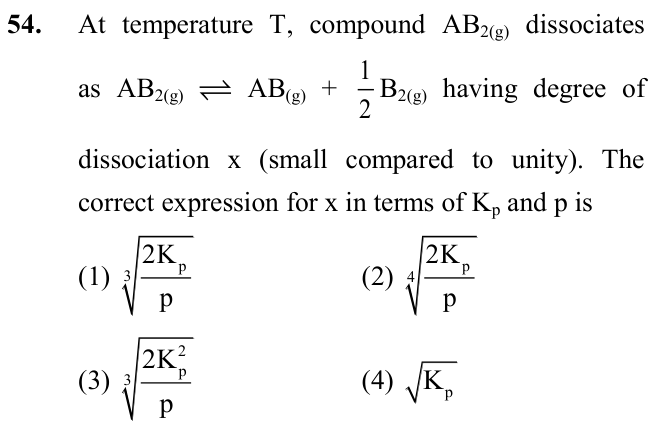
(1) p
3 2K
p
(2) p
4 2K
p
(3) 2
p
3 2K
p
(4) p
K
AB2(g)
AB(g) + 1
2 B2(g)
teq. (
)
1– x P
x
1
2 + xP
x
1
2 + x P
2
x
1
2
)
(
[
) + ⇒ x << 1 ⇒
x
1
2 + 1and 1 – x
1
⇒
(
)
1
2
P
xp
xp .
2
k
P
)
(
[
) = ⇒
2
2
P
xP
k
x . 2 = 2
P
3 2k
x
P
=
QUESTION 30
Equilibrium
SECTION B · NUMERICAL (+4, 0)
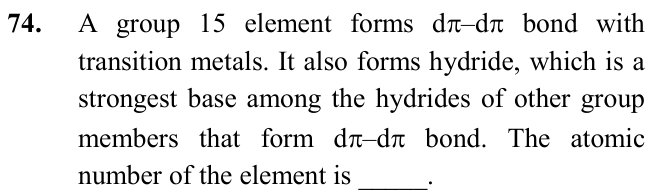
Phosphorus belongs to 15th group and forms
dπ – dπ bond with transition metal and PH3 is
strongest base among the other group members
excepet NH3.
6