
⚡ OFFICIAL NTA ASSESSMENT GENERATOR & WORD (.DOCX) EXPORTER
Redox Reactions · Practice Worksheet
JEE Main Chemistry · Curated Assessment Set Print directly or export as a beautifully formatted Microsoft Word document with embedded 180-DPI mathematical prompt clips and step-by-step derivations.
EDUPROD JEE MAIN TEST SERIES · NTA PATTERN
Redox Reactions · Practice Worksheet
JEE Main Chemistry · Curated Assessment Set · Assessment Code: JEE-101
Total Marks: 60
Marking: +4 / -1 (Sec A) · +4 / 0 (Sec B)
QUESTION 1
CHEMISTRY · Redox Reactions
SECTION A · MCQ (+4, -1)
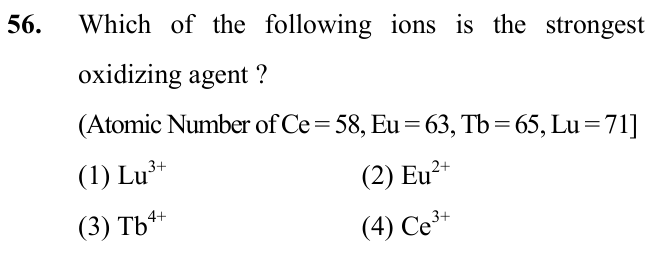
Candidate Response:
(1) (2) (3) (4)
QUESTION 2
CHEMISTRY · Redox Reactions
SECTION A · MCQ (+4, -1)
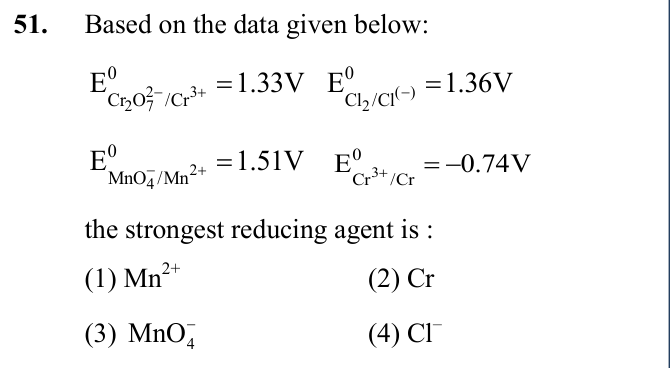
Candidate Response:
(1) (2) (3) (4)
QUESTION 3
CHEMISTRY · Redox Reactions
SECTION A · MCQ (+4, -1)
In the ion-electron method, a basic medium is balanced using which two species?
(1) H₂ gas
(2) OH⁻ and H₂O
(3) H⁺ and H₂O
(4) O₂ gas
Candidate Response:
(1) (2) (3) (4)
QUESTION 4
CHEMISTRY · Redox Reactions
SECTION A · MCQ (+4, -1)
What is the equivalent weight of KMnO4 (molar mass M) in acidic medium?
(1) M/6
(2) M/5
(3) M/3
(4) M/1
Candidate Response:
(1) (2) (3) (4)
QUESTION 5
CHEMISTRY · Redox Reactions
SECTION A · MCQ (+4, -1)
In the ion-electron method, an acidic medium is balanced using which two species?
(1) H⁺ only
(2) OH⁻ and H₂O
(3) Electrons only
(4) H⁺ and H₂O
Candidate Response:
(1) (2) (3) (4)
QUESTION 6
CHEMISTRY · Redox Reactions
SECTION A · MCQ (+4, -1)
Can Fe3+ oxidize I- to I2 under standard conditions? Given E°(Fe3+/Fe2+) = +0.77 V and E°(I2/I-) = +0.54 V.
(1) No; E°cell = -0.23 V, so the reaction is non-spontaneous
(2) No; the reaction is exactly at equilibrium
(3) Yes; E°cell = +0.23 V, so the reaction is spontaneous
(4) Yes; E°cell = +1.31 V
Candidate Response:
(1) (2) (3) (4)
QUESTION 7
CHEMISTRY · Redox Reactions
SECTION A · MCQ (+4, -1)
Calculate E°cell for the cell Al(s) | Al3+(aq) || Ni2+(aq) | Ni(s), given E°(Al3+/Al) = -1.66 V and E°(Ni2+/Ni) = -0.25 V.
(1) -1.91 V
(2) +1.91 V
(3) +1.41 V
(4) -1.41 V
Candidate Response:
(1) (2) (3) (4)
QUESTION 8
CHEMISTRY · Redox Reactions
SECTION A · MCQ (+4, -1)
Which of the following decomposition reactions is a redox reaction?
(1) NH4Cl → NH3 + HCl
(2) 2Fe(OH)3 → Fe2O3 + 3H2O
(3) CaCO3 → CaO + CO2
(4) 2KClO3 → 2KCl + 3O2
Candidate Response:
(1) (2) (3) (4)
QUESTION 9
CHEMISTRY · Redox Reactions
SECTION A · MCQ (+4, -1)
A fractional oxidation number for an element indicates which situation?
(1) It is in the elemental state
(2) The compound is fully ionic
(3) Its atoms are in different oxidation states
(4) It is always a free radical
Candidate Response:
(1) (2) (3) (4)
QUESTION 10
CHEMISTRY · Redox Reactions
SECTION A · MCQ (+4, -1)
What is the oxidation state of chromium in CrO5 (chromium peroxide)?
(1) +10
(2) +6
(3) +3
(4) +5
Candidate Response:
(1) (2) (3) (4)
QUESTION 11
CHEMISTRY · Redox Reactions
SECTION A · MCQ (+4, -1)
A reaction in which the same element is simultaneously oxidised and reduced is called what?
(1) Combination
(2) Comproportionation
(3) Displacement
(4) Disproportionation
Candidate Response:
(1) (2) (3) (4)
QUESTION 12
CHEMISTRY · Redox Reactions
SECTION A · MCQ (+4, -1)
What is the main function of the salt bridge in a galvanic cell?
(1) Prevent all ion movement
(2) Provide electrons to the anode
(3) Maintain electrical neutrality of the solutions
(4) Act as the cathode
Candidate Response:
(1) (2) (3) (4)
QUESTION 13
CHEMISTRY · Redox Reactions
SECTION A · MCQ (+4, -1)
In the reaction H2S + Cl2 → 2HCl + S, which statement correctly identifies the oxidized substance and the oxidizing agent?
(1) Cl2 is reduced; H2S acts as the oxidizing agent
(2) Cl2 is oxidized; H2S acts as the oxidizing agent
(3) H2S is oxidized and also acts as the oxidizing agent
(4) H2S is oxidized; Cl2 acts as the oxidizing agent
Candidate Response:
(1) (2) (3) (4)
QUESTION 14
CHEMISTRY · Redox Reactions
SECTION A · MCQ (+4, -1)
In the tetrathionate ion (S4O6²⁻), what are the oxidation states of the two central and two terminal sulfur atoms, respectively?
(1) Central S = +2, terminal S = +3
(2) Central S = 0, terminal S = +5
(3) All four S atoms = +2.5
(4) Central S = +5, terminal S = 0
Candidate Response:
(1) (2) (3) (4)
QUESTION 15
CHEMISTRY · Redox Reactions
SECTION A · MCQ (+4, -1)
A reaction in which one element replaces another element from its compound is called what?
(1) Neutralisation reaction
(2) Decomposition reaction
(3) Combination reaction
(4) Displacement reaction
Candidate Response:
(1) (2) (3) (4)