
✎ ANSWER ONLINE · EVERY MISTAKE LINKS BACK TO THE CONCEPT
Redox Reactions · Practice Worksheet
Answer each question here and it marks straight away, with the derivation and a link to the exact micro-concept to revisit.
2 questions from this set could not be marked online — a
bonus or dual-key question, which has no single defensible answer. The print and
.docx versions still include them.
// CONCEPT AUDIT RESULT
Everything you missed has been added to your Error Arena — retest them blind there, and a concept clears once you get it right.
QUESTION 1
Redox Reactions
SECTION A · MCQ (+4, -1)
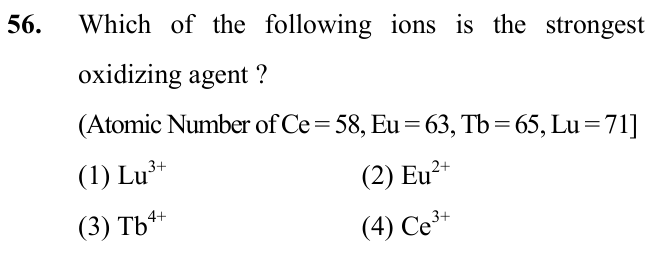
(1) Lu3+
(2) Eu2+
(3) Tb4+
(4) Ce3+
Tb4+ is strongest oxidising agent
QUESTION 2
Redox Reactions
SECTION A · MCQ (+4, -1)
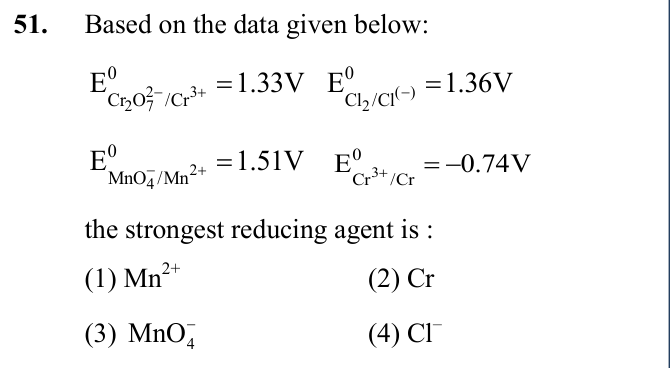
(1) Mn2+
(2) Cr
(3) 4
MnO-
(4) Cl–
For strongest reducing agent
Reduction potential should be lowest
Hence Cr is the strongest reducing agent.
Options (2)
QUESTION 3
Redox Reactions
SECTION A · MCQ (+4, -1)
In the ion-electron method, a basic medium is balanced using which two species?
(1) H₂ gas
(2) OH⁻ and H₂O
(3) H⁺ and H₂O
(4) O₂ gas
Basic solutions are balanced with OH⁻ and H₂O.
QUESTION 4
Redox Reactions
SECTION A · MCQ (+4, -1)
What is the equivalent weight of KMnO4 (molar mass M) in acidic medium?
(1) M/6
(2) M/5
(3) M/3
(4) M/1
In acidic medium, Mn(+7) is reduced to Mn2+ (+2), a change of five electrons, so the n-factor is 5 and the equivalent weight is M/5.
QUESTION 5
Redox Reactions
SECTION A · MCQ (+4, -1)
In the ion-electron method, an acidic medium is balanced using which two species?
(1) H⁺ only
(2) OH⁻ and H₂O
(3) Electrons only
(4) H⁺ and H₂O
Acidic solutions are balanced with H⁺ and H₂O.
QUESTION 6
Redox Reactions
SECTION A · MCQ (+4, -1)
Calculate E°cell for the cell Al(s) | Al3+(aq) || Ni2+(aq) | Ni(s), given E°(Al3+/Al) = -1.66 V and E°(Ni2+/Ni) = -0.25 V.
(1) -1.91 V
(2) +1.91 V
(3) +1.41 V
(4) -1.41 V
E°cell = E°cathode - E°anode = E°(Ni2+/Ni) - E°(Al3+/Al) = -0.25 - (-1.66) = +1.41 V. A positive value confirms the reaction is spontaneous.
QUESTION 7
Redox Reactions
SECTION A · MCQ (+4, -1)
Which of the following decomposition reactions is a redox reaction?
(1) NH4Cl → NH3 + HCl
(2) 2Fe(OH)3 → Fe2O3 + 3H2O
(3) CaCO3 → CaO + CO2
(4) 2KClO3 → 2KCl + 3O2
In KClO3 → KCl + O2, chlorine changes from +5 to -1 and oxygen from -2 to 0, so it is redox. The other three reactions show no change in any oxidation state (non-redox).
QUESTION 8
Redox Reactions
SECTION A · MCQ (+4, -1)
A fractional oxidation number for an element indicates which situation?
(1) It is in the elemental state
(2) The compound is fully ionic
(3) Its atoms are in different oxidation states
(4) It is always a free radical
A fractional oxidation number is the average of different oxidation states.
QUESTION 9
Redox Reactions
SECTION A · MCQ (+4, -1)
What is the oxidation state of chromium in CrO5 (chromium peroxide)?
(1) +10
(2) +6
(3) +3
(4) +5
CrO5 has a butterfly structure with one oxo oxygen (=O, -2) and four peroxy oxygens (-1 each). Cr + 4(-1) + 1(-2) = 0, so Cr = +6. The naive +10 exceeds chromium's six valence electrons and is impossible.
QUESTION 10
Redox Reactions
SECTION A · MCQ (+4, -1)
A reaction in which the same element is simultaneously oxidised and reduced is called what?
(1) Combination
(2) Comproportionation
(3) Displacement
(4) Disproportionation
Simultaneous oxidation and reduction of one element is disproportionation.
QUESTION 11
Redox Reactions
SECTION A · MCQ (+4, -1)
What is the main function of the salt bridge in a galvanic cell?
(1) Prevent all ion movement
(2) Provide electrons to the anode
(3) Maintain electrical neutrality of the solutions
(4) Act as the cathode
The salt bridge maintains charge neutrality by allowing ion migration.
QUESTION 12
Redox Reactions
SECTION A · MCQ (+4, -1)
In the reaction H2S + Cl2 → 2HCl + S, which statement correctly identifies the oxidized substance and the oxidizing agent?
(1) Cl2 is reduced; H2S acts as the oxidizing agent
(2) Cl2 is oxidized; H2S acts as the oxidizing agent
(3) H2S is oxidized and also acts as the oxidizing agent
(4) H2S is oxidized; Cl2 acts as the oxidizing agent
Sulfur in H2S goes from -2 to 0 (loss of electrons, oxidation), so H2S is the reducing agent. Chlorine goes from 0 to -1 (gain of electrons, reduction), so Cl2 is the oxidizing agent.
QUESTION 13
Redox Reactions
SECTION A · MCQ (+4, -1)
A reaction in which one element replaces another element from its compound is called what?
(1) Neutralisation reaction
(2) Decomposition reaction
(3) Combination reaction
(4) Displacement reaction
One element displacing another from a compound is a displacement reaction.
QUESTION 14
Redox Reactions
SECTION A · MCQ (+4, -1)
Which of the following species CANNOT undergo disproportionation?
(1) ClO3-
(2) ClO-
(3) ClO4-
(4) ClO2-
Disproportionation requires the element to be in an intermediate oxidation state that can both rise and fall. In ClO4-, chlorine is already at +7 (its maximum), so it can only be reduced and cannot disproportionate.
QUESTION 15
Redox Reactions
SECTION A · MCQ (+4, -1)
What is the oxidation state of phosphorus in Ba(H2PO2)2?
(1) -1
(2) +5
(3) +1
(4) +3
Ba is +2, so each H2PO2- ion carries a charge of -1. For H2PO2-: 2(+1) + P + 2(-2) = -1, giving +2 + P - 4 = -1, so P = +1 (hypophosphite ion).
QUESTION 16
Redox Reactions
SECTION A · MCQ (+4, -1)
What is the assigned standard electrode potential of the standard hydrogen electrode (SHE)?
(1) 0.34 V
(2) 1.00 V
(3) 0.00 V
(4) −0.76 V
The SHE is the reference with a potential of 0.00 V.
QUESTION 17
Redox Reactions
SECTION A · MCQ (+4, -1)
In the electronic concept of redox reactions, oxidation is defined as the loss of what?
(1) Electrons
(2) Protons
(3) Oxygen atoms
(4) Hydrogen atoms
Oxidation is loss of electrons in the electronic concept.
QUESTION 18
Redox Reactions
SECTION A · MCQ (+4, -1)
What is the oxidation number of fluorine in all of its compounds?
(1) −1
(2) 0
(3) +1
(4) −2
Fluorine, the most electronegative element, always has oxidation number −1 in compounds.