
✎ ANSWER ONLINE · EVERY MISTAKE LINKS BACK TO THE CONCEPT
Hydrocarbons · Practice Worksheet
Answer each question here and it marks straight away, with the derivation and a link to the exact micro-concept to revisit.
1 question from this set could not be marked online — a
bonus or dual-key question, which has no single defensible answer. The print and
.docx versions still include it.
// CONCEPT AUDIT RESULT
Everything you missed has been added to your Error Arena — retest them blind there, and a concept clears once you get it right.
QUESTION 1
Hydrocarbons
SECTION B · NUMERICAL (+4, 0)
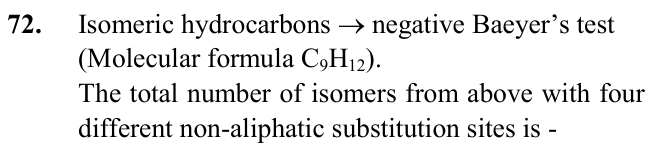
Above two isomers of C9H12 have four different sites for
aromatic electrophilic substitution reaction.
QUESTION 2
Hydrocarbons
SECTION A · MCQ (+4, -1)
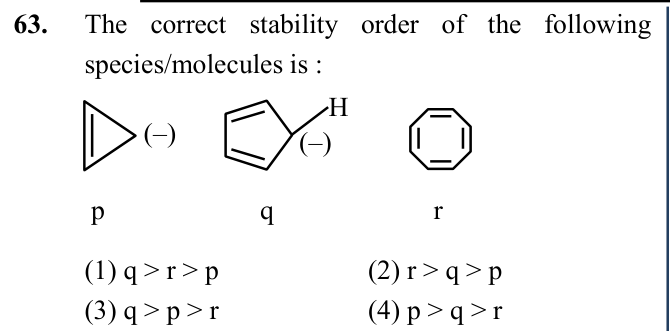
(1) q > r > p
(2) r > q > p
(3) q > p > r
(4) p > q > r
(1)
q is aromatic r is nonaromatic p is antiaromatic
QUESTION 3
Hydrocarbons
SECTION A · MCQ (+4, -1)
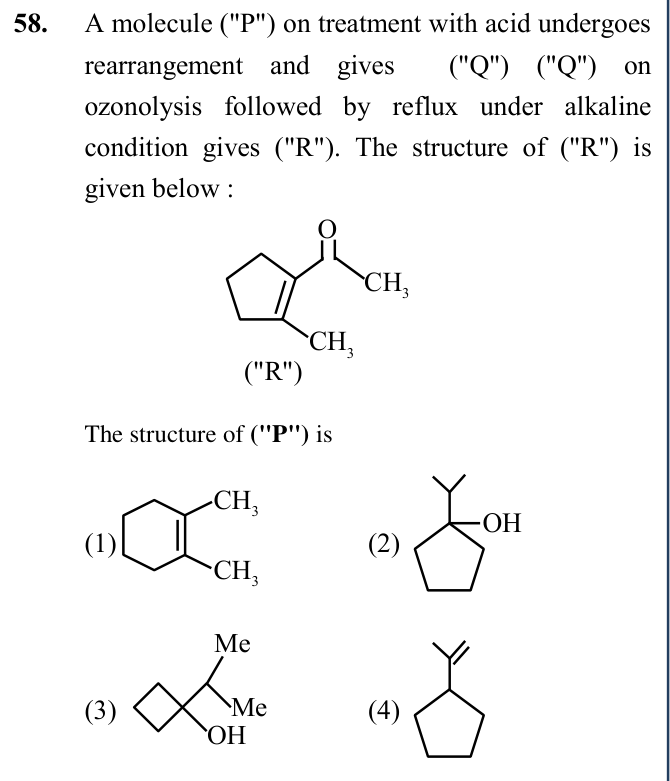
(1) CH3
CH3
(2) OH
(3) Me
Me
OH
——→
H⊕
From Acid + ——→
Ring
Exp.
Me
Me
←—
–H⊕
Me
Me + 1,2
Methyl
shift
Me
Me + i) O3
ii) Zn, H2O
O
O
Me
Me
H
OH
(Alkaline
med.)
O
O
Me
Me
←—
Me
OH
H
O
–H2O Δ
Me
O
CH3
OR
—→
H⊕
From
Acid
—→
–H2O
←——
1,2
Methyl
shift
Me
Me + OH/Δ
O
O
O
CH3
OH
O–H
H + H + +
←—
Ring
Exp.
Me + Me
Me
——→
i) O3
ii) H3O⊕
Me
Note : In question about molecule “P” is not
clarified, weather it is alcohol or alkene and as in
question language rearrangement product is asking
hence according to question language ans. is either
(2) or (4). As alkene also undergoes rearrangement
in presence of acid but option (2) also fulfil all
conditions.
4
QUESTION 4
Hydrocarbons
SECTION A · MCQ (+4, -1)
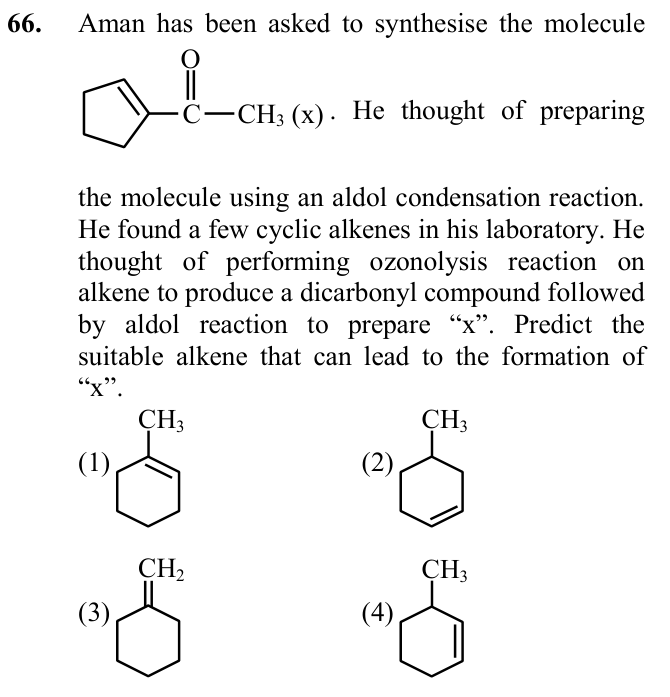
(1) CH3
(2) CH3
(3) CH2
(4) CH3
CH3
O3
Zn/H2O/Δ
7
6
5
4
3
2O
O
1
H
OH!/Δ
1
2
3
4
5
C
O
6
CH3
7
5
QUESTION 5
Hydrocarbons
SECTION A · MCQ (+4, -1)
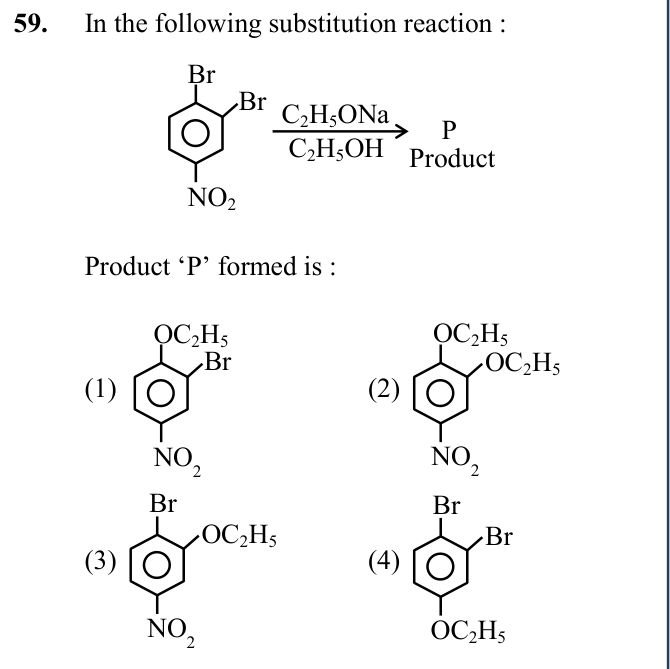
(1) OC2H5
Br
NO2
(2) OC2H5
OC2H5
NO2
(3) Br
OC2H5
NO2
(4) Br
Br
OC2H5
It is an example of nucleophillic Aromatic
substitution reaction.
Br
Br
NO2
C2H5ONa
C2H5OH
OC2H5
Br
NO2
QUESTION 6
Hydrocarbons
SECTION A · MCQ (+4, -1)
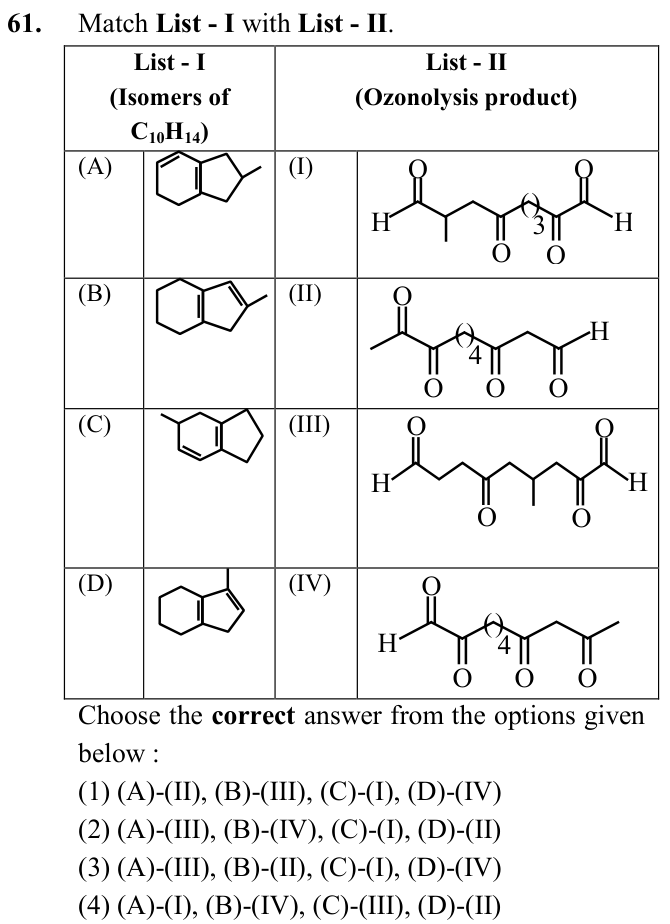
(1) (A)-(II), (B)-(III), (C)-(I), (D)-(IV)
(2) (A)-(III), (B)-(IV), (C)-(I), (D)-(II)
(3) (A)-(III), (B)-(II), (C)-(I), (D)-(IV)
(4) (A)-(I), (B)-(IV), (C)-(III), (D)-(II)
Ozonolysis product
(A)
→ H
O
O
O
O
H
(B)
→
O
O
O
( )
4
O
H
(C)
→H
O
O
O
O
H
( )
3
(D)
→
O
O
O
H
( )
4
O
4
QUESTION 7
Hydrocarbons
SECTION A · MCQ (+4, -1)
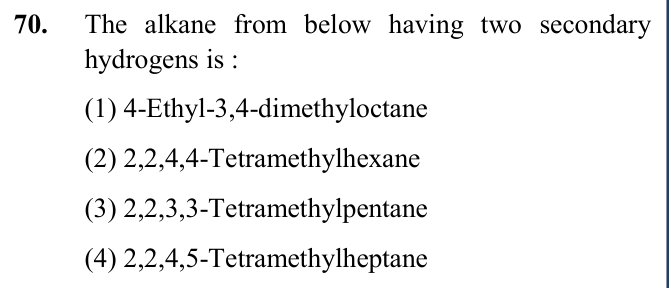
(1) 4-Ethyl-3,4-dimethyloctane
(2) 2,2,4,4-Tetramethylhexane
(3) 2,2,3,3-Tetramethylpentane
(4) 2,2,4,5-Tetramethylheptane
Alkane
2°H
1.
2°
2°
2°
2°
2°
10
2.
2°
2°
4
3.
2°
2
4.
2°
2°
4
SECTION-B
QUESTION 8
Hydrocarbons
SECTION A · MCQ (+4, -1)
Calculate the percentage of 2-chloropropane formed in the monochlorination of propane at 298 K (relative rates: 1° H = 1.0, 2° H = 3.8).
(1) 36.0%
(2) 55.9%
(3) 44.1%
(4) 75.0%
Propane has six 1° H and two 2° H. Weighted contributions: 1° = 6 × 1.0 = 6.0 and 2° = 2 × 3.8 = 7.6, giving a total of 13.6. Percentage of 2-chloropropane = (7.6 / 13.6) × 100 = 55.9%.
QUESTION 9
Hydrocarbons
SECTION A · MCQ (+4, -1)
What is the dihedral angle between the C–H bonds on adjacent carbons in the staggered (most stable) conformation of ethane?
(1) 180°
(2) 120°
(3) 60°
(4) 0°
In the staggered conformation, each front C–H bond sits midway between two back C–H bonds, giving a dihedral angle of 60°. This minimizes torsional strain, making the staggered form the most stable.
QUESTION 10
Hydrocarbons
SECTION A · MCQ (+4, -1)
Propyne undergoes Kutscherov hydration (H2O, HgSO4 / dilute H2SO4). What is the organic product?
(1) Propan-1-ol
(2) Propanoic acid
(3) Propan-2-one (acetone)
(4) Propanal
Hydration of an alkyne first forms an enol, which tautomerizes to a carbonyl compound. Markovnikov addition places the OH on the internal carbon, so the enol CH3–C(OH)=CH2 tautomerizes to the ketone acetone.
QUESTION 11
Hydrocarbons
SECTION A · MCQ (+4, -1)
In free-radical halogenation of methane, which step involves homolytic cleavage of the Cl–Cl bond to generate chlorine radicals?
(1) Inhibition
(2) Termination
(3) Propagation
(4) Initiation
Initiation homolytically splits Cl2 into two chlorine radicals.
QUESTION 12
Hydrocarbons
SECTION A · MCQ (+4, -1)
Addition of HBr to propene in the presence of peroxides gives which major product?
(1) 1-Bromopropane
(2) 2-Bromopropane
(3) Propan-1-ol
(4) 1,2-Dibromopropane
The peroxide (Kharasch) effect gives anti-Markovnikov addition, forming 1-bromopropane.
QUESTION 13
Hydrocarbons
SECTION A · MCQ (+4, -1)
Which alkane is produced at the anode during the electrolysis of an aqueous solution of sodium propanoate (CH3CH2COONa)?
(1) n-Butane (CH3CH2CH2CH3)
(2) Propane (CH3CH2CH3)
(3) Ethane (CH3CH3)
(4) Methane (CH4)
In Kolbe's electrolysis, the propanoate ion loses CO2 at the anode to generate an ethyl radical (CH3CH2•). Two ethyl radicals dimerize to give n-butane (CH3CH2–CH2CH3), while CO2 is released as a byproduct.
QUESTION 14
Hydrocarbons
SECTION A · MCQ (+4, -1)
Compared with its trans isomer, a cis-alkene generally has a higher value of which property?
(1) Boiling point
(2) Symmetry
(3) Melting point
(4) Stability
Cis-alkenes are polar and pack less well, giving a higher boiling point.
QUESTION 15
Hydrocarbons
SECTION A · MCQ (+4, -1)
Is the cyclopentadienyl cation (C5H5+) aromatic, anti-aromatic, or non-aromatic?
(1) Non-aromatic
(2) Aromatic
(3) Anti-aromatic
(4) It cannot be classified
The cyclopentadienyl cation is cyclic, planar, and fully conjugated, with 4 π-electrons (two double bonds plus a vacant p-orbital). Since 4 = 4n (n = 1), it is anti-aromatic and intensely unstable.
QUESTION 16
Hydrocarbons
SECTION A · MCQ (+4, -1)
Hydration of acetylene with HgSO4/H2SO4 (Kucherov reaction) gives which product?
(1) Acetaldehyde
(2) Ethanol
(3) Acetone
(4) Ethylene glycol
Kucherov hydration of acetylene yields acetaldehyde (CH3CHO).
QUESTION 17
Hydrocarbons
SECTION A · MCQ (+4, -1)
When 2-bromobutane is treated with potassium tert-butoxide [(CH3)3CO−K+], the major product is but-1-ene rather than but-2-ene. This outcome is an example of which rule?
(1) Saytzeff rule
(2) Markovnikov's rule
(3) Hückel's rule
(4) Hofmann rule
A bulky base such as tert-butoxide cannot reach the hindered internal β-hydrogen, so it abstracts a proton from the least hindered terminal carbon, giving the least substituted alkene (but-1-ene). This is the Hofmann orientation.
QUESTION 18
Hydrocarbons
SECTION A · MCQ (+4, -1)
A nitro (–NO2) group directs an incoming electrophile to which position(s) on a benzene ring?
(1) Ortho
(2) Meta
(3) Para
(4) Ortho and para
–NO2 is a deactivating, meta-directing group.
QUESTION 19
Hydrocarbons
SECTION A · MCQ (+4, -1)
In free-radical chlorination at 298 K, the relative reactivity of 3° : 2° : 1° C–H bonds is approximately which ratio?
(1) 1600 : 82 : 1
(2) 1 : 3.8 : 5
(3) 5 : 3.8 : 1
(4) 1 : 1 : 1
Chlorination shows low selectivity with a 3°:2°:1° ratio of about 5:3.8:1.