
✎ ANSWER ONLINE · EVERY MISTAKE LINKS BACK TO THE CONCEPT
Chemical Kinetics · Practice Worksheet
Answer each question here and it marks straight away, with the derivation and a link to the exact micro-concept to revisit.
// CONCEPT AUDIT RESULT
Everything you missed has been added to your Error Arena — retest them blind there, and a concept clears once you get it right.
QUESTION 1
Chemical Kinetics
SECTION A · MCQ (+4, -1)
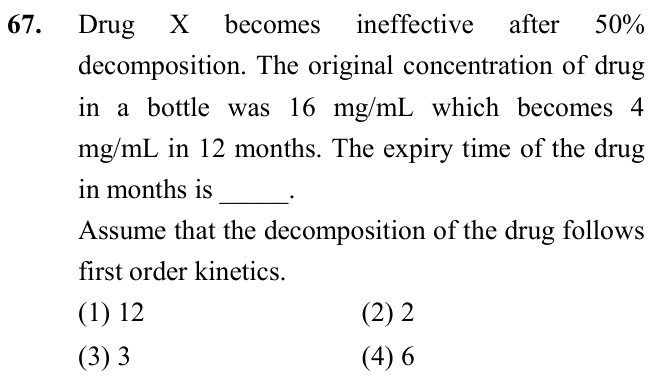
(1) 12
(2) 2
(3) 3
(4) 6
QUESTION 2
Chemical Kinetics
SECTION A · MCQ (+4, -1)
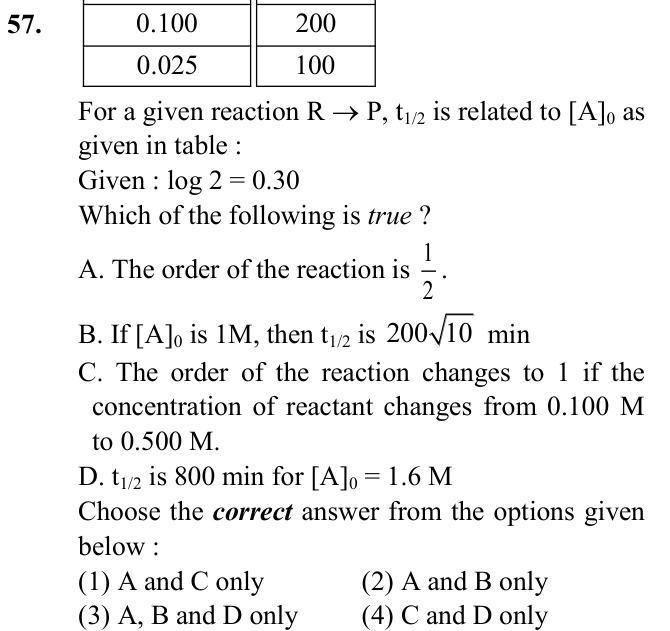
(1) A and C only
(2) A and B only
(3) A, B and D only
(4) C and D only
t1/2 ∝ - n 1
0
1
A - - = n 1
1/2 1
0 2
n 1
1/2 2
0 1
(t
)
(A )
(t
)
(A ) - )
=(
[
)
n 1
200
0.025
100
0.100
2 = - )
(
[
)
n 1
1
4
n – 1 = -1
2
n = 1 (order)
2
⇒t1/2 ∝
0
A = 1/2
1/2
1/2
200
(0.1)
t
(1)
when A0 = 1M
t1/2 = 200 10 min
* Ist order kinetics have t1/2 independent of their
concentration. So upon changing the concentration
t1/2 should not change for first order reaction. = 1/2
1/2
1/2
200
(0.1)
t
(1.6)
when A0 = 1.6 M
t1/2 = 800 min
QUESTION 3
Chemical Kinetics
SECTION A · MCQ (+4, -1)
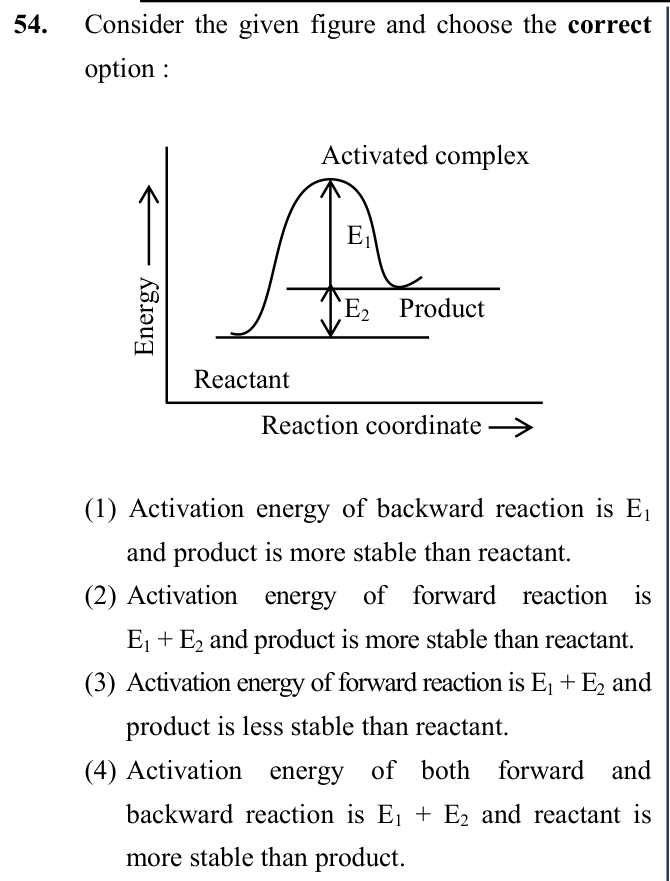
(1) Activation energy of backward reaction is E1
and product is more stable than reactant.
(2) Activation energy of forward reaction is
E1 + E2 and product is more stable than reactant.
(3) Activation energy of forward reaction is E1 + E2 and
product is less stable than reactant.
(4) Activation energy of both forward and
backward reaction is E1 + E2 and reactant is
more stable than product.
Activation energy of forward reaction = E1 + E2
Energy of product > Energy of reactant
Stability
Reactant > Product
QUESTION 4
Chemical Kinetics
SECTION B · NUMERICAL (+4, 0)
(900)
NTA. (897)
2
5
N O
K
= 2 × 4.606 ×10–2 S–1
2
5
2
4
2
2N O (g)
2N O (g)
O (g)
——→ + Pi
0.6
0
0
Pf
0.6 – P
P
P
2
2 × 4.606 × 10–2 = 2.303
0.6
log
100
0.6
P - 10
0.6
4log
0.6
P - 4
0.6
10
0.6
P = -
⇒0.6 × 10⁴ –104 P = 0.6
⇒104 P = 0.6(104 – 1)
P = (6000 – 0.6) × 10–4
= 5999. × 10–4
= 0.59994
Total
P
P
0.6
2 = +
= 0.6 + 0.29997
= 0.89997
= 899.97 × 10⁻³
Ans. 900
Given by NTA
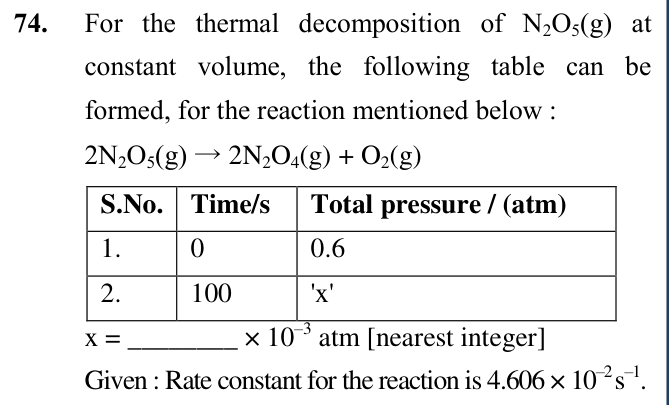
Given : 2N2O5(g) → 2N2O4(g) + O2(g)
t = 0 0.6 0
0
t = 100s 0.6 - x
x
x/2
Total
x
P
0.6
2 = +
As given in equation
Kr = 4.606 × 10⁻² sec–1
(Here language conflict in question)
(
r
KA
K
2 = not considered)
r
0.6
K t
ln 0.6
x = -
4.606 × 10–2 × 100 = 2.303 log
0.6
0.6
x - Total
0.594
P
0.6
0.897
2 = + = atm
= 897 × 10–3 atm
QUESTION 5
Chemical Kinetics
SECTION B · NUMERICAL (+4, 0)
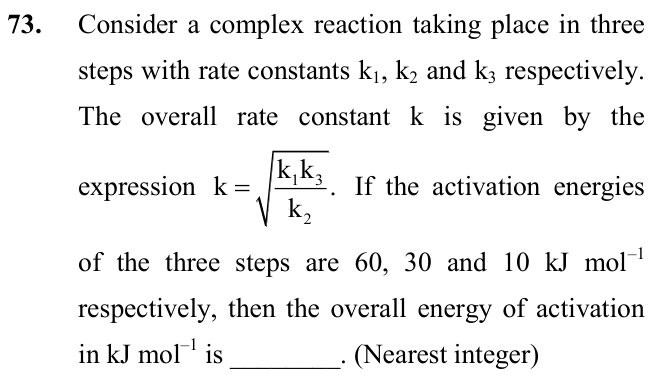
1
3
2
K K
K
K = 3
1
2
Ea /RT
Ea /RT
Ea/RT
1
3
Ea /RT
2
A e
A e
A.e
A e - - - - × =
By comparinig exponential term
3
1
2
a
a
a
a
E
E
E
E
1
RT
2
RT
RT
RT
) = × + -
(
[
)
1
3
2
a
a
a
a
E
(E
E
E ) / 2 = + - Ea = (60 + 10 – 30)/2 = 20 kJ mol–1
Ans. 20
7
QUESTION 6
Chemical Kinetics
SECTION B · NUMERICAL (+4, 0)
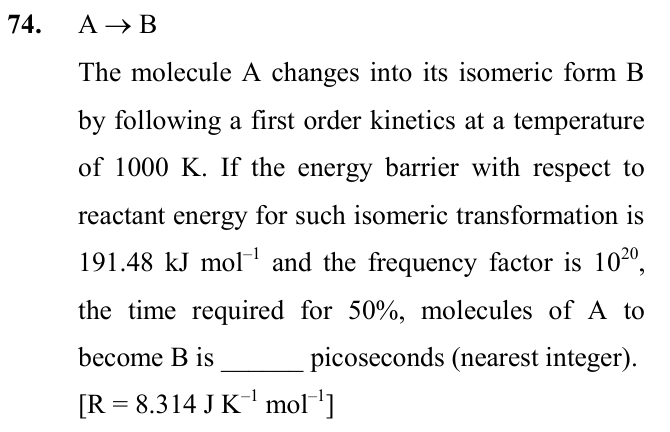
t1/2 = 0.693
K
K = Ae–Ea/RT
= 1020 ×
3
191.48 10
8.314 1000
e × - × = 1020 × e–23.031 = 1020 × – eln 10 × 10 = 20
10
10
10
= 1010 sec.
t1/2 =
10
0.693
10
= 6.93 × 10–11
= 69.3 × 10⁻¹² sec.
6
QUESTION 7
Chemical Kinetics
SECTION A · MCQ (+4, -1)
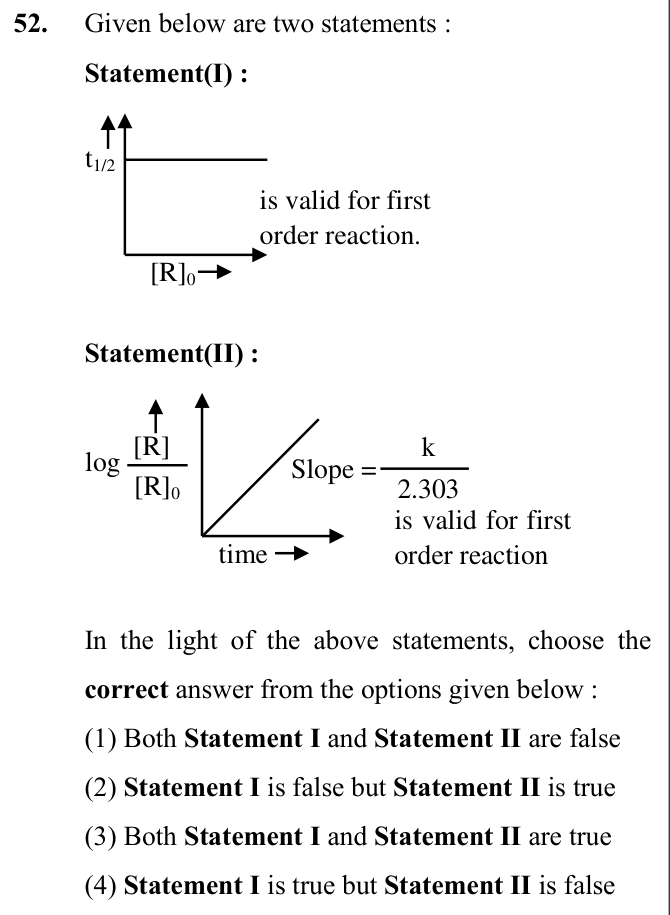
(1) Both Statement I and Statement II are false
(2) Statement I is false but Statement II is true
(3) Both Statement I and Statement II are true
(4) Statement I is true but Statement II is false
For first order reaction 1/2
n2
t
k = [R]0
t1/2
For first order reaction
0
[R]
1
log
kt
[R]
2.303 = 0
[R]
k
log
t
[R]
2.303
) = ×
(
[
)
time
log
Slope =
k
2.303
[R]0
[R]
Options (4)
QUESTION 8
Chemical Kinetics
SECTION A · MCQ (+4, -1)
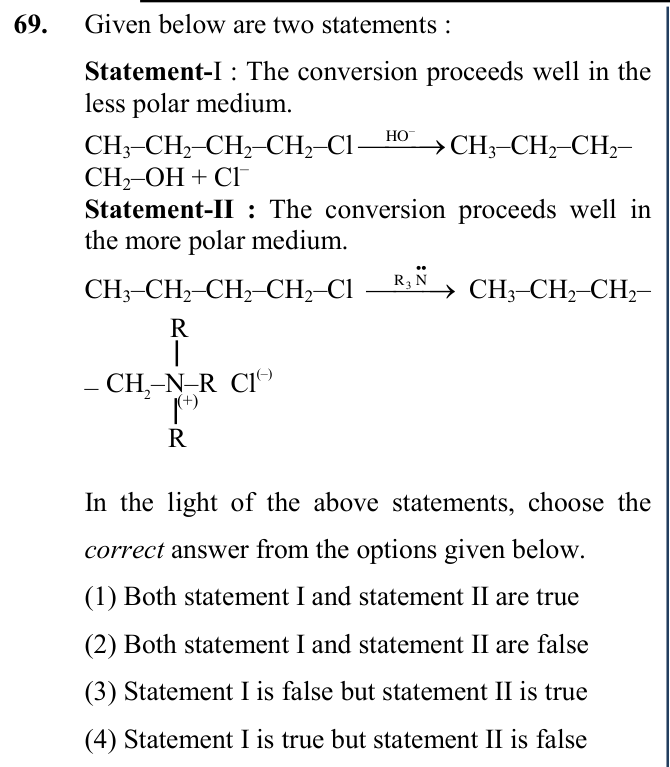
(1) Both statement I and statement II are true
(2) Both statement I and statement II are false
(3) Statement I is false but statement II is true
(4) Statement I is true but statement II is false
CH3 – CH2 – CH2 – CH2 – Cl + OH
!
SN2
Reactant (higher charge density)
HO ………. C ………. Cl
H
H
C3H7
!
Transition state (less charge density)
⇒ This reaction will proceed faster in less polar
medium which will not increase the activation
energy value.
CH3 – CH2 – CH2 – CH2 – Cl + R3N
SN2
Reactant (low charge density)
R3N ………. C ………. Cl
H
H
C3H7
Transition state (Higher charge density)
δ–
δ+
⇒ This reaction will proceed faster in more polar
medium which will decrease the activation energy
value.
QUESTION 9
Chemical Kinetics
SECTION A · MCQ (+4, -1)
In a multi-step reaction, the overall rate is governed by the step that is the what?
(1) last step
(2) slowest step
(3) first step
(4) fastest step
The slowest (rate-determining) step controls the overall reaction rate.
QUESTION 10
Chemical Kinetics
SECTION A · MCQ (+4, -1)
In a stoichiometric rate expression, the rate of reaction equals the rate of change of concentration of a species divided by its what?
(1) molecular mass
(2) molecularity
(3) order
(4) stoichiometric coefficient
Each species' rate is divided by its stoichiometric coefficient to give a single common reaction rate.