
✎ ANSWER ONLINE · EVERY MISTAKE LINKS BACK TO THE CONCEPT
Chemical Kinetics · Practice Worksheet
Answer each question here and it marks straight away, with the derivation and a link to the exact micro-concept to revisit.
1 question from this set could not be marked online — a
bonus or dual-key question, which has no single defensible answer. The print and
.docx versions still include it.
// CONCEPT AUDIT RESULT
Everything you missed has been added to your Error Arena — retest them blind there, and a concept clears once you get it right.
QUESTION 1
Chemical Kinetics
SECTION A · MCQ (+4, -1)
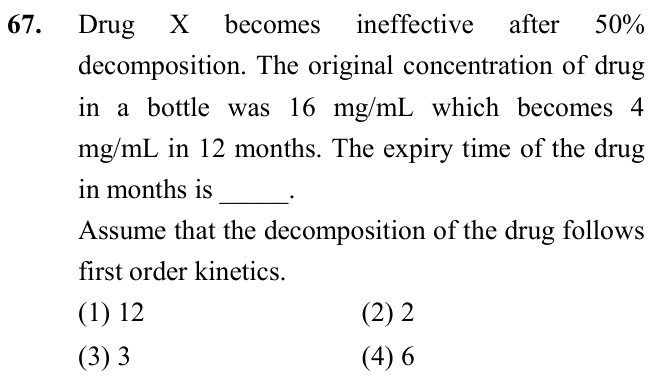
(1) 12
(2) 2
(3) 3
(4) 6
QUESTION 2
Chemical Kinetics
SECTION A · MCQ (+4, -1)
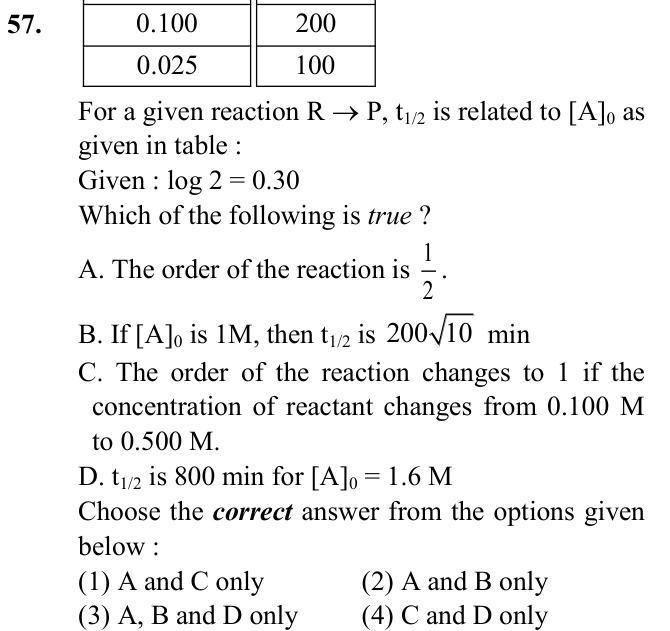
(1) A and C only
(2) A and B only
(3) A, B and D only
(4) C and D only
t1/2 ∝ - n 1
0
1
A - - = n 1
1/2 1
0 2
n 1
1/2 2
0 1
(t
)
(A )
(t
)
(A ) - )
=(
[
)
n 1
200
0.025
100
0.100
2 = - )
(
[
)
n 1
1
4
n – 1 = -1
2
n = 1 (order)
2
⇒t1/2 ∝
0
A = 1/2
1/2
1/2
200
(0.1)
t
(1)
when A0 = 1M
t1/2 = 200 10 min
* Ist order kinetics have t1/2 independent of their
concentration. So upon changing the concentration
t1/2 should not change for first order reaction. = 1/2
1/2
1/2
200
(0.1)
t
(1.6)
when A0 = 1.6 M
t1/2 = 800 min
QUESTION 3
Chemical Kinetics
SECTION A · MCQ (+4, -1)
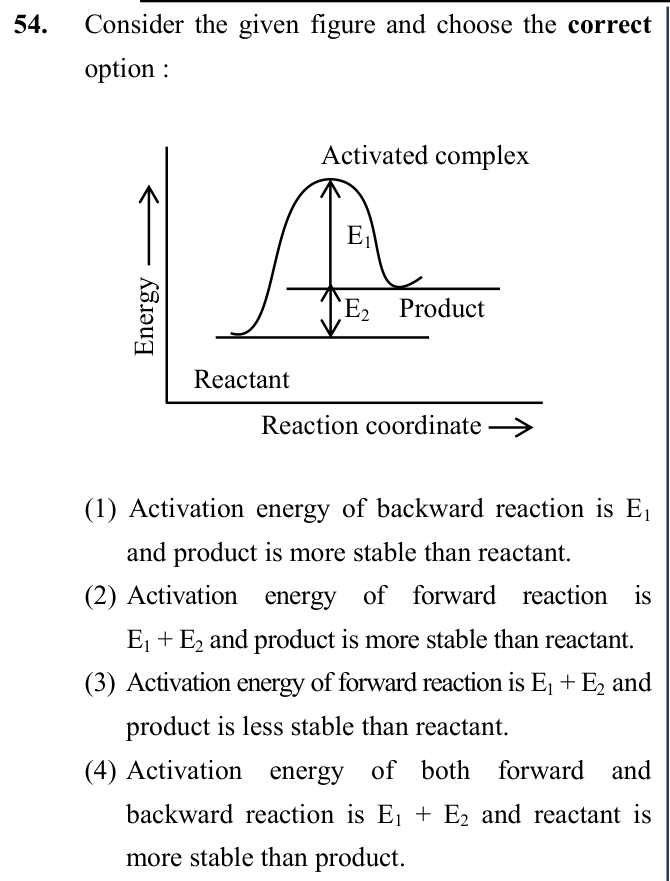
(1) Activation energy of backward reaction is E1
and product is more stable than reactant.
(2) Activation energy of forward reaction is
E1 + E2 and product is more stable than reactant.
(3) Activation energy of forward reaction is E1 + E2 and
product is less stable than reactant.
(4) Activation energy of both forward and
backward reaction is E1 + E2 and reactant is
more stable than product.
Activation energy of forward reaction = E1 + E2
Energy of product > Energy of reactant
Stability
Reactant > Product
QUESTION 4
Chemical Kinetics
SECTION B · NUMERICAL (+4, 0)
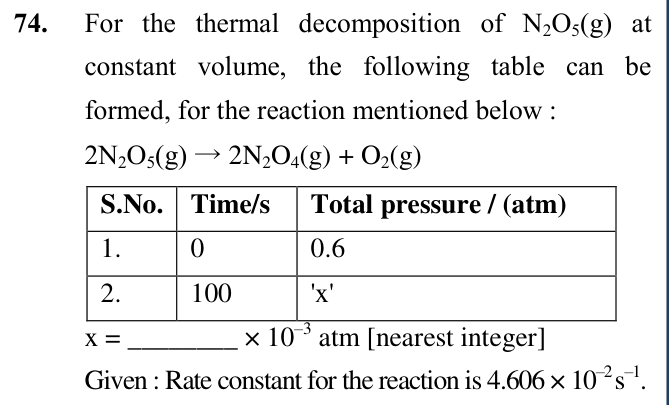
(900)
NTA. (897)
2
5
N O
K
= 2 × 4.606 ×10–2 S–1
2
5
2
4
2
2N O (g)
2N O (g)
O (g)
——→ + Pi
0.6
0
0
Pf
0.6 – P
P
P
2
2 × 4.606 × 10–2 = 2.303
0.6
log
100
0.6
P - 10
0.6
4log
0.6
P - 4
0.6
10
0.6
P = -
⇒0.6 × 10⁴ –104 P = 0.6
⇒104 P = 0.6(104 – 1)
P = (6000 – 0.6) × 10–4
= 5999. × 10–4
= 0.59994
Total
P
P
0.6
2 = +
= 0.6 + 0.29997
= 0.89997
= 899.97 × 10⁻³
Ans. 900
Given by NTA
Given : 2N2O5(g) → 2N2O4(g) + O2(g)
t = 0 0.6 0
0
t = 100s 0.6 - x
x
x/2
Total
x
P
0.6
2 = +
As given in equation
Kr = 4.606 × 10⁻² sec–1
(Here language conflict in question)
(
r
KA
K
2 = not considered)
r
0.6
K t
ln 0.6
x = -
4.606 × 10–2 × 100 = 2.303 log
0.6
0.6
x - Total
0.594
P
0.6
0.897
2 = + = atm
= 897 × 10–3 atm
QUESTION 5
Chemical Kinetics
SECTION B · NUMERICAL (+4, 0)
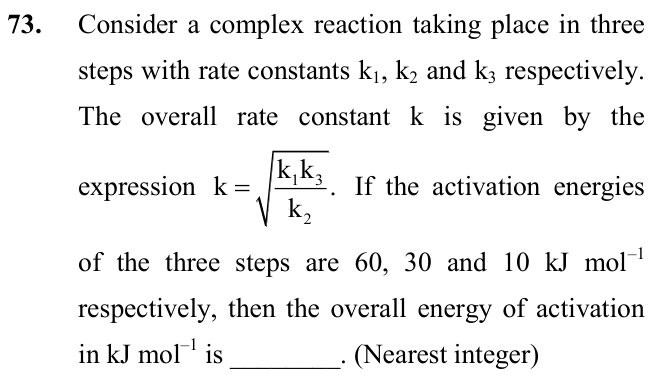
1
3
2
K K
K
K = 3
1
2
Ea /RT
Ea /RT
Ea/RT
1
3
Ea /RT
2
A e
A e
A.e
A e - - - - × =
By comparinig exponential term
3
1
2
a
a
a
a
E
E
E
E
1
RT
2
RT
RT
RT
) = × + -
(
[
)
1
3
2
a
a
a
a
E
(E
E
E ) / 2 = + - Ea = (60 + 10 – 30)/2 = 20 kJ mol–1
Ans. 20
7
QUESTION 6
Chemical Kinetics
SECTION B · NUMERICAL (+4, 0)
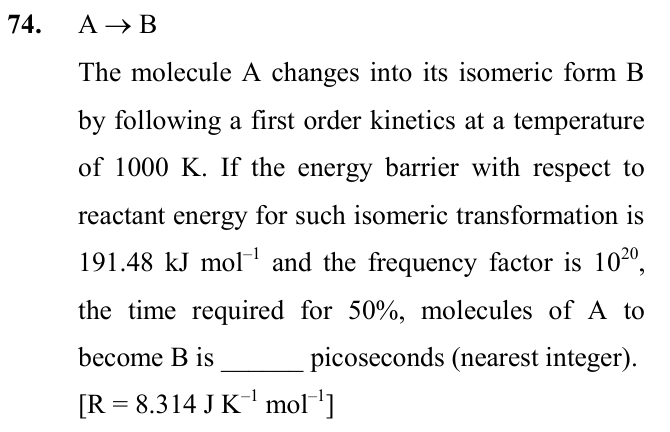
t1/2 = 0.693
K
K = Ae–Ea/RT
= 1020 ×
3
191.48 10
8.314 1000
e × - × = 1020 × e–23.031 = 1020 × – eln 10 × 10 = 20
10
10
10
= 1010 sec.
t1/2 =
10
0.693
10
= 6.93 × 10–11
= 69.3 × 10⁻¹² sec.
6
QUESTION 7
Chemical Kinetics
SECTION A · MCQ (+4, -1)
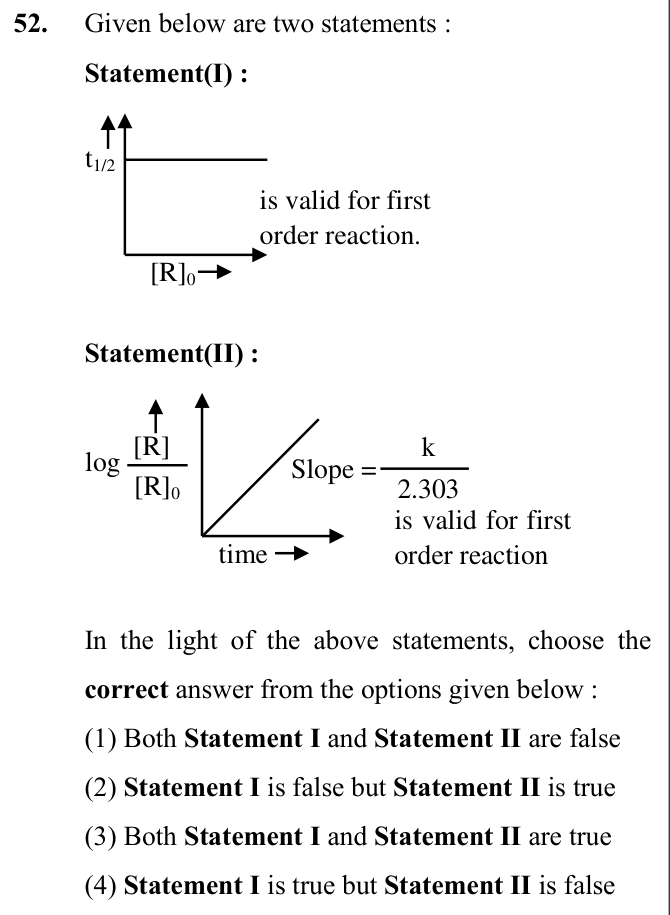
(1) Both Statement I and Statement II are false
(2) Statement I is false but Statement II is true
(3) Both Statement I and Statement II are true
(4) Statement I is true but Statement II is false
For first order reaction 1/2
n2
t
k = [R]0
t1/2
For first order reaction
0
[R]
1
log
kt
[R]
2.303 = 0
[R]
k
log
t
[R]
2.303
) = ×
(
[
)
time
log
Slope =
k
2.303
[R]0
[R]
Options (4)
QUESTION 8
Chemical Kinetics
SECTION A · MCQ (+4, -1)
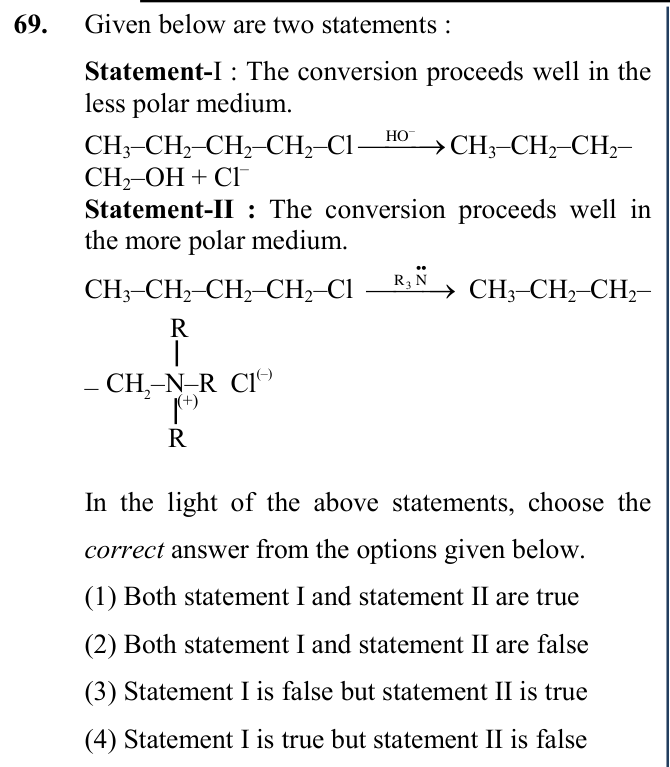
(1) Both statement I and statement II are true
(2) Both statement I and statement II are false
(3) Statement I is false but statement II is true
(4) Statement I is true but statement II is false
CH3 – CH2 – CH2 – CH2 – Cl + OH
!
SN2
Reactant (higher charge density)
HO ………. C ………. Cl
H
H
C3H7
!
Transition state (less charge density)
⇒ This reaction will proceed faster in less polar
medium which will not increase the activation
energy value.
CH3 – CH2 – CH2 – CH2 – Cl + R3N
SN2
Reactant (low charge density)
R3N ………. C ………. Cl
H
H
C3H7
Transition state (Higher charge density)
δ–
δ+
⇒ This reaction will proceed faster in more polar
medium which will decrease the activation energy
value.
QUESTION 9
Chemical Kinetics
SECTION A · MCQ (+4, -1)
In a multi-step reaction, the overall rate is governed by the step that is the what?
(1) last step
(2) slowest step
(3) first step
(4) fastest step
The slowest (rate-determining) step controls the overall reaction rate.
QUESTION 10
Chemical Kinetics
SECTION A · MCQ (+4, -1)
In a stoichiometric rate expression, the rate of reaction equals the rate of change of concentration of a species divided by its what?
(1) molecular mass
(2) molecularity
(3) order
(4) stoichiometric coefficient
Each species' rate is divided by its stoichiometric coefficient to give a single common reaction rate.
QUESTION 11
Chemical Kinetics
SECTION A · MCQ (+4, -1)
For a zero-order reaction, which plot yields a straight line?
(1) ln[A] versus t
(2) [A] versus t
(3) 1/[A] versus t
(4) log k versus 1/T
Zero-order kinetics follows [A] = [A]0 - kt, so a plot of [A] versus t is linear.
QUESTION 12
Chemical Kinetics
SECTION A · MCQ (+4, -1)
Which of the following is determined only by experiment and can be zero or a fraction?
(1) valence
(2) stoichiometric coefficient
(3) order of reaction
(4) molecularity
Order is experimental and may be zero or fractional, whereas molecularity is always a whole number.
QUESTION 13
Chemical Kinetics
SECTION A · MCQ (+4, -1)
In the acid-catalysed hydrolysis of cane sugar, 'inversion' refers to the change in the what?
(1) rate constant
(2) activation energy
(3) order of reaction
(4) sign of optical rotation
The optical rotation changes from dextrorotatory to laevorotatory as sucrose is hydrolysed.
QUESTION 14
Chemical Kinetics
SECTION A · MCQ (+4, -1)
According to collision theory, what fraction of molecular collisions possess at least the activation energy Ea?
(1) RT/Ea
(2) 1 − e^(−Ea/RT)
(3) e^(−Ea/RT) (the Boltzmann factor)
(4) Ea/RT
Only collisions with energy at least the threshold (E₀ = ground state + Ea) can react. The fraction of collisions in this high-energy tail is the Boltzmann factor e^(−Ea/RT).