
⚡ OFFICIAL NTA ASSESSMENT GENERATOR & WORD (.DOCX) EXPORTER
The d- and f-Block Elements · Practice Worksheet
JEE Main Chemistry · Curated Assessment Set Print directly or export as a beautifully formatted Microsoft Word document with embedded 180-DPI mathematical prompt clips and step-by-step derivations.
EDUPROD JEE MAIN TEST SERIES · NTA PATTERN
The d- and f-Block Elements · Practice Worksheet
JEE Main Chemistry · Curated Assessment Set · Assessment Code: JEE-101
Total Marks: 40
Marking: +4 / -1 (Sec A) · +4 / 0 (Sec B)
QUESTION 1
CHEMISTRY · d and f Block Elements
SECTION B · NUMERICAL (+4, 0)
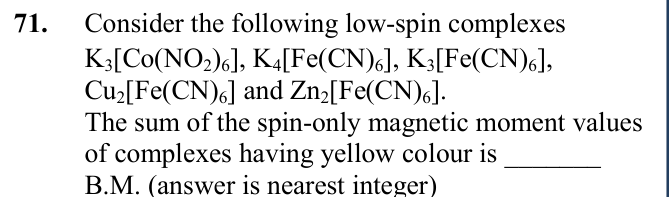
Numerical Value:
[ ]
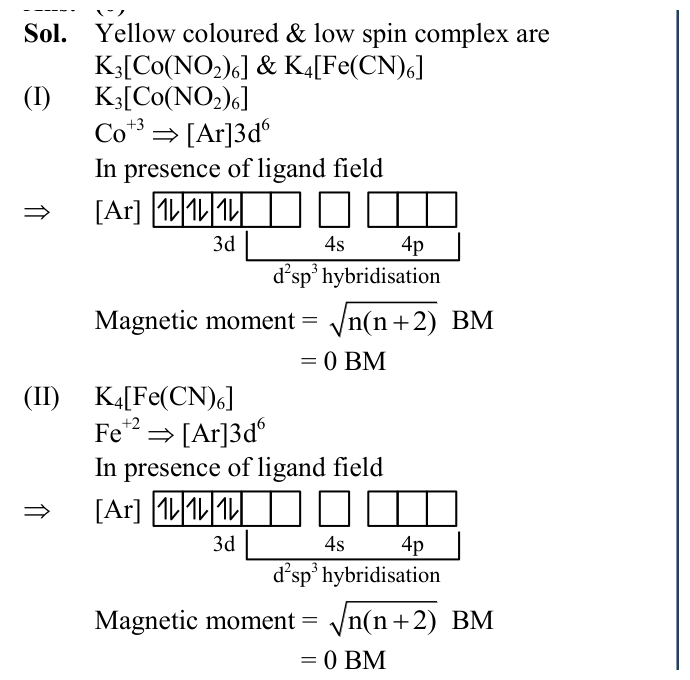
⚡ OFFICIAL KEY: 0
Step-by-Step Derivation
QUESTION 2
CHEMISTRY · d and f Block Elements
SECTION B · NUMERICAL (+4, 0)
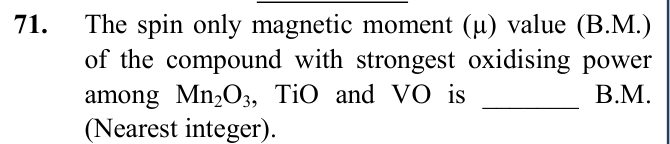
Numerical Value:
[ ]
⚡ OFFICIAL KEY: 5
Step-by-Step Derivation

QUESTION 3
CHEMISTRY · d and f Block Elements
SECTION A · MCQ (+4, -1)
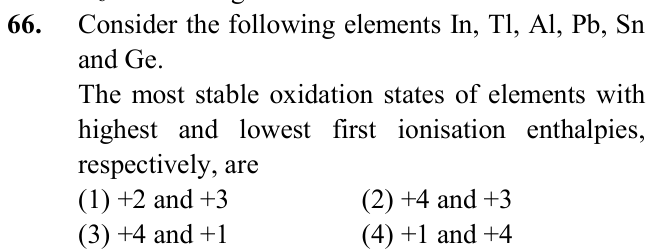
Candidate Response:
(1) (2) (3) (4)
⚡ OFFICIAL KEY: 3
Step-by-Step Derivation
QUESTION 4
CHEMISTRY · d and f Block Elements
SECTION A · MCQ (+4, -1)
Candidate Response:
(1) (2) (3) (4)
⚡ OFFICIAL KEY: 3
Step-by-Step Derivation

QUESTION 5
CHEMISTRY · d and f Block Elements
SECTION A · MCQ (+4, -1)
Candidate Response:
(1) (2) (3) (4)
⚡ OFFICIAL KEY: 2
Step-by-Step Derivation
QUESTION 6
CHEMISTRY · d and f Block Elements
SECTION A · MCQ (+4, -1)
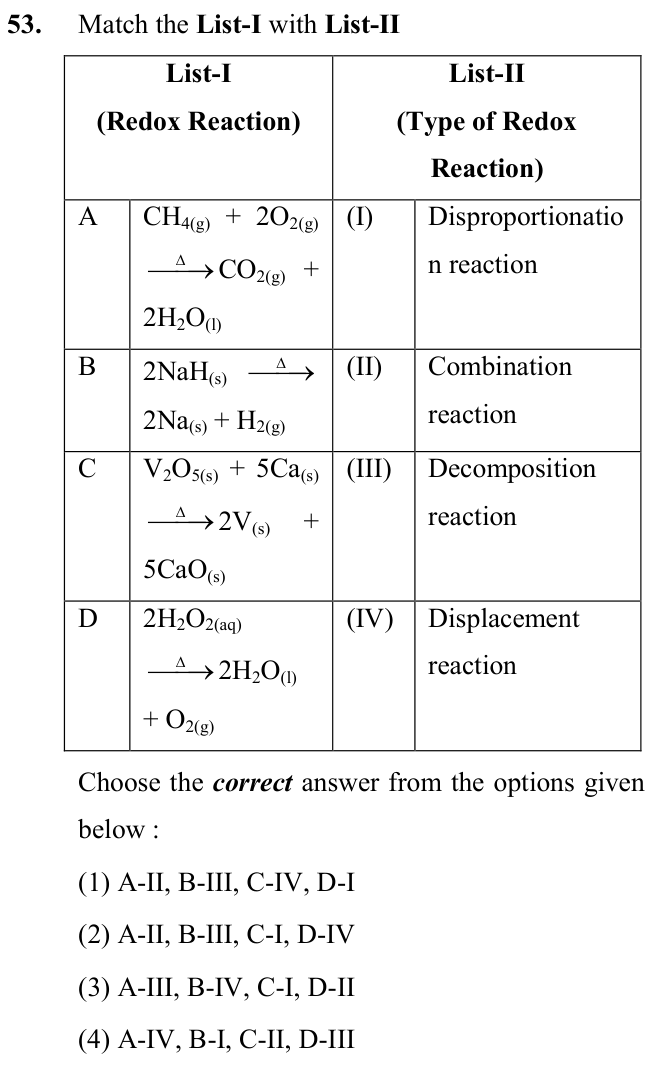
Candidate Response:
(1) (2) (3) (4)
⚡ OFFICIAL KEY: 1
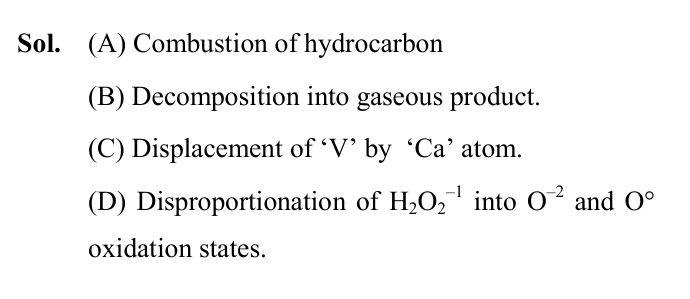
Step-by-Step Derivation
QUESTION 7
CHEMISTRY · d and f Block Elements
SECTION A · MCQ (+4, -1)
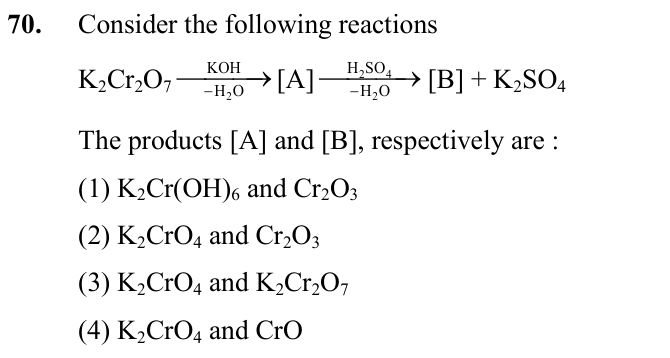
Candidate Response:
(1) (2) (3) (4)
⚡ OFFICIAL KEY: 3
Step-by-Step Derivation

QUESTION 8
CHEMISTRY · The d- and f-Block Elements
SECTION A · MCQ (+4, -1)
Why does copper not liberate hydrogen gas from dilute HCl?
(1) It has a negative standard electrode potential
(2) It has a positive standard electrode potential (E° = +0.34 V)
(3) It is less reactive than hydrogen
(4) It forms a protective oxide layer
Candidate Response:
(1) (2) (3) (4)
⚡ OFFICIAL KEY: It has a positive standard electrode potential (E° = +0.34 V)
Step-by-Step Derivation
Copper is the only 3d metal with a positive E°(M²⁺/M) = +0.34 V, so the reduction of Cu²⁺ is favoured over oxidation of Cu; it cannot displace H⁺ to form H₂.
QUESTION 9
CHEMISTRY · The d- and f-Block Elements
SECTION A · MCQ (+4, -1)
What is the ground-state valence electronic configuration of chromium (Z = 24)?
(1) 3d⁵ 4s¹
(2) 3d⁵ 4s²
(3) 3d⁴ 4s²
(4) 3d⁴ 4s¹
Candidate Response:
(1) (2) (3) (4)
⚡ OFFICIAL KEY: 3d⁵ 4s¹
Step-by-Step Derivation
Chromium has 24 electrons. Instead of the expected 3d⁴ 4s², it adopts 3d⁵ 4s¹ because the half-filled d⁵ subshell lowers inter-electronic repulsion and maximises exchange energy.
QUESTION 10
CHEMISTRY · The d- and f-Block Elements
SECTION A · MCQ (+4, -1)
Why is Zn²⁺ (3d¹⁰) colourless in aqueous solution?
(1) It has too many unpaired electrons
(2) It absorbs all visible light
(3) It has a completely filled d-subshell, so no d-d transition is possible
(4) It is too small to be hydrated
Candidate Response:
(1) (2) (3) (4)
⚡ OFFICIAL KEY: It has a completely filled d-subshell, so no d-d transition is possible
Step-by-Step Derivation
Zn²⁺ is d¹⁰, so its d-orbitals are full and there is no vacant orbital to promote an electron to; hence no d-d transition and no colour.