
⚡ OFFICIAL NTA ASSESSMENT GENERATOR & WORD (.DOCX) EXPORTER
The d- and f-Block Elements · Practice Worksheet
JEE Main Chemistry · Curated Assessment Set Print directly or export as a beautifully formatted Microsoft Word document with embedded 180-DPI mathematical prompt clips and step-by-step derivations.
EDUPROD JEE MAIN TEST SERIES · NTA PATTERN
The d- and f-Block Elements · Practice Worksheet
JEE Main Chemistry · Curated Assessment Set · Assessment Code: JEE-101
Total Marks: 120
Marking: +4 / -1 (Sec A) · +4 / 0 (Sec B)
QUESTION 1
CHEMISTRY · d and f Block Elements
SECTION B · NUMERICAL (+4, 0)
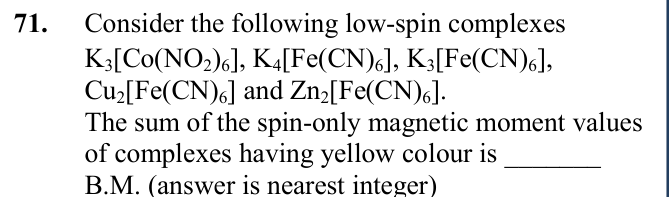
Numerical Value:
[ ]
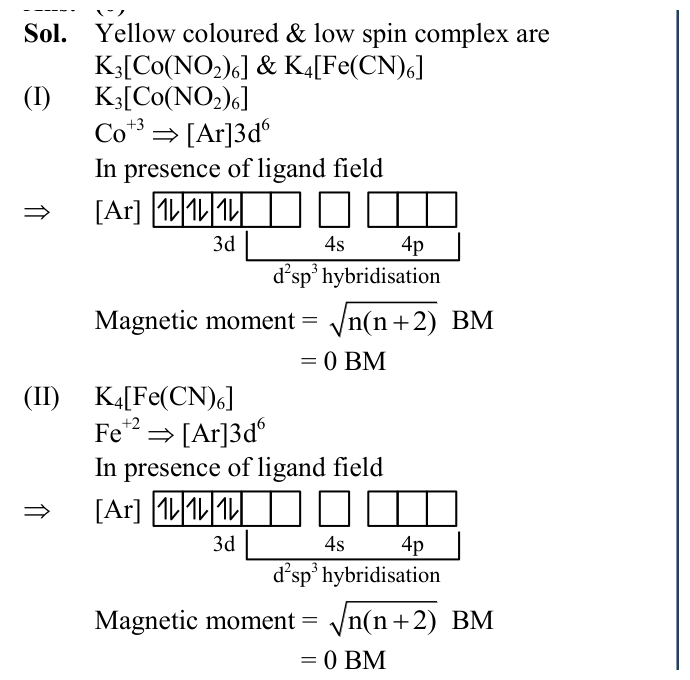
⚡ OFFICIAL KEY: 0
Step-by-Step Derivation
QUESTION 2
CHEMISTRY · d and f Block Elements
SECTION B · NUMERICAL (+4, 0)
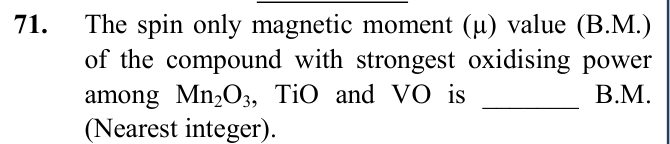
Numerical Value:
[ ]
⚡ OFFICIAL KEY: 5
Step-by-Step Derivation

QUESTION 3
CHEMISTRY · d and f Block Elements
SECTION A · MCQ (+4, -1)
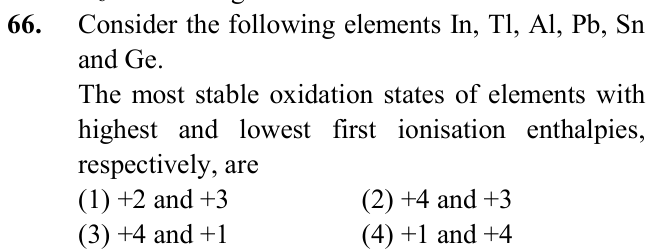
Candidate Response:
(1) (2) (3) (4)
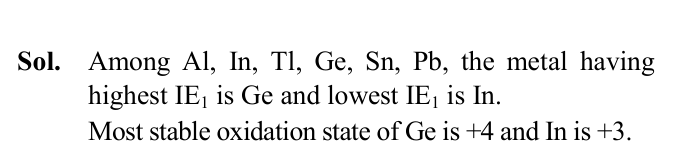
⚡ OFFICIAL KEY: 3
Step-by-Step Derivation
QUESTION 4
CHEMISTRY · d and f Block Elements
SECTION A · MCQ (+4, -1)
Candidate Response:
(1) (2) (3) (4)
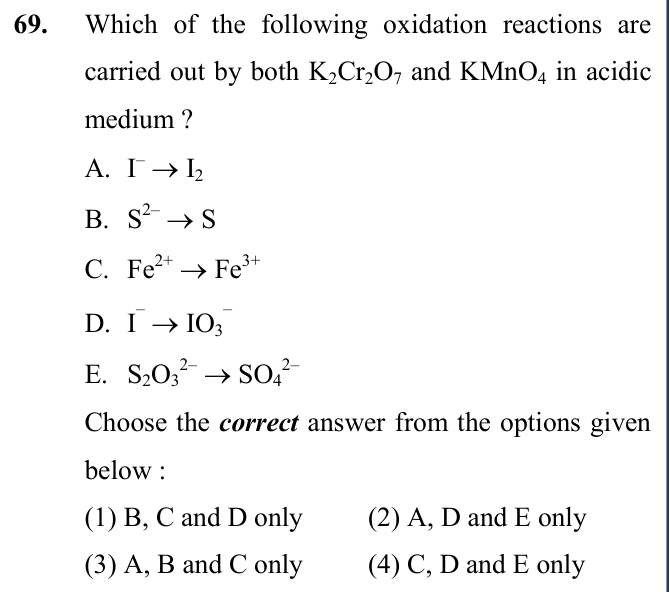
⚡ OFFICIAL KEY: 3
Step-by-Step Derivation

QUESTION 5
CHEMISTRY · d and f Block Elements
SECTION A · MCQ (+4, -1)
Candidate Response:
(1) (2) (3) (4)
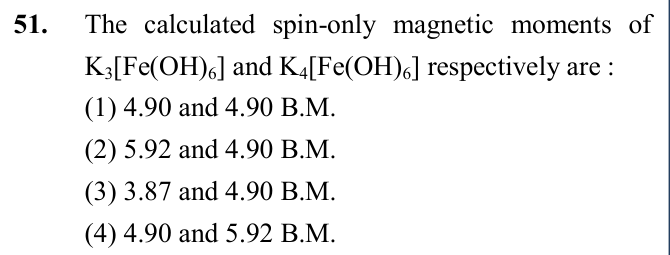
⚡ OFFICIAL KEY: 2
Step-by-Step Derivation
QUESTION 6
CHEMISTRY · d and f Block Elements
SECTION A · MCQ (+4, -1)
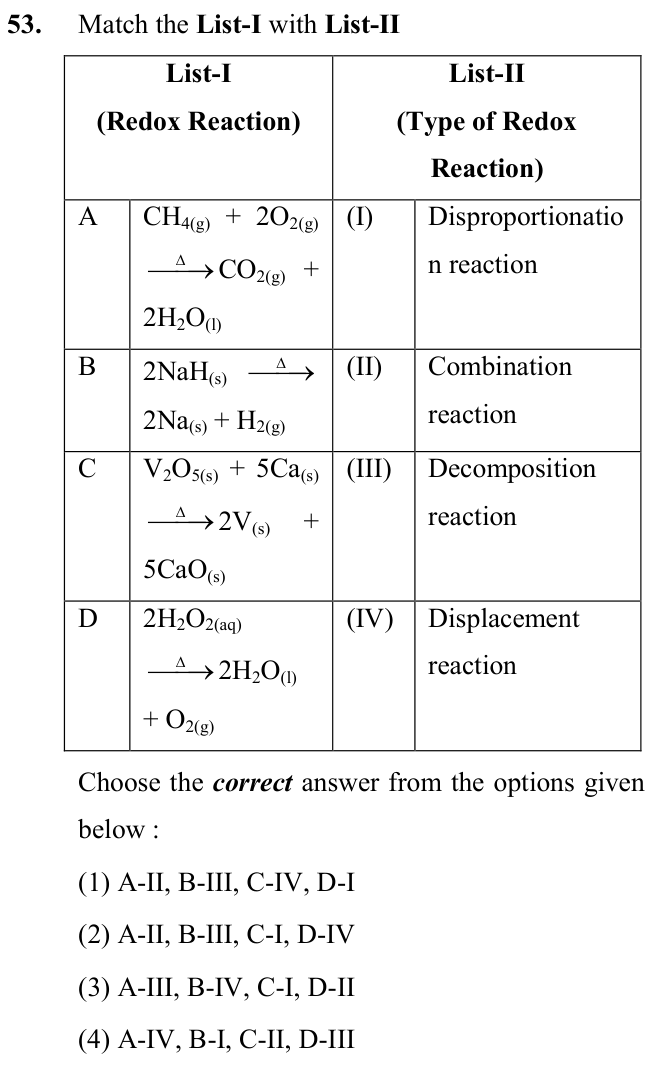
Candidate Response:
(1) (2) (3) (4)
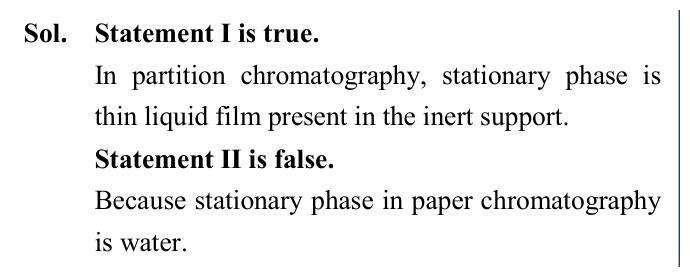
⚡ OFFICIAL KEY: 1
Step-by-Step Derivation
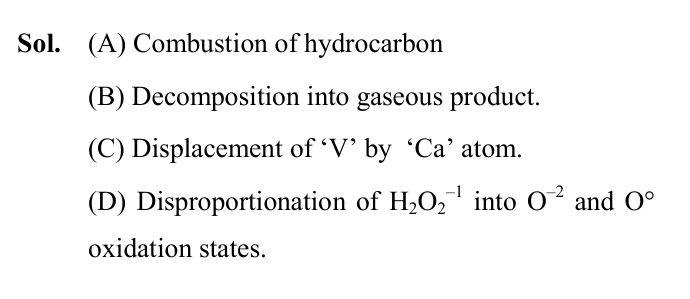
QUESTION 7
CHEMISTRY · d and f Block Elements
SECTION A · MCQ (+4, -1)
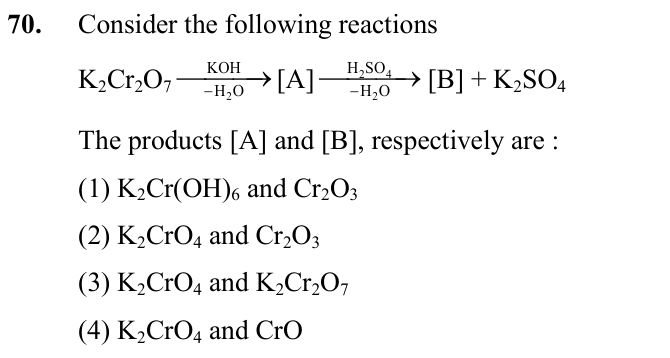
Candidate Response:
(1) (2) (3) (4)
⚡ OFFICIAL KEY: 3
Step-by-Step Derivation

QUESTION 8
CHEMISTRY · The d- and f-Block Elements
SECTION A · MCQ (+4, -1)
Why does copper not liberate hydrogen gas from dilute HCl?
(1) It has a negative standard electrode potential
(2) It has a positive standard electrode potential (E° = +0.34 V)
(3) It is less reactive than hydrogen
(4) It forms a protective oxide layer
Candidate Response:
(1) (2) (3) (4)
⚡ OFFICIAL KEY: It has a positive standard electrode potential (E° = +0.34 V)
Step-by-Step Derivation
Copper is the only 3d metal with a positive E°(M²⁺/M) = +0.34 V, so the reduction of Cu²⁺ is favoured over oxidation of Cu; it cannot displace H⁺ to form H₂.
QUESTION 9
CHEMISTRY · The d- and f-Block Elements
SECTION A · MCQ (+4, -1)
What is the ground-state valence electronic configuration of chromium (Z = 24)?
(1) 3d⁵ 4s¹
(2) 3d⁵ 4s²
(3) 3d⁴ 4s²
(4) 3d⁴ 4s¹
Candidate Response:
(1) (2) (3) (4)
⚡ OFFICIAL KEY: 3d⁵ 4s¹
Step-by-Step Derivation
Chromium has 24 electrons. Instead of the expected 3d⁴ 4s², it adopts 3d⁵ 4s¹ because the half-filled d⁵ subshell lowers inter-electronic repulsion and maximises exchange energy.
QUESTION 10
CHEMISTRY · The d- and f-Block Elements
SECTION A · MCQ (+4, -1)
Why is Zn²⁺ (3d¹⁰) colourless in aqueous solution?
(1) It has too many unpaired electrons
(2) It absorbs all visible light
(3) It has a completely filled d-subshell, so no d-d transition is possible
(4) It is too small to be hydrated
Candidate Response:
(1) (2) (3) (4)
⚡ OFFICIAL KEY: It has a completely filled d-subshell, so no d-d transition is possible
Step-by-Step Derivation
Zn²⁺ is d¹⁰, so its d-orbitals are full and there is no vacant orbital to promote an electron to; hence no d-d transition and no colour.
QUESTION 11
CHEMISTRY · The d- and f-Block Elements
SECTION A · MCQ (+4, -1)
What is the equivalent weight of KMnO₄ in acidic medium (molecular mass = M)?
(1) M/5
(2) M/1
(3) M/3
(4) M/2
Candidate Response:
(1) (2) (3) (4)
⚡ OFFICIAL KEY: M/5
Step-by-Step Derivation
In acidic medium, MnO₄⁻ gains 5 electrons to form Mn²⁺ (MnO₄⁻ + 8H⁺ + 5e⁻ → Mn²⁺ + 4H₂O), so its n-factor is 5 and equivalent weight = M/5.
QUESTION 12
CHEMISTRY · The d- and f-Block Elements
SECTION A · MCQ (+4, -1)
Actinoids exhibit a wider range of oxidation states than lanthanoids because their 5f, 6d and 7s orbitals have what property?
(1) comparable energies
(2) identical radii
(3) widely separated energies
(4) no unpaired electrons
Candidate Response:
(1) (2) (3) (4)
⚡ OFFICIAL KEY: comparable energies
Step-by-Step Derivation
The small energy gaps among 5f, 6d and 7s orbitals allow a wider range of oxidation states.
QUESTION 13
CHEMISTRY · The d- and f-Block Elements
SECTION A · MCQ (+4, -1)
On acidifying a yellow chromate solution, it turns orange due to the formation of which ion?
(1) dichromate ion (Cr2O7 2-)
(2) chromium(III) ion
(3) chromyl chloride
(4) chromate ion (CrO4 2-)
Candidate Response:
(1) (2) (3) (4)
⚡ OFFICIAL KEY: dichromate ion (Cr2O7 2-)
Step-by-Step Derivation
Acid shifts the equilibrium from chromate to the orange dichromate ion.
QUESTION 14
CHEMISTRY · The d- and f-Block Elements
SECTION A · MCQ (+4, -1)
Which lanthanoid ion has the stable [Xe]4f⁰ configuration?
(1) Ce⁴⁺ (cerium(IV))
(2) La³⁺ (lanthanum(III))
(3) Yb²⁺ (ytterbium(II))
(4) Eu²⁺ (europium(II))
Candidate Response:
(1) (2) (3) (4)
⚡ OFFICIAL KEY: Ce⁴⁺ (cerium(IV))
Step-by-Step Derivation
Cerium loses four electrons to reach the empty 4f⁰ configuration [Xe]4f⁰, which is extra stable; Ce⁴⁺ is a strong oxidant (E° Ce⁴⁺/Ce³⁺ = +1.74 V).
QUESTION 15
CHEMISTRY · The d- and f-Block Elements
SECTION A · MCQ (+4, -1)
The ground-state electronic configuration of chromium (Z = 24) is what?
(1) [Ar] 3d5 4s2
(2) [Ar] 3d4 4s2
(3) [Ar] 3d5 4s1
(4) [Ar] 3d6 4s0
Candidate Response:
(1) (2) (3) (4)
⚡ OFFICIAL KEY: [Ar] 3d5 4s1
Step-by-Step Derivation
Cr has the half-filled 3d5 and half-filled 4s1 configuration due to its extra stability.
QUESTION 16
CHEMISTRY · The d- and f-Block Elements
SECTION A · MCQ (+4, -1)
Mischmetal, used in gas-lighter flints, is an alloy of which elements?
(1) transition metals
(2) lanthanoid metals
(3) alkaline earth metals
(4) actinoid metals
Candidate Response:
(1) (2) (3) (4)
⚡ OFFICIAL KEY: lanthanoid metals
Step-by-Step Derivation
Mischmetal is an alloy of lanthanoid metals such as cerium and lanthanum.
QUESTION 17
CHEMISTRY · The d- and f-Block Elements
SECTION A · MCQ (+4, -1)
In acidic medium, the n-factor of KMnO4 (MnO4- to Mn2+) acting as an oxidising agent is what?
(1) 1
(2) 3
(3) 2
(4) 5
Candidate Response:
(1) (2) (3) (4)
⚡ OFFICIAL KEY: 5
Step-by-Step Derivation
Mn changes from +7 to +2, a gain of 5 electrons, so the n-factor is 5.
QUESTION 18
CHEMISTRY · The d- and f-Block Elements
SECTION A · MCQ (+4, -1)
The characteristic colours of transition metal ions arise mainly from which electronic transitions?
(1) s-p transitions
(2) d-d transitions
(3) vibrational transitions
(4) nucleus-to-electron transitions
Candidate Response:
(1) (2) (3) (4)
⚡ OFFICIAL KEY: d-d transitions
Step-by-Step Derivation
Absorption of visible light promotes electrons between the split d orbitals.
QUESTION 19
CHEMISTRY · The d- and f-Block Elements
SECTION A · MCQ (+4, -1)
A metal having a more negative standard electrode potential (E°) acts as a what?
(1) stronger oxidising agent
(2) weaker reducing agent
(3) weaker oxidising agent
(4) stronger reducing agent
Candidate Response:
(1) (2) (3) (4)
⚡ OFFICIAL KEY: stronger reducing agent
Step-by-Step Derivation
A more negative E° means a greater tendency to lose electrons and reduce others.
QUESTION 20
CHEMISTRY · The d- and f-Block Elements
SECTION A · MCQ (+4, -1)
The spin-only magnetic moment (in Bohr magnetons) is given by which formula?
(1) √(n+2) BM
(2) n(n+2) BM
(3) sqrt(n(n+1)) BM
(4) sqrt(n(n+2)) BM
Candidate Response:
(1) (2) (3) (4)
⚡ OFFICIAL KEY: sqrt(n(n+2)) BM
Step-by-Step Derivation
The spin-only moment is μ = sqrt(n(n+2)) BM, where n is the number of unpaired electrons.
QUESTION 21
CHEMISTRY · The d- and f-Block Elements
SECTION A · MCQ (+4, -1)
Why is actinoid contraction greater than lanthanoid contraction?
(1) 5f electrons have poorer shielding ability than 4f electrons
(2) Actinoids have more electrons
(3) Actinoids are more electronegative
(4) Lanthanoids have larger nuclear charge
Candidate Response:
(1) (2) (3) (4)
⚡ OFFICIAL KEY: 5f electrons have poorer shielding ability than 4f electrons
Step-by-Step Derivation
5f orbitals are more diffuse and shield the nucleus even more poorly than 4f, so each added proton raises the effective nuclear charge more steeply, shrinking radii more per element across the actinoid series.
QUESTION 22
CHEMISTRY · The d- and f-Block Elements
SECTION A · MCQ (+4, -1)
What is Mischmetal mainly used for?
(1) Making stainless steel
(2) Extracting hydrogen gas
(3) Lighter flints (and tracer bullet cartridges)
(4) Catalysing the Haber process
Candidate Response:
(1) (2) (3) (4)
⚡ OFFICIAL KEY: Lighter flints (and tracer bullet cartridges)
Step-by-Step Derivation
Mischmetal is a pyrophoric alloy (~95% lanthanoids, mainly Ce and La, plus ~5% Fe) that ignites on friction, making it ideal for lighter flints and tracer bullet cartridges.
QUESTION 23
CHEMISTRY · The d- and f-Block Elements
SECTION A · MCQ (+4, -1)
Which property is common to all actinoids without exception?
(1) colourless compounds
(2) radioactivity
(3) non-metallic nature
(4) diamagnetism
Candidate Response:
(1) (2) (3) (4)
⚡ OFFICIAL KEY: radioactivity
Step-by-Step Derivation
All actinoids are radioactive.
QUESTION 24
CHEMISTRY · The d- and f-Block Elements
SECTION A · MCQ (+4, -1)
What colour change occurs when acid (H⁺) is added to a yellow chromate (CrO₄²⁻) solution?
(1) It turns purple
(2) It turns green (Cr³⁺)
(3) It turns colourless
(4) It turns orange (dichromate, Cr₂O₇²⁻)
Candidate Response:
(1) (2) (3) (4)
⚡ OFFICIAL KEY: It turns orange (dichromate, Cr₂O₇²⁻)
Step-by-Step Derivation
Adding acid shifts 2CrO₄²⁻ + 2H⁺ ⇌ Cr₂O₇²⁻ + H₂O to the right, converting yellow chromate into orange dichromate.
QUESTION 25
CHEMISTRY · The d- and f-Block Elements
SECTION A · MCQ (+4, -1)
The close similarity in atomic and ionic radii of zirconium and hafnium is mainly due to what?
(1) actinoid contraction
(2) screening effect of 4s electrons
(3) relativistic contraction
(4) lanthanoid contraction
Candidate Response:
(1) (2) (3) (4)
⚡ OFFICIAL KEY: lanthanoid contraction
Step-by-Step Derivation
Poor shielding by 4f electrons shrinks Hf to nearly the same size as Zr.
QUESTION 26
CHEMISTRY · The d- and f-Block Elements
SECTION A · MCQ (+4, -1)
Which two elements have almost identical atomic radii because of the lanthanoid contraction?
(1) Cr and Cu
(2) Zr and Hf
(3) Zn and Cd
(4) Fe and Co
Candidate Response:
(1) (2) (3) (4)
⚡ OFFICIAL KEY: Zr and Hf
Step-by-Step Derivation
Zirconium (160 pm) and hafnium (159 pm) have virtually identical atomic radii because the poor shielding of the 14 intervening 4f electrons (lanthanoid contraction) cancels the size increase expected on adding a shell.
QUESTION 27
CHEMISTRY · The d- and f-Block Elements
SECTION A · MCQ (+4, -1)
Transition metals show variable oxidation states because their (n-1)d and ns orbitals have what property?
(1) very different energies
(2) nearly equal energies
(3) full occupancy
(4) no electrons
Candidate Response:
(1) (2) (3) (4)
⚡ OFFICIAL KEY: nearly equal energies
Step-by-Step Derivation
Both (n-1)d and ns electrons can be lost because their energies are close.
QUESTION 28
CHEMISTRY · The d- and f-Block Elements
SECTION A · MCQ (+4, -1)
Which 3d-series element shows the highest oxidation state of +7?
(1) Chromium (Cr)
(2) Cobalt (Co)
(3) Iron (Fe)
(4) Manganese (Mn)
Candidate Response:
(1) (2) (3) (4)
⚡ OFFICIAL KEY: Manganese (Mn)
Step-by-Step Derivation
Manganese reaches +7 (as in MnO₄⁻) because it can use all seven of its valence electrons (4s² 3d⁵) in bonding, the maximum in the 3d series.
QUESTION 29
CHEMISTRY · The d- and f-Block Elements
SECTION A · MCQ (+4, -1)
Ce4+ is unusually stable because it attains which 4f configuration?
(1) fully-filled 4f subshell (4f14)
(2) empty 4f subshell (4f0)
(3) half-filled 4f subshell (4f7)
(4) one 4f electron (4f1)
Candidate Response:
(1) (2) (3) (4)
⚡ OFFICIAL KEY: empty 4f subshell (4f0)
Step-by-Step Derivation
Ce4+ has the stable empty 4f0 configuration.
QUESTION 30
CHEMISTRY · The d- and f-Block Elements
SECTION A · MCQ (+4, -1)
Calculate the spin-only magnetic moment of Fe³⁺ (3d⁵).
(1) 5.92 BM
(2) 3.87 BM
(3) 4.90 BM
(4) 1.73 BM
Candidate Response:
(1) (2) (3) (4)
⚡ OFFICIAL KEY: 5.92 BM
Step-by-Step Derivation
Fe³⁺ is 3d⁵ with n = 5 unpaired electrons. μ = √(n(n+2)) = √(5×7) = √35 ≈ 5.92 BM.