
✎ ANSWER ONLINE · EVERY MISTAKE LINKS BACK TO THE CONCEPT
The d- and f-Block Elements · Practice Worksheet
Answer each question here and it marks straight away, with the derivation and a link to the exact micro-concept to revisit.
1 question from this set could not be marked online — a
bonus or dual-key question, which has no single defensible answer. The print and
.docx versions still include it.
// CONCEPT AUDIT RESULT
Everything you missed has been added to your Error Arena — retest them blind there, and a concept clears once you get it right.
QUESTION 1
d and f Block Elements
SECTION B · NUMERICAL (+4, 0)
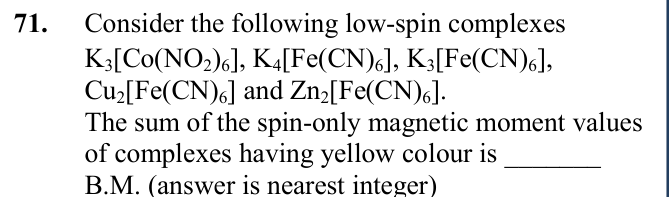
Yellow coloured & low spin complex are
K3[Co(NO2)6] & K4[Fe(CN)6]
(I)
K3[Co(NO2)6]
Co+3 ⇒ [Ar]3d6
In presence of ligand field
⇒
[Ar]
3d
4s
4p
d2sp3 hybridisation
Magnetic moment =
n(n
2) + BM
= 0 BM
(II)
K4[Fe(CN)6]
Fe+2 ⇒ [Ar]3d6
In presence of ligand field
⇒
[Ar]
3d
4s
4p
d2sp3 hybridisation
Magnetic moment =
n(n
2) + BM
= 0 BM
QUESTION 2
d and f Block Elements
SECTION B · NUMERICAL (+4, 0)
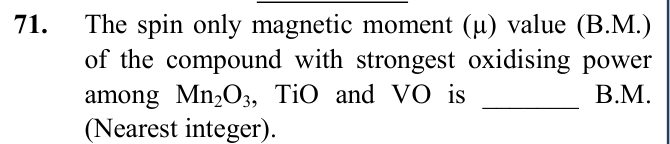
Strongest oxidising power among the option is
Mn2O3 because of E° value
3
2
Mn
/Mn
E
1.57V + +
°
=+
Mn+3 → d4 configuration
µ
24 BM = = 4.89 BM
⇒5
QUESTION 3
d and f Block Elements
SECTION A · MCQ (+4, -1)
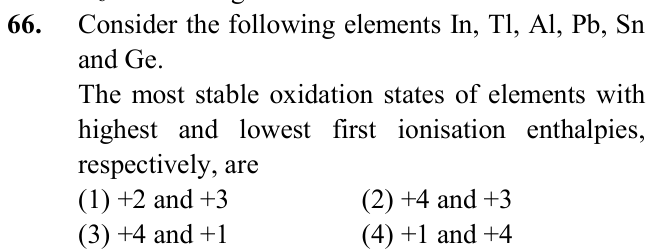
(1) +2 and +3
(2) +4 and +3
(3) +4 and +1
(4) +1 and +4
Among Al, In, Tl, Ge, Sn, Pb, the metal having
highest IE1 is Ge and lowest IE1 is In.
Most stable oxidation state of Ge is +4 and In is +3.
QUESTION 4
d and f Block Elements
SECTION A · MCQ (+4, -1)
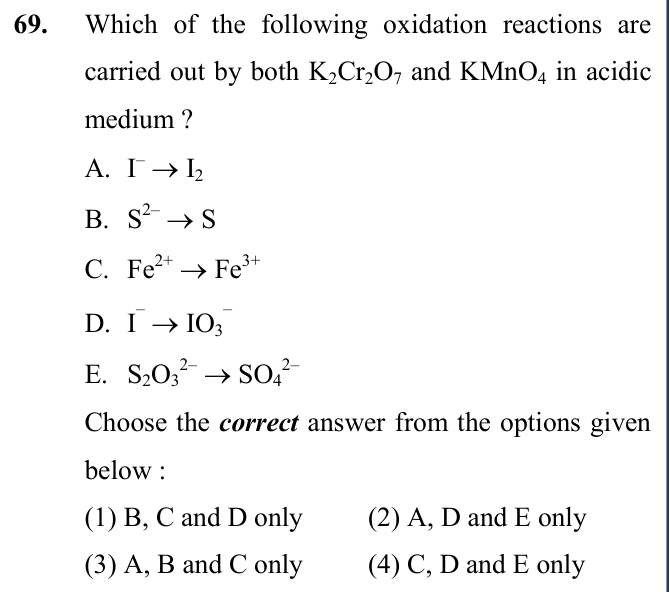
(1) B, C and D only
(2) A, D and E only
(3) A, B and C only
(4) C, D and E only
H
2
I
I + -——→
3
OH
I
IO - - - ———
→
H
2
S
S + -——→
OH
2
2
2
3
4
S O
SO - - - ———
→
2
3
Fe
Fe + +
——→
H
2
2
2
3
4
S O
S
SO + - - ——→↓+
QUESTION 5
d and f Block Elements
SECTION A · MCQ (+4, -1)
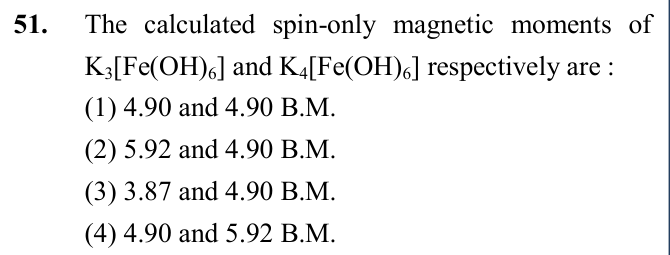
(1) 4.90 and 4.90 B.M.
(2) 5.92 and 4.90 B.M.
(3) 3.87 and 4.90 B.M.
(4) 4.90 and 5.92 B.M.
QUESTION 6
d and f Block Elements
SECTION A · MCQ (+4, -1)
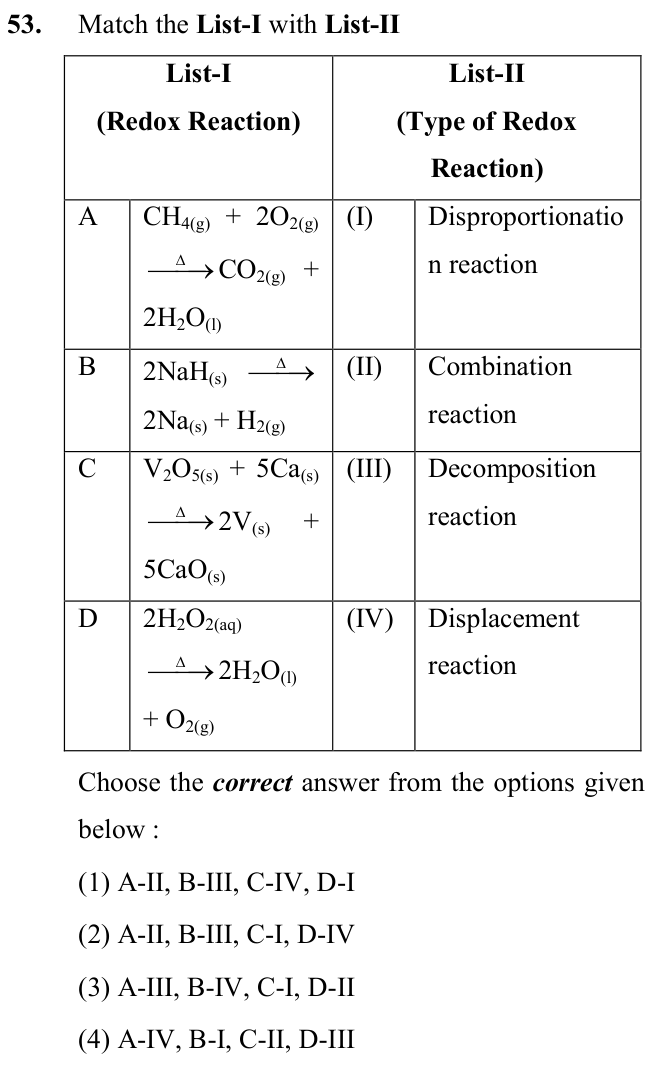
(1) A-II, B-III, C-IV, D-I
(2) A-II, B-III, C-I, D-IV
(3) A-III, B-IV, C-I, D-II
(4) A-IV, B-I, C-II, D-III
(A) Combustion of hydrocarbon
(B) Decomposition into gaseous product.
(C) Displacement of „V‟ by „Ca‟ atom.
(D) Disproportionation of H2O2
–1 into O–2 and O°
oxidation states.
2
QUESTION 7
d and f Block Elements
SECTION A · MCQ (+4, -1)
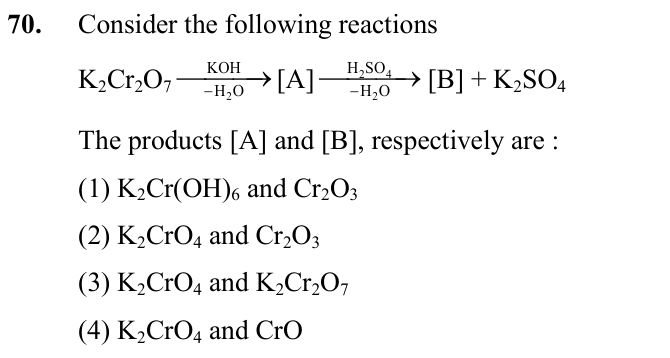
(1) K2Cr(OH)6 and Cr2O3
(2) K2CrO4 and Cr2O3
(3) K2CrO4 and K2Cr2O7
(4) K2CrO4 and CrO
K2Cr2O7
2
KOH
H O - ———→
2
4
[A]
K CrO
2
4
2
H SO
H O - ———→
2
2
7
[ ]
B
K Cr O + K2SO4
6
SECTION-B
QUESTION 8
The d- and f-Block Elements
SECTION A · MCQ (+4, -1)
Why does copper not liberate hydrogen gas from dilute HCl?
(1) It has a negative standard electrode potential
(2) It has a positive standard electrode potential (E° = +0.34 V)
(3) It is less reactive than hydrogen
(4) It forms a protective oxide layer
Copper is the only 3d metal with a positive E°(M²⁺/M) = +0.34 V, so the reduction of Cu²⁺ is favoured over oxidation of Cu; it cannot displace H⁺ to form H₂.
QUESTION 9
The d- and f-Block Elements
SECTION A · MCQ (+4, -1)
What is the ground-state valence electronic configuration of chromium (Z = 24)?
(1) 3d⁵ 4s¹
(2) 3d⁵ 4s²
(3) 3d⁴ 4s²
(4) 3d⁴ 4s¹
Chromium has 24 electrons. Instead of the expected 3d⁴ 4s², it adopts 3d⁵ 4s¹ because the half-filled d⁵ subshell lowers inter-electronic repulsion and maximises exchange energy.