
✎ ANSWER ONLINE · EVERY MISTAKE LINKS BACK TO THE CONCEPT
The d- and f-Block Elements · Practice Worksheet
Answer each question here and it marks straight away, with the derivation and a link to the exact micro-concept to revisit.
1 question from this set could not be marked online — a
bonus or dual-key question, which has no single defensible answer. The print and
.docx versions still include it.
// CONCEPT AUDIT RESULT
Everything you missed has been added to your Error Arena — retest them blind there, and a concept clears once you get it right.
QUESTION 1
d and f Block Elements
SECTION B · NUMERICAL (+4, 0)
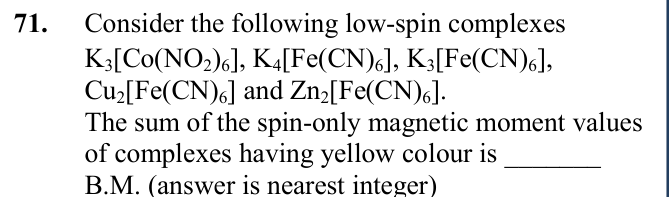
Yellow coloured & low spin complex are
K3[Co(NO2)6] & K4[Fe(CN)6]
(I)
K3[Co(NO2)6]
Co+3 ⇒ [Ar]3d6
In presence of ligand field
⇒
[Ar]
3d
4s
4p
d2sp3 hybridisation
Magnetic moment =
n(n
2) + BM
= 0 BM
(II)
K4[Fe(CN)6]
Fe+2 ⇒ [Ar]3d6
In presence of ligand field
⇒
[Ar]
3d
4s
4p
d2sp3 hybridisation
Magnetic moment =
n(n
2) + BM
= 0 BM
QUESTION 2
d and f Block Elements
SECTION B · NUMERICAL (+4, 0)
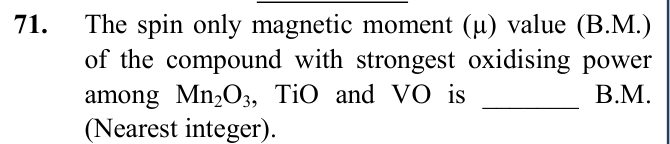
Strongest oxidising power among the option is
Mn2O3 because of E° value
3
2
Mn
/Mn
E
1.57V + +
°
=+
Mn+3 → d4 configuration
µ
24 BM = = 4.89 BM
⇒5
QUESTION 3
d and f Block Elements
SECTION A · MCQ (+4, -1)
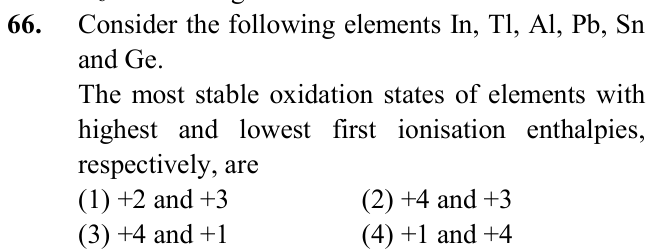
(1) +2 and +3
(2) +4 and +3
(3) +4 and +1
(4) +1 and +4
Among Al, In, Tl, Ge, Sn, Pb, the metal having
highest IE1 is Ge and lowest IE1 is In.
Most stable oxidation state of Ge is +4 and In is +3.
QUESTION 4
d and f Block Elements
SECTION A · MCQ (+4, -1)
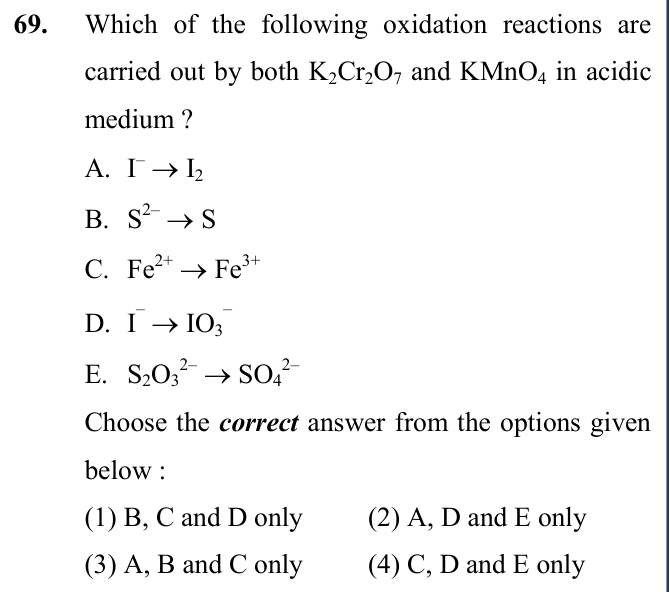
(1) B, C and D only
(2) A, D and E only
(3) A, B and C only
(4) C, D and E only
H
2
I
I + -——→
3
OH
I
IO - - - ———
→
H
2
S
S + -——→
OH
2
2
2
3
4
S O
SO - - - ———
→
2
3
Fe
Fe + +
——→
H
2
2
2
3
4
S O
S
SO + - - ——→↓+
QUESTION 5
d and f Block Elements
SECTION A · MCQ (+4, -1)
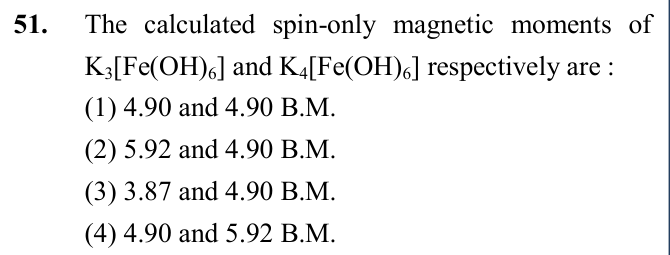
(1) 4.90 and 4.90 B.M.
(2) 5.92 and 4.90 B.M.
(3) 3.87 and 4.90 B.M.
(4) 4.90 and 5.92 B.M.
QUESTION 6
d and f Block Elements
SECTION A · MCQ (+4, -1)
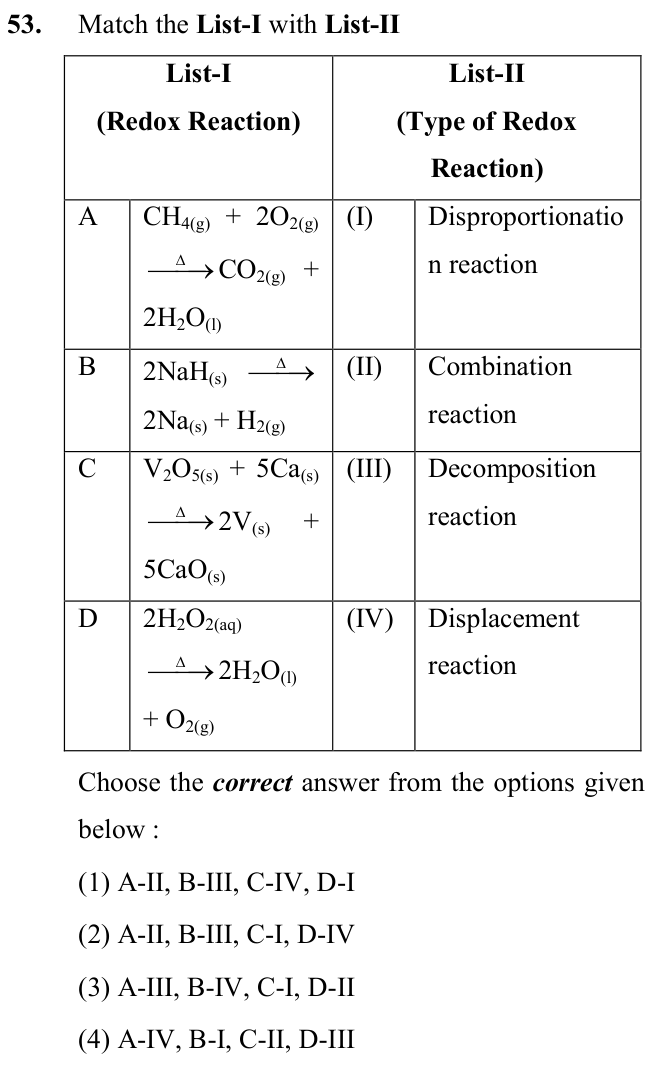
(1) A-II, B-III, C-IV, D-I
(2) A-II, B-III, C-I, D-IV
(3) A-III, B-IV, C-I, D-II
(4) A-IV, B-I, C-II, D-III
(A) Combustion of hydrocarbon
(B) Decomposition into gaseous product.
(C) Displacement of „V‟ by „Ca‟ atom.
(D) Disproportionation of H2O2
–1 into O–2 and O°
oxidation states.
2
QUESTION 7
d and f Block Elements
SECTION A · MCQ (+4, -1)
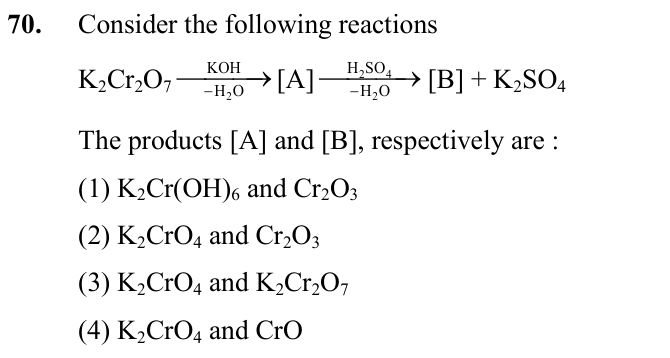
(1) K2Cr(OH)6 and Cr2O3
(2) K2CrO4 and Cr2O3
(3) K2CrO4 and K2Cr2O7
(4) K2CrO4 and CrO
K2Cr2O7
2
KOH
H O - ———→
2
4
[A]
K CrO
2
4
2
H SO
H O - ———→
2
2
7
[ ]
B
K Cr O + K2SO4
6
SECTION-B
QUESTION 8
The d- and f-Block Elements
SECTION A · MCQ (+4, -1)
Why does copper not liberate hydrogen gas from dilute HCl?
(1) It has a negative standard electrode potential
(2) It has a positive standard electrode potential (E° = +0.34 V)
(3) It is less reactive than hydrogen
(4) It forms a protective oxide layer
Copper is the only 3d metal with a positive E°(M²⁺/M) = +0.34 V, so the reduction of Cu²⁺ is favoured over oxidation of Cu; it cannot displace H⁺ to form H₂.
QUESTION 9
The d- and f-Block Elements
SECTION A · MCQ (+4, -1)
What is the ground-state valence electronic configuration of chromium (Z = 24)?
(1) 3d⁵ 4s¹
(2) 3d⁵ 4s²
(3) 3d⁴ 4s²
(4) 3d⁴ 4s¹
Chromium has 24 electrons. Instead of the expected 3d⁴ 4s², it adopts 3d⁵ 4s¹ because the half-filled d⁵ subshell lowers inter-electronic repulsion and maximises exchange energy.
QUESTION 10
The d- and f-Block Elements
SECTION A · MCQ (+4, -1)
What is the equivalent weight of KMnO₄ in acidic medium (molecular mass = M)?
(1) M/5
(2) M/1
(3) M/3
(4) M/2
In acidic medium, MnO₄⁻ gains 5 electrons to form Mn²⁺ (MnO₄⁻ + 8H⁺ + 5e⁻ → Mn²⁺ + 4H₂O), so its n-factor is 5 and equivalent weight = M/5.
QUESTION 11
The d- and f-Block Elements
SECTION A · MCQ (+4, -1)
Actinoids exhibit a wider range of oxidation states than lanthanoids because their 5f, 6d and 7s orbitals have what property?
(1) comparable energies
(2) identical radii
(3) widely separated energies
(4) no unpaired electrons
The small energy gaps among 5f, 6d and 7s orbitals allow a wider range of oxidation states.
QUESTION 12
The d- and f-Block Elements
SECTION A · MCQ (+4, -1)
On acidifying a yellow chromate solution, it turns orange due to the formation of which ion?
(1) dichromate ion (Cr2O7 2-)
(2) chromium(III) ion
(3) chromyl chloride
(4) chromate ion (CrO4 2-)
Acid shifts the equilibrium from chromate to the orange dichromate ion.
QUESTION 13
The d- and f-Block Elements
SECTION A · MCQ (+4, -1)
Which lanthanoid ion has the stable [Xe]4f⁰ configuration?
(1) Ce⁴⁺ (cerium(IV))
(2) La³⁺ (lanthanum(III))
(3) Yb²⁺ (ytterbium(II))
(4) Eu²⁺ (europium(II))
Cerium loses four electrons to reach the empty 4f⁰ configuration [Xe]4f⁰, which is extra stable; Ce⁴⁺ is a strong oxidant (E° Ce⁴⁺/Ce³⁺ = +1.74 V).
QUESTION 14
The d- and f-Block Elements
SECTION A · MCQ (+4, -1)
The ground-state electronic configuration of chromium (Z = 24) is what?
(1) [Ar] 3d5 4s2
(2) [Ar] 3d4 4s2
(3) [Ar] 3d5 4s1
(4) [Ar] 3d6 4s0
Cr has the half-filled 3d5 and half-filled 4s1 configuration due to its extra stability.