
⚡ OFFICIAL NTA ASSESSMENT GENERATOR & WORD (.DOCX) EXPORTER
Coordination Compounds · Practice Worksheet
JEE Main Chemistry · Curated Assessment Set Print directly or export as a beautifully formatted Microsoft Word document with embedded 180-DPI mathematical prompt clips and step-by-step derivations.
EDUPROD JEE MAIN TEST SERIES · NTA PATTERN
Coordination Compounds · Practice Worksheet
JEE Main Chemistry · Curated Assessment Set · Assessment Code: JEE-101
Total Marks: 80
Marking: +4 / -1 (Sec A) · +4 / 0 (Sec B)
QUESTION 1
CHEMISTRY · Coordination Compounds
SECTION A · MCQ (+4, -1)
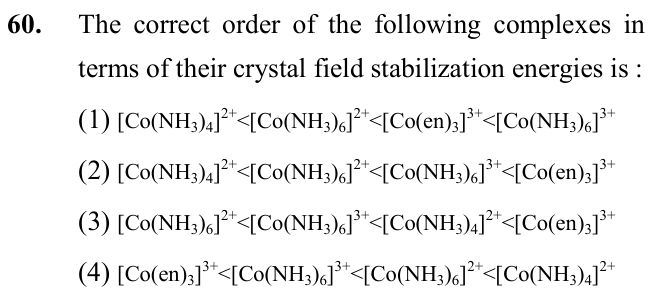
Candidate Response:
(1) (2) (3) (4)
⚡ OFFICIAL KEY: 2
Step-by-Step Derivation
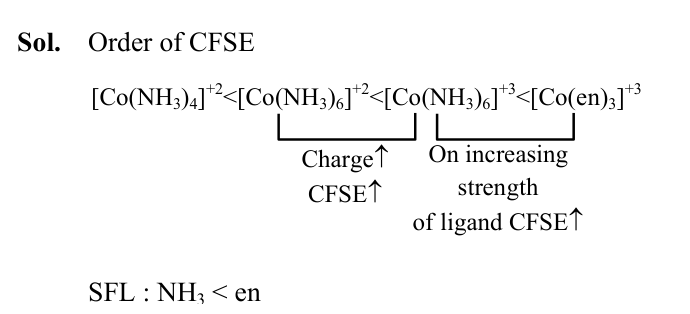
QUESTION 2
CHEMISTRY · Coordination Compounds
SECTION A · MCQ (+4, -1)
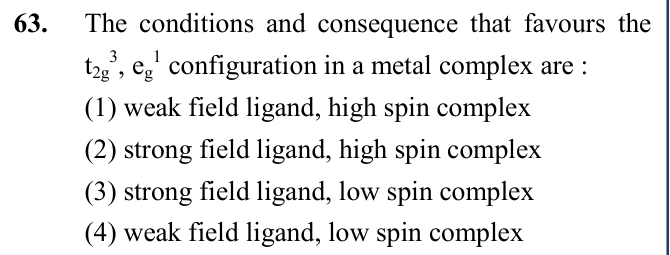
Candidate Response:
(1) (2) (3) (4)
⚡ OFFICIAL KEY: 1
Step-by-Step Derivation
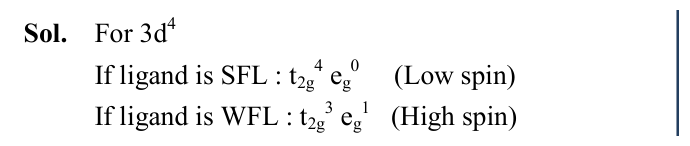
QUESTION 3
CHEMISTRY · Coordination Compounds
SECTION A · MCQ (+4, -1)
The hybridization and magnetic behaviour of [Co(NH3)6]3+ are:
(1) sp3d2 and paramagnetic
(2) d2sp3 and paramagnetic (4 unpaired electrons)
(3) d2sp3 and diamagnetic
(4) sp3d2 and diamagnetic
Candidate Response:
(1) (2) (3) (4)
⚡ OFFICIAL KEY: d2sp3 and diamagnetic
Step-by-Step Derivation
Co3+ is d6. NH3 acts as a strong-field ligand with Co3+, forcing all six electrons to pair in the t2g set, giving an inner-orbital d2sp3 complex with zero unpaired electrons (diamagnetic).
QUESTION 4
CHEMISTRY · Coordination Compounds
SECTION A · MCQ (+4, -1)
The correct IUPAC name of [Co(NH3)5Cl]Cl2 is:
(1) Pentaaquachloridocobalt(II) chloride
(2) Pentaamminechloridocobaltate(III) chloride
(3) Pentaamminechloridocobalt(III) chloride
(4) Chloropentaamminecobalt(III) chloride
Candidate Response:
(1) (2) (3) (4)
⚡ OFFICIAL KEY: Pentaamminechloridocobalt(III) chloride
Step-by-Step Derivation
Ligands are named alphabetically (ammine before chlorido); the complex ion is cationic, so cobalt keeps its English name with oxidation state (III); the outer Cl- is named chloride.
QUESTION 5
CHEMISTRY · Coordination Compounds
SECTION A · MCQ (+4, -1)
In an octahedral crystal field, the five d orbitals split into which two sets?
(1) t2g and eg
(2) e and t2
(3) σ and π
(4) s and p
Candidate Response:
(1) (2) (3) (4)
⚡ OFFICIAL KEY: t2g and eg
Step-by-Step Derivation
An octahedral field splits the d orbitals into the lower t2g and higher eg sets.
QUESTION 6
CHEMISTRY · Coordination Compounds
SECTION A · MCQ (+4, -1)
According to Werner's theory, the ionisable valency of the central metal ion is called the what?
(1) primary valency
(2) residual valency
(3) coordinate valency
(4) secondary valency
Candidate Response:
(1) (2) (3) (4)
⚡ OFFICIAL KEY: primary valency
Step-by-Step Derivation
Primary valency is ionisable (oxidation state), while secondary valency is non-ionisable (coordination number).
QUESTION 7
CHEMISTRY · Coordination Compounds
SECTION A · MCQ (+4, -1)
How many moles of AgCl precipitate when 1 mole of [Co(NH3)5Cl]Cl2 is treated with excess aqueous AgNO3?
(1) 4 moles
(2) 2 moles
(3) 3 moles
(4) 1 mole
Candidate Response:
(1) (2) (3) (4)
⚡ OFFICIAL KEY: 2 moles
Step-by-Step Derivation
Only the chloride ions OUTSIDE the coordination sphere ionize and precipitate as AgCl. [Co(NH3)5Cl]Cl2 has two outer Cl- (and one inner Cl-), so 2 moles of AgCl form.
QUESTION 8
CHEMISTRY · Coordination Compounds
SECTION A · MCQ (+4, -1)
For a tetrahedral complex, which statement is correct?
(1) Δt = 9/4 Δo and the complex is low spin
(2) Δt = Δo and the complex is low spin
(3) Δt = 4/9 Δo and the complex is always low spin
(4) Δt = 4/9 Δo and the complex is always high spin
Candidate Response:
(1) (2) (3) (4)
⚡ OFFICIAL KEY: Δt = 4/9 Δo and the complex is always high spin
Step-by-Step Derivation
Tetrahedral splitting Δt = (4/9)Δo. Because Δt is always smaller than the pairing energy P, tetrahedral complexes are essentially always high spin.
QUESTION 9
CHEMISTRY · Coordination Compounds
SECTION A · MCQ (+4, -1)
In the IUPAC name of a coordination compound, ligands are named in what order relative to the central metal?
(1) in order of molecular mass
(2) before the central metal, alphabetically
(3) after the central metal
(4) in order of increasing charge only
Candidate Response:
(1) (2) (3) (4)
⚡ OFFICIAL KEY: before the central metal, alphabetically
Step-by-Step Derivation
Ligands are named alphabetically before the central metal ion.
QUESTION 10
CHEMISTRY · Coordination Compounds
SECTION A · MCQ (+4, -1)
A complex ion has a spin-only magnetic moment of 5.92 BM. The number of unpaired electrons it contains is:
(1) 4
(2) 2
(3) 3
(4) 5
Candidate Response:
(1) (2) (3) (4)
⚡ OFFICIAL KEY: 5
Step-by-Step Derivation
μ = 5.92 BM corresponds to n = 5 unpaired electrons, since √(5×7) = √35 ≈ 5.92. This is the high-spin d5 configuration.
QUESTION 11
CHEMISTRY · Coordination Compounds
SECTION A · MCQ (+4, -1)
Which type of isomerism is NOT exhibited by tetrahedral complexes?
(1) geometrical (cis-trans) isomerism
(2) linkage isomerism
(3) ionisation isomerism
(4) optical isomerism
Candidate Response:
(1) (2) (3) (4)
⚡ OFFICIAL KEY: geometrical (cis-trans) isomerism
Step-by-Step Derivation
All four positions in a tetrahedron are equivalent, so cis-trans isomerism is impossible.
QUESTION 12
CHEMISTRY · Coordination Compounds
SECTION A · MCQ (+4, -1)
The metal ion present in vitamin B12 (cyanocobalamin) is:
(1) Fe2+
(2) Cu2+
(3) Mg2+
(4) Co3+
Candidate Response:
(1) (2) (3) (4)
⚡ OFFICIAL KEY: Co3+
Step-by-Step Derivation
Vitamin B12 (cyanocobalamin) is a cobalt(III) complex; Co3+ sits at the centre of its corrin ring system.
QUESTION 13
CHEMISTRY · Coordination Compounds
SECTION A · MCQ (+4, -1)
Valence bond theory fails to explain which property of coordination compounds?
(1) magnetic moment
(2) geometry
(3) colour due to d-d transitions
(4) coordination number
Candidate Response:
(1) (2) (3) (4)
⚡ OFFICIAL KEY: colour due to d-d transitions
Step-by-Step Derivation
VBT cannot explain the colour or spectra of complexes, nor their relative stabilities.
QUESTION 14
CHEMISTRY · Coordination Compounds
SECTION A · MCQ (+4, -1)
A complex appears green because it absorbs light of which complementary colour?
(1) red
(2) green
(3) violet
(4) blue
Candidate Response:
(1) (2) (3) (4)
⚡ OFFICIAL KEY: red
Step-by-Step Derivation
Green is complementary to red, so the complex absorbs red light.
QUESTION 15
CHEMISTRY · Coordination Compounds
SECTION A · MCQ (+4, -1)
In an octahedral crystal field, which set of d-orbitals lies at higher energy?
(1) Both sets have equal energy
(2) t2g (dxy, dyz, dxz)
(3) eg (dx2-y2 and dz2)
(4) All five d-orbitals remain degenerate
Candidate Response:
(1) (2) (3) (4)
⚡ OFFICIAL KEY: eg (dx2-y2 and dz2)
Step-by-Step Derivation
The eg orbitals point directly along the axes toward the six ligands and suffer greater electrostatic repulsion, so they are raised in energy; the t2g orbitals point between the axes and are lowered.
QUESTION 16
CHEMISTRY · Coordination Compounds
SECTION A · MCQ (+4, -1)
Which of the following ligands lies at the strong-field (high) end of the spectrochemical series?
(1) I-
(2) Cl-
(3) Br-
(4) CN-
Candidate Response:
(1) (2) (3) (4)
⚡ OFFICIAL KEY: CN-
Step-by-Step Derivation
CN- is a strong-field ligand, whereas the halides are weak-field ligands.
QUESTION 17
CHEMISTRY · Coordination Compounds
SECTION A · MCQ (+4, -1)
One mole of [Co(NH3)6]Cl3 gives how many moles of AgCl on treatment with excess AgNO3?
(1) 1
(2) 2
(3) 3
(4) 6
Candidate Response:
(1) (2) (3) (4)
⚡ OFFICIAL KEY: 3
Step-by-Step Derivation
All three chloride ions lie outside the coordination sphere and precipitate as AgCl.
QUESTION 18
CHEMISTRY · Coordination Compounds
SECTION A · MCQ (+4, -1)
In a tetrahedral crystal field, which set of d orbitals lies at the lower energy?
(1) all five equally
(2) t2 set (dxy, dyz, dxz)
(3) e set (dz2 and dx2-y2)
(4) the s orbitals
Candidate Response:
(1) (2) (3) (4)
⚡ OFFICIAL KEY: e set (dz2 and dx2-y2)
Step-by-Step Derivation
Tetrahedral splitting is inverted, with the e set lower and the t2 set higher than in octahedral.
QUESTION 19
CHEMISTRY · Coordination Compounds
SECTION A · MCQ (+4, -1)
Between Cl- and CN-, which ligand produces the larger crystal field splitting (Δo)?
(1) Both produce equal Δo
(2) Cl- (a weak-field ligand)
(3) Neither ligand produces any splitting
(4) CN- (a strong-field ligand)
Candidate Response:
(1) (2) (3) (4)
⚡ OFFICIAL KEY: CN- (a strong-field ligand)
Step-by-Step Derivation
CN- is a strong-field ligand (a carbon donor) that produces a large Δo and favours low-spin complexes, while Cl- is a weak-field halide giving a small Δo.
QUESTION 20
CHEMISTRY · Coordination Compounds
SECTION A · MCQ (+4, -1)
Why is anhydrous CuSO4 colourless while CuSO4·5H2O is blue?
(1) Anhydrous CuSO4 contains more d electrons
(2) Water absorbs blue light preferentially
(3) Anhydrous CuSO4 is a d10 system
(4) Water ligands create the crystal field splitting needed for d-d transitions
Candidate Response:
(1) (2) (3) (4)
⚡ OFFICIAL KEY: Water ligands create the crystal field splitting needed for d-d transitions
Step-by-Step Derivation
In anhydrous CuSO4 there is no ligand field, so the d-orbitals remain degenerate and no d-d transition can occur (colourless). Coordinating water ligands split the d-orbitals, enabling d-d absorption and giving the blue colour.