
✎ ANSWER ONLINE · EVERY MISTAKE LINKS BACK TO THE CONCEPT
Coordination Compounds · Practice Worksheet
Answer each question here and it marks straight away, with the derivation and a link to the exact micro-concept to revisit.
1 question from this set could not be marked online — a
bonus or dual-key question, which has no single defensible answer. The print and
.docx versions still include it.
// CONCEPT AUDIT RESULT
Everything you missed has been added to your Error Arena — retest them blind there, and a concept clears once you get it right.
QUESTION 1
Coordination Compounds
SECTION A · MCQ (+4, -1)
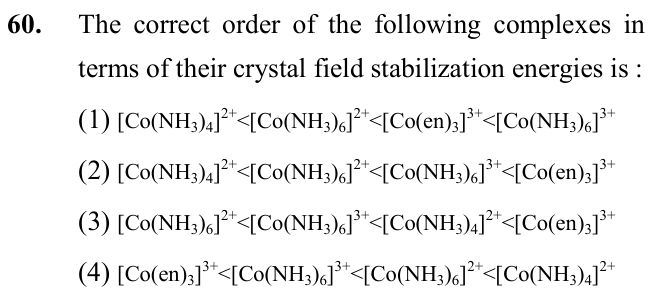
(1) [Co(NH3)4]2+<[Co(NH3)6]2+<[Co(en)3]3+<[Co(NH3)6]3+
(2) [Co(NH3)4]2+<[Co(NH3)6]2+<[Co(NH3)6]3+<[Co(en)3]3+
(3) [Co(NH3)6]2+<[Co(NH3)6]3+<[Co(NH3)4]2+<[Co(en)3]3+
(4) [Co(en)3]3+<[Co(NH3)6]3+<[Co(NH3)6]2+<[Co(NH3)4]2+
Order of CFSE
[Co(NH3)4]+2<[Co(NH3)6]+2<[Co(NH3)6]+3<[Co(en)3]+3
Charge↑
CFSE↑
On increasing
strength
of ligand CFSE↑
SFL : NH3 < en
4
QUESTION 2
Coordination Compounds
SECTION A · MCQ (+4, -1)
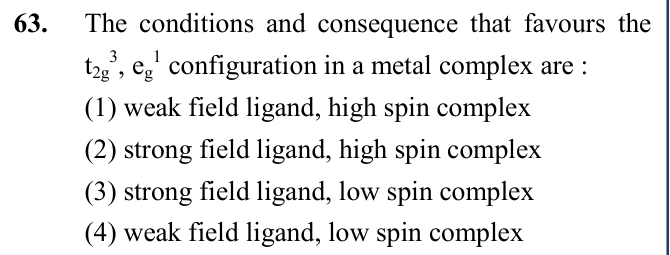
(1) weak field ligand, high spin complex
(2) strong field ligand, high spin complex
(3) strong field ligand, low spin complex
(4) weak field ligand, low spin complex
For 3d4
If ligand is SFL : t2g
4 eg
0 (Low spin)
If ligand is WFL : t2g
3 eg
1 (High spin)
QUESTION 3
Coordination Compounds
SECTION A · MCQ (+4, -1)
The hybridization and magnetic behaviour of [Co(NH3)6]3+ are:
(1) sp3d2 and paramagnetic
(2) d2sp3 and paramagnetic (4 unpaired electrons)
(3) d2sp3 and diamagnetic
(4) sp3d2 and diamagnetic
Co3+ is d6. NH3 acts as a strong-field ligand with Co3+, forcing all six electrons to pair in the t2g set, giving an inner-orbital d2sp3 complex with zero unpaired electrons (diamagnetic).
QUESTION 4
Coordination Compounds
SECTION A · MCQ (+4, -1)
The correct IUPAC name of [Co(NH3)5Cl]Cl2 is:
(1) Pentaaquachloridocobalt(II) chloride
(2) Pentaamminechloridocobaltate(III) chloride
(3) Pentaamminechloridocobalt(III) chloride
(4) Chloropentaamminecobalt(III) chloride
Ligands are named alphabetically (ammine before chlorido); the complex ion is cationic, so cobalt keeps its English name with oxidation state (III); the outer Cl- is named chloride.
QUESTION 5
Coordination Compounds
SECTION A · MCQ (+4, -1)
In an octahedral crystal field, the five d orbitals split into which two sets?
(1) t2g and eg
(2) e and t2
(3) σ and π
(4) s and p
An octahedral field splits the d orbitals into the lower t2g and higher eg sets.
QUESTION 6
Coordination Compounds
SECTION A · MCQ (+4, -1)
According to Werner's theory, the ionisable valency of the central metal ion is called the what?
(1) primary valency
(2) residual valency
(3) coordinate valency
(4) secondary valency
Primary valency is ionisable (oxidation state), while secondary valency is non-ionisable (coordination number).
QUESTION 7
Coordination Compounds
SECTION A · MCQ (+4, -1)
How many moles of AgCl precipitate when 1 mole of [Co(NH3)5Cl]Cl2 is treated with excess aqueous AgNO3?
(1) 4 moles
(2) 2 moles
(3) 3 moles
(4) 1 mole
Only the chloride ions OUTSIDE the coordination sphere ionize and precipitate as AgCl. [Co(NH3)5Cl]Cl2 has two outer Cl- (and one inner Cl-), so 2 moles of AgCl form.
QUESTION 8
Coordination Compounds
SECTION A · MCQ (+4, -1)
For a tetrahedral complex, which statement is correct?
(1) Δt = 9/4 Δo and the complex is low spin
(2) Δt = Δo and the complex is low spin
(3) Δt = 4/9 Δo and the complex is always low spin
(4) Δt = 4/9 Δo and the complex is always high spin
Tetrahedral splitting Δt = (4/9)Δo. Because Δt is always smaller than the pairing energy P, tetrahedral complexes are essentially always high spin.
QUESTION 9
Coordination Compounds
SECTION A · MCQ (+4, -1)
A complex ion has a spin-only magnetic moment of 5.92 BM. The number of unpaired electrons it contains is:
(1) 4
(2) 2
(3) 3
(4) 5
μ = 5.92 BM corresponds to n = 5 unpaired electrons, since √(5×7) = √35 ≈ 5.92. This is the high-spin d5 configuration.