
⚡ OFFICIAL NTA ASSESSMENT GENERATOR & WORD (.DOCX) EXPORTER
Haloalkanes and Haloarenes · Practice Worksheet
JEE Main Chemistry · Curated Assessment Set Print directly or export as a beautifully formatted Microsoft Word document with embedded 180-DPI mathematical prompt clips and step-by-step derivations.
EDUPROD JEE MAIN TEST SERIES · NTA PATTERN
Haloalkanes and Haloarenes · Practice Worksheet
JEE Main Chemistry · Curated Assessment Set · Assessment Code: JEE-101
Total Marks: 80
Marking: +4 / -1 (Sec A) · +4 / 0 (Sec B)
QUESTION 1
CHEMISTRY · Haloalkanes and Haloarenes
SECTION A · MCQ (+4, -1)
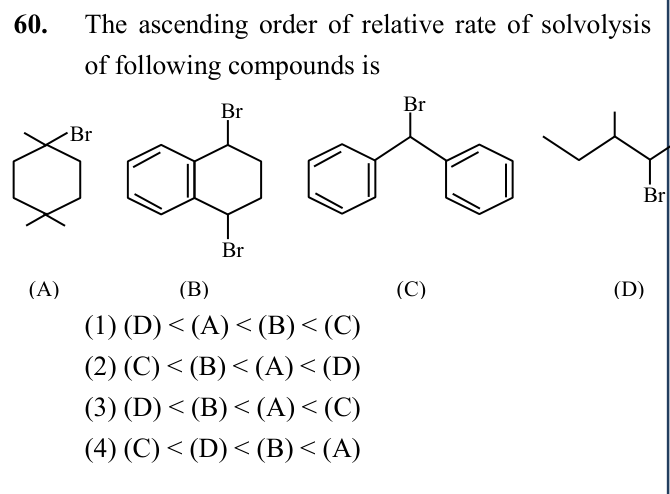
Candidate Response:
(1) (2) (3) (4)
QUESTION 2
CHEMISTRY · Haloalkanes and Haloarenes
SECTION A · MCQ (+4, -1)
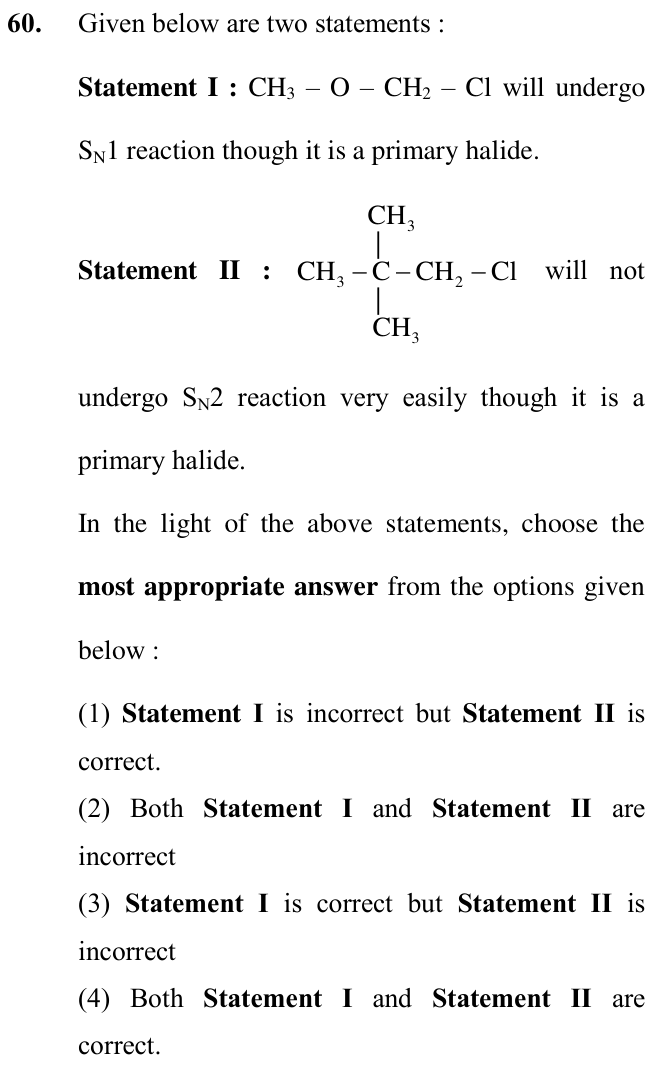
Candidate Response:
(1) (2) (3) (4)
QUESTION 3
CHEMISTRY · Haloalkanes and Haloarenes
SECTION A · MCQ (+4, -1)
The Hofmann rule predicts that elimination with a bulky base gives which alkene as the major product?
(1) more substituted alkene
(2) alkyne
(3) no alkene
(4) less substituted alkene
Candidate Response:
(1) (2) (3) (4)
QUESTION 4
CHEMISTRY · Haloalkanes and Haloarenes
SECTION A · MCQ (+4, -1)
Chloromethane has a larger dipole moment (1.860 D) than fluoromethane (1.847 D) even though fluorine is more electronegative than chlorine. This is because:
(1) Dipole moment depends on bond length as well, and the longer C–Cl bond outweighs the smaller electronegativity difference
(2) The C–Cl bond is shorter than the C–F bond
(3) Chlorine is more electronegative than fluorine in organic compounds
(4) Fluorine's high electronegativity makes the C–F bond non-polar
Candidate Response:
(1) (2) (3) (4)
QUESTION 5
CHEMISTRY · Haloalkanes and Haloarenes
SECTION A · MCQ (+4, -1)
Which halogenated compound has its halogen bonded to an sp²-hybridised carbon and is therefore largely inert toward nucleophilic substitution?
(1) Benzyl chloride (C₆H₅–CH₂Cl)
(2) Allyl chloride (CH₂=CH–CH₂Cl)
(3) Ethyl chloride (CH₃CH₂Cl)
(4) Vinyl chloride (CH₂=CH–Cl)
Candidate Response:
(1) (2) (3) (4)
QUESTION 6
CHEMISTRY · Haloalkanes and Haloarenes
SECTION A · MCQ (+4, -1)
In electrophilic aromatic substitution, halogens are deactivating groups yet they direct the incoming electrophile to which ring positions?
(1) meta
(2) ortho and para
(3) only meta
(4) only ortho
Candidate Response:
(1) (2) (3) (4)
QUESTION 7
CHEMISTRY · Haloalkanes and Haloarenes
SECTION A · MCQ (+4, -1)
In E2 elimination, the departing β-hydrogen and the leaving group must adopt which spatial arrangement for the reaction to proceed?
(1) syn-periplanar
(2) perpendicular (90°)
(3) gauche
(4) anti-periplanar
Candidate Response:
(1) (2) (3) (4)
QUESTION 8
CHEMISTRY · Haloalkanes and Haloarenes
SECTION A · MCQ (+4, -1)
Which polyhalogen compound is a chlorofluorocarbon whose use depletes the stratospheric ozone layer?
(1) chloroform
(2) Freon (CCl₂F₂)
(3) phosgene (COCl₂)
(4) DDT
Candidate Response:
(1) (2) (3) (4)
QUESTION 9
CHEMISTRY · Haloalkanes and Haloarenes
SECTION A · MCQ (+4, -1)
The Wurtz reaction couples two alkyl halide molecules using which metal in dry ether?
(1) zinc
(2) sodium
(3) magnesium
(4) lithium
Candidate Response:
(1) (2) (3) (4)
QUESTION 10
CHEMISTRY · Haloalkanes and Haloarenes
SECTION A · MCQ (+4, -1)
For an E2 elimination to occur, what relative geometry must the β-C–H and α-C–X bonds adopt?
(1) Anti-periplanar (180° dihedral angle)
(2) Any geometry, because E2 is not stereospecific
(3) Perpendicular (90° dihedral angle)
(4) Syn-periplanar (0° dihedral angle)
Candidate Response:
(1) (2) (3) (4)
QUESTION 11
CHEMISTRY · Haloalkanes and Haloarenes
SECTION A · MCQ (+4, -1)
Halogens attached to a benzene ring are deactivating yet ortho/para-directing in electrophilic substitution. This 'halogen paradox' arises because:
(1) The halogen's +R effect withdraws density overall while its –I effect donates at ortho/para
(2) The strong –I effect withdraws σ-density overall (deactivating), while the weak +R effect donates π-density specifically at ortho/para positions (directing)
(3) The halogen is both a strong +R and a strong –I donor overall
(4) The halogen donates electron density at the meta position while withdrawing from ortho/para
Candidate Response:
(1) (2) (3) (4)
QUESTION 12
CHEMISTRY · Haloalkanes and Haloarenes
SECTION A · MCQ (+4, -1)
The rate of an SN1 reaction depends only on the substrate concentration and is independent of the nucleophile concentration. Why?
(1) The nucleophile is always present in large excess
(2) The rate-determining step is the slow formation of the carbocation, which involves only the substrate
(3) The nucleophile is too weak to influence the rate
(4) SN1 follows a bimolecular rate law
Candidate Response:
(1) (2) (3) (4)
QUESTION 13
CHEMISTRY · Haloalkanes and Haloarenes
SECTION A · MCQ (+4, -1)
Which reagent converts an alcohol into an alkyl chloride while releasing two gaseous byproducts, so that essentially pure product is obtained without a separation step?
(1) PCl₃
(2) Red phosphorus + Cl₂
(3) PCl₅
(4) SOCl₂ (thionyl chloride)
Candidate Response:
(1) (2) (3) (4)
QUESTION 14
CHEMISTRY · Haloalkanes and Haloarenes
SECTION A · MCQ (+4, -1)
Which reagent converts an alcohol directly into the corresponding alkyl chloride, releasing SO₂ and HCl as by-products?
(1) SOCl₂ (thionyl chloride)
(2) HCl
(3) PCl₃
(4) Cl₂
Candidate Response:
(1) (2) (3) (4)
QUESTION 15
CHEMISTRY · Haloalkanes and Haloarenes
SECTION A · MCQ (+4, -1)
Aryl halides are generally unreactive toward nucleophilic substitution because of which structural feature of the C–X bond?
(1) free rotation about C–X
(2) sp³ hybridised carbon
(3) resonance giving partial double-bond character
(4) absence of π electrons
Candidate Response:
(1) (2) (3) (4)
QUESTION 16
CHEMISTRY · Haloalkanes and Haloarenes
SECTION A · MCQ (+4, -1)
Which base gives the less-substituted (Hofmann) alkene as the major product in elimination, and for what reason?
(1) Alcoholic KOH, because it forms a carbocation
(2) Bulky potassium tert-butoxide (t-BuOK), because steric hindrance forces abstraction of the accessible terminal β-hydrogen
(3) Dilute aqueous NaOH, because it is a strong base
(4) Concentrated HCl, because it protonates the alkene
Candidate Response:
(1) (2) (3) (4)
QUESTION 17
CHEMISTRY · Haloalkanes and Haloarenes
SECTION A · MCQ (+4, -1)
In the Finkelstein reaction, an alkyl chloride or bromide is converted to an alkyl iodide using NaI in dry acetone. Why is dry acetone essential?
(1) Acetone prevents the formation of alkene side-products
(2) NaI dissolves in dry acetone whereas the NaCl/NaBr formed precipitates out, shifting the equilibrium to favour R–I
(3) Acetone makes the C–X bond more reactive toward iodide
(4) Acetone supplies the iodide ions needed for the reaction
Candidate Response:
(1) (2) (3) (4)
QUESTION 18
CHEMISTRY · Haloalkanes and Haloarenes
SECTION A · MCQ (+4, -1)
The SN2 mechanism proceeds in a single step via backside attack of the nucleophile, which produces what stereochemical outcome at the reaction centre?
(1) inversion of configuration (Walden inversion)
(2) no change in configuration
(3) racemisation
(4) retention of configuration
Candidate Response:
(1) (2) (3) (4)
QUESTION 19
CHEMISTRY · Haloalkanes and Haloarenes
SECTION A · MCQ (+4, -1)
Unlike ortho- and para-nitrochlorobenzenes, meta-nitrochlorobenzene is almost as unreactive as chlorobenzene toward nucleophilic substitution. Why?
(1) The meta isomer is more sterically hindered than the ortho isomer
(2) The meta –NO₂ group lengthens the C–Cl bond
(3) In the Meisenheimer intermediate the negative charge never falls on the carbon bearing the –NO₂ group, so it cannot be resonance-stabilised
(4) The meta –NO₂ group withdraws electrons by resonance from the C–Cl bond
Candidate Response:
(1) (2) (3) (4)
QUESTION 20
CHEMISTRY · Haloalkanes and Haloarenes
SECTION A · MCQ (+4, -1)
A Grignard reagent (R–MgX) reacts immediately on contact with water. What is the product?
(1) The alkane R–H together with Mg(OH)X
(2) An alcohol R–OH
(3) An alkene
(4) The original halide R–X is regenerated
Candidate Response:
(1) (2) (3) (4)