
⚡ OFFICIAL NTA ASSESSMENT GENERATOR & WORD (.DOCX) EXPORTER
Haloalkanes and Haloarenes · Practice Worksheet
JEE Main Chemistry · Curated Assessment Set Print directly or export as a beautifully formatted Microsoft Word document with embedded 180-DPI mathematical prompt clips and step-by-step derivations.
EDUPROD JEE MAIN TEST SERIES · NTA PATTERN
Haloalkanes and Haloarenes · Practice Worksheet
JEE Main Chemistry · Curated Assessment Set · Assessment Code: JEE-101
Total Marks: 40
Marking: +4 / -1 (Sec A) · +4 / 0 (Sec B)
QUESTION 1
CHEMISTRY · Haloalkanes and Haloarenes
SECTION A · MCQ (+4, -1)
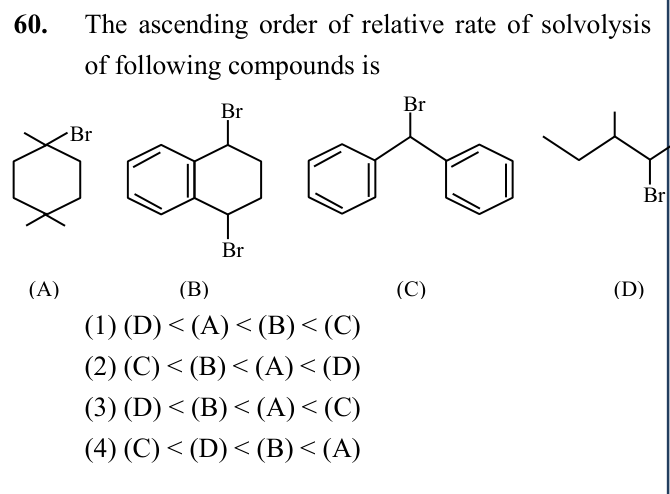
Candidate Response:
(1) (2) (3) (4)
⚡ OFFICIAL KEY: 1
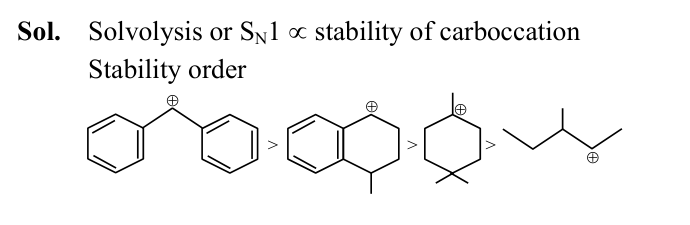
Step-by-Step Derivation
QUESTION 2
CHEMISTRY · Haloalkanes and Haloarenes
SECTION A · MCQ (+4, -1)
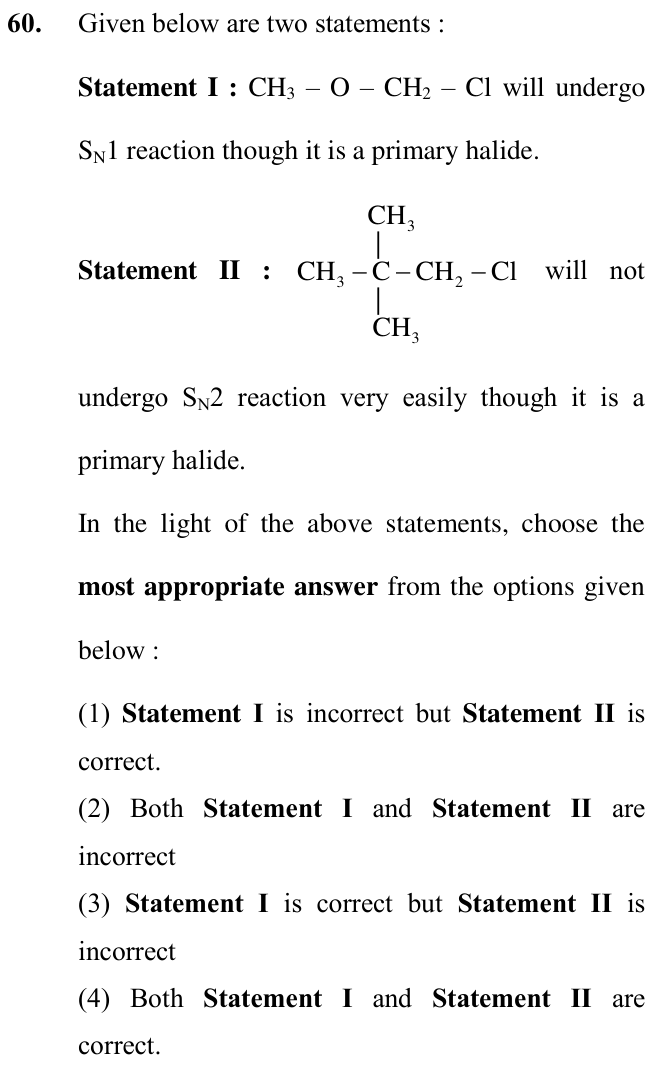
Candidate Response:
(1) (2) (3) (4)
⚡ OFFICIAL KEY: 4
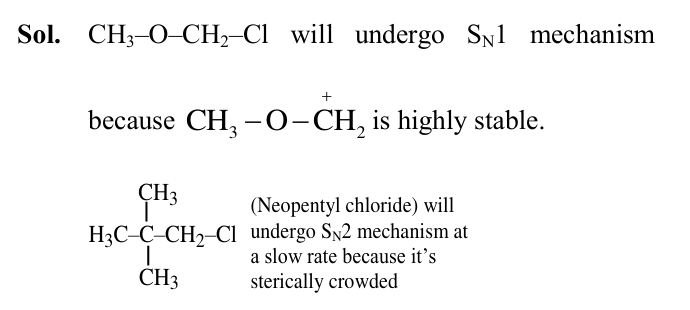
Step-by-Step Derivation
QUESTION 3
CHEMISTRY · Haloalkanes and Haloarenes
SECTION A · MCQ (+4, -1)
The Hofmann rule predicts that elimination with a bulky base gives which alkene as the major product?
(1) more substituted alkene
(2) alkyne
(3) no alkene
(4) less substituted alkene
Candidate Response:
(1) (2) (3) (4)
⚡ OFFICIAL KEY: less substituted alkene
Step-by-Step Derivation
Bulky bases favour the less substituted (Hofmann) alkene.
QUESTION 4
CHEMISTRY · Haloalkanes and Haloarenes
SECTION A · MCQ (+4, -1)
Chloromethane has a larger dipole moment (1.860 D) than fluoromethane (1.847 D) even though fluorine is more electronegative than chlorine. This is because:
(1) Dipole moment depends on bond length as well, and the longer C–Cl bond outweighs the smaller electronegativity difference
(2) The C–Cl bond is shorter than the C–F bond
(3) Chlorine is more electronegative than fluorine in organic compounds
(4) Fluorine's high electronegativity makes the C–F bond non-polar
Candidate Response:
(1) (2) (3) (4)
⚡ OFFICIAL KEY: Dipole moment depends on bond length as well, and the longer C–Cl bond outweighs the smaller electronegativity difference
Step-by-Step Derivation
Dipole moment is μ = q × d, the product of charge separation and distance. Although fluorine gives a larger charge difference (q), chlorine's much longer C–Cl bond (178 pm vs 139 pm for C–F) enlarges the distance term (d) enough to give CH₃Cl the higher μ.
QUESTION 5
CHEMISTRY · Haloalkanes and Haloarenes
SECTION A · MCQ (+4, -1)
Which halogenated compound has its halogen bonded to an sp²-hybridised carbon and is therefore largely inert toward nucleophilic substitution?
(1) Benzyl chloride (C₆H₅–CH₂Cl)
(2) Allyl chloride (CH₂=CH–CH₂Cl)
(3) Ethyl chloride (CH₃CH₂Cl)
(4) Vinyl chloride (CH₂=CH–Cl)
Candidate Response:
(1) (2) (3) (4)
⚡ OFFICIAL KEY: Vinyl chloride (CH₂=CH–Cl)
Step-by-Step Derivation
Vinyl chloride has its chlorine directly attached to a C=C carbon, which is sp²-hybridised. Vinylic (and aryl) halides are inert toward nucleophilic substitution. Benzyl, allyl and ethyl halides all carry the halogen on sp³ carbons.
QUESTION 6
CHEMISTRY · Haloalkanes and Haloarenes
SECTION A · MCQ (+4, -1)
In electrophilic aromatic substitution, halogens are deactivating groups yet they direct the incoming electrophile to which ring positions?
(1) meta
(2) ortho and para
(3) only meta
(4) only ortho
Candidate Response:
(1) (2) (3) (4)
⚡ OFFICIAL KEY: ortho and para
Step-by-Step Derivation
Halogens are ortho/para directing despite being deactivating (–I > +R).
QUESTION 7
CHEMISTRY · Haloalkanes and Haloarenes
SECTION A · MCQ (+4, -1)
In E2 elimination, the departing β-hydrogen and the leaving group must adopt which spatial arrangement for the reaction to proceed?
(1) syn-periplanar
(2) perpendicular (90°)
(3) gauche
(4) anti-periplanar
Candidate Response:
(1) (2) (3) (4)
⚡ OFFICIAL KEY: anti-periplanar
Step-by-Step Derivation
E2 requires the H and leaving group to be anti-periplanar (180°).
QUESTION 8
CHEMISTRY · Haloalkanes and Haloarenes
SECTION A · MCQ (+4, -1)
Which polyhalogen compound is a chlorofluorocarbon whose use depletes the stratospheric ozone layer?
(1) chloroform
(2) Freon (CCl₂F₂)
(3) phosgene (COCl₂)
(4) DDT
Candidate Response:
(1) (2) (3) (4)
⚡ OFFICIAL KEY: Freon (CCl₂F₂)
Step-by-Step Derivation
Freons are CFCs that destroy stratospheric ozone.
QUESTION 9
CHEMISTRY · Haloalkanes and Haloarenes
SECTION A · MCQ (+4, -1)
The Wurtz reaction couples two alkyl halide molecules using which metal in dry ether?
(1) zinc
(2) sodium
(3) magnesium
(4) lithium
Candidate Response:
(1) (2) (3) (4)
⚡ OFFICIAL KEY: sodium
Step-by-Step Derivation
Wurtz reaction uses sodium to couple alkyl halides into a higher alkane.
QUESTION 10
CHEMISTRY · Haloalkanes and Haloarenes
SECTION A · MCQ (+4, -1)
For an E2 elimination to occur, what relative geometry must the β-C–H and α-C–X bonds adopt?
(1) Anti-periplanar (180° dihedral angle)
(2) Any geometry, because E2 is not stereospecific
(3) Perpendicular (90° dihedral angle)
(4) Syn-periplanar (0° dihedral angle)
Candidate Response:
(1) (2) (3) (4)
⚡ OFFICIAL KEY: Anti-periplanar (180° dihedral angle)
Step-by-Step Derivation
E2 is a concerted elimination that requires the β-C–H and α-C–X bonds to lie anti-periplanar (180°) so their orbitals overlap optimally to form the new π bond as the proton is abstracted and the halide leaves.