
✎ ANSWER ONLINE · EVERY MISTAKE LINKS BACK TO THE CONCEPT
Haloalkanes and Haloarenes · Practice Worksheet
Answer each question here and it marks straight away, with the derivation and a link to the exact micro-concept to revisit.
6 questions from this set could not be marked online — a
bonus or dual-key question, which has no single defensible answer. The print and
.docx versions still include them.
// CONCEPT AUDIT RESULT
Everything you missed has been added to your Error Arena — retest them blind there, and a concept clears once you get it right.
QUESTION 1
Haloalkanes and Haloarenes
SECTION A · MCQ (+4, -1)
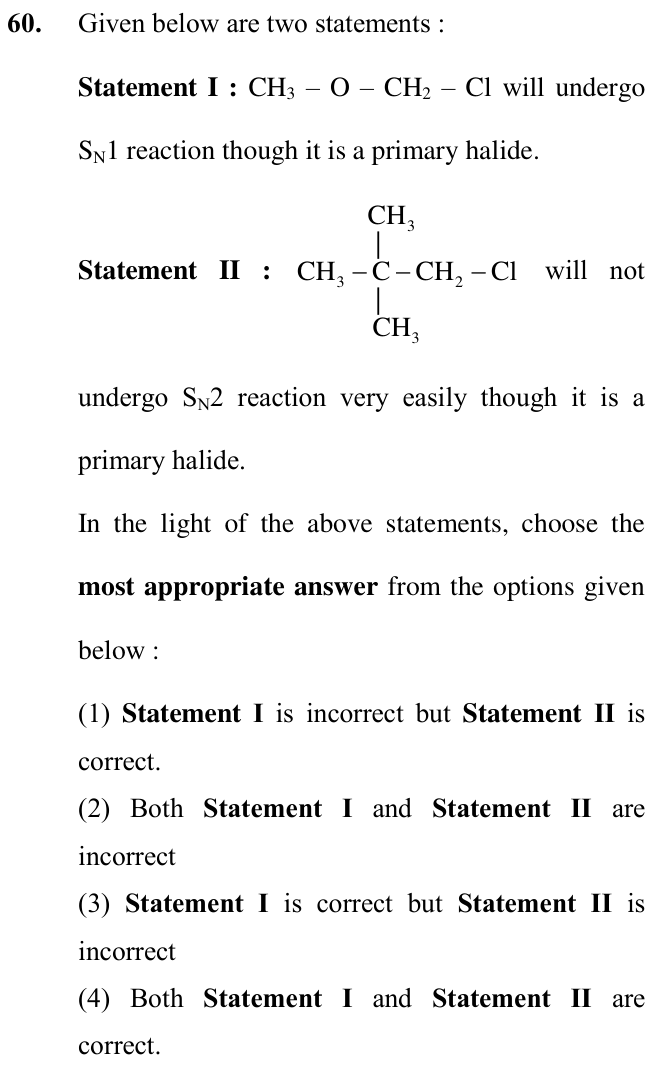
(1) Statement I is incorrect but Statement II is
correct.
(2) Both Statement I and Statement II are
incorrect
(3) Statement I is correct but Statement II is
incorrect
(4) Both Statement I and Statement II are
correct.
CH3–O–CH2–Cl will undergo SN1 mechanism
because
3
2
CH
O
CH + - - is highly stable.
H3C–C–CH2–Cl
CH3
CH3
(Neopentyl chloride) will
undergo SN2 mechanism at
a slow rate because it’s
sterically crowded
3
QUESTION 2
Haloalkanes and Haloarenes
SECTION A · MCQ (+4, -1)
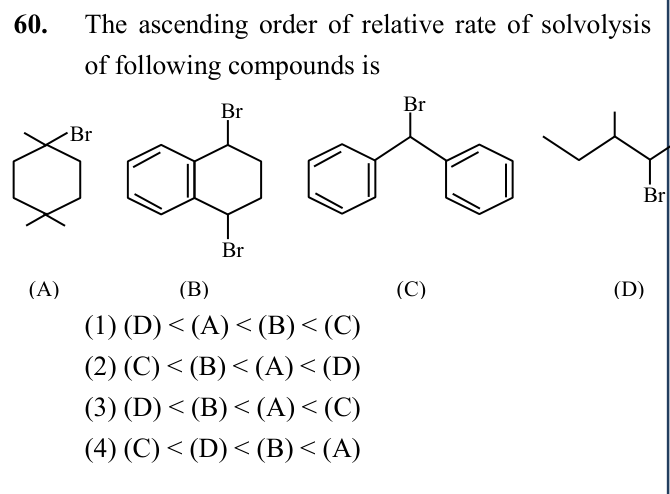
(1) (D) < (A) < (B) < (C)
(2) (C) < (B) < (A) < (D)
(3) (D) < (B) < (A) < (C)
(4) (C) < (D) < (B) < (A)
Solvolysis or SN1 ∝ stability of carboccation
Stability order
⊕
⊕
⊕
⊕
>
>
>
QUESTION 3
Haloalkanes and Haloarenes
SECTION A · MCQ (+4, -1)
Which halogenated compound has its halogen bonded to an sp²-hybridised carbon and is therefore largely inert toward nucleophilic substitution?
(1) Benzyl chloride (C₆H₅–CH₂Cl)
(2) Allyl chloride (CH₂=CH–CH₂Cl)
(3) Ethyl chloride (CH₃CH₂Cl)
(4) Vinyl chloride (CH₂=CH–Cl)
Vinyl chloride has its chlorine directly attached to a C=C carbon, which is sp²-hybridised. Vinylic (and aryl) halides are inert toward nucleophilic substitution. Benzyl, allyl and ethyl halides all carry the halogen on sp³ carbons.
QUESTION 4
Haloalkanes and Haloarenes
SECTION A · MCQ (+4, -1)
Which reagent converts an alcohol into an alkyl chloride while releasing two gaseous byproducts, so that essentially pure product is obtained without a separation step?
(1) PCl₃
(2) Red phosphorus + Cl₂
(3) PCl₅
(4) SOCl₂ (thionyl chloride)
The Darzens process uses thionyl chloride: R–OH + SOCl₂ → R–Cl + SO₂↑ + HCl↑. Both SO₂ and HCl are volatile gases that escape, leaving pure alkyl chloride, so no purification is needed.
QUESTION 5
Haloalkanes and Haloarenes
SECTION A · MCQ (+4, -1)
An optically active secondary alkyl bromide undergoes an SN2 reaction with OH⁻. What is the stereochemical outcome?
(1) Retention of configuration
(2) A mixture that favours retention over inversion
(3) Complete (100%) inversion of configuration (Walden inversion)
(4) Racemization
SN2 is a single concerted step in which the nucleophile attacks from the backside (180° opposite the leaving group) through a pentacoordinate transition state, causing a complete umbrella inversion of configuration (Walden inversion).
QUESTION 6
Haloalkanes and Haloarenes
SECTION A · MCQ (+4, -1)
For an E2 elimination to occur, what relative geometry must the β-C–H and α-C–X bonds adopt?
(1) Anti-periplanar (180° dihedral angle)
(2) Any geometry, because E2 is not stereospecific
(3) Perpendicular (90° dihedral angle)
(4) Syn-periplanar (0° dihedral angle)
E2 is a concerted elimination that requires the β-C–H and α-C–X bonds to lie anti-periplanar (180°) so their orbitals overlap optimally to form the new π bond as the proton is abstracted and the halide leaves.
QUESTION 7
Haloalkanes and Haloarenes
SECTION A · MCQ (+4, -1)
A Grignard reagent (R–MgX) reacts immediately on contact with water. What is the product?
(1) The alkane R–H together with Mg(OH)X
(2) An alcohol R–OH
(3) An alkene
(4) The original halide R–X is regenerated
The C–Mg bond is strongly polarised toward carbon, making it a carbanion that acts as a strong base. Water (an active proton source) instantly protonates it: R–MgX + H₂O → R–H + Mg(OH)X. This is why Grignard reactions require rigorously dry ether.
QUESTION 8
Haloalkanes and Haloarenes
SECTION A · MCQ (+4, -1)
Chloroform kept for anaesthetic use is stored in dark bottles with about 1% ethanol. The ethanol is added to:
(1) Make chloroform a more effective anaesthetic
(2) Prevent evaporation of the chloroform
(3) Convert any phosgene (COCl₂) formed by oxidation into harmless diethyl carbonate
(4) Lower the freezing point of chloroform
Chloroform slowly oxidises in air and light to the highly toxic gas phosgene (2CHCl₃ + O₂ → 2COCl₂ + 2HCl). About 1% ethanol is added as a scavenger: it reacts with phosgene to form non-toxic diethyl carbonate.
QUESTION 9
Haloalkanes and Haloarenes
SECTION A · MCQ (+4, -1)
On the basis of the hybridisation of the carbon bonded to the halogen, an aryl halide has the halogen attached to which type of carbon?
(1) sp carbon of an alkyne
(2) sp³ carbon of a carbonyl
(3) sp² carbon of an aromatic ring
(4) sp³ carbon
Aryl halides have halogen bonded to an sp²-hybridised ring carbon.
QUESTION 10
Haloalkanes and Haloarenes
SECTION A · MCQ (+4, -1)
Although fluorine is the most electronegative halogen, CH₃F has a smaller dipole moment than CH₃Cl because dipole moment is proportional to which combination of charge and distance?
(1) bond dissociation energy
(2) electronegativity difference alone
(3) charge × bond length (μ = q × d)
(4) charge ÷ bond length
Dipole moment depends on both charge separation and the C–X bond distance.
QUESTION 11
Haloalkanes and Haloarenes
SECTION A · MCQ (+4, -1)
Which reagent converts an alcohol directly into the corresponding alkyl chloride, releasing SO₂ and HCl as by-products?
(1) SOCl₂ (thionyl chloride)
(2) HCl
(3) PCl₃
(4) Cl₂
Thionyl chloride replaces –OH by –Cl with loss of SO₂ and HCl.
QUESTION 12
Haloalkanes and Haloarenes
SECTION A · MCQ (+4, -1)
The SN2 mechanism proceeds in a single step via backside attack of the nucleophile, which produces what stereochemical outcome at the reaction centre?
(1) inversion of configuration (Walden inversion)
(2) no change in configuration
(3) racemisation
(4) retention of configuration
Backside attack in SN2 inverts the configuration at the carbon.
QUESTION 13
Haloalkanes and Haloarenes
SECTION A · MCQ (+4, -1)
Because an SN1 reaction proceeds through a planar carbocation intermediate that can be attacked from either face, it typically gives which stereochemical result?
(1) no reaction
(2) racemisation
(3) retention only
(4) inversion only
A planar carbocation allows attack from both faces, giving a racemic mixture.
QUESTION 14
Haloalkanes and Haloarenes
SECTION A · MCQ (+4, -1)
In E2 elimination, the departing β-hydrogen and the leaving group must adopt which spatial arrangement for the reaction to proceed?
(1) syn-periplanar
(2) perpendicular (90°)
(3) gauche
(4) anti-periplanar
E2 requires the H and leaving group to be anti-periplanar (180°).
QUESTION 15
Haloalkanes and Haloarenes
SECTION A · MCQ (+4, -1)
The Hofmann rule predicts that elimination with a bulky base gives which alkene as the major product?
(1) more substituted alkene
(2) alkyne
(3) no alkene
(4) less substituted alkene
Bulky bases favour the less substituted (Hofmann) alkene.
QUESTION 16
Haloalkanes and Haloarenes
SECTION A · MCQ (+4, -1)
Aryl halides are generally unreactive toward nucleophilic substitution because of which structural feature of the C–X bond?
(1) free rotation about C–X
(2) sp³ hybridised carbon
(3) resonance giving partial double-bond character
(4) absence of π electrons
Resonance shortens and strengthens the C–X bond, making it hard to break.
QUESTION 17
Haloalkanes and Haloarenes
SECTION A · MCQ (+4, -1)
In electrophilic aromatic substitution, halogens are deactivating groups yet they direct the incoming electrophile to which ring positions?
(1) meta
(2) ortho and para
(3) only meta
(4) only ortho
Halogens are ortho/para directing despite being deactivating (–I > +R).
QUESTION 18
Haloalkanes and Haloarenes
SECTION A · MCQ (+4, -1)
The Wurtz reaction couples two alkyl halide molecules using which metal in dry ether?
(1) zinc
(2) sodium
(3) magnesium
(4) lithium
Wurtz reaction uses sodium to couple alkyl halides into a higher alkane.
QUESTION 19
Haloalkanes and Haloarenes
SECTION A · MCQ (+4, -1)
Which polyhalogen compound is a chlorofluorocarbon whose use depletes the stratospheric ozone layer?
(1) chloroform
(2) Freon (CCl₂F₂)
(3) phosgene (COCl₂)
(4) DDT
Freons are CFCs that destroy stratospheric ozone.