
✎ ANSWER ONLINE · EVERY MISTAKE LINKS BACK TO THE CONCEPT
Alcohols, Phenols and Ethers · Practice Worksheet
Answer each question here and it marks straight away, with the derivation and a link to the exact micro-concept to revisit.
2 questions from this set could not be marked online — a
bonus or dual-key question, which has no single defensible answer. The print and
.docx versions still include them.
// CONCEPT AUDIT RESULT
Everything you missed has been added to your Error Arena — retest them blind there, and a concept clears once you get it right.
QUESTION 1
Alcohols, Phenols and Ethers
SECTION A · MCQ (+4, -1)
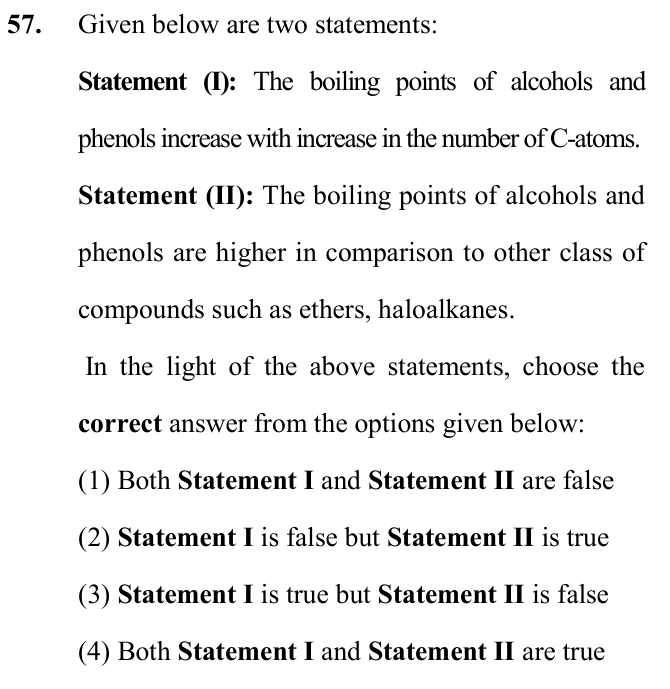
(1) Both Statement I and Statement II are false
(2) Statement I is false but Statement II is true
(3) Statement I is true but Statement II is false
(4) Both Statement I and Statement II are true
B.P. ∝ M.W.
B.P. ∝ Inter molecular hydrogen bonding
Alcohol & Phenol have intermolecular H-bonding
3
QUESTION 2
Alcohols, Phenols and Ethers
SECTION A · MCQ (+4, -1)
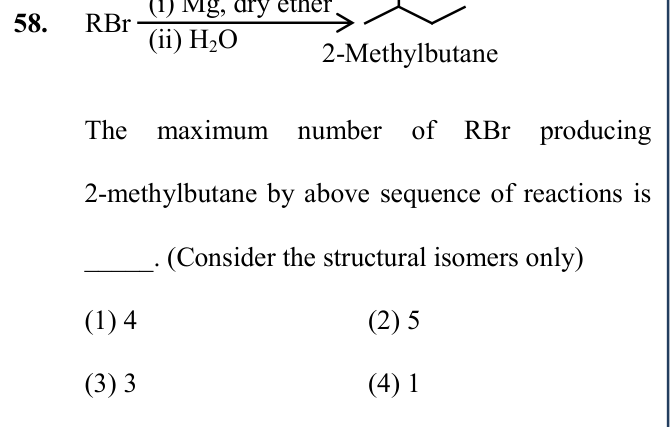
(1) 4
(2) 5
(3) 3
(4) 1
Br
Br
Br
Br
Total number of possible structures
of RBr = 4
QUESTION 3
Alcohols, Phenols and Ethers
SECTION B · NUMERICAL (+4, 0)
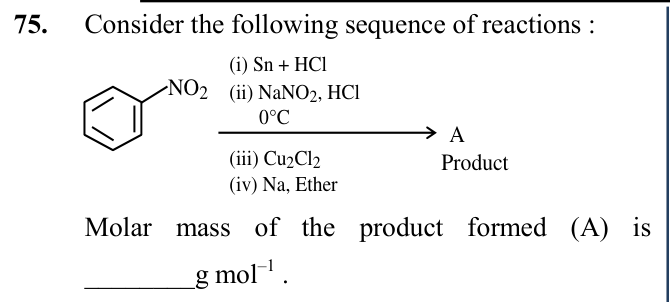
NO2
Sn + HCl
NH2
Cu2Cl2
N2Cl– + Na/Ether
NaNO2 + HCl
0-5°C
Cl
QUESTION 4
Alcohols, Phenols and Ethers
SECTION A · MCQ (+4, -1)
Why is phenol (pKa ≈ 10) far more acidic than ethanol (pKa ≈ 16)?
(1) Phenol has a much weaker O–H bond
(2) The phenoxide ion is resonance-stabilised by delocalisation of the negative charge over the ring
(3) Phenol forms dimers in solution
(4) The ethyl group stabilises the alkoxide ion
On deprotonation, phenol gives the phenoxide ion, whose negative charge is delocalised over the ortho and para carbons through five resonance structures. This strong stabilisation of the conjugate base makes phenol about 10⁶ times more acidic than ethanol, whose alkoxide ion has no such delocalisation.
QUESTION 5
Alcohols, Phenols and Ethers
SECTION A · MCQ (+4, -1)
In the cleavage of an unsymmetrical ether by HI, the iodide ion preferentially attacks which alkyl group?
(1) the smaller (less hindered) alkyl group
(2) the bulkier alkyl group
(3) neither group
(4) the aryl group
Iodide attacks the less hindered alkyl group via SN2.
QUESTION 6
Alcohols, Phenols and Ethers
SECTION A · MCQ (+4, -1)
Alcohols have much higher boiling points than alkanes of comparable molar mass because of which intermolecular force?
(1) ionic bonding
(2) van der Waals forces
(3) dipole-induced dipole forces
(4) hydrogen bonding
Intermolecular hydrogen bonding raises the boiling points of alcohols.
QUESTION 7
Alcohols, Phenols and Ethers
SECTION A · MCQ (+4, -1)
Williamson ether synthesis gives the best yield of an ether when the alkyl halide used is which type?
(1) tertiary
(2) primary
(3) secondary
(4) aryl
Primary halides favour SN2 ether formation over elimination.
QUESTION 8
Alcohols, Phenols and Ethers
SECTION A · MCQ (+4, -1)
An alcohol in which the carbon bearing the –OH group is attached to two other carbon atoms is classified as which type?
(1) secondary (2°)
(2) quaternary
(3) tertiary (3°)
(4) primary (1°)
Two carbon atoms bonded to the –OH-bearing carbon make it secondary.