
✎ ANSWER ONLINE · EVERY MISTAKE LINKS BACK TO THE CONCEPT
Alcohols, Phenols and Ethers · Practice Worksheet
Answer each question here and it marks straight away, with the derivation and a link to the exact micro-concept to revisit.
4 questions from this set could not be marked online — a
bonus or dual-key question, which has no single defensible answer. The print and
.docx versions still include them.
// CONCEPT AUDIT RESULT
Everything you missed has been added to your Error Arena — retest them blind there, and a concept clears once you get it right.
QUESTION 1
Alcohols, Phenols and Ethers
SECTION A · MCQ (+4, -1)
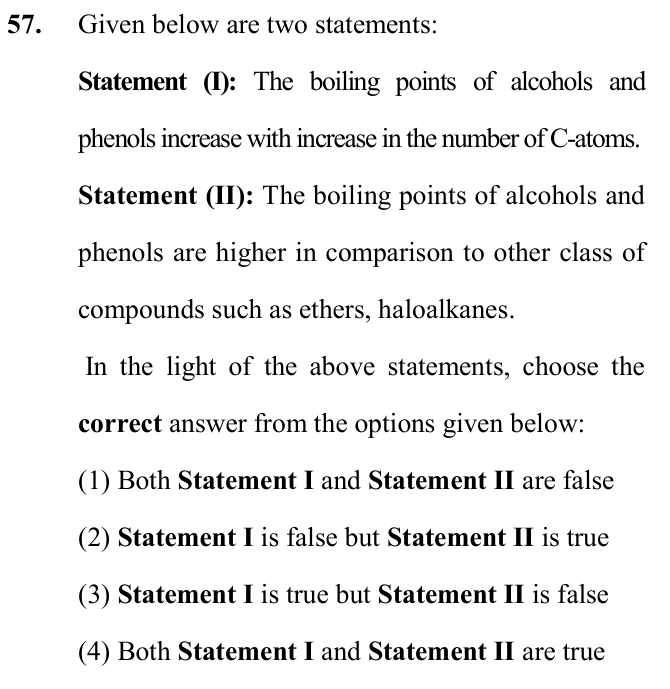
(1) Both Statement I and Statement II are false
(2) Statement I is false but Statement II is true
(3) Statement I is true but Statement II is false
(4) Both Statement I and Statement II are true
B.P. ∝ M.W.
B.P. ∝ Inter molecular hydrogen bonding
Alcohol & Phenol have intermolecular H-bonding
3
QUESTION 2
Alcohols, Phenols and Ethers
SECTION A · MCQ (+4, -1)
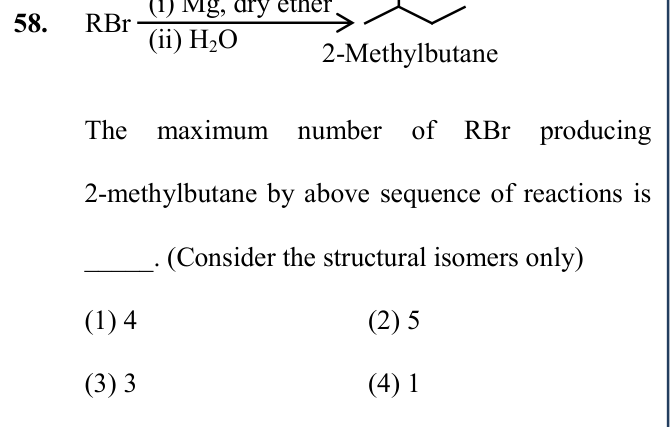
(1) 4
(2) 5
(3) 3
(4) 1
Br
Br
Br
Br
Total number of possible structures
of RBr = 4
QUESTION 3
Alcohols, Phenols and Ethers
SECTION B · NUMERICAL (+4, 0)
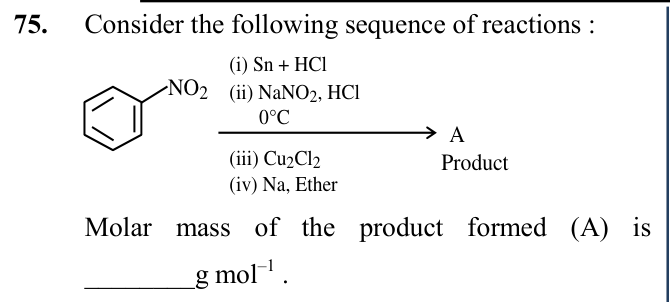
NO2
Sn + HCl
NH2
Cu2Cl2
N2Cl– + Na/Ether
NaNO2 + HCl
0-5°C
Cl
QUESTION 4
Alcohols, Phenols and Ethers
SECTION A · MCQ (+4, -1)
Why is phenol (pKa ≈ 10) far more acidic than ethanol (pKa ≈ 16)?
(1) Phenol has a much weaker O–H bond
(2) The phenoxide ion is resonance-stabilised by delocalisation of the negative charge over the ring
(3) Phenol forms dimers in solution
(4) The ethyl group stabilises the alkoxide ion
On deprotonation, phenol gives the phenoxide ion, whose negative charge is delocalised over the ortho and para carbons through five resonance structures. This strong stabilisation of the conjugate base makes phenol about 10⁶ times more acidic than ethanol, whose alkoxide ion has no such delocalisation.
QUESTION 5
Alcohols, Phenols and Ethers
SECTION A · MCQ (+4, -1)
In the cleavage of an unsymmetrical ether by HI, the iodide ion preferentially attacks which alkyl group?
(1) the smaller (less hindered) alkyl group
(2) the bulkier alkyl group
(3) neither group
(4) the aryl group
Iodide attacks the less hindered alkyl group via SN2.
QUESTION 6
Alcohols, Phenols and Ethers
SECTION A · MCQ (+4, -1)
Alcohols have much higher boiling points than alkanes of comparable molar mass because of which intermolecular force?
(1) ionic bonding
(2) van der Waals forces
(3) dipole-induced dipole forces
(4) hydrogen bonding
Intermolecular hydrogen bonding raises the boiling points of alcohols.
QUESTION 7
Alcohols, Phenols and Ethers
SECTION A · MCQ (+4, -1)
Williamson ether synthesis gives the best yield of an ether when the alkyl halide used is which type?
(1) tertiary
(2) primary
(3) secondary
(4) aryl
Primary halides favour SN2 ether formation over elimination.
QUESTION 8
Alcohols, Phenols and Ethers
SECTION A · MCQ (+4, -1)
An alcohol in which the carbon bearing the –OH group is attached to two other carbon atoms is classified as which type?
(1) secondary (2°)
(2) quaternary
(3) tertiary (3°)
(4) primary (1°)
Two carbon atoms bonded to the –OH-bearing carbon make it secondary.
QUESTION 9
Alcohols, Phenols and Ethers
SECTION A · MCQ (+4, -1)
Sodium phenoxide heated with CO₂ under pressure (400 K, 4–7 atm), followed by acidification, gives which product?
(1) Salicylic acid (2-hydroxybenzoic acid)
(2) Acetylsalicylic acid
(3) Phenol
(4) Benzoic acid
In the Kolbe reaction, the strongly nucleophilic phenoxide ion attacks the weak electrophile CO₂ at the ortho position to give sodium salicylate, which on acidification yields salicylic acid (2-hydroxybenzoic acid).
QUESTION 10
Alcohols, Phenols and Ethers
SECTION A · MCQ (+4, -1)
Heating ethanol with concentrated H₂SO₄ at 443 K gives ethene, whereas at 413 K the major product is which compound?
(1) ethanal
(2) ethyl hydrogen sulfate
(3) diethyl ether
(4) ethanoic acid
At the lower temperature (413 K) dehydration gives diethyl ether instead of ethene.
QUESTION 11
Alcohols, Phenols and Ethers
SECTION A · MCQ (+4, -1)
The Kolbe reaction converts sodium phenoxide with carbon dioxide into which product?
(1) aspirin
(2) benzoic acid
(3) phenol
(4) salicylic acid
Kolbe reaction gives salicylic acid (o-hydroxybenzoic acid).
QUESTION 12
Alcohols, Phenols and Ethers
SECTION A · MCQ (+4, -1)
Propene on hydroboration–oxidation (B₂H₆ followed by H₂O₂/OH⁻) gives which alcohol?
(1) Propan-2-ol (Markovnikov addition)
(2) 2-Methylpropan-2-ol
(3) Propan-1-ol (anti-Markovnikov addition)
(4) Propane-1,2-diol
Boron adds to the less-substituted terminal carbon of the double bond, and alkaline H₂O₂ then replaces boron with –OH at that same terminal carbon, giving propan-1-ol (anti-Markovnikov addition of water).
QUESTION 13
Alcohols, Phenols and Ethers
SECTION A · MCQ (+4, -1)
Reaction of a Grignard reagent (RMgX) with formaldehyde followed by hydrolysis gives which class of alcohol?
(1) tertiary alcohol
(2) secondary alcohol
(3) phenol
(4) primary alcohol
Formaldehyde has no alkyl group, so it yields a primary alcohol.
QUESTION 14
Alcohols, Phenols and Ethers
SECTION A · MCQ (+4, -1)
PCC (pyridinium chlorochromate) oxidises a primary alcohol to which product, without further oxidation to a carboxylic acid?
(1) alkene
(2) aldehyde
(3) carboxylic acid
(4) ketone
PCC is a mild oxidant that stops primary alcohols at the aldehyde stage.
QUESTION 15
Alcohols, Phenols and Ethers
SECTION A · MCQ (+4, -1)
Why is the C–O–C bond angle in dimethyl ether (111.7°) larger than the tetrahedral angle (109.5°)?
(1) The C–O bonds have partial double-bond character
(2) Steric repulsion between the two bulky methyl groups pushes the C–O bonds apart
(3) Lone-pair–lone-pair repulsion widens the angle
(4) The oxygen in ethers is sp²-hybridised
Oxygen in ethers is approximately sp³, but the two bulky alkyl groups exert large steric repulsion against each other, forcing the C–O–C angle open to 111.7°, greater than the ideal 109.5°.
QUESTION 16
Alcohols, Phenols and Ethers
SECTION A · MCQ (+4, -1)
Phenol is more acidic than ethanol mainly because the phenoxide ion is stabilised by which factor?
(1) absence of charge
(2) inductive electron release
(3) intramolecular hydrogen bonding
(4) resonance delocalisation of the negative charge
The phenoxide anion is resonance-stabilised across the ring.