
⚡ OFFICIAL NTA ASSESSMENT GENERATOR & WORD (.DOCX) EXPORTER
Alcohols, Phenols and Ethers · Practice Worksheet
JEE Main Chemistry · Curated Assessment Set Print directly or export as a beautifully formatted Microsoft Word document with embedded 180-DPI mathematical prompt clips and step-by-step derivations.
EDUPROD JEE MAIN TEST SERIES · NTA PATTERN
Alcohols, Phenols and Ethers · Practice Worksheet
JEE Main Chemistry · Curated Assessment Set · Assessment Code: JEE-101
Total Marks: 100
Marking: +4 / -1 (Sec A) · +4 / 0 (Sec B)
QUESTION 1
CHEMISTRY · Alcohols, Phenols and Ethers
SECTION A · MCQ (+4, -1)
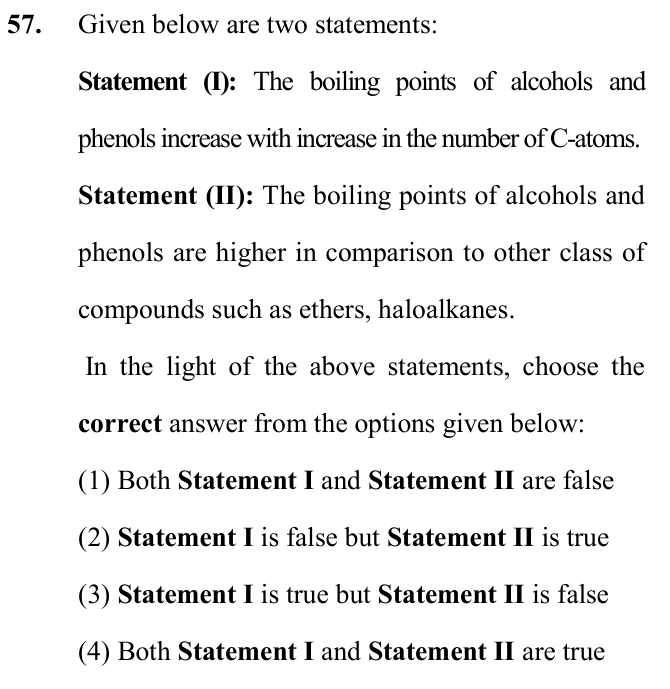
Candidate Response:
(1) (2) (3) (4)
QUESTION 2
CHEMISTRY · Alcohols, Phenols and Ethers
SECTION A · MCQ (+4, -1)
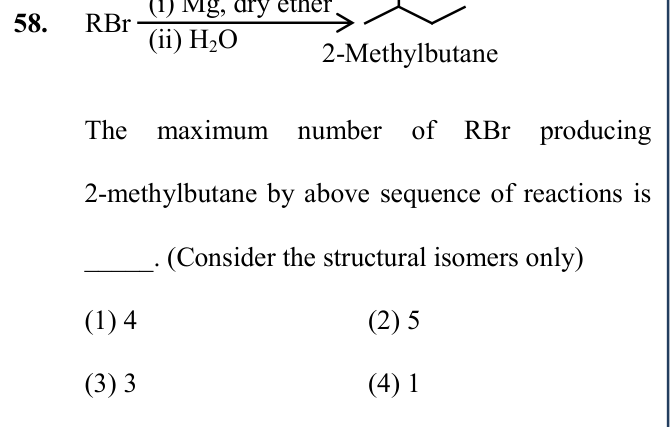
Candidate Response:
(1) (2) (3) (4)
QUESTION 3
CHEMISTRY · Alcohols, Phenols and Ethers
SECTION B · NUMERICAL (+4, 0)
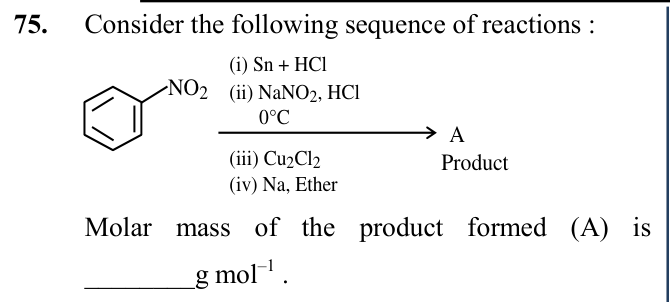
Numerical Value:
[ ]
QUESTION 4
CHEMISTRY · Alcohols, Phenols and Ethers
SECTION A · MCQ (+4, -1)
Why is phenol (pKa ≈ 10) far more acidic than ethanol (pKa ≈ 16)?
(1) Phenol has a much weaker O–H bond
(2) The phenoxide ion is resonance-stabilised by delocalisation of the negative charge over the ring
(3) Phenol forms dimers in solution
(4) The ethyl group stabilises the alkoxide ion
Candidate Response:
(1) (2) (3) (4)
QUESTION 5
CHEMISTRY · Alcohols, Phenols and Ethers
SECTION A · MCQ (+4, -1)
In the cleavage of an unsymmetrical ether by HI, the iodide ion preferentially attacks which alkyl group?
(1) the smaller (less hindered) alkyl group
(2) the bulkier alkyl group
(3) neither group
(4) the aryl group
Candidate Response:
(1) (2) (3) (4)
QUESTION 6
CHEMISTRY · Alcohols, Phenols and Ethers
SECTION A · MCQ (+4, -1)
tert-Butyl methyl ether reacts with concentrated HI to give which iodide?
(1) Methyl iodide plus tert-butyl alcohol
(2) tert-Butyl iodide ((CH₃)₃C–I) plus methanol, via an SN1 carbocation mechanism
(3) Both iodides in equal amounts
(4) No reaction occurs
Candidate Response:
(1) (2) (3) (4)
QUESTION 7
CHEMISTRY · Alcohols, Phenols and Ethers
SECTION A · MCQ (+4, -1)
Which statement correctly classifies benzyl alcohol, C₆H₅CH₂OH?
(1) It is a secondary alcohol
(2) It is a primary (benzylic) alcohol because the –OH is bonded to an sp³ side-chain carbon, not the aromatic ring
(3) It is a phenol because it contains a benzene ring
(4) It is a dihydric phenol
Candidate Response:
(1) (2) (3) (4)
QUESTION 8
CHEMISTRY · Alcohols, Phenols and Ethers
SECTION A · MCQ (+4, -1)
Alcohols have much higher boiling points than alkanes of comparable molar mass because of which intermolecular force?
(1) ionic bonding
(2) van der Waals forces
(3) dipole-induced dipole forces
(4) hydrogen bonding
Candidate Response:
(1) (2) (3) (4)
QUESTION 9
CHEMISTRY · Alcohols, Phenols and Ethers
SECTION A · MCQ (+4, -1)
Williamson ether synthesis gives the best yield of an ether when the alkyl halide used is which type?
(1) tertiary
(2) primary
(3) secondary
(4) aryl
Candidate Response:
(1) (2) (3) (4)
QUESTION 10
CHEMISTRY · Alcohols, Phenols and Ethers
SECTION A · MCQ (+4, -1)
An alcohol in which the carbon bearing the –OH group is attached to two other carbon atoms is classified as which type?
(1) secondary (2°)
(2) quaternary
(3) tertiary (3°)
(4) primary (1°)
Candidate Response:
(1) (2) (3) (4)
QUESTION 11
CHEMISTRY · Alcohols, Phenols and Ethers
SECTION A · MCQ (+4, -1)
Sodium phenoxide heated with CO₂ under pressure (400 K, 4–7 atm), followed by acidification, gives which product?
(1) Salicylic acid (2-hydroxybenzoic acid)
(2) Acetylsalicylic acid
(3) Phenol
(4) Benzoic acid
Candidate Response:
(1) (2) (3) (4)
QUESTION 12
CHEMISTRY · Alcohols, Phenols and Ethers
SECTION A · MCQ (+4, -1)
Heating ethanol with concentrated H₂SO₄ at 443 K gives ethene, whereas at 413 K the major product is which compound?
(1) ethanal
(2) ethyl hydrogen sulfate
(3) diethyl ether
(4) ethanoic acid
Candidate Response:
(1) (2) (3) (4)
QUESTION 13
CHEMISTRY · Alcohols, Phenols and Ethers
SECTION A · MCQ (+4, -1)
The Kolbe reaction converts sodium phenoxide with carbon dioxide into which product?
(1) aspirin
(2) benzoic acid
(3) phenol
(4) salicylic acid
Candidate Response:
(1) (2) (3) (4)
QUESTION 14
CHEMISTRY · Alcohols, Phenols and Ethers
SECTION A · MCQ (+4, -1)
Dehydration of alcohols by concentrated H₂SO₄ follows the ease order 3° > 2° > 1°. Why?
(1) Tertiary alcohols have the most β-hydrogens
(2) The acid dissolves primary alcohols
(3) The rate-determining step forms a carbocation, and its stability (3° > 2° > 1°) controls the rate
(4) Primary alcohols are sterically hindered
Candidate Response:
(1) (2) (3) (4)
QUESTION 15
CHEMISTRY · Alcohols, Phenols and Ethers
SECTION A · MCQ (+4, -1)
Propene on hydroboration–oxidation (B₂H₆ followed by H₂O₂/OH⁻) gives which alcohol?
(1) Propan-2-ol (Markovnikov addition)
(2) 2-Methylpropan-2-ol
(3) Propan-1-ol (anti-Markovnikov addition)
(4) Propane-1,2-diol
Candidate Response:
(1) (2) (3) (4)
QUESTION 16
CHEMISTRY · Alcohols, Phenols and Ethers
SECTION A · MCQ (+4, -1)
Why can't tert-butyl bromide be used as the alkyl halide in a Williamson ether synthesis?
(1) It is unreactive toward alkoxides
(2) It is too expensive
(3) It forms a phenoxide
(4) It undergoes E2 elimination (to 2-methylpropene) instead of SN2 substitution, so no ether forms
Candidate Response:
(1) (2) (3) (4)
QUESTION 17
CHEMISTRY · Alcohols, Phenols and Ethers
SECTION A · MCQ (+4, -1)
Reaction of a Grignard reagent (RMgX) with formaldehyde followed by hydrolysis gives which class of alcohol?
(1) tertiary alcohol
(2) secondary alcohol
(3) phenol
(4) primary alcohol
Candidate Response:
(1) (2) (3) (4)
QUESTION 18
CHEMISTRY · Alcohols, Phenols and Ethers
SECTION A · MCQ (+4, -1)
PCC (pyridinium chlorochromate) oxidises a primary alcohol to which product, without further oxidation to a carboxylic acid?
(1) alkene
(2) aldehyde
(3) carboxylic acid
(4) ketone
Candidate Response:
(1) (2) (3) (4)
QUESTION 19
CHEMISTRY · Alcohols, Phenols and Ethers
SECTION A · MCQ (+4, -1)
Why is the C–O–C bond angle in dimethyl ether (111.7°) larger than the tetrahedral angle (109.5°)?
(1) The C–O bonds have partial double-bond character
(2) Steric repulsion between the two bulky methyl groups pushes the C–O bonds apart
(3) Lone-pair–lone-pair repulsion widens the angle
(4) The oxygen in ethers is sp²-hybridised
Candidate Response:
(1) (2) (3) (4)
QUESTION 20
CHEMISTRY · Alcohols, Phenols and Ethers
SECTION A · MCQ (+4, -1)
Phenol is more acidic than ethanol mainly because the phenoxide ion is stabilised by which factor?
(1) absence of charge
(2) inductive electron release
(3) intramolecular hydrogen bonding
(4) resonance delocalisation of the negative charge
Candidate Response:
(1) (2) (3) (4)
QUESTION 21
CHEMISTRY · Alcohols, Phenols and Ethers
SECTION A · MCQ (+4, -1)
The Reimer-Tiemann reaction converts phenol with chloroform and aqueous NaOH into which product?
(1) benzaldehyde
(2) benzoic acid
(3) salicylaldehyde
(4) salicylic acid
Candidate Response:
(1) (2) (3) (4)
QUESTION 22
CHEMISTRY · Alcohols, Phenols and Ethers
SECTION A · MCQ (+4, -1)
Why is o-nitrophenol steam-volatile (it distills over with steam) whereas p-nitrophenol is not?
(1) p-Nitrophenol is covalent
(2) o-Nitrophenol has a higher molar mass
(3) o-Nitrophenol forms an intramolecular hydrogen bond, so it cannot associate intermolecularly and boils lower
(4) o-Nitrophenol is more acidic
Candidate Response:
(1) (2) (3) (4)
QUESTION 23
CHEMISTRY · Alcohols, Phenols and Ethers
SECTION A · MCQ (+4, -1)
o-Nitrophenol is steam-volatile while p-nitrophenol is not because o-nitrophenol possesses which type of hydrogen bonding?
(1) ionic bonding
(2) intermolecular hydrogen bonding
(3) no hydrogen bonding
(4) intramolecular hydrogen bonding
Candidate Response:
(1) (2) (3) (4)
QUESTION 24
CHEMISTRY · Alcohols, Phenols and Ethers
SECTION A · MCQ (+4, -1)
What is the active electrophile in the Reimer–Tiemann reaction of phenol with CHCl₃ and aqueous NaOH?
(1) Chloride ion (Cl⁻)
(2) The formyl cation (CHO⁺)
(3) Dichlorocarbene (:CCl₂)
(4) The trichloromethyl carbanion (:CCl₃⁻)
Candidate Response:
(1) (2) (3) (4)
QUESTION 25
CHEMISTRY · Alcohols, Phenols and Ethers
SECTION A · MCQ (+4, -1)
In hydroboration-oxidation of an alkene, the –OH group becomes attached to which carbon of the double bond?
(1) both carbons equally
(2) the less substituted (anti-Markovnikov) carbon
(3) the terminal carbon in all cases
(4) the more substituted carbon
Candidate Response:
(1) (2) (3) (4)