
✎ ANSWER ONLINE · EVERY MISTAKE LINKS BACK TO THE CONCEPT
Aldehydes, Ketones and Carboxylic Acids · Practice Worksheet
Answer each question here and it marks straight away, with the derivation and a link to the exact micro-concept to revisit.
// CONCEPT AUDIT RESULT
Everything you missed has been added to your Error Arena — retest them blind there, and a concept clears once you get it right.
QUESTION 1
Aldehydes, Ketones and Carboxylic Acids
SECTION A · MCQ (+4, -1)
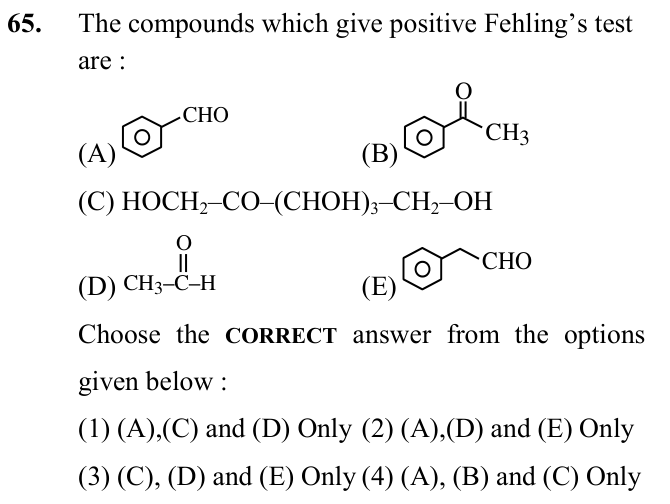
(1) (A),(C) and (D) Only
(2) (A),(D) and (E) Only
(3) (C), (D) and (E) Only
(4) (A), (B) and (C) Only
3
(C)
CH CH
O = ,
2
(D)
PhCH CH
O = ,
HOCH2 – C – (CHOH)3 – CH2OH
O
(E)
All gives positive Fehling test
4
QUESTION 2
Aldehydes, Ketones and Carboxylic Acids
SECTION A · MCQ (+4, -1)
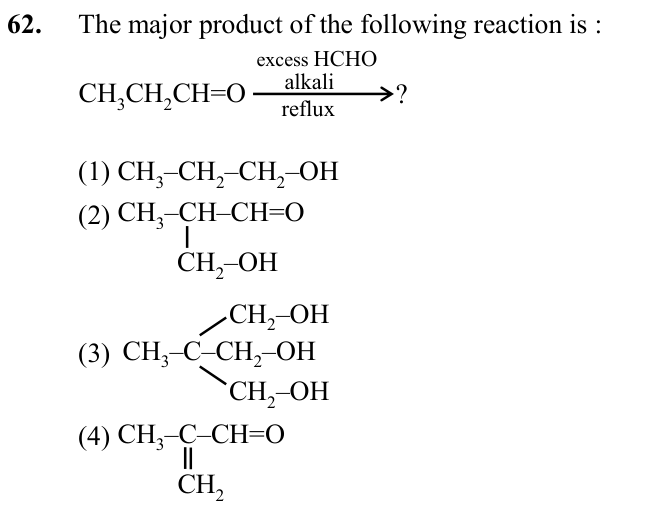
(1) CH3–CH2–CH2–OH
(2) CH3–CH–CH=O
CH2–OH
(3) CH3–C–CH2–OH
CH2–OH
CH2–OH
(4) CH3–C–CH=O
CH2
(3)
This is an example of Tollen‟s reaction i.e.
multiple cross aldol followed by cross Cannizaro
reaction
CH3CH2CH=O ———→
2HCHO
Alkali
CH3–C–CHO
CH2–OH
CH2–OH
———→
HCHO
Alkali
CH3–C–CH2–OH
CH2–OH
CH2–OH + Θ
HCOO
4
QUESTION 3
Aldehydes, Ketones and Carboxylic Acids
SECTION A · MCQ (+4, -1)
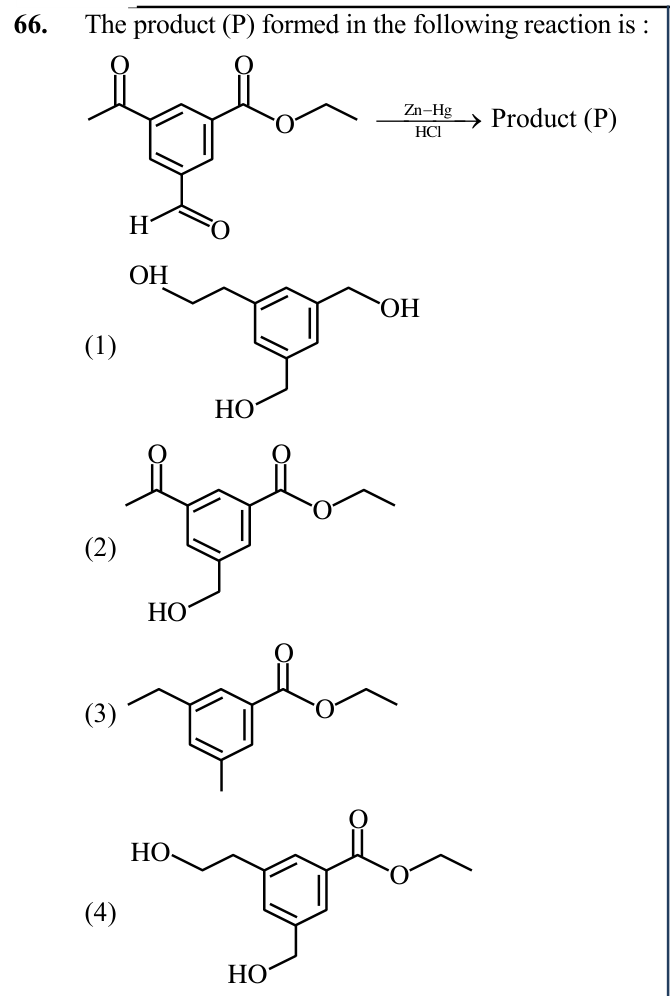
(1) OH
OH
HO
(2) O
O
HO
O
(3) O
O
(4) O
O
HO
HO
O
O
O
H
O
O
O
Zn-Hg/HCl
Clemmensen
Reduction
QUESTION 4
Aldehydes, Ketones and Carboxylic Acids
SECTION A · MCQ (+4, -1)
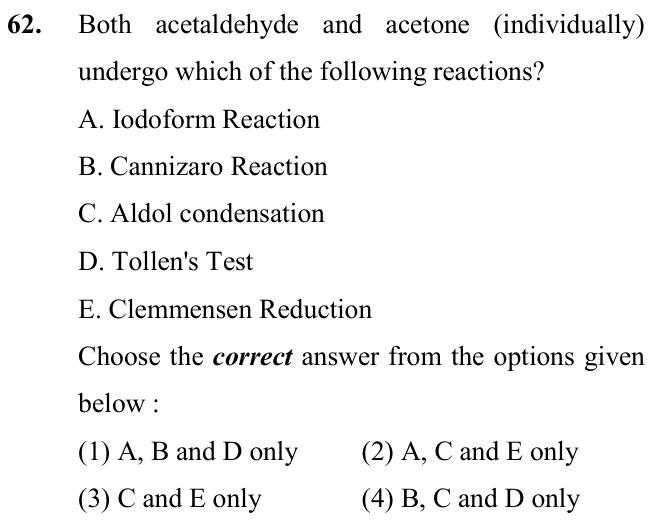
(1) A, B and D only
(2) A, C and E only
(3) C and E only
(4) B, C and D only
S.No.
Name of
Reaction
Acetaldehyde
CH3–C–H
O
Acetone
CH3–C–CH3
O
1
Iodoform
reaction
⊕ve
⊕ve
2
Cannizaro
ve
ve
3
Aldol
reaction
⊕ve
⊕ve
4
Tollen‟s test
⊕ve
ve
5
Clemmensen
reduction
⊕ve
⊕ve
Ans. (2) A, C and E only
5
QUESTION 5
Aldehydes, Ketones and Carboxylic Acids
SECTION A · MCQ (+4, -1)
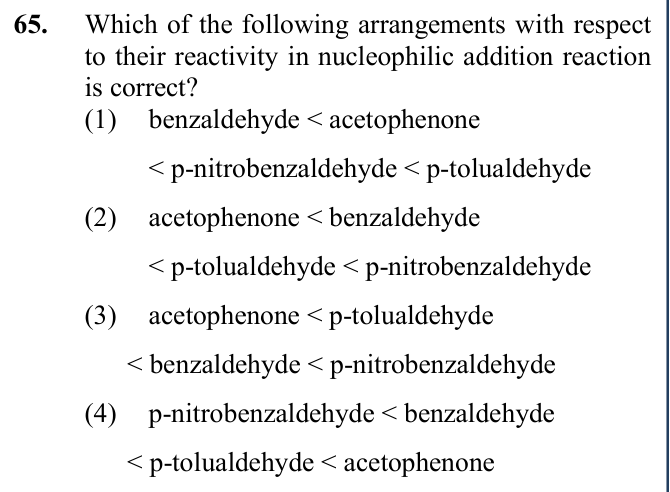
(1) benzaldehyde < acetophenone
< p-nitrobenzaldehyde < p-tolualdehyde
(2) acetophenone < benzaldehyde
< p-tolualdehyde < p-nitrobenzaldehyde
(3) acetophenone < p-tolualdehyde
< benzaldehyde < p-nitrobenzaldehyde
(4) p-nitrobenzaldehyde < benzaldehyde
< p-tolualdehyde < acetophenone
The rate of nucleophilic addition decreased due to
steric crowding around carbonyl carbon &
increased by electron withdrawing group if the
steric crowding is same hence the reactivity
towards nucleophilic addition will be
O
CH3
(Acetophenone)
(p-tolualdehyde)
CHO
CH3
(benzaldehyde)
(p-nitrobenzaldehyde)
CHO
NO2
CH
QUESTION 6
Aldehydes, Ketones and Carboxylic Acids
SECTION A · MCQ (+4, -1)
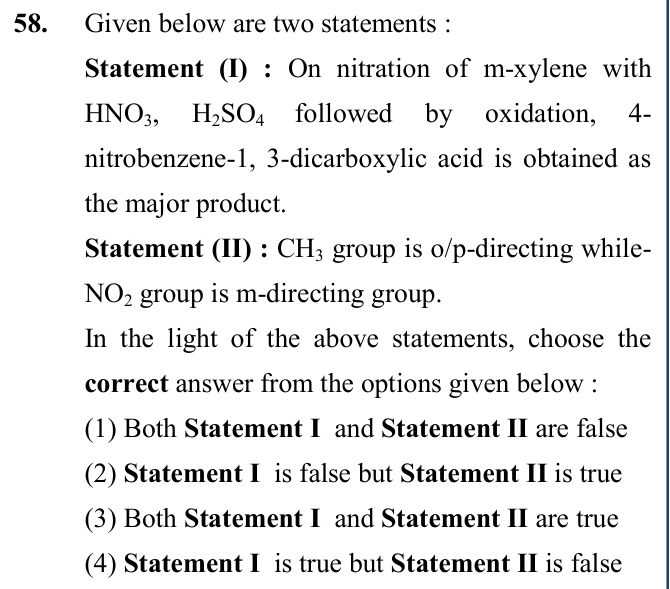
(1) Both Statement I and Statement II are false
(2) Statement I is false but Statement II is true
(3) Both Statement I and Statement II are true
(4) Statement I is true but Statement II is false
Statement-I
CH3
CH3
HNO3/H2SO4
CH3
CH3
NO2
Oxidation
COOH
COOH
NO2
(m-xylene)
Statement-II
–CH3 group is o/p directing while –NO2 group is
meta directing.
QUESTION 7
Aldehydes, Ketones and Carboxylic Acids
SECTION A · MCQ (+4, -1)
Heating the sodium salt of a carboxylic acid with soda lime (NaOH + CaO) produces which type of hydrocarbon by decarboxylation?
(1) alkane
(2) alkene
(3) alcohol
(4) alkyne
Soda lime decarboxylation (Dumas) gives an alkane with one fewer carbon.
QUESTION 8
Aldehydes, Ketones and Carboxylic Acids
SECTION A · MCQ (+4, -1)
The Rosenmund reduction converts an acid chloride into which product using H₂ over Pd/BaSO₄?
(1) aldehyde
(2) alcohol
(3) carboxylic acid
(4) ketone
Rosenmund reduction selectively yields an aldehyde from an acid chloride.
QUESTION 9
Aldehydes, Ketones and Carboxylic Acids
SECTION A · MCQ (+4, -1)
A ketone containing an acid-sensitive carbon–carbon double bond (C=C) must be reduced to the corresponding hydrocarbon. Which reagent should be used?
(1) Concentrated H₂SO₄
(2) Wolff-Kishner (NH₂NH₂/KOH in ethylene glycol)
(3) Clemmensen (Zn-Hg/conc. HCl)
(4) Dilute aqueous NaOH
Clemmensen's conc. HCl would attack the acid-sensitive C=C, so the basic Wolff-Kishner conditions (NH₂NH₂/KOH) are chosen to reduce only the carbonyl while leaving the C=C intact.
QUESTION 10
Aldehydes, Ketones and Carboxylic Acids
SECTION A · MCQ (+4, -1)
Benzaldehyde is heated with concentrated NaOH. The products of this Cannizzaro reaction are:
(1) benzyl alcohol and sodium benzoate
(2) benzaldehyde and sodium formate
(3) benzoic acid and methanol
(4) phenol and sodium carbonate
Benzaldehyde has no α-hydrogen, so it cannot form an enolate; with conc. NaOH it disproportionates — one molecule is reduced to benzyl alcohol and the other is oxidised to sodium benzoate.