
✎ ANSWER ONLINE · EVERY MISTAKE LINKS BACK TO THE CONCEPT
Aldehydes, Ketones and Carboxylic Acids · Practice Worksheet
Answer each question here and it marks straight away, with the derivation and a link to the exact micro-concept to revisit.
3 questions from this set could not be marked online — a
bonus or dual-key question, which has no single defensible answer. The print and
.docx versions still include them.
// CONCEPT AUDIT RESULT
Everything you missed has been added to your Error Arena — retest them blind there, and a concept clears once you get it right.
QUESTION 1
Aldehydes, Ketones and Carboxylic Acids
SECTION A · MCQ (+4, -1)
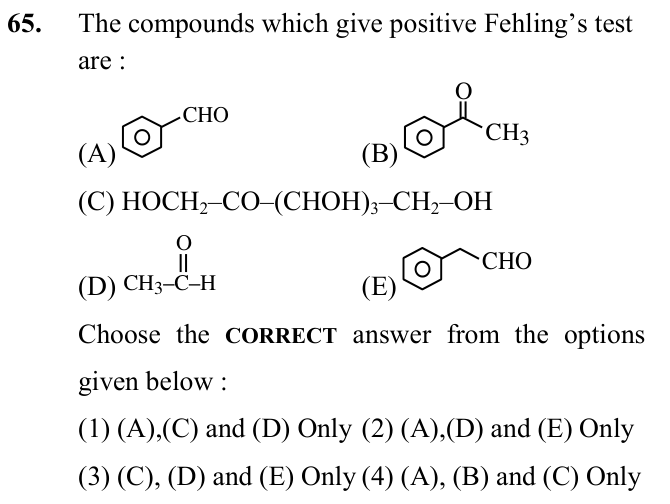
(1) (A),(C) and (D) Only
(2) (A),(D) and (E) Only
(3) (C), (D) and (E) Only
(4) (A), (B) and (C) Only
3
(C)
CH CH
O = ,
2
(D)
PhCH CH
O = ,
HOCH2 – C – (CHOH)3 – CH2OH
O
(E)
All gives positive Fehling test
4
QUESTION 2
Aldehydes, Ketones and Carboxylic Acids
SECTION A · MCQ (+4, -1)
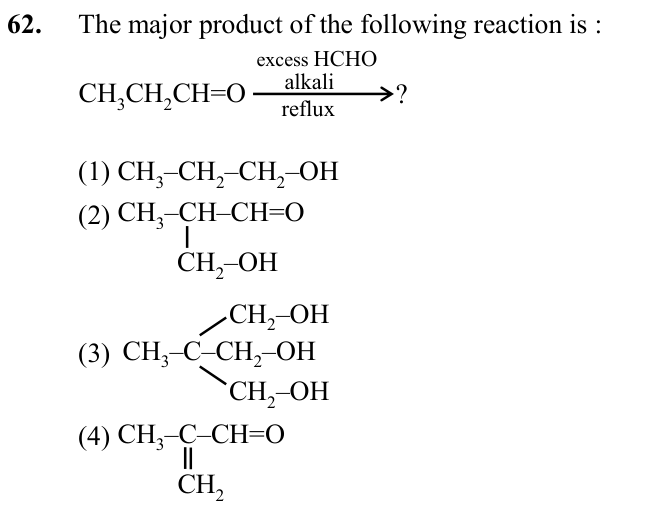
(1) CH3–CH2–CH2–OH
(2) CH3–CH–CH=O
CH2–OH
(3) CH3–C–CH2–OH
CH2–OH
CH2–OH
(4) CH3–C–CH=O
CH2
(3)
This is an example of Tollen‟s reaction i.e.
multiple cross aldol followed by cross Cannizaro
reaction
CH3CH2CH=O ———→
2HCHO
Alkali
CH3–C–CHO
CH2–OH
CH2–OH
———→
HCHO
Alkali
CH3–C–CH2–OH
CH2–OH
CH2–OH + Θ
HCOO
4
QUESTION 3
Aldehydes, Ketones and Carboxylic Acids
SECTION A · MCQ (+4, -1)
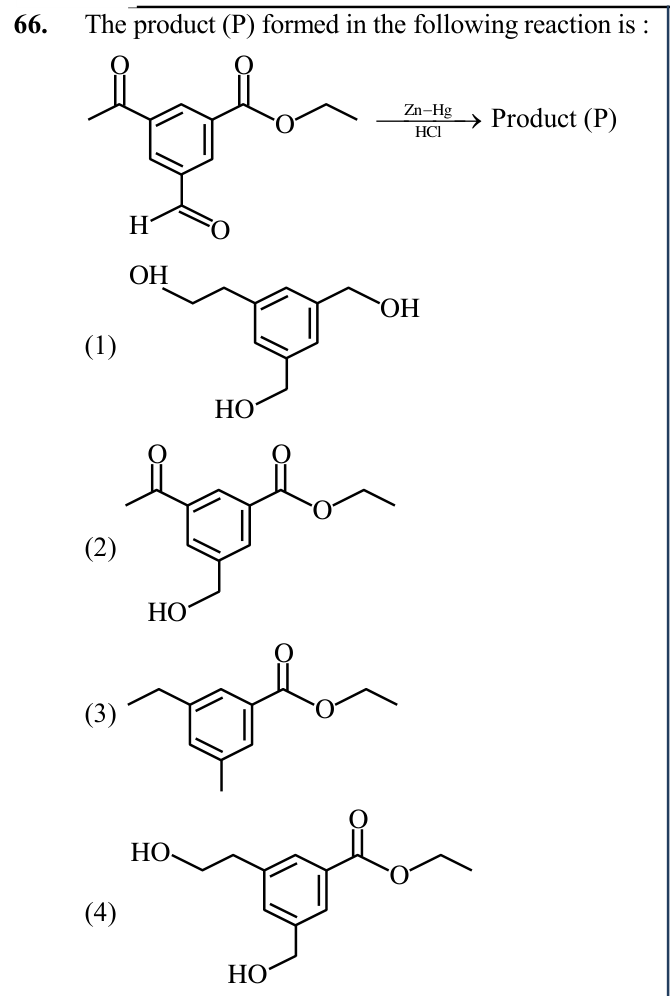
(1) OH
OH
HO
(2) O
O
HO
O
(3) O
O
(4) O
O
HO
HO
O
O
O
H
O
O
O
Zn-Hg/HCl
Clemmensen
Reduction
QUESTION 4
Aldehydes, Ketones and Carboxylic Acids
SECTION A · MCQ (+4, -1)
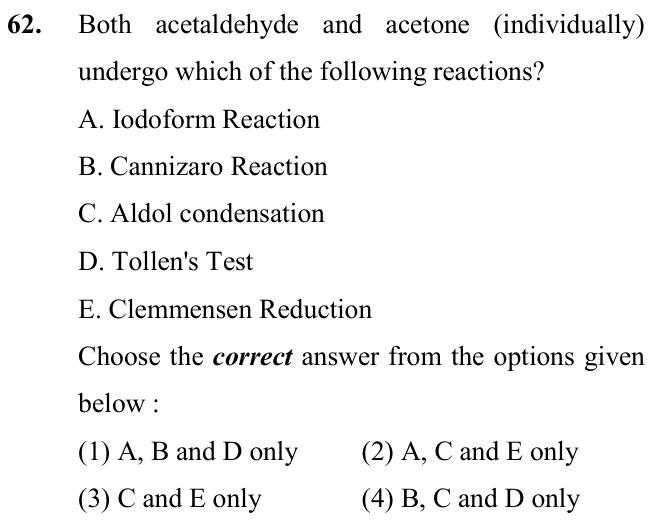
(1) A, B and D only
(2) A, C and E only
(3) C and E only
(4) B, C and D only
S.No.
Name of
Reaction
Acetaldehyde
CH3–C–H
O
Acetone
CH3–C–CH3
O
1
Iodoform
reaction
⊕ve
⊕ve
2
Cannizaro
ve
ve
3
Aldol
reaction
⊕ve
⊕ve
4
Tollen‟s test
⊕ve
ve
5
Clemmensen
reduction
⊕ve
⊕ve
Ans. (2) A, C and E only
5
QUESTION 5
Aldehydes, Ketones and Carboxylic Acids
SECTION A · MCQ (+4, -1)
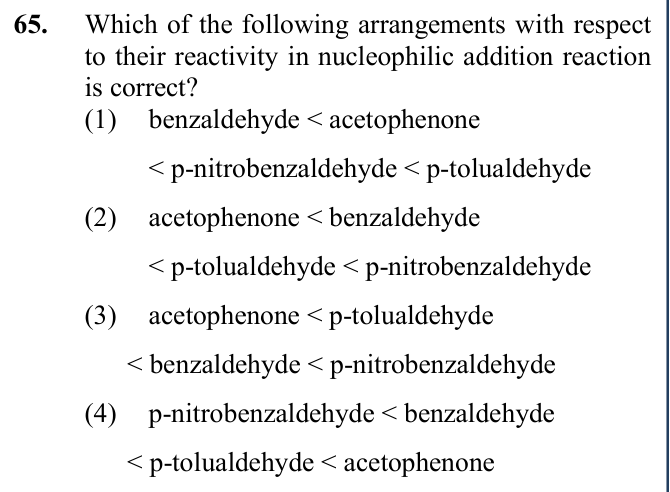
(1) benzaldehyde < acetophenone
< p-nitrobenzaldehyde < p-tolualdehyde
(2) acetophenone < benzaldehyde
< p-tolualdehyde < p-nitrobenzaldehyde
(3) acetophenone < p-tolualdehyde
< benzaldehyde < p-nitrobenzaldehyde
(4) p-nitrobenzaldehyde < benzaldehyde
< p-tolualdehyde < acetophenone
The rate of nucleophilic addition decreased due to
steric crowding around carbonyl carbon &
increased by electron withdrawing group if the
steric crowding is same hence the reactivity
towards nucleophilic addition will be
O
CH3
(Acetophenone)
(p-tolualdehyde)
CHO
CH3
(benzaldehyde)
(p-nitrobenzaldehyde)
CHO
NO2
CH
QUESTION 6
Aldehydes, Ketones and Carboxylic Acids
SECTION A · MCQ (+4, -1)
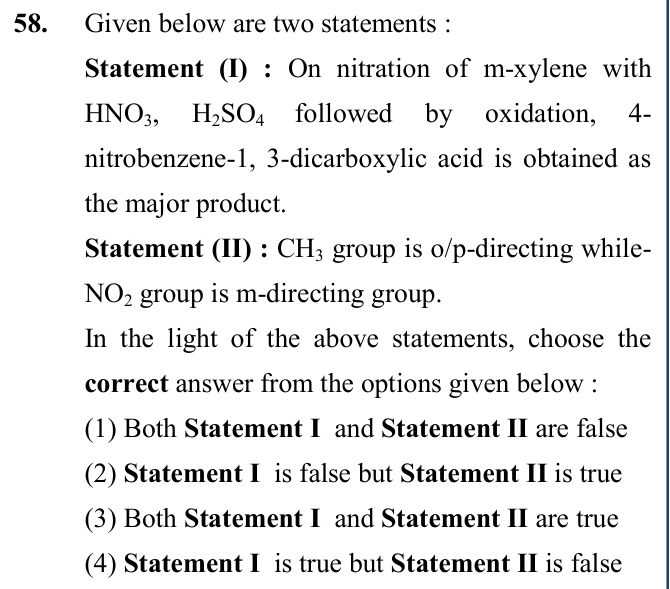
(1) Both Statement I and Statement II are false
(2) Statement I is false but Statement II is true
(3) Both Statement I and Statement II are true
(4) Statement I is true but Statement II is false
Statement-I
CH3
CH3
HNO3/H2SO4
CH3
CH3
NO2
Oxidation
COOH
COOH
NO2
(m-xylene)
Statement-II
–CH3 group is o/p directing while –NO2 group is
meta directing.
QUESTION 7
Aldehydes, Ketones and Carboxylic Acids
SECTION A · MCQ (+4, -1)
Heating the sodium salt of a carboxylic acid with soda lime (NaOH + CaO) produces which type of hydrocarbon by decarboxylation?
(1) alkane
(2) alkene
(3) alcohol
(4) alkyne
Soda lime decarboxylation (Dumas) gives an alkane with one fewer carbon.
QUESTION 8
Aldehydes, Ketones and Carboxylic Acids
SECTION A · MCQ (+4, -1)
The Rosenmund reduction converts an acid chloride into which product using H₂ over Pd/BaSO₄?
(1) aldehyde
(2) alcohol
(3) carboxylic acid
(4) ketone
Rosenmund reduction selectively yields an aldehyde from an acid chloride.
QUESTION 9
Aldehydes, Ketones and Carboxylic Acids
SECTION A · MCQ (+4, -1)
A ketone containing an acid-sensitive carbon–carbon double bond (C=C) must be reduced to the corresponding hydrocarbon. Which reagent should be used?
(1) Concentrated H₂SO₄
(2) Wolff-Kishner (NH₂NH₂/KOH in ethylene glycol)
(3) Clemmensen (Zn-Hg/conc. HCl)
(4) Dilute aqueous NaOH
Clemmensen's conc. HCl would attack the acid-sensitive C=C, so the basic Wolff-Kishner conditions (NH₂NH₂/KOH) are chosen to reduce only the carbonyl while leaving the C=C intact.
QUESTION 10
Aldehydes, Ketones and Carboxylic Acids
SECTION A · MCQ (+4, -1)
Benzaldehyde is heated with concentrated NaOH. The products of this Cannizzaro reaction are:
(1) benzyl alcohol and sodium benzoate
(2) benzaldehyde and sodium formate
(3) benzoic acid and methanol
(4) phenol and sodium carbonate
Benzaldehyde has no α-hydrogen, so it cannot form an enolate; with conc. NaOH it disproportionates — one molecule is reduced to benzyl alcohol and the other is oxidised to sodium benzoate.
QUESTION 11
Aldehydes, Ketones and Carboxylic Acids
SECTION A · MCQ (+4, -1)
Which compound CANNOT undergo the Hell-Volhard-Zelinsky (HVZ) reaction?
(1) Acetic acid (CH₃COOH)
(2) Propanoic acid (CH₃CH₂COOH)
(3) Butanoic acid (CH₃CH₂CH₂COOH)
(4) Benzoic acid (no α-hydrogen)
The HVZ reaction requires an α-hydrogen to form the enolisable acyl halide intermediate. Benzoic acid has no α-hydrogen, so it cannot undergo HVZ; acetic, propanoic and butanoic acids all have α-hydrogens.
QUESTION 12
Aldehydes, Ketones and Carboxylic Acids
SECTION A · MCQ (+4, -1)
Arrange formaldehyde (HCHO), acetaldehyde (CH₃CHO) and acetone (CH₃COCH₃) in decreasing order of reactivity toward nucleophilic addition:
(1) CH₃CHO > HCHO > CH₃COCH₃
(2) HCHO > CH₃COCH₃ > CH₃CHO
(3) CH₃COCH₃ > CH₃CHO > HCHO
(4) HCHO > CH₃CHO > CH₃COCH₃
More alkyl groups mean more +I electron donation and more steric crowding, both lowering the carbonyl carbon's electrophilicity. HCHO (no alkyl group) is most reactive; acetone (two methyl groups) is least.
QUESTION 13
Aldehydes, Ketones and Carboxylic Acids
SECTION A · MCQ (+4, -1)
The α-hydrogen of aldehydes and ketones is acidic because the resulting enolate is stabilised by which factor?
(1) inductive effect only
(2) resonance
(3) hyperconjugation only
(4) no stabilisation
Resonance delocalises the negative charge of the enolate ion.
QUESTION 14
Aldehydes, Ketones and Carboxylic Acids
SECTION A · MCQ (+4, -1)
Aldehydes are more reactive than ketones toward nucleophilic addition because of which combined effect?
(1) sp³ hybridised carbon
(2) more steric hindrance
(3) less steric hindrance and less electron-donating inductive effect
(4) a stronger +I effect
Smaller groups and weaker +I donation make aldehydes more reactive.
QUESTION 15
Aldehydes, Ketones and Carboxylic Acids
SECTION A · MCQ (+4, -1)
In the Rosenmund reduction, palladium is supported on BaSO₄ and poisoned with quinoline or sulphur. The purpose of this poisoning is to:
(1) dampen palladium's activity so reduction stops at the aldehyde instead of over-reducing to the alcohol
(2) increase the rate of hydrogenation all the way to the primary alcohol
(3) convert the acyl chloride into an ester
(4) make the catalyst dissolve into the reaction medium
Unpoisoned Pd is so active that it would reduce RCOCl past the aldehyde to the alcohol. The BaSO₄ support plus quinoline/sulphur poison damps Pd's activity, arresting reduction precisely at RCHO.
QUESTION 16
Aldehydes, Ketones and Carboxylic Acids
SECTION A · MCQ (+4, -1)
Clemmensen reduction converts a carbonyl group into a –CH₂– group using which reagent?
(1) LiAlH₄
(2) Zn–Hg amalgam and concentrated HCl
(3) NaBH₄
(4) H₂/Pd
Clemmensen uses Zn–Hg/HCl to reduce carbonyls to methylene.
QUESTION 17
Aldehydes, Ketones and Carboxylic Acids
SECTION A · MCQ (+4, -1)
The Hell-Volhard-Zelinsky reaction halogenates a carboxylic acid specifically at which position?
(1) β-carbon
(2) α-carbon
(3) aromatic ring
(4) carbonyl carbon
HVZ replaces the α-hydrogen of a carboxylic acid with a halogen.