
✎ ANSWER ONLINE · EVERY MISTAKE LINKS BACK TO THE CONCEPT
Amines · Practice Worksheet
Answer each question here and it marks straight away, with the derivation and a link to the exact micro-concept to revisit.
5 questions from this set could not be marked online — a
bonus or dual-key question, which has no single defensible answer. The print and
.docx versions still include them.
// CONCEPT AUDIT RESULT
Everything you missed has been added to your Error Arena — retest them blind there, and a concept clears once you get it right.
QUESTION 1
Amines
SECTION A · MCQ (+4, -1)
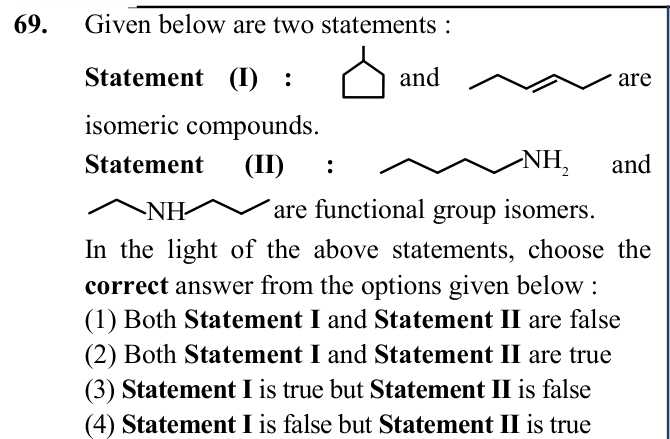
(1) Both Statement I and Statement II are false
(2) Both Statement I and Statement II are true
(3) Statement I is true but Statement II is false
(4) Statement I is false but Statement II is true
Statement-I → True
Both are ring chain isomers
Statement-II → True
NH2
NH
1° Amine
2° Amine
1° Amine and 2° Amine are different functional
groups, hence both are functional group isomers.
QUESTION 2
Amines
SECTION A · MCQ (+4, -1)
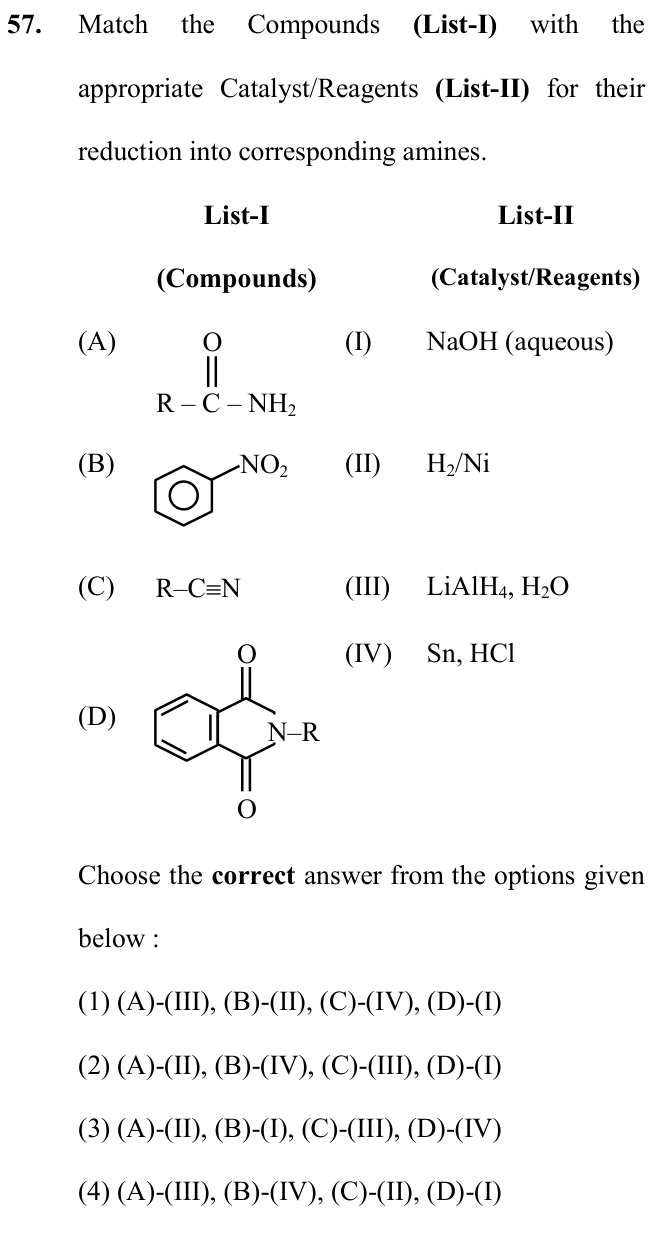
(1) (A)-(III), (B)-(II), (C)-(IV), (D)-(I)
(2) (A)-(II), (B)-(IV), (C)-(III), (D)-(I)
(3) (A)-(II), (B)-(I), (C)-(III), (D)-(IV)
(4) (A)-(III), (B)-(IV), (C)-(II), (D)-(I)
(A) R – C – NH2
O
LiAlH4
H2O
R – CH2 – NH2
(B)
NO2
Sn, HCl
NH2
(C)
2
H /Ni
2
2
R
C
N
R
CH NH - ≡
———→ - (D)
N–R
O
O
Aq.NaOH
R–NH2 +
ONa+
O
O
–
ONa+
–
QUESTION 3
Amines
SECTION A · MCQ (+4, -1)
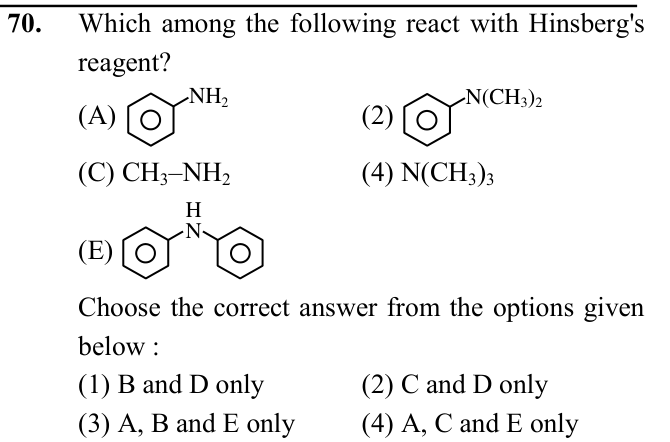
(1) B and D only
(2) C and D only
(3) A, B and E only
(4) A, C and E only
(4)
B and D are 3º amine which does not have
replaceable H on N, So does not react.
SECTION-B
QUESTION 4
Amines
SECTION A · MCQ (+4, -1)
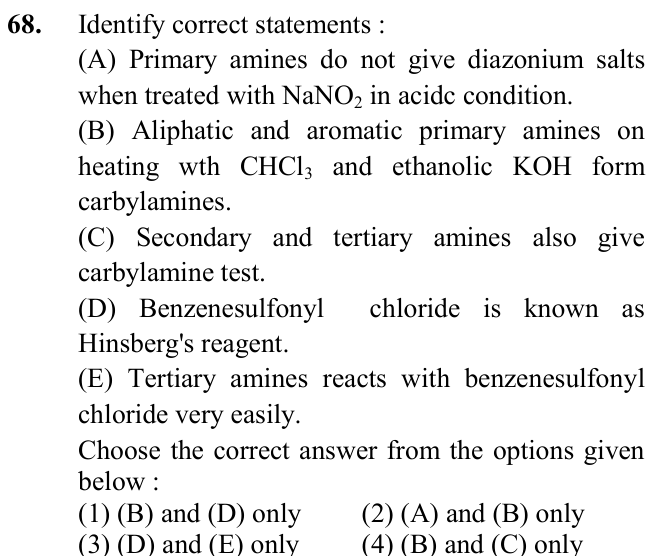
(1) (B) and (D) only
(2) (A) and (B) only
(3) (D) and (E) only
(4) (B) and (C) only
(A) R–NH2
2
NaNO
HCl
———→
2
R
N Cl
⊕ - Θ
(B)
NH2
NC
————→
CHCl3
KOH(EtOH)
R–NH2
3
CHCl
KOH(EtOH)
—————→ R–NC
(C) Only primary amine gives carbyl amine test
(D) Ph–SO2Cl —→ Hinsberg reagent
Benzene sulphonyl chloride
(E) Tertiary amine do not react with Ph–SO2Cl
So correct options are (B) and (D) only
5
QUESTION 5
Amines
SECTION A · MCQ (+4, -1)
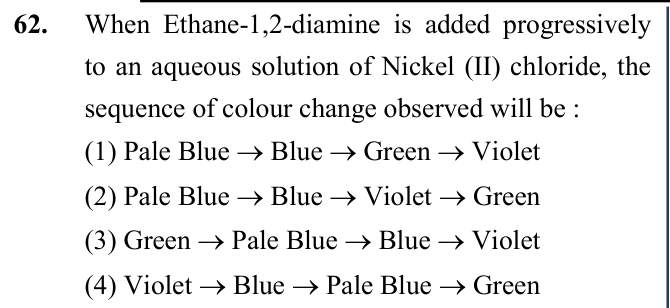
(1) Pale Blue → Blue → Green → Violet
(2) Pale Blue → Blue → Violet → Green
(3) Green → Pale Blue → Blue → Violet
(4) Violet → Blue → Pale Blue → Green
[Ni(H2O)6]+2
(aq) + en(aq) → [Ni(H2O)4(en)]+2
(aq) + 2H2O
Green
[Ni(H2O)4(en)]+2
(aq) + en(aq)→[Ni(H2O)2(en)2]+2
(aq) + 2H2O
Pale Blue
[Ni(H2O)2(en)]+2
(aq) + en(aq) → [Ni(en)3]+2
(aq) + 2H2O
Blue / purple
QUESTION 6
Amines
SECTION A · MCQ (+4, -1)
A trivalent amine with three different substituents on nitrogen is chiral in principle, yet cannot be resolved into stable enantiomers because:
(1) rapid pyramidal (umbrella) inversion through a planar sp² transition state interconverts the enantiomers
(2) the amine nitrogen is sp² hybridised and therefore permanently planar
(3) the nitrogen lone pair physically blocks the resolving agent
(4) such chiral amines always contain a plane of symmetry
Amine nitrogen is sp³ with a lone pair in one orbital. The lone pair flips through a planar sp² transition state with a very low barrier (~25 kJ/mol), interconverting the two enantiomeric forms about 10¹¹ times per second and causing instant racemisation.
QUESTION 7
Amines
SECTION A · MCQ (+4, -1)
Benzenediazonium chloride is prepared by treating aniline with NaNO₂ and HCl at which temperature range?
(1) 25–30 °C
(2) 100 °C
(3) 50–60 °C
(4) 0–5 °C
Diazotisation is carried out at 0–5 °C to keep the diazonium salt stable.
QUESTION 8
Amines
SECTION A · MCQ (+4, -1)
In aqueous solution, the correct order of basic strength of methylamine, dimethylamine and trimethylamine is:
(1) (CH₃)₃N > CH₃NH₂ > (CH₃)₂NH
(2) CH₃NH₂ > (CH₃)₂NH > (CH₃)₃N
(3) (CH₃)₃N > (CH₃)₂NH > CH₃NH₂ (the gas-phase order)
(4) (CH₃)₂NH > CH₃NH₂ > (CH₃)₃N (the 213 rule)
In water the +I inductive effect competes with hydration (favouring more N–H bonds, i.e. 1°) and steric hindrance. For the small methyl groups, hydration dominates slightly over sterics, so the sequence is 2° > 1° > 3° — the 213 rule.
QUESTION 9
Amines
SECTION A · MCQ (+4, -1)
In the gas phase, the basicity of simple alkyl amines follows which order?
(1) primary > secondary > tertiary
(2) secondary > primary > tertiary
(3) secondary > tertiary > primary
(4) tertiary > secondary > primary
In the gas phase only the +I effect operates, so basicity increases with alkyl substitution.
QUESTION 10
Amines
SECTION A · MCQ (+4, -1)
Fluorobenzene is best prepared from benzenediazonium chloride by:
(1) warming with aqueous KI
(2) converting to the diazonium fluoroborate (C₆H₅N₂⁺BF₄⁻) and heating it dry (Balz-Schiemann reaction)
(3) Sandmeyer reaction with Cu₂Cl₂
(4) warming with aqueous HF
Fluoride cannot directly replace the diazonium group in aqueous solution. Instead the insoluble diazonium fluoroborate is isolated and decomposed by dry heating: C₆H₅N₂⁺BF₄⁻ → C₆H₅F + BF₃ + N₂ (the Balz-Schiemann reaction).
QUESTION 11
Amines
SECTION A · MCQ (+4, -1)
On reaction with nitrous acid (HNO₂), a secondary amine gives which product?
(1) an alcohol
(2) a yellow oily N-nitroso compound
(3) nitrogen gas
(4) a diazonium salt
Secondary amines give N-nitroso compounds; primary amines evolve N₂ or form diazonium salts.
QUESTION 12
Amines
SECTION A · MCQ (+4, -1)
On what basis is the degree (1°, 2°, 3°) of an amine assigned?
(1) number of carbon atoms attached to the carbon bearing –OH
(2) number of hydrogen atoms on nitrogen
(3) number of carbon atoms attached to nitrogen
(4) molecular weight
Amine degree counts carbons bonded directly to nitrogen.
QUESTION 13
Amines
SECTION A · MCQ (+4, -1)
Hofmann bromamide degradation converts an amide into a primary amine having how many carbon atoms relative to the parent amide?
(1) the same number
(2) one more
(3) one less
(4) two less
The reaction removes one carbon (step-down) from the amide.
QUESTION 14
Amines
SECTION A · MCQ (+4, -1)
Before nitrating aniline to obtain para-substitution, the –NH₂ group is protected by which reaction?
(1) oxidation
(2) acetylation
(3) hydrolysis
(4) reduction
Acetylation converts –NH₂ to –NHCOCH₃, protecting it during nitration.
QUESTION 15
Amines
SECTION A · MCQ (+4, -1)
Direct nitration of aniline with concentrated HNO₃ yields a significant amount of which isomeric product?
(1) meta-nitroaniline
(2) para-nitroaniline
(3) no reaction
(4) ortho-nitroaniline
Protonation to the meta-directing anilinium ion gives the meta isomer.