
✎ ANSWER ONLINE · EVERY MISTAKE LINKS BACK TO THE CONCEPT
Biomolecules · Practice Worksheet
Answer each question here and it marks straight away, with the derivation and a link to the exact micro-concept to revisit.
1 question from this set could not be marked online — a
bonus or dual-key question, which has no single defensible answer. The print and
.docx versions still include it.
// CONCEPT AUDIT RESULT
Everything you missed has been added to your Error Arena — retest them blind there, and a concept clears once you get it right.
QUESTION 1
Biomolecules
SECTION A · MCQ (+4, -1)
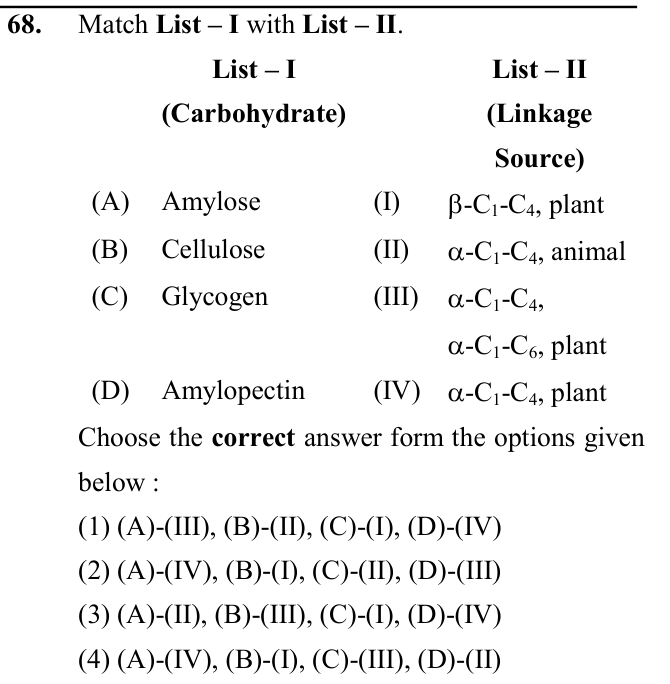
(1) (A)-(III), (B)-(II), (C)-(I), (D)-(IV)
(2) (A)-(IV), (B)-(I), (C)-(II), (D)-(III)
(3) (A)-(II), (B)-(III), (C)-(I), (D)-(IV)
(4) (A)-(IV), (B)-(I), (C)-(III), (D)-(II)
Informative
QUESTION 2
Biomolecules
SECTION A · MCQ (+4, -1)
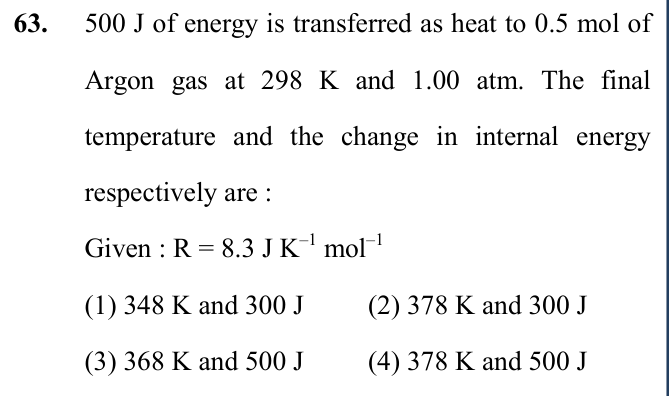
(1) 348 K and 300 J
(2) 378 K and 300 J
(3) 368 K and 500 J
(4) 378 K and 500 J
qp = n × cp × ΔT
⇒ 500 = 0.5 × 5
2 × 8.3 (Tf –298)
⇒ Tf
346.2K
H
U
Δ
Δ = p
v
C
C = 5
3
)
(
[
)
⇒ ΔU = 3
5 × 500 = 300 J
QUESTION 3
Biomolecules
SECTION A · MCQ (+4, -1)
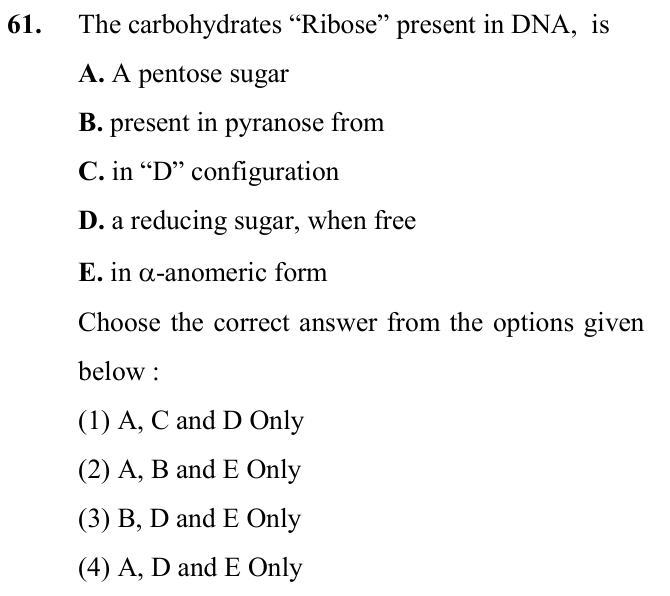
(1) A, C and D Only
(2) A, B and E Only
(3) B, D and E Only
(4) A, D and E Only
In Ribose carbohydrate present in DNA is β-2-
Deoxy-D-Ribose whose structure is
H
OH
O
HOCH2
H
H
OH
H
H
which is a reducing D-sugar in β anomeric form &
it is a pentose sugar.
QUESTION 4
Biomolecules
SECTION A · MCQ (+4, -1)
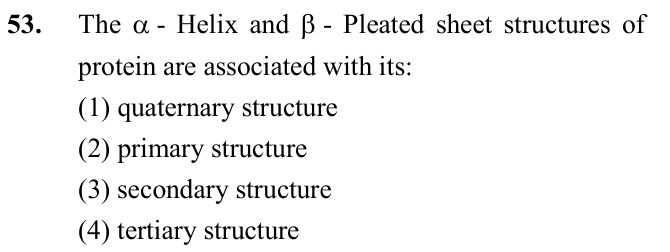
(1) quaternary structure
(2) primary structure
(3) secondary structure
(4) tertiary structure
α-helix and β-pleated sheet belongs to secondary
structure of protein, which have hydrogen bonds.
QUESTION 5
Biomolecules
SECTION A · MCQ (+4, -1)
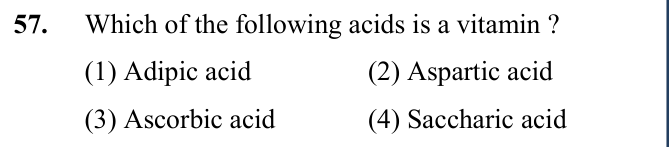
(1) Adipic acid
(2) Aspartic acid
(3) Ascorbic acid
(4) Saccharic acid
Vitamin-C is Ascorbic acid.
QUESTION 6
Biomolecules
SECTION A · MCQ (+4, -1)
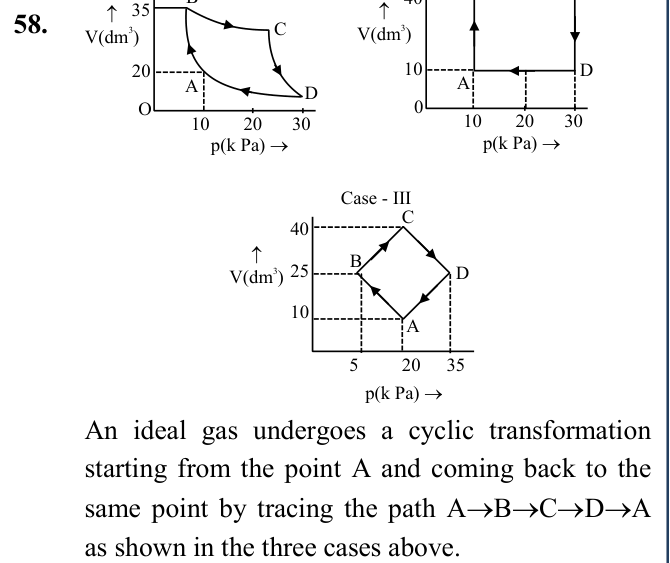
(1) ΔU (Case-III) > ΔU (Case-II) > ΔU (Case-I)
(2) ΔU (Case-I) > ΔU (Case-II) > ΔU (Case-III)
(3) ΔU (Case-I) > ΔU (Case-III) > ΔU (Case-II)
(4) ΔU (Case-I) = ΔU (Case-II) = ΔU (Case-III)
As internal energy ‘U’ is a state function, its cyclic
integral must be zero in a cyclic process
∴ΔU case (I) = ΔU case (II) = ΔU case (III)
QUESTION 7
Biomolecules
SECTION A · MCQ (+4, -1)
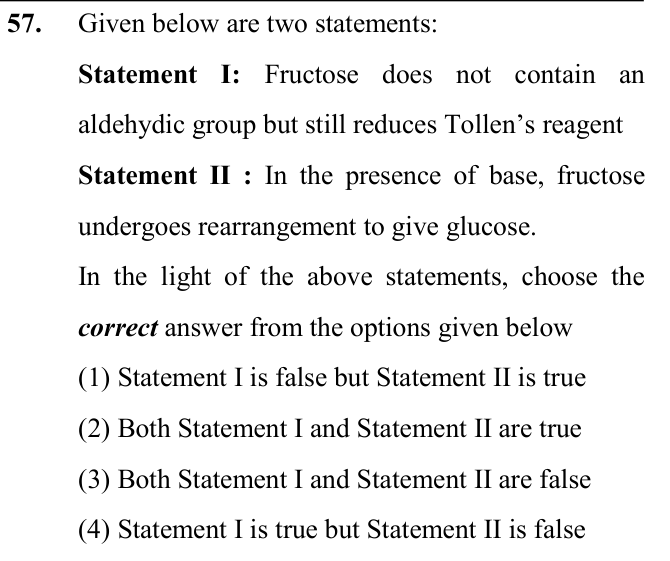
(1) Statement I is false but Statement II is true
(2) Both Statement I and Statement II are true
(3) Both Statement I and Statement II are false
(4) Statement I is true but Statement II is false
(2)
CH2–OH
C = O
H
OH
OH
HO
H
H
CH2OH
(D. Fructose)
(Enediol)
CH–OH
C – OH
HO
H
H
H
OH
OH
CH2OH
OH
–
OH
OH
OH
H
H
H
H
HO + CH=O
CH=O
HO
HO
CH2OH
CH2OH
H
H
OH
OH
H
H
D-Glucose
D-Mannose
QUESTION 8
Biomolecules
SECTION A · MCQ (+4, -1)
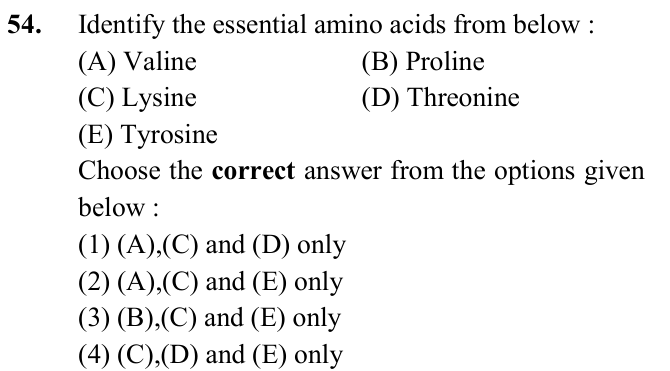
(1) (A),(C) and (D) only
(2) (A),(C) and (E) only
(3) (B),(C) and (E) only
(4) (C),(D) and (E) only
Valine, Lysine and Threonine are essential amino
acids.
QUESTION 9
Biomolecules
SECTION A · MCQ (+4, -1)
Deficiency of which fat-soluble vitamin causes increased blood-clotting time (haemorrhage)?
(1) Vitamin A
(2) Vitamin D
(3) Vitamin K
(4) Vitamin E
Vitamin K is required for the synthesis of blood-clotting factors; its deficiency prolongs clotting time and can cause haemorrhage.
QUESTION 10
Biomolecules
SECTION A · MCQ (+4, -1)
Which bond links amino acid residues together to form the primary structure of a protein?
(1) Glycosidic bond
(2) Peptide bond (-CO-NH-)
(3) Phosphodiester bond
(4) Hydrogen bond
The primary structure is the linear sequence of amino acids joined by covalent peptide (amide) bonds, -CO-NH-, formed by condensation with loss of water.
QUESTION 11
Biomolecules
SECTION A · MCQ (+4, -1)
At which carbon atom do α-D-glucopyranose and β-D-glucopyranose differ in configuration?
(1) C1
(2) C6
(3) C5
(4) C2
Ring closure converts C1 (the former aldehyde carbon) into a new chiral centre, the anomeric carbon. The two anomers differ only in the orientation of the -OH group at this C1 position.
QUESTION 12
Biomolecules
SECTION A · MCQ (+4, -1)
In an electric field, in which direction does an amino acid migrate when the pH is below its isoelectric point (pI)?
(1) Toward the cathode (it is a cation)
(2) It does not migrate
(3) Toward neither electrode
(4) Toward the anode (it is an anion)
At pH < pI the amino acid gains a proton to become a net cation (+1) and migrates toward the negative cathode.
QUESTION 13
Biomolecules
SECTION A · MCQ (+4, -1)
On complete hydrolysis, how many monosaccharide units does a disaccharide such as sucrose yield?
(1) Two
(2) Three
(3) One
(4) A large number
Disaccharides are the simplest oligosaccharides and split into exactly two monosaccharide units on hydrolysis. Sucrose, for example, gives one glucose and one fructose; maltose gives two glucose units.
QUESTION 14
Biomolecules
SECTION A · MCQ (+4, -1)
A double-stranded DNA molecule contains 20% guanine. What percentage of thymine does it contain?
(1) 20%
(2) 30%
(3) 60%
(4) 40%
By Chargaff's rule G = C, so C = 20%. Together G + C = 40%, leaving A + T = 60%. Since A = T, thymine = 30%.