
✎ ANSWER ONLINE · EVERY MISTAKE LINKS BACK TO THE CONCEPT
Biomolecules · Practice Worksheet
Answer each question here and it marks straight away, with the derivation and a link to the exact micro-concept to revisit.
1 question from this set could not be marked online — a
bonus or dual-key question, which has no single defensible answer. The print and
.docx versions still include it.
// CONCEPT AUDIT RESULT
Everything you missed has been added to your Error Arena — retest them blind there, and a concept clears once you get it right.
QUESTION 1
Biomolecules
SECTION A · MCQ (+4, -1)
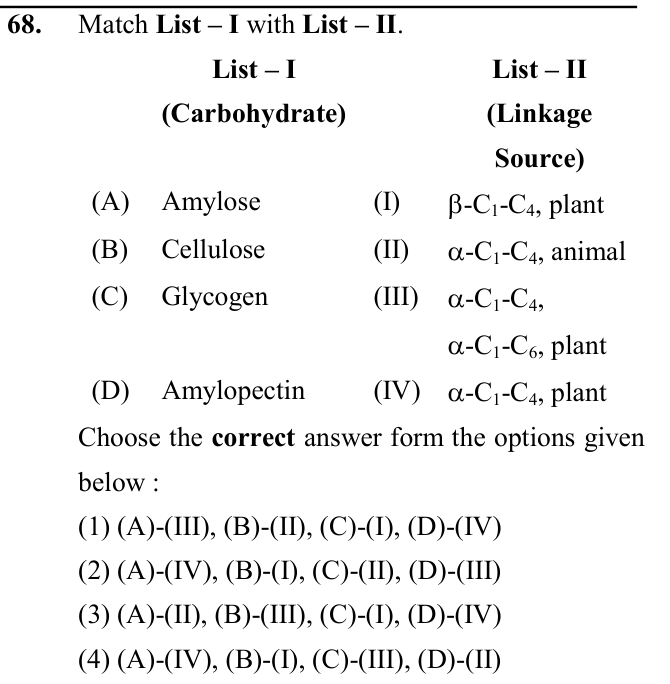
(1) (A)-(III), (B)-(II), (C)-(I), (D)-(IV)
(2) (A)-(IV), (B)-(I), (C)-(II), (D)-(III)
(3) (A)-(II), (B)-(III), (C)-(I), (D)-(IV)
(4) (A)-(IV), (B)-(I), (C)-(III), (D)-(II)
Informative
QUESTION 2
Biomolecules
SECTION A · MCQ (+4, -1)
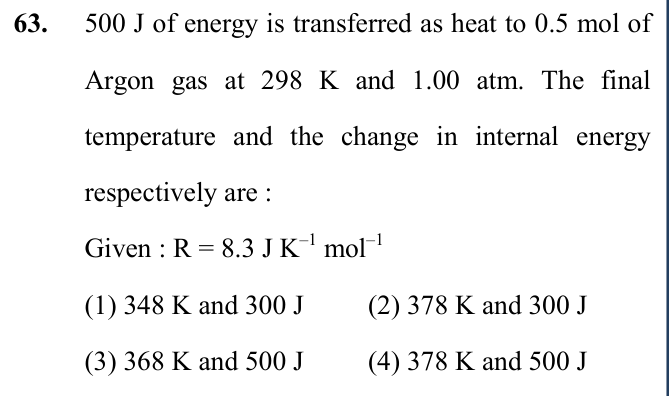
(1) 348 K and 300 J
(2) 378 K and 300 J
(3) 368 K and 500 J
(4) 378 K and 500 J
qp = n × cp × ΔT
⇒ 500 = 0.5 × 5
2 × 8.3 (Tf –298)
⇒ Tf
346.2K
H
U
Δ
Δ = p
v
C
C = 5
3
)
(
[
)
⇒ ΔU = 3
5 × 500 = 300 J
QUESTION 3
Biomolecules
SECTION A · MCQ (+4, -1)
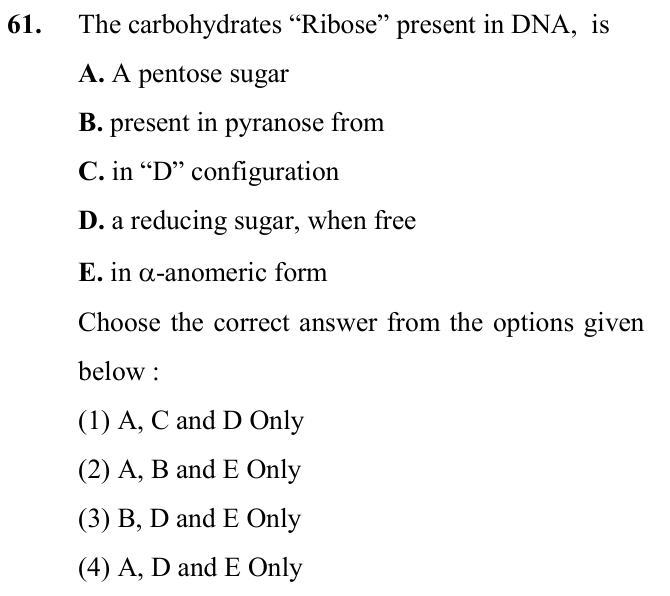
(1) A, C and D Only
(2) A, B and E Only
(3) B, D and E Only
(4) A, D and E Only
In Ribose carbohydrate present in DNA is β-2-
Deoxy-D-Ribose whose structure is
H
OH
O
HOCH2
H
H
OH
H
H
which is a reducing D-sugar in β anomeric form &
it is a pentose sugar.
QUESTION 4
Biomolecules
SECTION A · MCQ (+4, -1)
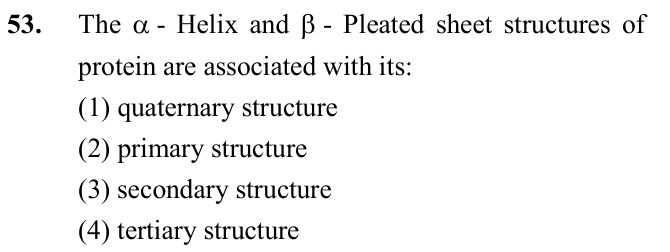
(1) quaternary structure
(2) primary structure
(3) secondary structure
(4) tertiary structure
α-helix and β-pleated sheet belongs to secondary
structure of protein, which have hydrogen bonds.
QUESTION 5
Biomolecules
SECTION A · MCQ (+4, -1)
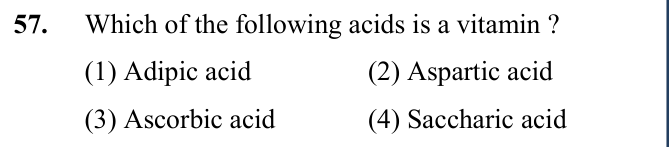
(1) Adipic acid
(2) Aspartic acid
(3) Ascorbic acid
(4) Saccharic acid
Vitamin-C is Ascorbic acid.
QUESTION 6
Biomolecules
SECTION A · MCQ (+4, -1)
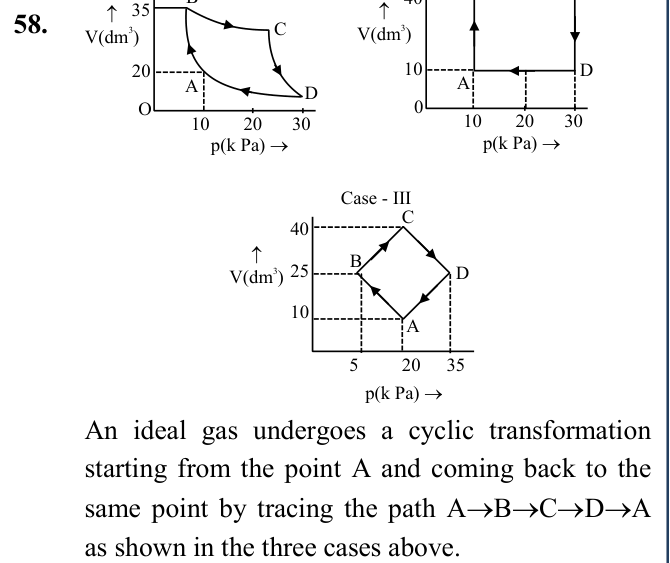
(1) ΔU (Case-III) > ΔU (Case-II) > ΔU (Case-I)
(2) ΔU (Case-I) > ΔU (Case-II) > ΔU (Case-III)
(3) ΔU (Case-I) > ΔU (Case-III) > ΔU (Case-II)
(4) ΔU (Case-I) = ΔU (Case-II) = ΔU (Case-III)
As internal energy ‘U’ is a state function, its cyclic
integral must be zero in a cyclic process
∴ΔU case (I) = ΔU case (II) = ΔU case (III)
QUESTION 7
Biomolecules
SECTION A · MCQ (+4, -1)
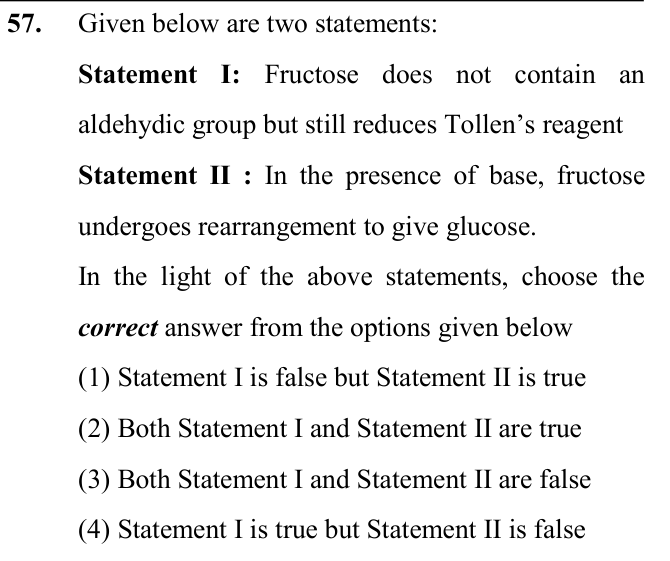
(1) Statement I is false but Statement II is true
(2) Both Statement I and Statement II are true
(3) Both Statement I and Statement II are false
(4) Statement I is true but Statement II is false
(2)
CH2–OH
C = O
H
OH
OH
HO
H
H
CH2OH
(D. Fructose)
(Enediol)
CH–OH
C – OH
HO
H
H
H
OH
OH
CH2OH
OH
–
OH
OH
OH
H
H
H
H
HO + CH=O
CH=O
HO
HO
CH2OH
CH2OH
H
H
OH
OH
H
H
D-Glucose
D-Mannose
QUESTION 8
Biomolecules
SECTION A · MCQ (+4, -1)
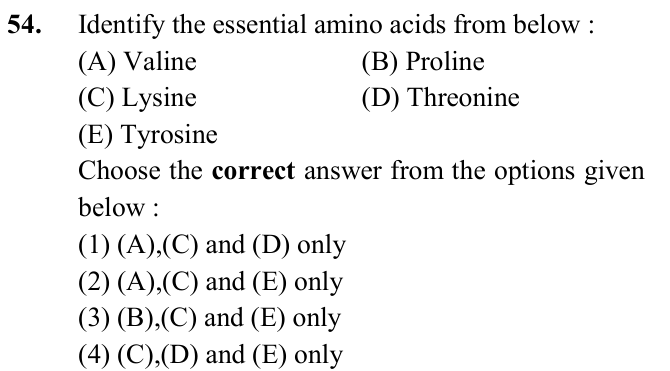
(1) (A),(C) and (D) only
(2) (A),(C) and (E) only
(3) (B),(C) and (E) only
(4) (C),(D) and (E) only
Valine, Lysine and Threonine are essential amino
acids.
QUESTION 9
Biomolecules
SECTION A · MCQ (+4, -1)
Deficiency of which fat-soluble vitamin causes increased blood-clotting time (haemorrhage)?
(1) Vitamin A
(2) Vitamin D
(3) Vitamin K
(4) Vitamin E
Vitamin K is required for the synthesis of blood-clotting factors; its deficiency prolongs clotting time and can cause haemorrhage.
QUESTION 10
Biomolecules
SECTION A · MCQ (+4, -1)
Which bond links amino acid residues together to form the primary structure of a protein?
(1) Glycosidic bond
(2) Peptide bond (-CO-NH-)
(3) Phosphodiester bond
(4) Hydrogen bond
The primary structure is the linear sequence of amino acids joined by covalent peptide (amide) bonds, -CO-NH-, formed by condensation with loss of water.
QUESTION 11
Biomolecules
SECTION A · MCQ (+4, -1)
At which carbon atom do α-D-glucopyranose and β-D-glucopyranose differ in configuration?
(1) C1
(2) C6
(3) C5
(4) C2
Ring closure converts C1 (the former aldehyde carbon) into a new chiral centre, the anomeric carbon. The two anomers differ only in the orientation of the -OH group at this C1 position.
QUESTION 12
Biomolecules
SECTION A · MCQ (+4, -1)
In an electric field, in which direction does an amino acid migrate when the pH is below its isoelectric point (pI)?
(1) Toward the cathode (it is a cation)
(2) It does not migrate
(3) Toward neither electrode
(4) Toward the anode (it is an anion)
At pH < pI the amino acid gains a proton to become a net cation (+1) and migrates toward the negative cathode.
QUESTION 13
Biomolecules
SECTION A · MCQ (+4, -1)
On complete hydrolysis, how many monosaccharide units does a disaccharide such as sucrose yield?
(1) Two
(2) Three
(3) One
(4) A large number
Disaccharides are the simplest oligosaccharides and split into exactly two monosaccharide units on hydrolysis. Sucrose, for example, gives one glucose and one fructose; maltose gives two glucose units.
QUESTION 14
Biomolecules
SECTION A · MCQ (+4, -1)
A double-stranded DNA molecule contains 20% guanine. What percentage of thymine does it contain?
(1) 20%
(2) 30%
(3) 60%
(4) 40%
By Chargaff's rule G = C, so C = 20%. Together G + C = 40%, leaving A + T = 60%. Since A = T, thymine = 30%.
QUESTION 15
Biomolecules
SECTION A · MCQ (+4, -1)
At its isoelectric point, an amino acid does which of the following?
(1) decomposes rapidly
(2) migrates to the anode
(3) does not migrate in an electric field
(4) migrates to the cathode
At the pI the amino acid has no net charge and shows no electrophoretic migration.
QUESTION 16
Biomolecules
SECTION A · MCQ (+4, -1)
A freshly prepared aqueous solution of pure α-D-glucose (specific rotation +112°) is allowed to stand. To what specific rotation does the solution finally drift?
(1) +52.7°
(2) +19°
(3) -19.85°
(4) +112°
Through mutarotation, the α-anomer interconverts with the β-anomer via a trace open-chain aldehyde, and the solution settles at an equilibrium rotation of +52.7° (36% α, 64% β).
QUESTION 17
Biomolecules
SECTION A · MCQ (+4, -1)
A peptide bond is formed between which two functional groups of amino acids?
(1) –COOH of one and –NH₂ of another
(2) –COOH of one and –COOH of another
(3) –NH₂ of one and –NH₂ of another
(4) –COOH and –OH of the same amino acid
The peptide (amide) bond links the carboxyl group of one amino acid to the amino group of another.
QUESTION 18
Biomolecules
SECTION A · MCQ (+4, -1)
Which disaccharide is non-reducing because its two anomeric carbons are linked together?
(1) sucrose
(2) maltose
(3) lactose
(4) cellobiose
Sucrose links C-1 of glucose to C-2 of fructose, leaving no free reducing group.
QUESTION 19
Biomolecules
SECTION A · MCQ (+4, -1)
Which of the following lists only water-soluble vitamins?
(1) A, D, E, K
(2) B complex and vitamin C
(3) A and C
(4) D and E
B-complex and vitamin C are water-soluble; A, D, E, K are fat-soluble.