
⚡ OFFICIAL NTA ASSESSMENT GENERATOR & WORD (.DOCX) EXPORTER
Biomolecules · Practice Worksheet
JEE Main Chemistry · Curated Assessment Set Print directly or export as a beautifully formatted Microsoft Word document with embedded 180-DPI mathematical prompt clips and step-by-step derivations.
EDUPROD JEE MAIN TEST SERIES · NTA PATTERN
Biomolecules · Practice Worksheet
JEE Main Chemistry · Curated Assessment Set · Assessment Code: JEE-101
Total Marks: 120
Marking: +4 / -1 (Sec A) · +4 / 0 (Sec B)
QUESTION 1
CHEMISTRY · Biomolecules
SECTION A · MCQ (+4, -1)
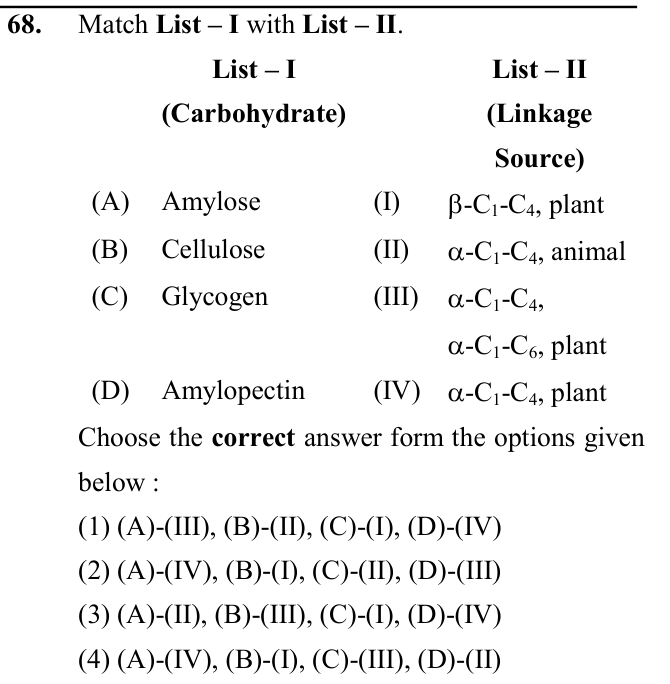
Candidate Response:
(1) (2) (3) (4)
QUESTION 2
CHEMISTRY · Biomolecules
SECTION A · MCQ (+4, -1)
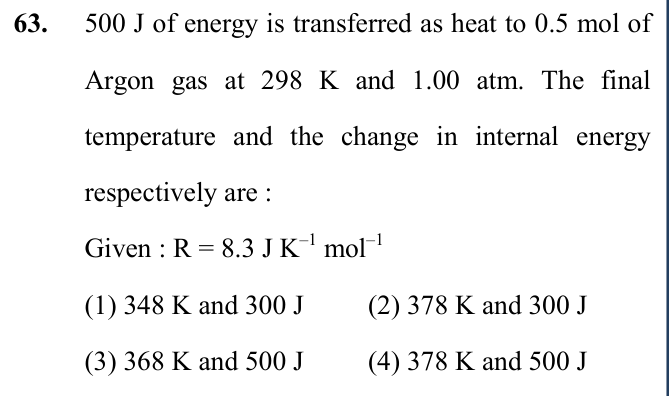
Candidate Response:
(1) (2) (3) (4)
QUESTION 3
CHEMISTRY · Biomolecules
SECTION A · MCQ (+4, -1)
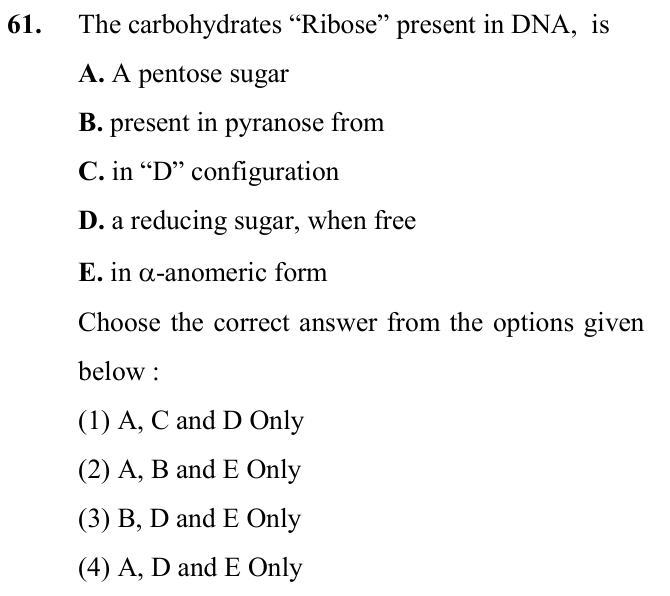
Candidate Response:
(1) (2) (3) (4)
QUESTION 4
CHEMISTRY · Biomolecules
SECTION A · MCQ (+4, -1)
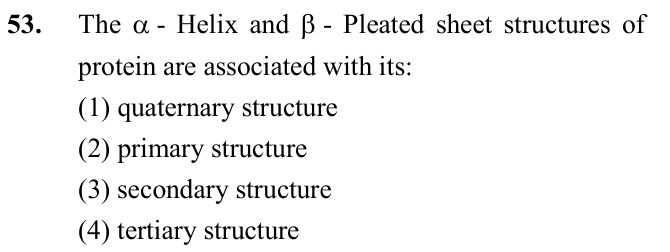
Candidate Response:
(1) (2) (3) (4)
QUESTION 5
CHEMISTRY · Biomolecules
SECTION A · MCQ (+4, -1)
Candidate Response:
(1) (2) (3) (4)
QUESTION 6
CHEMISTRY · Biomolecules
SECTION A · MCQ (+4, -1)
Candidate Response:
(1) (2) (3) (4)
QUESTION 7
CHEMISTRY · Biomolecules
SECTION A · MCQ (+4, -1)
Candidate Response:
(1) (2) (3) (4)
QUESTION 8
CHEMISTRY · Biomolecules
SECTION A · MCQ (+4, -1)
Candidate Response:
(1) (2) (3) (4)
QUESTION 9
CHEMISTRY · Biomolecules
SECTION A · MCQ (+4, -1)
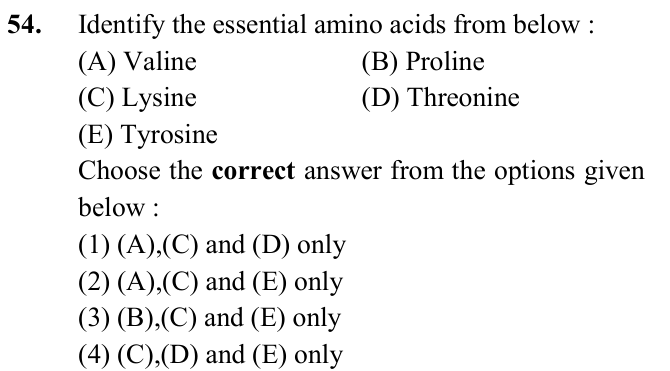
Candidate Response:
(1) (2) (3) (4)
QUESTION 10
CHEMISTRY · Biomolecules
SECTION A · MCQ (+4, -1)
Deficiency of which fat-soluble vitamin causes increased blood-clotting time (haemorrhage)?
(1) Vitamin A
(2) Vitamin D
(3) Vitamin K
(4) Vitamin E
Candidate Response:
(1) (2) (3) (4)
QUESTION 11
CHEMISTRY · Biomolecules
SECTION A · MCQ (+4, -1)
Which bond links amino acid residues together to form the primary structure of a protein?
(1) Glycosidic bond
(2) Peptide bond (-CO-NH-)
(3) Phosphodiester bond
(4) Hydrogen bond
Candidate Response:
(1) (2) (3) (4)
QUESTION 12
CHEMISTRY · Biomolecules
SECTION A · MCQ (+4, -1)
At which carbon atom do α-D-glucopyranose and β-D-glucopyranose differ in configuration?
(1) C1
(2) C6
(3) C5
(4) C2
Candidate Response:
(1) (2) (3) (4)
QUESTION 13
CHEMISTRY · Biomolecules
SECTION A · MCQ (+4, -1)
In an electric field, in which direction does an amino acid migrate when the pH is below its isoelectric point (pI)?
(1) Toward the cathode (it is a cation)
(2) It does not migrate
(3) Toward neither electrode
(4) Toward the anode (it is an anion)
Candidate Response:
(1) (2) (3) (4)
QUESTION 14
CHEMISTRY · Biomolecules
SECTION A · MCQ (+4, -1)
On complete hydrolysis, how many monosaccharide units does a disaccharide such as sucrose yield?
(1) Two
(2) Three
(3) One
(4) A large number
Candidate Response:
(1) (2) (3) (4)
QUESTION 15
CHEMISTRY · Biomolecules
SECTION A · MCQ (+4, -1)
A double-stranded DNA molecule contains 20% guanine. What percentage of thymine does it contain?
(1) 20%
(2) 30%
(3) 60%
(4) 40%
Candidate Response:
(1) (2) (3) (4)
QUESTION 16
CHEMISTRY · Biomolecules
SECTION A · MCQ (+4, -1)
At its isoelectric point, an amino acid does which of the following?
(1) decomposes rapidly
(2) migrates to the anode
(3) does not migrate in an electric field
(4) migrates to the cathode
Candidate Response:
(1) (2) (3) (4)
QUESTION 17
CHEMISTRY · Biomolecules
SECTION A · MCQ (+4, -1)
A freshly prepared aqueous solution of pure α-D-glucose (specific rotation +112°) is allowed to stand. To what specific rotation does the solution finally drift?
(1) +52.7°
(2) +19°
(3) -19.85°
(4) +112°
Candidate Response:
(1) (2) (3) (4)
QUESTION 18
CHEMISTRY · Biomolecules
SECTION A · MCQ (+4, -1)
A peptide bond is formed between which two functional groups of amino acids?
(1) –COOH of one and –NH₂ of another
(2) –COOH of one and –COOH of another
(3) –NH₂ of one and –NH₂ of another
(4) –COOH and –OH of the same amino acid
Candidate Response:
(1) (2) (3) (4)
QUESTION 19
CHEMISTRY · Biomolecules
SECTION A · MCQ (+4, -1)
Which disaccharide is non-reducing because its two anomeric carbons are linked together?
(1) sucrose
(2) maltose
(3) lactose
(4) cellobiose
Candidate Response:
(1) (2) (3) (4)
QUESTION 20
CHEMISTRY · Biomolecules
SECTION A · MCQ (+4, -1)
Which of the following lists only water-soluble vitamins?
(1) A, D, E, K
(2) B complex and vitamin C
(3) A and C
(4) D and E
Candidate Response:
(1) (2) (3) (4)
QUESTION 21
CHEMISTRY · Biomolecules
SECTION A · MCQ (+4, -1)
When sucrose (specific rotation +66.5°) is hydrolysed, what is the net specific rotation of the resulting 'invert sugar'?
(1) -92.4°
(2) +52.7°
(3) -19.85°
(4) +66.5°
Candidate Response:
(1) (2) (3) (4)
QUESTION 22
CHEMISTRY · Biomolecules
SECTION A · MCQ (+4, -1)
Which reagent, on prolonged heating, reduces glucose to n-hexane and thereby proves that glucose has a straight six-carbon chain?
(1) Concentrated HNO3
(2) Hydroxylamine (NH2OH)
(3) Bromine water (Br2/H2O)
(4) HI/red phosphorus
Candidate Response:
(1) (2) (3) (4)
QUESTION 23
CHEMISTRY · Biomolecules
SECTION A · MCQ (+4, -1)
The specific rotation of the equilibrium mixture of α- and β-D-glucose (mutarotation) is about?
(1) +19°
(2) +112°
(3) +52.7°
(4) −52.7°
Candidate Response:
(1) (2) (3) (4)
QUESTION 24
CHEMISTRY · Biomolecules
SECTION A · MCQ (+4, -1)
Which disaccharide is non-reducing, and why?
(1) Lactose, because it lacks a hemiacetal group
(2) Sucrose, because both anomeric carbons are tied up in the glycosidic bond
(3) Maltose, because it has a free anomeric carbon
(4) Maltose, because its glucose units are α-linked
Candidate Response:
(1) (2) (3) (4)
QUESTION 25
CHEMISTRY · Biomolecules
SECTION A · MCQ (+4, -1)
According to Chargaff's rule for double-stranded DNA, which base pairing is correct?
(1) A = T and G = C
(2) A = G and T = C
(3) A = C and G = T
(4) A = U and G = C
Candidate Response:
(1) (2) (3) (4)
QUESTION 26
CHEMISTRY · Biomolecules
SECTION A · MCQ (+4, -1)
Carbohydrates are classified as mono-, oligo- or polysaccharides on the basis of which criterion?
(1) their behaviour on hydrolysis
(2) their solubility in water
(3) their colour
(4) their melting point
Candidate Response:
(1) (2) (3) (4)
QUESTION 27
CHEMISTRY · Biomolecules
SECTION A · MCQ (+4, -1)
Which standard amino acid is optically inactive, and why?
(1) Glycine, because its α-carbon carries two identical H atoms
(2) Valine, because it is non-polar
(3) Proline, because it is a secondary amine
(4) Alanine, because it has no chiral centre
Candidate Response:
(1) (2) (3) (4)
QUESTION 28
CHEMISTRY · Biomolecules
SECTION A · MCQ (+4, -1)
Invert sugar is an equimolar mixture of which two monosaccharides?
(1) glucose and maltose
(2) glucose and galactose
(3) fructose and sucrose
(4) glucose and fructose
Candidate Response:
(1) (2) (3) (4)
QUESTION 29
CHEMISTRY · Biomolecules
SECTION A · MCQ (+4, -1)
In the cyclic pyranose form of glucose, the anomeric carbon is which carbon atom?
(1) C-1
(2) C-2
(3) C-5
(4) C-6
Candidate Response:
(1) (2) (3) (4)
QUESTION 30
CHEMISTRY · Biomolecules
SECTION A · MCQ (+4, -1)
In aqueous solution at neutral pH, an amino acid exists mainly as which form?
(1) a zwitterion
(2) a neutral non-ionic molecule
(3) a cation only
(4) an anion only
Candidate Response:
(1) (2) (3) (4)