
⚡ OFFICIAL NTA ASSESSMENT GENERATOR & WORD (.DOCX) EXPORTER
Complex Numbers and Quadratic Equations · Practice Worksheet
JEE Main Mathematics · Curated Assessment Set Print directly or export as a beautifully formatted Microsoft Word document with embedded 180-DPI mathematical prompt clips and step-by-step derivations.
EDUPROD JEE MAIN TEST SERIES · NTA PATTERN
Complex Numbers and Quadratic Equations · Practice Worksheet
JEE Main Mathematics · Curated Assessment Set · Assessment Code: JEE-101
Total Marks: 60
Marking: +4 / -1 (Sec A) · +4 / 0 (Sec B)
QUESTION 1
MATHEMATICS · Complex Numbers
SECTION A · MCQ (+4, -1)
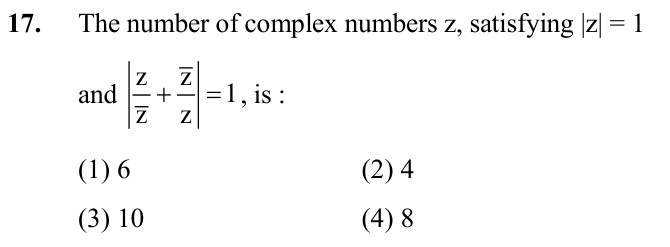
Candidate Response:
(1) (2) (3) (4)
⚡ OFFICIAL KEY: 4
Step-by-Step Derivation
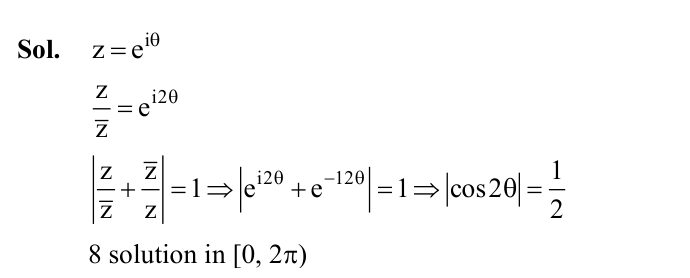
QUESTION 2
MATHEMATICS · Complex Numbers
SECTION B · NUMERICAL (+4, 0)
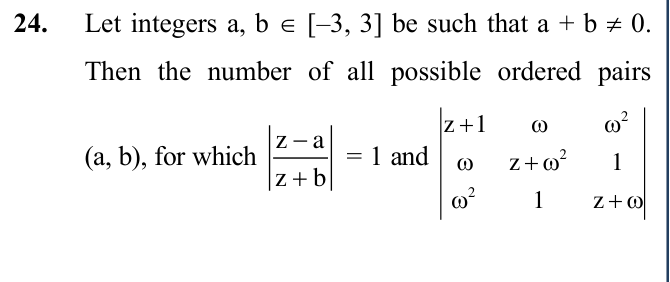
Numerical Value:
[ ]
⚡ OFFICIAL KEY: 10
Step-by-Step Derivation
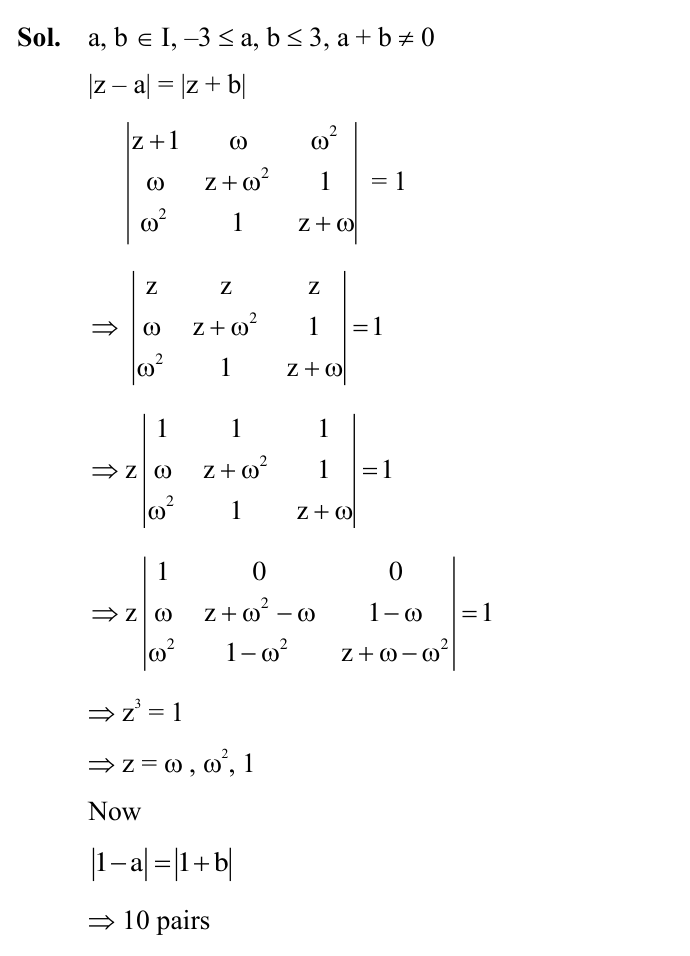
QUESTION 3
MATHEMATICS · Complex Numbers
SECTION A · MCQ (+4, -1)
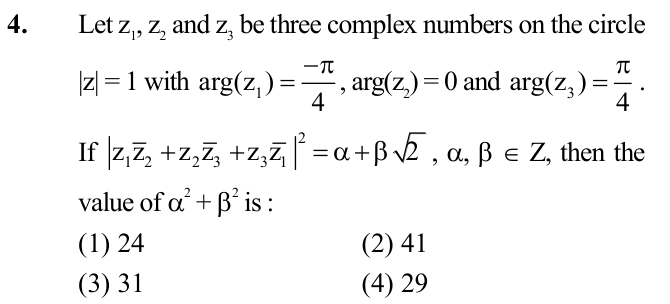
Candidate Response:
(1) (2) (3) (4)
⚡ OFFICIAL KEY: 4
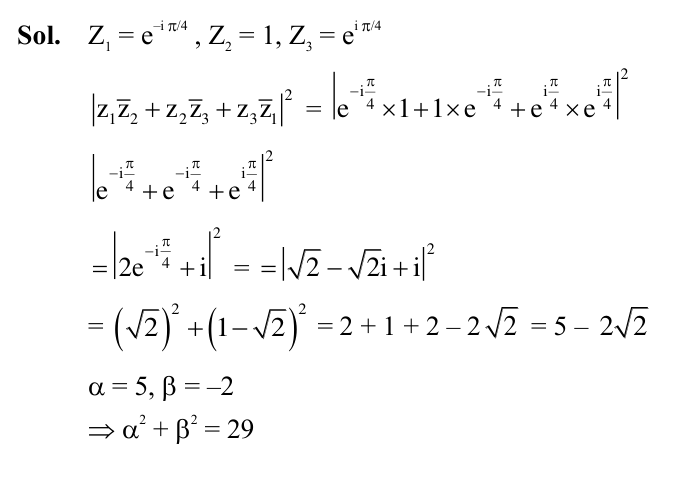
Step-by-Step Derivation
QUESTION 4
MATHEMATICS · Complex Numbers
SECTION A · MCQ (+4, -1)
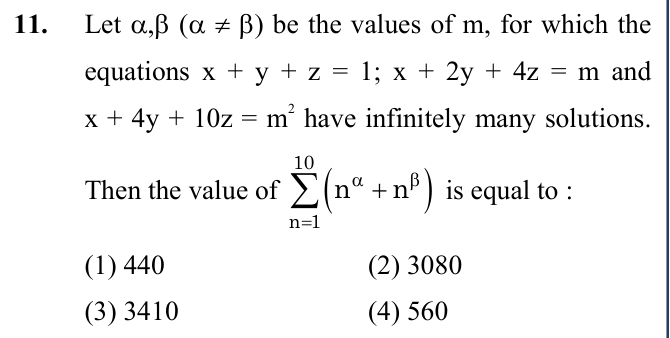
Candidate Response:
(1) (2) (3) (4)
⚡ OFFICIAL KEY: 1
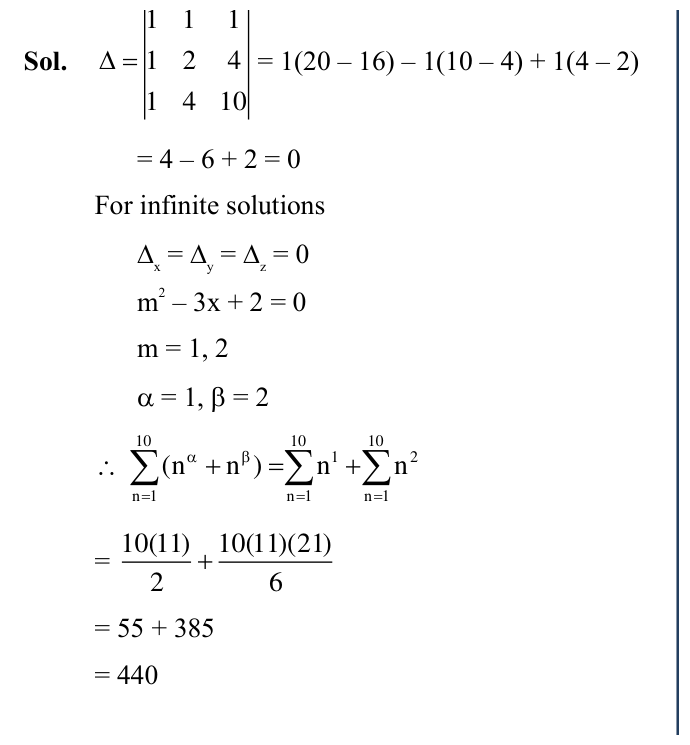
Step-by-Step Derivation
QUESTION 5
MATHEMATICS · Complex Numbers
SECTION A · MCQ (+4, -1)
Candidate Response:
(1) (2) (3) (4)
⚡ OFFICIAL KEY: 3
Step-by-Step Derivation
QUESTION 6
MATHEMATICS · Complex Numbers
SECTION B · NUMERICAL (+4, 0)

Numerical Value:
[ ]
⚡ OFFICIAL KEY: 64
Step-by-Step Derivation
QUESTION 7
MATHEMATICS · Complex Numbers
SECTION A · MCQ (+4, -1)
Candidate Response:
(1) (2) (3) (4)
⚡ OFFICIAL KEY: 1
Step-by-Step Derivation
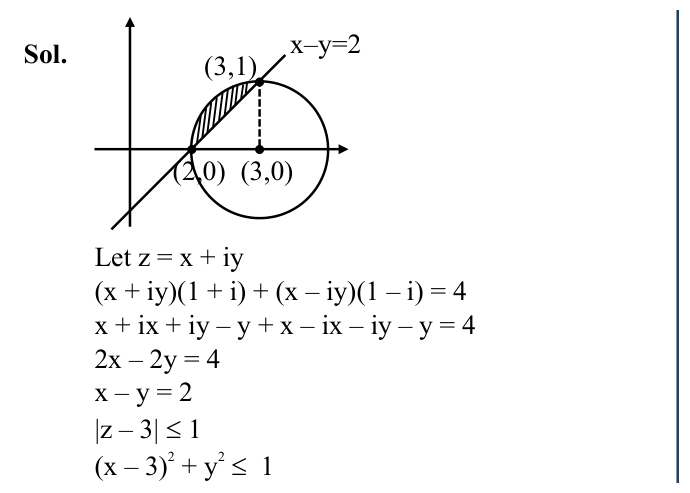
QUESTION 8
MATHEMATICS · Complex Numbers
SECTION A · MCQ (+4, -1)
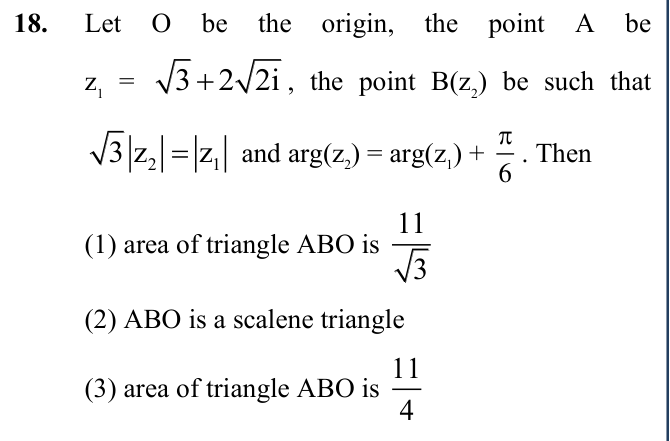
Candidate Response:
(1) (2) (3) (4)
⚡ OFFICIAL KEY: 4
Step-by-Step Derivation
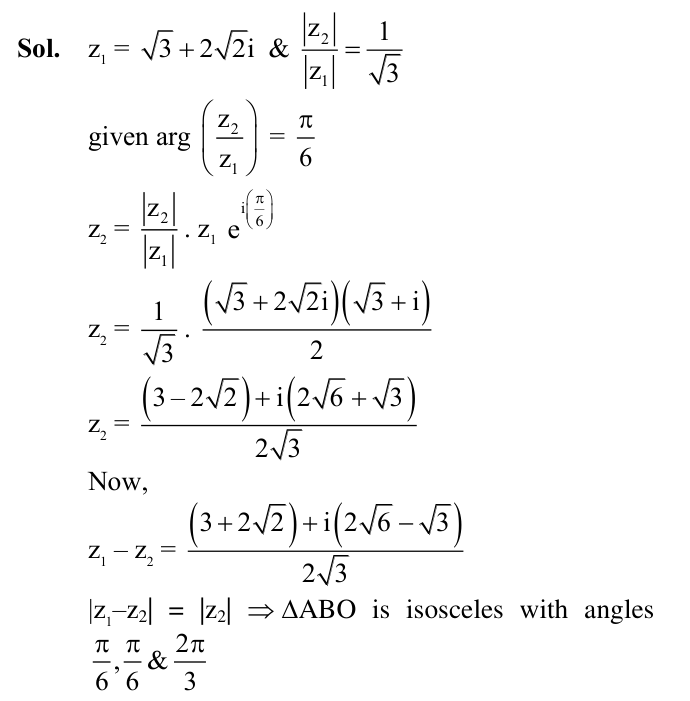
QUESTION 9
MATHEMATICS · Complex Numbers and Quadratic Equations
SECTION A · MCQ (+4, -1)
If 2 - 3i is a root of the quadratic equation x² + px + q = 0 with real coefficients p and q, find p and q.
(1) Since coefficients are real, the other root must be 2 + 3i. Sum of roots = -p = (2 - 3i) + (2 + 3i) = 4 => p = -4. Product of roots = q = (2 - 3i)(2 + 3i) = 2² + 3² = 13 => q = 13.
(2) [-5, 7)
(3) Undefined under standard Complex Numbers and Quadratic Equations axioms.
(4) Since coefficients are real, the other root must be 2 + 3i. Sum of roots = +p = (2 + 3i) + (2 + 3i) = 4 => p = +4. Product of roots = q = (2 + 3i)(2 + 3i) = 2² + 3² = 13 => q = 13.
Candidate Response:
(1) (2) (3) (4)
⚡ OFFICIAL KEY: Since coefficients are real, the other root must be 2 + 3i. Sum of roots = -p = (2 - 3i) + (2 + 3i) = 4 => p = -4. Product of roots = q = (2 - 3i)(2 + 3i) = 2² + 3² = 13 => q = 13.
Step-by-Step Derivation
Conjugate invariance P(z̄) = (P(z))̄ requires that if P(z) = 0, then P(z̄) = 0 for real polynomials.
QUESTION 10
MATHEMATICS · Complex Numbers and Quadratic Equations
SECTION A · MCQ (+4, -1)
Express (2 - i) / (1 + 2i) in the form a + bi.
(1) Undefined under standard Complex Numbers and Quadratic Equations axioms.
(2) (2 - i)(1 - 2i) / (1² + 2²) = (2 - 4i - i + 2i²) / 5 = (2 - 5i - 2) / 5 = -5i / 5 = -i (or 0 - i).
(3) [-5, 7)
(4) (2 + i)(1 + 2i) / (1² + 2²) = (2 + 4i + i + 2i²) / 5 = (2 + 5i + 2) / 5 = +5i / 5 = +i (or 0 + i).
Candidate Response:
(1) (2) (3) (4)
⚡ OFFICIAL KEY: (2 - i)(1 - 2i) / (1² + 2²) = (2 - 4i - i + 2i²) / 5 = (2 - 5i - 2) / 5 = -5i / 5 = -i (or 0 - i).
Step-by-Step Derivation
Multiplying (c + di) by (c - di) yields c² - (di)² = c² + d², which is a strictly positive real number.
QUESTION 11
MATHEMATICS · Complex Numbers and Quadratic Equations
SECTION A · MCQ (+4, -1)
Represent z = -√3 + i in polar form.
(1) r = √((+√3)² + 1²) = √(3 + 1) = 2. α = tan^(+1)|1/(+√3)| = π/6. Since a < 0, b > 0 (QII), θ = π + π/6 = 5π/6. z = 2(cos(5π/6) + i sin(5π/6)).
(2) [-5, 7)
(3) r = √((-√3)² + 1²) = √(3 + 1) = 2. α = tan^(-1)|1/(-√3)| = π/6. Since a < 0, b > 0 (QII), θ = π - π/6 = 5π/6. z = 2(cos(5π/6) + i sin(5π/6)).
(4) Undefined under standard Complex Numbers and Quadratic Equations axioms.
Candidate Response:
(1) (2) (3) (4)
⚡ OFFICIAL KEY: r = √((-√3)² + 1²) = √(3 + 1) = 2. α = tan^(-1)|1/(-√3)| = π/6. Since a < 0, b > 0 (QII), θ = π - π/6 = 5π/6. z = 2(cos(5π/6) + i sin(5π/6)).
Step-by-Step Derivation
Trigonometric decomposition on the Argand plane maps horizontal and vertical projections.
QUESTION 12
MATHEMATICS · Complex Numbers and Quadratic Equations
SECTION A · MCQ (+4, -1)
What is the value of (1 - ω)(1 - ω²)(1 - ω⁴)(1 - ω⁸)?
(1) Since ω⁴ = ω and ω⁸ = ω², the product is ((1 - ω)(1 - ω²))² = (1 - ω² - ω + ω³)² = (1 - (ω + ω²) + 1)² = (1 - (-1) + 1)² = 3² = 9.
(2) Since ω⁴ = ω and ω⁸ = ω², the product is [(1 + ω)(1 + ω²)]² = [1 + ω² + ω + ω³]² = [1 + (ω + ω²) + 1]² = [1 + (+1) + 1]² = 3² = 9.
(3) Since ω⁴ = ω and ω⁸ = ω², the product is [(1 - ω)(1 - ω²)]² = [1 - ω² - ω + ω³]² = [1 - (ω + ω²) + 1]² = [1 - (-1) + 1]² = 3² = 9.
(4) (-5, 7]
Candidate Response:
(1) (2) (3) (4)
⚡ OFFICIAL KEY: Since ω⁴ = ω and ω⁸ = ω², the product is [(1 - ω)(1 - ω²)]² = [1 - ω² - ω + ω³]² = [1 - (ω + ω²) + 1]² = [1 - (-1) + 1]² = 3² = 9.
Step-by-Step Derivation
Factoring z³ - 1 = (z - 1)(z² + z + 1) = 0 yields the quadratic z² + z + 1 = 0 whose roots are ω and ω².
QUESTION 13
MATHEMATICS · Complex Numbers and Quadratic Equations
SECTION A · MCQ (+4, -1)
If |z1| = 3, |z2| = 4, and |z1 + z2| = 5, find |z1 - z2|.
(1) Using Parallelogram Law: |z1 + z2|² + |z1 - z2|² = 2(|z1|² + |z2|²) => 5² + |z1 - z2|² = 2(3² + 4²) = 2(9 + 16) = 50 => 25 + |z1 - z2|² = 50 => |z1 - z2|² = 25 => |z1 - z2| = 5.
(2) Using Parallelogram Law: |z1 + z2|² + |z1 + z2|² = 2(|z1|² + |z2|²) => 5² + |z1 + z2|² = 2(3² + 4²) = 2(9 + 16) = 50 => 25 + |z1 + z2|² = 50 => |z1 + z2|² = 25 => |z1 + z2| = 5.
(3) [-5, 7)
(4) Undefined under standard Complex Numbers and Quadratic Equations axioms.
Candidate Response:
(1) (2) (3) (4)
⚡ OFFICIAL KEY: Using Parallelogram Law: |z1 + z2|² + |z1 - z2|² = 2(|z1|² + |z2|²) => 5² + |z1 - z2|² = 2(3² + 4²) = 2(9 + 16) = 50 => 25 + |z1 - z2|² = 50 => |z1 - z2|² = 25 => |z1 - z2| = 5.
Step-by-Step Derivation
Vector triangle formed by 0, z1, and z1 + z2 has side lengths |z1|, |z2|, and |z1 + z2|.
QUESTION 14
MATHEMATICS · Complex Numbers and Quadratic Equations
SECTION A · MCQ (+4, -1)
Find the value of √(-25) * √(-4) + √(-49).
(1) [-5, 7)
(2) √(-25) * √(-4) = (5i)(2i) = 10i² = -10. √(-49) = 7i. The expression equals -10 + 7i.
(3) Undefined under standard Complex Numbers and Quadratic Equations axioms.
(4) √(+25) * √(+4) = (5i)(2i) = 10i² = +10. √(+49) = 7i. The expression equals +10 + 7i.
Candidate Response:
(1) (2) (3) (4)
⚡ OFFICIAL KEY: √(-25) * √(-4) = (5i)(2i) = 10i² = -10. √(-49) = 7i. The expression equals -10 + 7i.
Step-by-Step Derivation
Im(z) represents the y-coordinate on the Argand plane, which is a real scalar.
QUESTION 15
MATHEMATICS · Complex Numbers and Quadratic Equations
SECTION A · MCQ (+4, -1)
Find the square roots of 2i.
(1) [-5, 7)
(2) Here a = 0, b = 2, |z| = 2. x = √((2 + 0)/2) = 1; y = √((2 - 0)/2) = 1. Since b > 0, sgn(b) = +1. Roots: ±(1 + i).
(3) Undefined under standard Complex Numbers and Quadratic Equations axioms.
(4) Here a = 0, b = 2, |z| = 2. x = √((2 + 0)/2) = 1; y = √((2 + 0)/2) = 1. Since b > 0, sgn(b) = +1. Roots: ±(1 + i).
Candidate Response:
(1) (2) (3) (4)
⚡ OFFICIAL KEY: Here a = 0, b = 2, |z| = 2. x = √((2 + 0)/2) = 1; y = √((2 - 0)/2) = 1. Since b > 0, sgn(b) = +1. Roots: ±(1 + i).
Step-by-Step Derivation
Squaring and equating real/imaginary parts yields x² - y² = a and x² + y² = |z|.