
✎ ANSWER ONLINE · EVERY MISTAKE LINKS BACK TO THE CONCEPT
Complex Numbers and Quadratic Equations · Practice Worksheet
Answer each question here and it marks straight away, with the derivation and a link to the exact micro-concept to revisit.
7 questions from this set could not be marked online — a
bonus or dual-key question, which has no single defensible answer. The print and
.docx versions still include them.
// CONCEPT AUDIT RESULT
Everything you missed has been added to your Error Arena — retest them blind there, and a concept clears once you get it right.
QUESTION 1
Complex Numbers
SECTION A · MCQ (+4, -1)
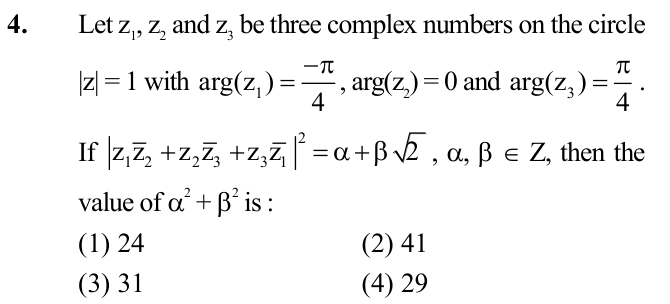
(1) 24
(2) 41
(3) 31
(4) 29
Z1 = e
–i π/4 , Z2 = 1, Z3 = e
i π/4
2
1
2
2
3
3 1
z z
z z
z z + + = 2
i
i
i
i
4
4
4
4
e
1 1 e
e
e
π
π
π
π - -
×+× + ×
2
i
i
i
4
4
4
e
e
e
π
π
π - - + +
2
i 4
2e
i
π - = + =
2
2
2i
i = - + = (
)
(
)
2
2
2
1
2 + -
= 2 + 1 + 2 – 2
2 = 5 – 2 2
α= 5, β = –2
⇒α
2 + β
2 = 29
2
QUESTION 2
Complex Numbers
SECTION A · MCQ (+4, -1)
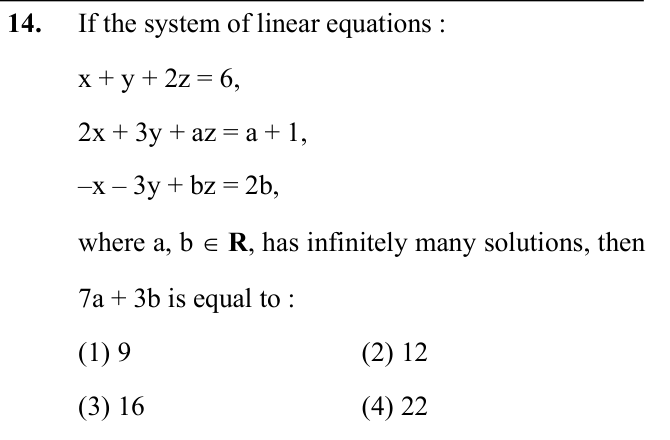
(1) 9
(2) 12
(3) 16
(4) 22
Δ =
1
1
2
2
3
a
1
3
b - -
= 0
⇒2a + b – 6 = 0
…….(1)
Δ1 =
1
1
6
2
3
a
1
1
3
2b + - - = 0
⇒a + b – 8 = 0
…….(2)
Solving (1) + (2)
a = –2, b = 10
⇒7a + 3b = 16
QUESTION 3
Complex Numbers
SECTION A · MCQ (+4, -1)
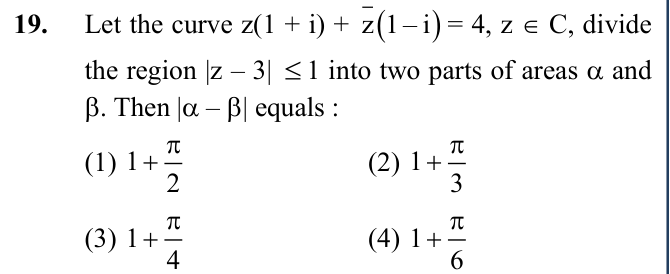
(1) 1
2
π
+
(2) 1
3
π
+
(3) 1
4
π
+
(4) 1
6
π
+
(3,0)
(2,0)
(3,1)
x–y=2
Let z = x + iy
(x + iy)(1 + i) + (x – iy)(1 – i) = 4
x + ix + iy – y + x – ix – iy – y = 4
2x – 2y = 4
x – y = 2
|z – 3| ≤ 1
(x – 3)
2 + y
2 ≤ 1
Area of shaded region =
2
.1
1.1.1
4
2
π - =
1
4
2
π-
Area of unshaded region inside the circle
= 3
1
.1
.1.1
4
2
2
π + = 3
1
4
2
π+
∴difference of area =
3
1
1
4
2
4
2
π
π
)
) + - - (
(
[
)
[
) = 1
2
π+
QUESTION 4
Complex Numbers
SECTION A · MCQ (+4, -1)
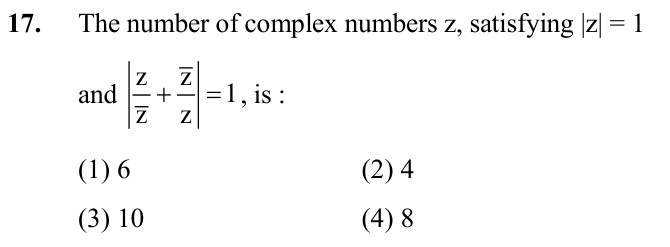
(1) 6
(2) 4
(3) 10
(4) 8
θ = i
z
e
θ = i2
z
e
z
θ - θ + =⇒ + =⇒
θ=
i2
12
z
z
1
1
e
e
1
cos2
z
z
2
8 solution in [0, 2π)
QUESTION 5
Complex Numbers
SECTION A · MCQ (+4, -1)
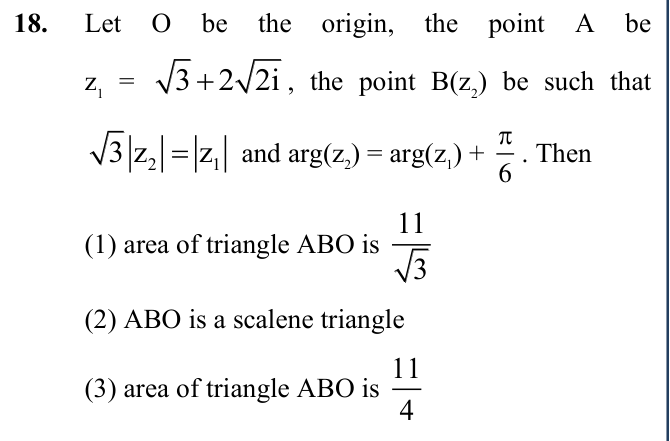
(1) area of triangle ABO is 11
3
(2) ABO is a scalene triangle
(3) area of triangle ABO is 11
4
(4) ABO is an obtuse angled isosceles triangle
z1 =
3
2 2i + &
2
1
z
1
z
3 = given arg
2
1
z
z
)
(
[
)
= 6
π
z2 =
2
1
z
z
. z1
i 6
e
π
)
(
[
)
z2 = 1
3
. (
)(
)
3
2 2i
3
i
2 + +
z2 = (
)
(
)
3 – 2 2
i 2 6
3
2 3 + +
Now,
z1 – z2 = (
)
(
)
3
2 2
i 2 6
3
2 3 + + - |z1–z2| = |z2| ⇒ ΔABO is isosceles with angles
2
,
&
6 6
3
ππ
π
QUESTION 6
Complex Numbers
SECTION B · NUMERICAL (+4, 0)

x
y
z
Let x = 2 ⇒ y + z = 13
(4,9), (5,8), (6,7), (7,6), (8,5), (9,4), → 6
Let x = 3 → y + z = 12
(3,9), (4,8), ........, (9,3) →7
Let x = 4 → y + z = 11
(2,9), (3,8), ........, (9,1) →9
Let x = 5 → y + z = 10
(1,9), (2,8), ........, (9,1) →10
Let x = 6 → y + z = 9
(0,9), (1,8), ........, (9,0) →9
Let x = 7 → y + z = 8
(0,9), (1,7), ........, (8,0) →9
Let x = 8 → y + z = 7
(0,7), (1,6), ........, (7,0) →8
Let x = 9 → y + z = 6
(0,6), (1,5), ........, (6,0) →7
Total = 6 = 7 + 8 + 9 + 10 + 9 + 8 + 7 = 64
8
QUESTION 7
Complex Numbers
SECTION A · MCQ (+4, -1)
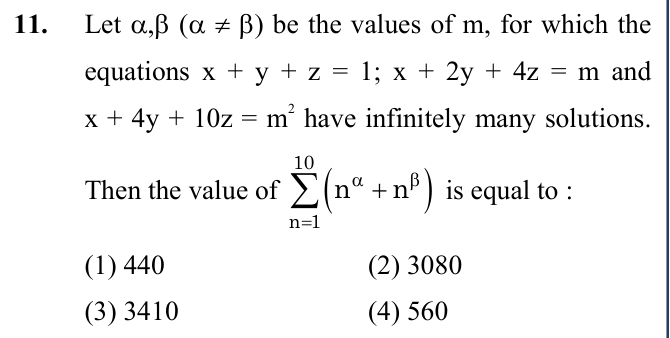
(1) 440
(2) 3080
(3) 3410
(4) 560
1
1
1
1
2
4
1
4
10
Δ=
= 1(20 – 16) – 1(10 – 4) + 1(4 – 2)
= 4 – 6 + 2 = 0
For infinite solutions
Δx = Δy = Δz = 0
m
2 – 3x + 2 = 0
m = 1, 2
α= 1, β = 2
∴
10
10
10
1
2
n 1
n 1
n 1
(n
n )
n
n
α
β = = = + = +
∑
∑
∑
= 10(11)
10(11)(21)
2
6 + = 55 + 385
= 440
QUESTION 8
Complex Numbers
SECTION B · NUMERICAL (+4, 0)
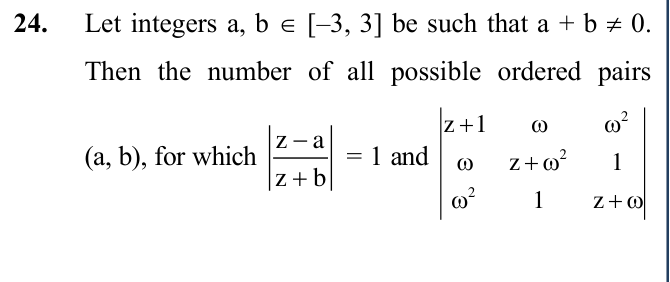
a, b ∈ I, –3 ≤ a, b ≤ 3, a + b ≠ 0
|z – a| = |z + b|
2
2
2
z
1
z
1
1
z + ω
ω
ω
+ω
ω
+ω
= 1
2
2
z
z
z
z
1
1
1
z
⇒
ω
+ω = ω
+ω
2
2
1
1
1
z
z
1
1
1
z
⇒
ω
+ω = ω
+ω
2
2
2
2
1
0
0
z
z
1
1
1
z
⇒
ω
+ω-ω
-ω = ω
-ω
+ω-ω
⇒ z
3 = 1
⇒ z = ω , ω
2, 1
Now
1 a
1 b - = + ⇒ 10 pairs
QUESTION 9
Complex Numbers and Quadratic Equations
SECTION A · MCQ (+4, -1)
Find the value of √(-25) * √(-4) + √(-49).
(1) [-5, 7)
(2) √(-25) * √(-4) = (5i)(2i) = 10i² = -10. √(-49) = 7i. The expression equals -10 + 7i.
(3) Undefined under standard Complex Numbers and Quadratic Equations axioms.
(4) √(+25) * √(+4) = (5i)(2i) = 10i² = +10. √(+49) = 7i. The expression equals +10 + 7i.
Im(z) represents the y-coordinate on the Argand plane, which is a real scalar.
QUESTION 10
Complex Numbers and Quadratic Equations
SECTION A · MCQ (+4, -1)
Simplify (2 + 3i)² into standard a + bi form.
(1) (2 + 3i)² = 2² + 2(2)(3i) + (3i)² = 4 + 12i + 9(-1) = 4 - 9 + 12i = -5 + 12i.
(2) Undefined under standard Complex Numbers and Quadratic Equations axioms.
(3) (2 + 3i)² = 2² + 2(2)(3i) + (3i)² = 4 + 12i + 9(+1) = 4 + 9 + 12i = +5 + 12i.
(4) [-5, 7)
Distributive law holds over complex numbers, and i² = -1 turns the quadratic imaginary product into a negative real scalar.
QUESTION 11
Complex Numbers and Quadratic Equations
SECTION A · MCQ (+4, -1)
Express (2 - i) / (1 + 2i) in the form a + bi.
(1) Undefined under standard Complex Numbers and Quadratic Equations axioms.
(2) (2 - i)(1 - 2i) / (1² + 2²) = (2 - 4i - i + 2i²) / 5 = (2 - 5i - 2) / 5 = -5i / 5 = -i (or 0 - i).
(3) [-5, 7)
(4) (2 + i)(1 + 2i) / (1² + 2²) = (2 + 4i + i + 2i²) / 5 = (2 + 5i + 2) / 5 = +5i / 5 = +i (or 0 + i).
Multiplying (c + di) by (c - di) yields c² - (di)² = c² + d², which is a strictly positive real number.
QUESTION 12
Complex Numbers and Quadratic Equations
SECTION A · MCQ (+4, -1)
If |z1| = 3, |z2| = 4, and |z1 + z2| = 5, find |z1 - z2|.
(1) Using Parallelogram Law: |z1 + z2|² + |z1 - z2|² = 2(|z1|² + |z2|²) => 5² + |z1 - z2|² = 2(3² + 4²) = 2(9 + 16) = 50 => 25 + |z1 - z2|² = 50 => |z1 - z2|² = 25 => |z1 - z2| = 5.
(2) Using Parallelogram Law: |z1 + z2|² + |z1 + z2|² = 2(|z1|² + |z2|²) => 5² + |z1 + z2|² = 2(3² + 4²) = 2(9 + 16) = 50 => 25 + |z1 + z2|² = 50 => |z1 + z2|² = 25 => |z1 + z2| = 5.
(3) [-5, 7)
(4) Undefined under standard Complex Numbers and Quadratic Equations axioms.
Vector triangle formed by 0, z1, and z1 + z2 has side lengths |z1|, |z2|, and |z1 + z2|.
QUESTION 13
Complex Numbers and Quadratic Equations
SECTION A · MCQ (+4, -1)
What is the principal argument of z = -4i and w = -7?
(1) [-5, 7)
(2) z = +4i lies on negative imaginary axis => Arg(z) = +π/2. w = +7 lies on negative real axis => Arg(w) = π.
(3) z = -4i lies on negative imaginary axis => Arg(z) = -π/2. w = -7 lies on negative real axis => Arg(w) = π.
(4) Undefined under standard Complex Numbers and Quadratic Equations axioms.
Confining the argument to a single 2π interval ensures that Arg(z) is a single-valued, well-defined function.