
✎ ANSWER ONLINE · EVERY MISTAKE LINKS BACK TO THE CONCEPT
Straight Lines · Practice Worksheet
Answer each question here and it marks straight away, with the derivation and a link to the exact micro-concept to revisit.
2 questions from this set could not be marked online — a
bonus or dual-key question, which has no single defensible answer. The print and
.docx versions still include them.
// CONCEPT AUDIT RESULT
Everything you missed has been added to your Error Arena — retest them blind there, and a concept clears once you get it right.
QUESTION 1
Straight Lines
SECTION A · MCQ (+4, -1)
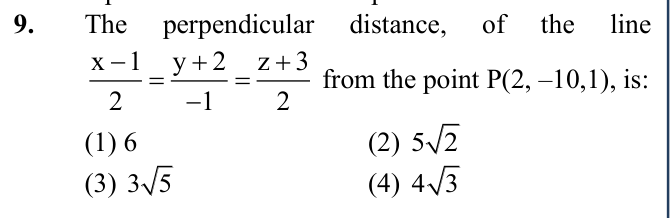
(1) 6
(2) 5 2
(3) 3 5
(4) 4 3
P(2,–10, 1)
A
x
1
y
2
z
3
(let)
2
1
2 - + + = = =λ - (2λ + 1, –λ – 2, 2λ – 3)
PA.n
0 = ⇒(2λ – 1)2 + (–λ + 8)(–1) + (2λ – 4)2 = 0
⇒4λ – 2 + λ – 8 + 4λ – 8 = 0
⇒9λ – 18 = 0 ⇒ λ = 2
∴A(5, –4, 1)
∴AP =
2
2
2
3
6
0 + + = 45 = 3 5
QUESTION 2
Straight Lines
SECTION B · NUMERICAL (+4, 0)
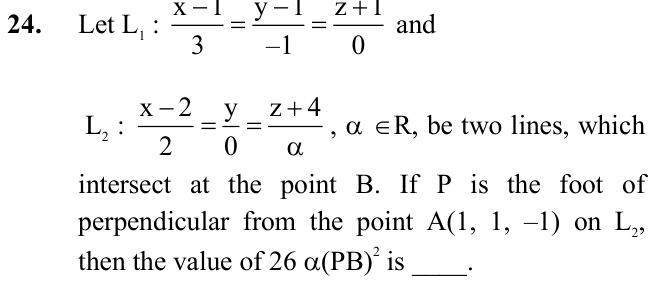
Point B
(3λ + 1, –λ + 1, –1) ≡ (2µ + 2, 0, αµ – 4)
3λ + 1 = 2µ + 2
–λ + 1 = 0
–1 = αµ – 4
λ = 1, µ = 1, α = 3
B(4, 0, –1)
Let Point ‘P’ is (2δ + 2, 0, 3δ – 4)
Dr’s of AP < 2δ + 1, –1, 3δ – 3 >
AP ⊥ L2 ⇒
7
13
δ=
40
31
P
,0,
13
13 - )
(
[
)
2
144
324
2
(PB)
26 3
169
169
)
σδ = ×× + (
[
)
= 216
QUESTION 3
Straight Lines
SECTION A · MCQ (+4, -1)
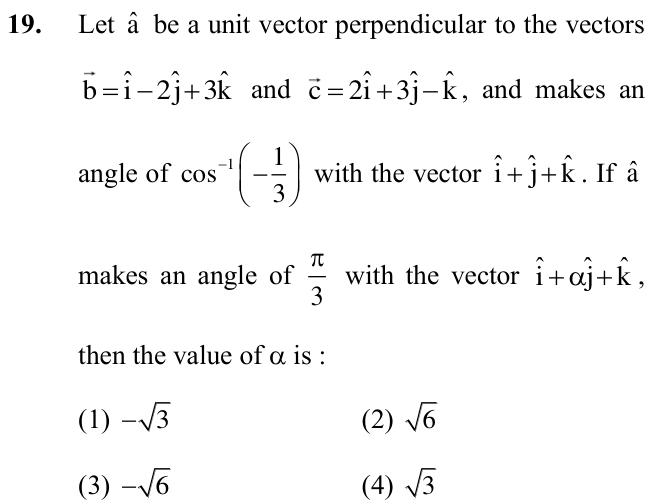
(1) 3
-
(2) 6
(3) 6
-
(4) 3
Let
ˆ
ˆ
ˆ
v
i
j
k
=++
ˆ
ˆ
ˆ
i
j
k
b
c
1
2
3
2
3
1 × = - -
ˆ
ˆ
ˆ
7i
7j
7k
=- + +
ˆ
ˆ
ˆ
7(i – j– k)
=-
Now
ˆ
ˆ
ˆ
ˆ
ˆ
ˆ
i
j
k
i
j
k
ˆa
or
3
3
--
-++ = ↓
↓
ˆa.v
1 1 1
1
cos
v
3
3 3
-- - θ= = =
ˆa.v
1 1 1
1
cos
v
3
3
-++
θ= = =
(rejected)
ˆ
ˆ
ˆ
i
j
k
ˆa
3
--
⇒ = 7
Now
2
ˆ
ˆ
ˆ
ˆa·(i
j
k)
cos 3
1
1
π
+α+ = +α+
2
1
1
1
2
3
2
-α-
⇒ = α+
2
3
2
2
⇒
α+
=-α (∴ α < 0)
3α2 + 6 = 4α2
⇒α =
6
-
QUESTION 4
Straight Lines
SECTION A · MCQ (+4, -1)
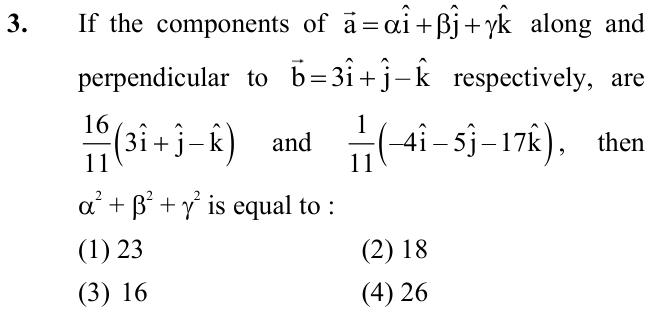
(1) 23
(2) 18
(3) 16
(4) 26
let
11
a
= component of a along b
1a = component of a perpendicular to b
11
a = (
)
16
ˆ
ˆ
ˆ
3i
j
k
11
+-
1a =
(
)
1
ˆ
ˆ
ˆ
4i – 5j 17k
11 - - 11
1
a
a
a = +
∴a =
(
)
(
)
16
1
ˆ
ˆ
ˆ
ˆ
ˆ
ˆ
3i
j
k
4i
5j 17k
11
11
+- + - - -
= 44
11
33
ˆ
ˆ
ˆ
i
j
k
11
11
11 + -
a = ˆ
ˆ
ˆ
4i
j
3k
+-
α= 4
β= 1
γ= –3
α
2 + β
2 + γ
2 = 16 + 1 + 9 = 26
QUESTION 5
Straight Lines
SECTION A · MCQ (+4, -1)
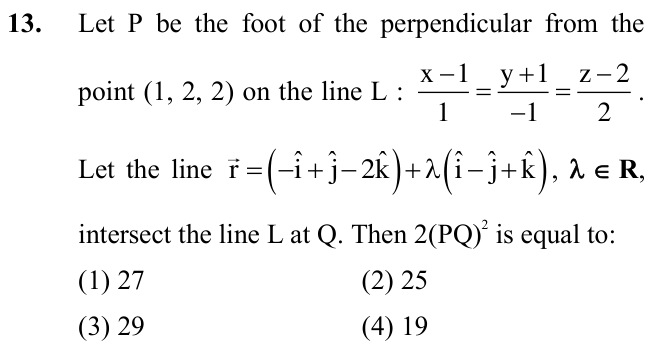
(1) 27
(2) 25
(3) 29
(4) 19
A(1, 2, 2)
L
P (1, –1, 2)
(1, –1, 2) ≡
x
1
y
1
z
2
L:
1
1
2 - + - = = =μ - P(μ + 1, – μ – 1, 2μ + 2)
AP·d
0 = ⇒ (μ , – μ – 3, 2μ)·(1, –1, 2) = 0
⇒ μ + μ + 3 + 4μ = 0 ⇒ μ = – 1
2
∴
1
1
1
P
1,
1, 2
2
2
2
2
) - -
) + + - +
(
(
[
)
[
)
1
1
P
,
,1
2
2 - )
(
[
)
Now general pt. on L2 is Q(–1 + λ , 1 – λ, –2 + λ)
Equate it with general pt of L
1
1
1 1
2
2
2
2
2
μ+=-+λ-μ-=-λ
μ+
=-+λ
μ=λ-
μ=λ-
↓
2(λ – 2) + 2 = –2 + λ
2λ– 4 + 2 = –2 + λ
∴ μ = –2 , λ = 0
∴ Q ≡ (–1 ,1 –2)
(
)
1
1
P
,
,1
and Q
1,1, 2
2
2 - ) - -
(
[
)
2
2
2
1
1
PQ
1
1
(1
2)
2
2 - )
) = + + - + +
(
(
[
)
[
)
9
9
54
9
4
4
4 = + + =
∴2(PQ)
2 =
54
2
27
4
)=
(
[
)
QUESTION 6
Straight Lines
SECTION A · MCQ (+4, -1)
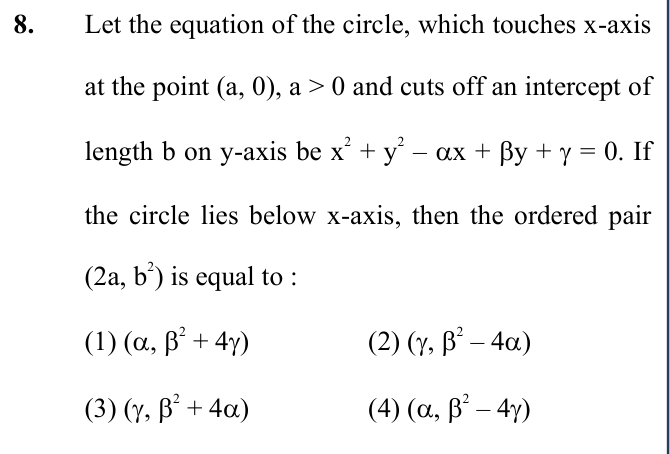
(1) (α, β
2 + 4γ)
(2) (γ, β
2 – 4α)
(3) (γ, β
2 + 4α)
(4) (α, β
2 – 4γ)
r
(a,–r)
r
a
O
(a, 0)
b
By pytogorus
2
2
2
2
b
r
a
P
4 = + = 2
2
4a
b
r
4 + =
Equation of circle is (x – α)
2 + (y – β)
2 = r
2
x
2 + y
2 – 2ax – 2py + α
2 + p
2 – r
2 = 0
comparision x
2 + y
2 – αx + βy + r = 0
–α = –2a, β = –2p, r = a
2
⇒2a = α, 4a
2 + b
2 = 4p
2
α
2 + b
2 = 4p
2
α
2 + b
2 = β
2
So, (2a, b
2) = (α, β
2 – 4r)
QUESTION 7
Straight Lines
SECTION A · MCQ (+4, -1)
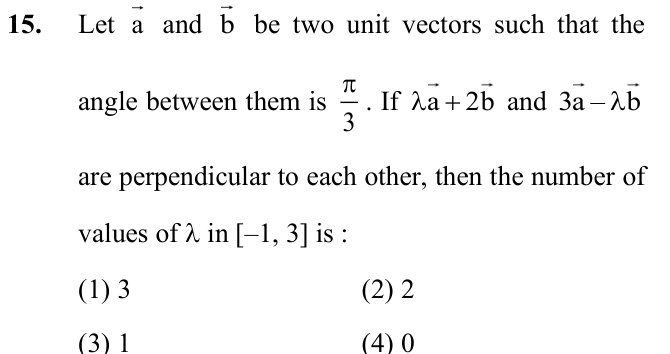
(1) 3
(2) 2
(3) 1
(4) 0
1
ˆ
ˆa.b
2 = Now (
)(
)
ˆ
ˆ
ˆ
ˆ
a
2b . 3a
b
0
λ+
-λ = 2 ˆ
ˆ
ˆ ˆ
ˆ ˆ
ˆ
ˆ
3 a.a
a.b
6a.b
2 b.b
0
λ
-λ + -λ = 2
3
3
2
0
2
λ
λ- + -λ=
λ
2 – 2λ – 6 = 0
λ= 1
7
±
⇒number of values = 0
5
QUESTION 8
Straight Lines
SECTION A · MCQ (+4, -1)
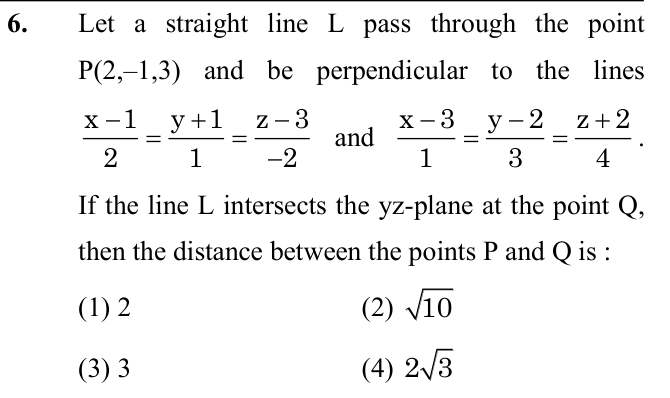
(1) 2
(2) 10
(3) 3
(4) 2 3
Vector parallel to 'L'
ˆ
ˆ
ˆ
i
j
k
2
1
2
1
3
4 = -
ˆ
ˆ
ˆ
10i
10j
5k = - + ˆ
ˆ
ˆ
5(2i
2j
k) = - + Equation of 'L'
x
2
y
1
z
3
(say)
2
2
1 - + - = = =λ - Let Q(2λ + 2, –2λ – 1, λ + 3)
⇒2λ + 2 = 0 ⇒ λ = –1
⇒ Q (0, 1, 2)
d(P, Q) = 3
QUESTION 9
Straight Lines
SECTION A · MCQ (+4, -1)
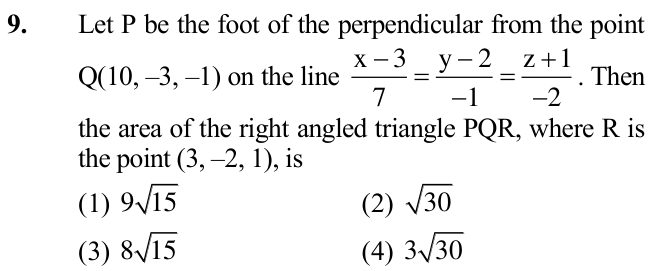
(1) 9 15
(2) 30
(3) 8 15
(4) 3 30
P(α,β,γ) =(10,1,–3)
Q(10,–3,–1)
R(3,–2,1)
x
3
y
2
z
1
7
1
2 - - + = = =λ - -
⇒7λ + 3, – λ + 2, – 2 λ – 1
dr’s of QP ⇒
7 λ – 7, – λ + 5, – 2 λ
Now
(7 λ – 7) . 7 – (–λ + 5) + (2 λ).2 = 0
54 λ – 54 = 0 ⇒ λ = 1
∴P = (10, 1, – 3)
ˆ
ˆ
PQ
4j
2k
=- + =- - +
ˆ
ˆ
ˆ
PR
7i
3j
4k = - - -
i
j
k
1
Area
0
4
2
2
7
3
4
= 3 30
4
QUESTION 10
Straight Lines
SECTION A · MCQ (+4, -1)
Find the equation of the line whose perpendicular distance from the origin is 4 units and the angle which the normal makes with the positive direction of the x-axis is 15 degrees.
(1) [-5, 7)
(2) (sqrt(6) + sqrt(2)) x + (sqrt(6) - sqrt(2)) y = 16.
(3) Undefined under standard Straight Lines axioms.
(4) (sqrt(6) + sqrt(2)) x + (sqrt(6) + sqrt(2)) y = 16.
Equation asserts that any point (x, y) maintains constant slope m with (x_1, y_1).
QUESTION 11
Straight Lines
SECTION A · MCQ (+4, -1)
A straight line L is drawn through the point P(2, 2) intersecting the coordinate axes at A and B. Find the minimum area of the triangle OAB, where O is the origin, and determine the equation of line L that minimizes this area.
(1) Minimum Area = 8 sq units; Line equation: x + y = 4.
(2) Requires uniform continuity across the entire open interval $(a, b)$.
(3) Contradicted by boundary limit constraints under standard Cartesian mapping.
(4) Valid only when elements belong strictly to the non-negative real domain $\mathbb{R}^+$.
Setting y = 0 yields x = a; setting x = 0 yields y = b.
QUESTION 12
Straight Lines
SECTION A · MCQ (+4, -1)
Find the equation of the line mid-way between the parallel lines 9x + 6y - 7 = 0 and 3x + 2y + 6 = 0.
(1) (-∞, 18x + 12y + 11 = 0 (or 3x + 2y + 11/6 = 0).)
(2) [-5, 7)
(3) Undefined under standard Straight Lines axioms.
(4) 18x + 12y + 11 = 0 (or 3x + 2y + 11/6 = 0).
Projection of vector from line point to P onto normal unit vector (A, B)/sqrt(A^2+B^2).
QUESTION 13
Straight Lines
SECTION A · MCQ (+4, -1)
A line through the point P(1, 2) makes an angle of 60 degrees with the positive direction of the x-axis and intersects the line x + y = 6 at the point Q. Find the distance PQ.
(1) 3(sqrt(3) - 1).
(2) 3(sqrt(3) + 1).
(3) Undefined under standard Straight Lines axioms.
(4) [-5, 7)
Linearity in x and y guarantees zero second derivatives; slope is constant throughout.