
⚡ OFFICIAL NTA ASSESSMENT GENERATOR & WORD (.DOCX) EXPORTER
Matrices · Practice Worksheet
JEE Main Mathematics · Curated Assessment Set Print directly or export as a beautifully formatted Microsoft Word document with embedded 180-DPI mathematical prompt clips and step-by-step derivations.
EDUPROD JEE MAIN TEST SERIES · NTA PATTERN
Matrices · Practice Worksheet
JEE Main Mathematics · Curated Assessment Set · Assessment Code: JEE-101
Total Marks: 60
Marking: +4 / -1 (Sec A) · +4 / 0 (Sec B)
QUESTION 1
MATHEMATICS · Matrices
SECTION B · NUMERICAL (+4, 0)
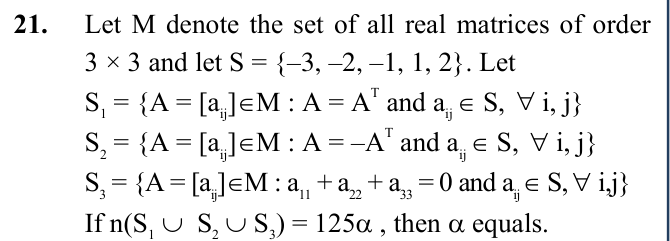
Numerical Value:
[ ]
⚡ OFFICIAL KEY: 1613
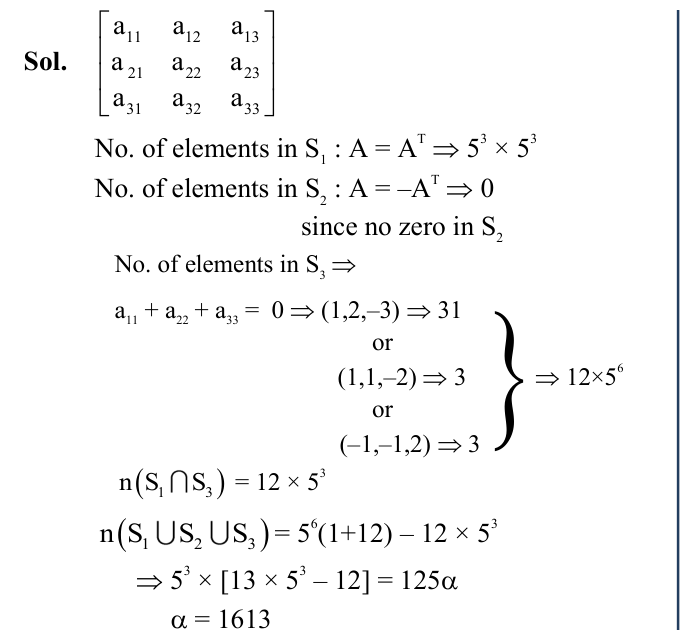
Step-by-Step Derivation
QUESTION 2
MATHEMATICS · Matrices
SECTION B · NUMERICAL (+4, 0)
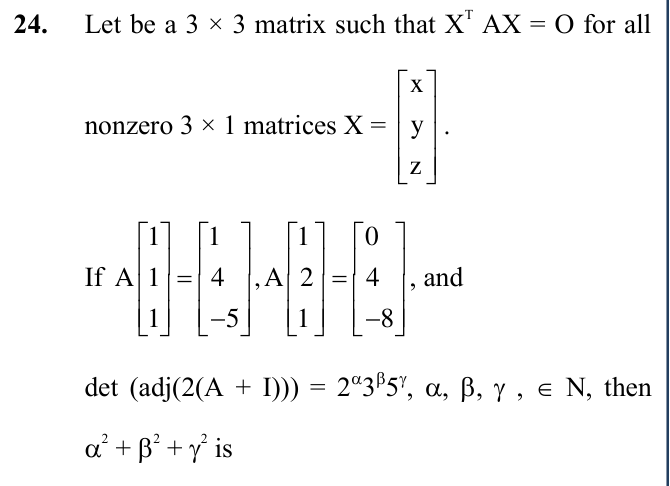
Numerical Value:
[ ]
⚡ OFFICIAL KEY: 44
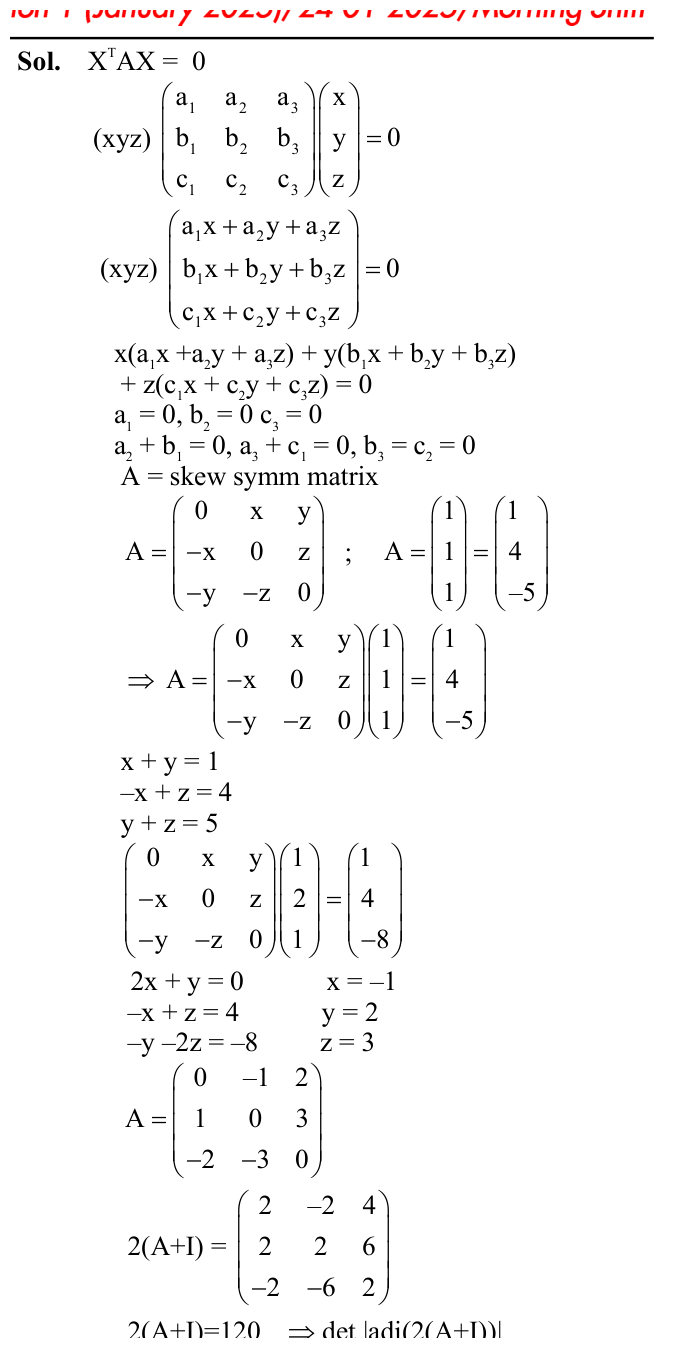
Step-by-Step Derivation
QUESTION 3
MATHEMATICS · Matrices
SECTION A · MCQ (+4, -1)
Candidate Response:
(1) (2) (3) (4)
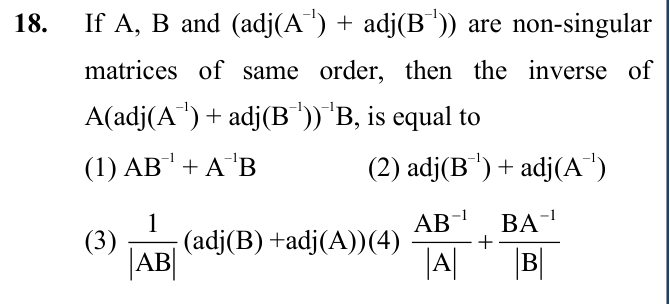
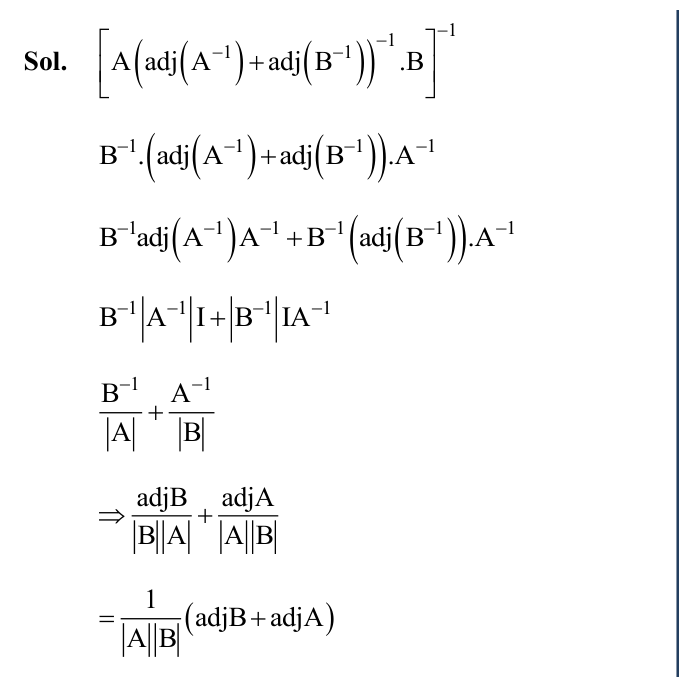
⚡ OFFICIAL KEY: 3
Step-by-Step Derivation
QUESTION 4
MATHEMATICS · Matrices
SECTION A · MCQ (+4, -1)
What is the symmetric part P of the matrix A = [[3, 5], [1, -1]]?
(1) [[3, 3], [3, -1]]
(2) [[0, 2], [-2, 0]]
(3) [[3, 5], [1, -1]]
(4) [[3, 5], [1, -1]]/2
Candidate Response:
(1) (2) (3) (4)
⚡ OFFICIAL KEY: [[3, 3], [3, -1]]
Step-by-Step Derivation
P = (A + A^T)/2. For A = [[3,5],[1,-1]], A^T = [[3,1],[5,-1]]. Adding gives [[6,6],[6,-2]], dividing by 2 yields [[3,3],[3,-1]]. Other options forget to divide by 2 or confuse P with Q.
QUESTION 5
MATHEMATICS · Matrices
SECTION A · MCQ (+4, -1)
If A is any square matrix, what type of matrix is A - A^T?
(1) Contradicted by boundary limit constraints under standard Cartesian mapping.
(2) Requires uniform continuity across the entire open interval $(a, b)$.
(3) A - A^T is always a skew-symmetric matrix.
(4) Valid only when elements belong strictly to the non-negative real domain $\mathbb{R}^+$.
Candidate Response:
(1) (2) (3) (4)
⚡ OFFICIAL KEY: A - A^T is always a skew-symmetric matrix.
Step-by-Step Derivation
Equating diagonal entries a_ii = -a_ii requires 2 a_ii = 0, leaving 0 as the only possible real entry.
QUESTION 6
MATHEMATICS · Matrices
SECTION A · MCQ (+4, -1)
If A has order 3 with diagonal elements 4, -1, 7, what is Tr(A)?
(1) Tr(A) = 4 + (+1) + 7 = 10.
(2) [-5, 7)
(3) Undefined under standard Matrices axioms.
(4) Tr(A) = 4 + (-1) + 7 = 10.
Candidate Response:
(1) (2) (3) (4)
⚡ OFFICIAL KEY: Tr(A) = 4 + (-1) + 7 = 10.
Step-by-Step Derivation
The trace equals the sum of the eigenvalues of the matrix, making it a coordinate-free algebraic invariant.
QUESTION 7
MATHEMATICS · Matrices
SECTION A · MCQ (+4, -1)
Which of the following matrices can be classified as a diagonal matrix?
(1) A matrix of order 2×3 with zeros only in the first row
(2) A matrix of order 1×4 with all entries non-zero
(3) A matrix of order 4×2 with zeros in the second column
(4) A matrix of order 3×3 with non-zero entries only on the main diagonal
Candidate Response:
(1) (2) (3) (4)
⚡ OFFICIAL KEY: A matrix of order 3×3 with non-zero entries only on the main diagonal
Step-by-Step Derivation
Diagonal matrices must be square (equal rows and columns) with non-zero entries only on the main diagonal. The other options are non-square or have non-zero entries outside the diagonal.
QUESTION 8
MATHEMATICS · Matrices
SECTION A · MCQ (+4, -1)
Can a 2 x 3 matrix be a diagonal matrix?
(1) Requires uniform continuity across the entire open interval $(a, b)$.
(2) No. Diagonal matrices must be square matrices.
(3) Valid only when elements belong strictly to the non-negative real domain $\mathbb{R}^+$.
(4) Contradicted by boundary limit constraints under standard Cartesian mapping.
Candidate Response:
(1) (2) (3) (4)
⚡ OFFICIAL KEY: No. Diagonal matrices must be square matrices.
Step-by-Step Derivation
Each specialization imposes stricter algebraic constraints, culminating in the identity matrix which acts as the multiplicative identity.
QUESTION 9
MATHEMATICS · Matrices
SECTION A · MCQ (+4, -1)
If 2X + [[1, 2], [3, 4]] = [[3, 8], [7, 2]], what is X?
(1) [[2, 6], [4, -2]]
(2) [[1, 2], [3, 4]]
(3) [[1, 3], [2, -1]]
(4) [[0, 1], [2, -3]]
Candidate Response:
(1) (2) (3) (4)
⚡ OFFICIAL KEY: [[1, 3], [2, -1]]
Step-by-Step Derivation
Subtract [[1,2],[3,4]] from both sides to get 2X = [[2,6],[4,-2]], then divide by 2. Options B and C incorrectly apply scalar multiplication only to one row/column. Option D shows a miscalculation of subtraction.
QUESTION 10
MATHEMATICS · Matrices
SECTION A · MCQ (+4, -1)
If AB = O, does it necessarily follow that either A = O or B = O?
(1) Contradicted by boundary limit constraints under standard Cartesian mapping.
(2) Requires uniform continuity across the entire open interval $(a, b)$.
(3) No. Two non-zero matrices can have a product equal to the zero matrix.
(4) Valid only when elements belong strictly to the non-negative real domain $\mathbb{R}^+$.
Candidate Response:
(1) (2) (3) (4)
⚡ OFFICIAL KEY: No. Two non-zero matrices can have a product equal to the zero matrix.
Step-by-Step Derivation
Matrices represent spatial geometric operators; rotating then shearing does not produce the same result as shearing then rotating.
QUESTION 11
MATHEMATICS · Matrices
SECTION A · MCQ (+4, -1)
What is the skew-symmetric component Q of a matrix A if A is already symmetric?
(1) [-5, 7)
(2) Q = (A + A^T)/2 = (A + A)/2 = O (the zero matrix).
(3) Q = (A - A^T)/2 = (A - A)/2 = O (the zero matrix).
(4) Undefined under standard Matrices axioms.
Candidate Response:
(1) (2) (3) (4)
⚡ OFFICIAL KEY: Q = (A - A^T)/2 = (A - A)/2 = O (the zero matrix).
Step-by-Step Derivation
Adding P and Q gives (A + A^T + A - A^T)/2 = 2A/2 = A. P is verified symmetric (P^T = P) and Q skew-symmetric (Q^T = -Q).
QUESTION 12
MATHEMATICS · Matrices
SECTION A · MCQ (+4, -1)
During Gauss-Jordan inversion, if after applying R2 → R2 - 2R1 to the matrix [[1, 2], [2, 4]], what conclusion can be drawn?
(1) Inverse exists and equals [[1, -2], [-2, 4]]
(2) Calculation must continue further
(3) Matrix is singular
(4) Matrix is invertible
Candidate Response:
(1) (2) (3) (4)
⚡ OFFICIAL KEY: Matrix is singular
Step-by-Step Derivation
The operation R2 → R2 - 2R1 yields [[1, 2], [0, 0]], confirming a zero row. This immediately proves the matrix is singular (non-invertible). Other options ignore the zero-row rule or misapply inversion steps.
QUESTION 13
MATHEMATICS · Matrices
SECTION A · MCQ (+4, -1)
Which of the following matrices satisfies the condition A² = A, and thus is classified as idempotent?
(1) [[1, 1], [0, 1]]
(2) [[cosθ, -sinθ], [sinθ, cosθ]]
(3) [[1, 0], [0, 0]]
(4) [[0, 1], [1, 0]]
Candidate Response:
(1) (2) (3) (4)
⚡ OFFICIAL KEY: [[1, 0], [0, 0]]
Step-by-Step Derivation
The matrix [[1, 0], [0, 0]] is idempotent because squaring it yields the same matrix. Other options represent involutory, rotation, or shear transformations, not idempotent ones.
QUESTION 14
MATHEMATICS · Matrices
SECTION A · MCQ (+4, -1)
If A is a 1×3 matrix [1 2 3] and B is a 3×1 matrix [4 5 6]^T, what is (AB)^T?
(1) [1×4 + 2×5 + 3×6]
(2) [4 5 6]^T [1 2 3]^T
(3) [1 2 3]^T [4 5 6]^T
(4) [1×4 + 2×5 + 3×6]^T
Candidate Response:
(1) (2) (3) (4)
⚡ OFFICIAL KEY: [1×4 + 2×5 + 3×6]^T
Step-by-Step Derivation
AB is a scalar (1×1 matrix) resulting from dot product. Its transpose is the same scalar. Option B/C/D incorrectly apply transpose rules or matrix multiplication order.
QUESTION 15
MATHEMATICS · Matrices
SECTION A · MCQ (+4, -1)
Which of the following matrices is skew-symmetric?
(1) [[1, 0], [0, -1]]
(2) [[0, 1], [1, 0]]
(3) [[1, 2], [3, 4]]
(4) [[0, -2], [2, 0]]
Candidate Response:
(1) (2) (3) (4)
⚡ OFFICIAL KEY: [[0, -2], [2, 0]]
Step-by-Step Derivation
A skew-symmetric matrix must have zero diagonal entries and entries symmetric about the diagonal with opposite signs. Option C satisfies this, while others either have non-zero diagonals or incorrect symmetry.