
⚡ OFFICIAL NTA ASSESSMENT GENERATOR & WORD (.DOCX) EXPORTER
Matrices · Practice Worksheet
JEE Main Mathematics · Curated Assessment Set Print directly or export as a beautifully formatted Microsoft Word document with embedded 180-DPI mathematical prompt clips and step-by-step derivations.
EDUPROD JEE MAIN TEST SERIES · NTA PATTERN
Matrices · Practice Worksheet
JEE Main Mathematics · Curated Assessment Set · Assessment Code: JEE-101
Total Marks: 100
Marking: +4 / -1 (Sec A) · +4 / 0 (Sec B)
QUESTION 1
MATHEMATICS · Matrices
SECTION B · NUMERICAL (+4, 0)
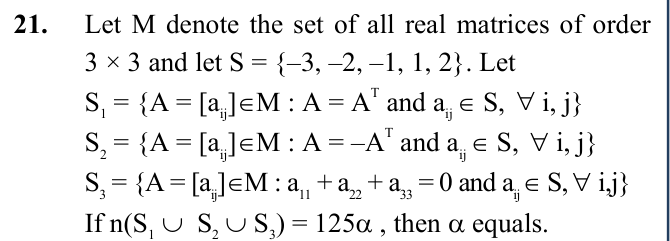
Numerical Value:
[ ]
⚡ OFFICIAL KEY: 1613
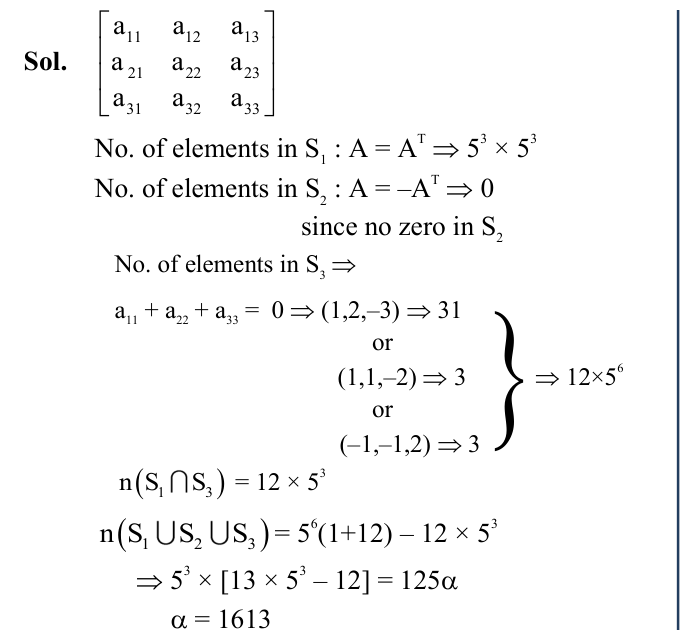
Step-by-Step Derivation
QUESTION 2
MATHEMATICS · Matrices
SECTION B · NUMERICAL (+4, 0)
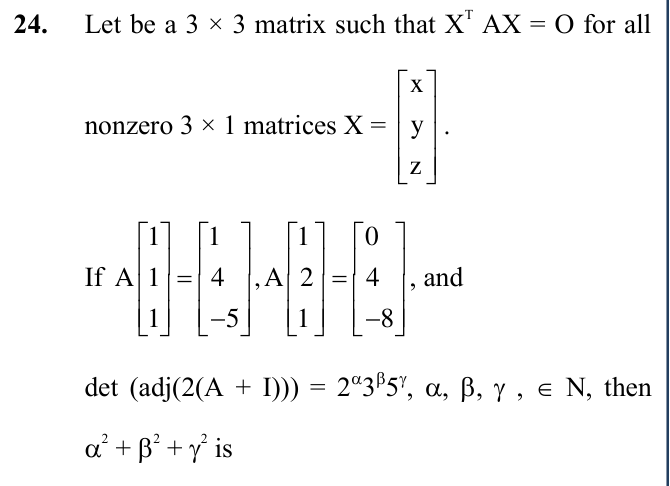
Numerical Value:
[ ]
⚡ OFFICIAL KEY: 44
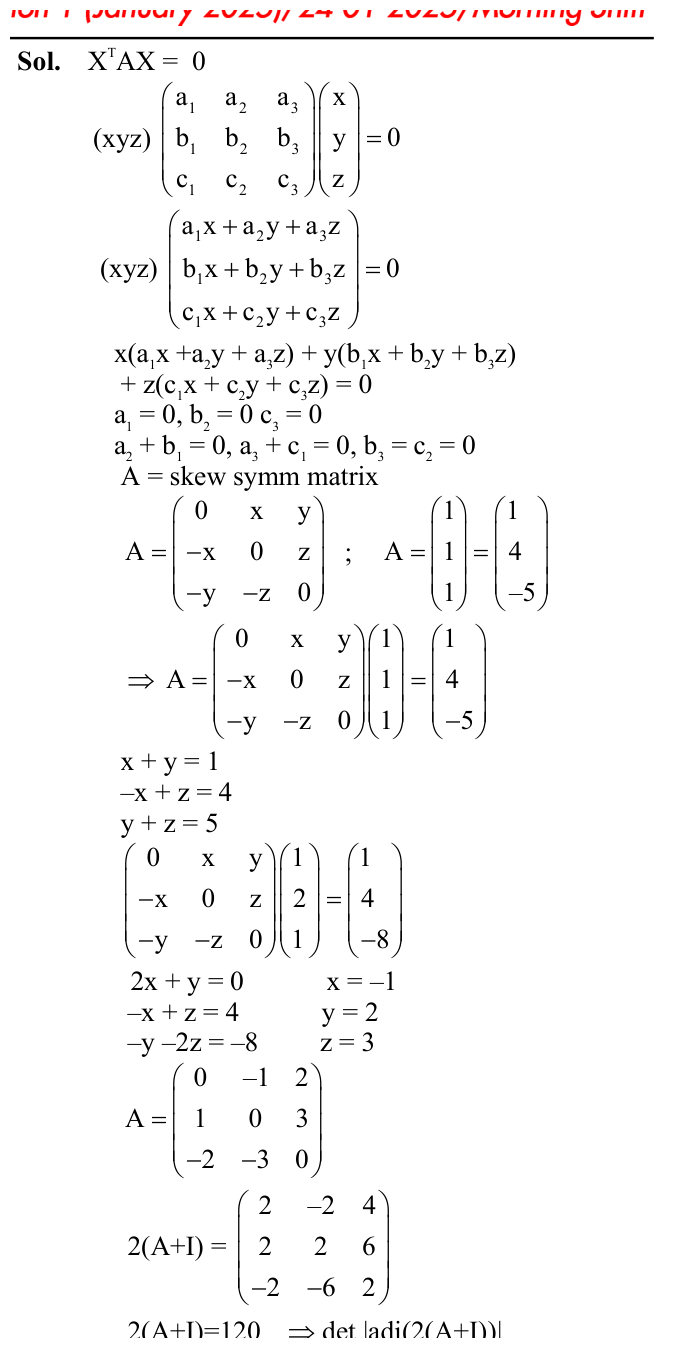
Step-by-Step Derivation
QUESTION 3
MATHEMATICS · Matrices
SECTION A · MCQ (+4, -1)
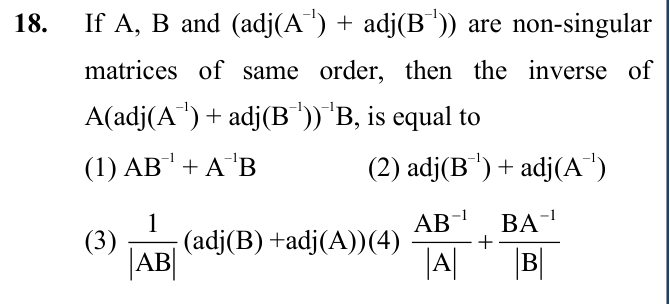
Candidate Response:
(1) (2) (3) (4)
⚡ OFFICIAL KEY: 3
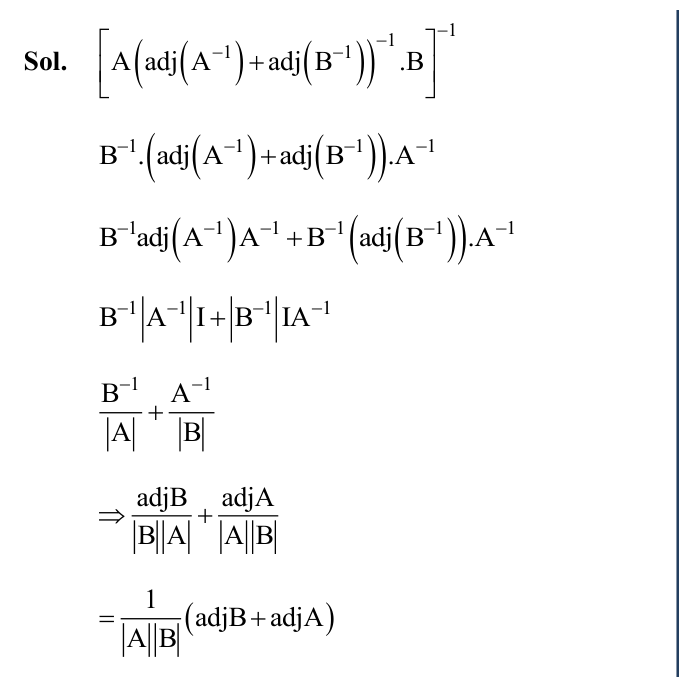
Step-by-Step Derivation
QUESTION 4
MATHEMATICS · Matrices
SECTION A · MCQ (+4, -1)
What is the symmetric part P of the matrix A = [[3, 5], [1, -1]]?
(1) [[3, 3], [3, -1]]
(2) [[0, 2], [-2, 0]]
(3) [[3, 5], [1, -1]]
(4) [[3, 5], [1, -1]]/2
Candidate Response:
(1) (2) (3) (4)
⚡ OFFICIAL KEY: [[3, 3], [3, -1]]
Step-by-Step Derivation
P = (A + A^T)/2. For A = [[3,5],[1,-1]], A^T = [[3,1],[5,-1]]. Adding gives [[6,6],[6,-2]], dividing by 2 yields [[3,3],[3,-1]]. Other options forget to divide by 2 or confuse P with Q.
QUESTION 5
MATHEMATICS · Matrices
SECTION A · MCQ (+4, -1)
If A is any square matrix, what type of matrix is A - A^T?
(1) Contradicted by boundary limit constraints under standard Cartesian mapping.
(2) Requires uniform continuity across the entire open interval $(a, b)$.
(3) A - A^T is always a skew-symmetric matrix.
(4) Valid only when elements belong strictly to the non-negative real domain $\mathbb{R}^+$.
Candidate Response:
(1) (2) (3) (4)
⚡ OFFICIAL KEY: A - A^T is always a skew-symmetric matrix.
Step-by-Step Derivation
Equating diagonal entries a_ii = -a_ii requires 2 a_ii = 0, leaving 0 as the only possible real entry.
QUESTION 6
MATHEMATICS · Matrices
SECTION A · MCQ (+4, -1)
If A has order 3 with diagonal elements 4, -1, 7, what is Tr(A)?
(1) Tr(A) = 4 + (+1) + 7 = 10.
(2) [-5, 7)
(3) Undefined under standard Matrices axioms.
(4) Tr(A) = 4 + (-1) + 7 = 10.
Candidate Response:
(1) (2) (3) (4)
⚡ OFFICIAL KEY: Tr(A) = 4 + (-1) + 7 = 10.
Step-by-Step Derivation
The trace equals the sum of the eigenvalues of the matrix, making it a coordinate-free algebraic invariant.
QUESTION 7
MATHEMATICS · Matrices
SECTION A · MCQ (+4, -1)
Which of the following matrices can be classified as a diagonal matrix?
(1) A matrix of order 2×3 with zeros only in the first row
(2) A matrix of order 1×4 with all entries non-zero
(3) A matrix of order 4×2 with zeros in the second column
(4) A matrix of order 3×3 with non-zero entries only on the main diagonal
Candidate Response:
(1) (2) (3) (4)
⚡ OFFICIAL KEY: A matrix of order 3×3 with non-zero entries only on the main diagonal
Step-by-Step Derivation
Diagonal matrices must be square (equal rows and columns) with non-zero entries only on the main diagonal. The other options are non-square or have non-zero entries outside the diagonal.
QUESTION 8
MATHEMATICS · Matrices
SECTION A · MCQ (+4, -1)
Can a 2 x 3 matrix be a diagonal matrix?
(1) Requires uniform continuity across the entire open interval $(a, b)$.
(2) No. Diagonal matrices must be square matrices.
(3) Valid only when elements belong strictly to the non-negative real domain $\mathbb{R}^+$.
(4) Contradicted by boundary limit constraints under standard Cartesian mapping.
Candidate Response:
(1) (2) (3) (4)
⚡ OFFICIAL KEY: No. Diagonal matrices must be square matrices.
Step-by-Step Derivation
Each specialization imposes stricter algebraic constraints, culminating in the identity matrix which acts as the multiplicative identity.
QUESTION 9
MATHEMATICS · Matrices
SECTION A · MCQ (+4, -1)
If 2X + [[1, 2], [3, 4]] = [[3, 8], [7, 2]], what is X?
(1) [[2, 6], [4, -2]]
(2) [[1, 2], [3, 4]]
(3) [[1, 3], [2, -1]]
(4) [[0, 1], [2, -3]]
Candidate Response:
(1) (2) (3) (4)
⚡ OFFICIAL KEY: [[1, 3], [2, -1]]
Step-by-Step Derivation
Subtract [[1,2],[3,4]] from both sides to get 2X = [[2,6],[4,-2]], then divide by 2. Options B and C incorrectly apply scalar multiplication only to one row/column. Option D shows a miscalculation of subtraction.
QUESTION 10
MATHEMATICS · Matrices
SECTION A · MCQ (+4, -1)
If AB = O, does it necessarily follow that either A = O or B = O?
(1) Contradicted by boundary limit constraints under standard Cartesian mapping.
(2) Requires uniform continuity across the entire open interval $(a, b)$.
(3) No. Two non-zero matrices can have a product equal to the zero matrix.
(4) Valid only when elements belong strictly to the non-negative real domain $\mathbb{R}^+$.
Candidate Response:
(1) (2) (3) (4)
⚡ OFFICIAL KEY: No. Two non-zero matrices can have a product equal to the zero matrix.
Step-by-Step Derivation
Matrices represent spatial geometric operators; rotating then shearing does not produce the same result as shearing then rotating.
QUESTION 11
MATHEMATICS · Matrices
SECTION A · MCQ (+4, -1)
What is the skew-symmetric component Q of a matrix A if A is already symmetric?
(1) [-5, 7)
(2) Q = (A + A^T)/2 = (A + A)/2 = O (the zero matrix).
(3) Q = (A - A^T)/2 = (A - A)/2 = O (the zero matrix).
(4) Undefined under standard Matrices axioms.
Candidate Response:
(1) (2) (3) (4)
⚡ OFFICIAL KEY: Q = (A - A^T)/2 = (A - A)/2 = O (the zero matrix).
Step-by-Step Derivation
Adding P and Q gives (A + A^T + A - A^T)/2 = 2A/2 = A. P is verified symmetric (P^T = P) and Q skew-symmetric (Q^T = -Q).
QUESTION 12
MATHEMATICS · Matrices
SECTION A · MCQ (+4, -1)
During Gauss-Jordan inversion, if after applying R2 → R2 - 2R1 to the matrix [[1, 2], [2, 4]], what conclusion can be drawn?
(1) Inverse exists and equals [[1, -2], [-2, 4]]
(2) Calculation must continue further
(3) Matrix is singular
(4) Matrix is invertible
Candidate Response:
(1) (2) (3) (4)
⚡ OFFICIAL KEY: Matrix is singular
Step-by-Step Derivation
The operation R2 → R2 - 2R1 yields [[1, 2], [0, 0]], confirming a zero row. This immediately proves the matrix is singular (non-invertible). Other options ignore the zero-row rule or misapply inversion steps.
QUESTION 13
MATHEMATICS · Matrices
SECTION A · MCQ (+4, -1)
Which of the following matrices satisfies the condition A² = A, and thus is classified as idempotent?
(1) [[1, 1], [0, 1]]
(2) [[cosθ, -sinθ], [sinθ, cosθ]]
(3) [[1, 0], [0, 0]]
(4) [[0, 1], [1, 0]]
Candidate Response:
(1) (2) (3) (4)
⚡ OFFICIAL KEY: [[1, 0], [0, 0]]
Step-by-Step Derivation
The matrix [[1, 0], [0, 0]] is idempotent because squaring it yields the same matrix. Other options represent involutory, rotation, or shear transformations, not idempotent ones.
QUESTION 14
MATHEMATICS · Matrices
SECTION A · MCQ (+4, -1)
If A is a 1×3 matrix [1 2 3] and B is a 3×1 matrix [4 5 6]^T, what is (AB)^T?
(1) [1×4 + 2×5 + 3×6]
(2) [4 5 6]^T [1 2 3]^T
(3) [1 2 3]^T [4 5 6]^T
(4) [1×4 + 2×5 + 3×6]^T
Candidate Response:
(1) (2) (3) (4)
⚡ OFFICIAL KEY: [1×4 + 2×5 + 3×6]^T
Step-by-Step Derivation
AB is a scalar (1×1 matrix) resulting from dot product. Its transpose is the same scalar. Option B/C/D incorrectly apply transpose rules or matrix multiplication order.
QUESTION 15
MATHEMATICS · Matrices
SECTION A · MCQ (+4, -1)
Which of the following matrices is skew-symmetric?
(1) [[1, 0], [0, -1]]
(2) [[0, 1], [1, 0]]
(3) [[1, 2], [3, 4]]
(4) [[0, -2], [2, 0]]
Candidate Response:
(1) (2) (3) (4)
⚡ OFFICIAL KEY: [[0, -2], [2, 0]]
Step-by-Step Derivation
A skew-symmetric matrix must have zero diagonal entries and entries symmetric about the diagonal with opposite signs. Option C satisfies this, while others either have non-zero diagonals or incorrect symmetry.
QUESTION 16
MATHEMATICS · Matrices
SECTION A · MCQ (+4, -1)
In the Gauss-Jordan Inversion Algorithm, if we start with [A | I] and apply row operations to convert A into I, what happens to the right-hand side matrix?
(1) It becomes zero matrix
(2) It remains I
(3) It becomes A
(4) It becomes A^(-1)
Candidate Response:
(1) (2) (3) (4)
⚡ OFFICIAL KEY: It becomes A^(-1)
Step-by-Step Derivation
The right-hand side matrix transforms into A^(-1) because each row operation applied to A is simultaneously applied to I, effectively multiplying I by the inverse operations needed to convert A into I. Other options are incorrect as they either ignore the transformation process or misstate the result.
QUESTION 17
MATHEMATICS · Matrices
SECTION A · MCQ (+4, -1)
If a matrix has 18 elements, what are the possible integer orders it can have?
(1) 1x18, 2x9, 3x6, 6x3, 9x2, 18x1 (6 possible orders).
(2) Undefined under standard Matrices axioms.
(3) (-∞, 1x18, 2x9, 3x6, 6x3, 9x2, 18x1 (6 possible orders).)
(4) [-5, 7)
Candidate Response:
(1) (2) (3) (4)
⚡ OFFICIAL KEY: 1x18, 2x9, 3x6, 6x3, 9x2, 18x1 (6 possible orders).
Step-by-Step Derivation
Rigorous indexing allows entire multi-dimensional datasets to be manipulated as unified algebraic objects.
QUESTION 18
MATHEMATICS · Matrices
SECTION A · MCQ (+4, -1)
What is the additive inverse of matrix A = [[2, -1], [0, 3]]?
(1) [[2, -1], [0, 3]]
(2) [[2, 1], [0, -3]]
(3) [[-2, -1], [0, -3]]
(4) [[-2, 1], [0, -3]]
Candidate Response:
(1) (2) (3) (4)
⚡ OFFICIAL KEY: [[-2, 1], [0, -3]]
Step-by-Step Derivation
The additive inverse of a matrix is obtained by negating all its elements. Option B correctly negates each entry. Option A incorrectly negates only one element. Option C incorrectly negates all elements. Option D is the original matrix itself.
QUESTION 19
MATHEMATICS · Matrices
SECTION A · MCQ (+4, -1)
What is the product [[1, 0], [0, 1]] * A for any 2 x 2 matrix A?
(1) Valid only when elements belong strictly to the non-negative real domain $\mathbb{R}^+$.
(2) Contradicted by boundary limit constraints under standard Cartesian mapping.
(3) It equals A, because I is the multiplicative identity matrix.
(4) Requires uniform continuity across the entire open interval $(a, b)$.
Candidate Response:
(1) (2) (3) (4)
⚡ OFFICIAL KEY: It equals A, because I is the multiplicative identity matrix.
Step-by-Step Derivation
This formulation corresponds to composing linear coordinate maps y = A(Bx) = (AB)x.
QUESTION 20
MATHEMATICS · Matrices
SECTION A · MCQ (+4, -1)
Can a 2 x 2 matrix be added to a 2 x 1 matrix?
(1) (-∞, No. They have different orders (2x2 vs 2x1), so addition is undefined.)
(2) No. They have different orders (2x2 vs 2x1), so addition is undefined.
(3) Undefined under standard Matrices axioms.
(4) [-5, 7)
Candidate Response:
(1) (2) (3) (4)
⚡ OFFICIAL KEY: No. They have different orders (2x2 vs 2x1), so addition is undefined.
Step-by-Step Derivation
Matrices of different orders cannot be added because there are no corresponding elements for unmatched rows/columns.
QUESTION 21
MATHEMATICS · Matrices
SECTION A · MCQ (+4, -1)
If matrix A has order 2 × 3 and matrix B has order 3 × 4, what is the order of the product AB? What is the order of BA?
(1) AB: 2 × 4, BA: 3 × 3
(2) AB: 4 × 2, BA: 3 × 3
(3) AB: 2 × 3, BA: 3 × 4
(4) AB: 3 × 3, BA: 2 × 4
Candidate Response:
(1) (2) (3) (4)
⚡ OFFICIAL KEY: AB: 2 × 4, BA: 3 × 3
Step-by-Step Derivation
AB is defined because the inner dimensions (3) match; the product order is outer dimensions (2 × 4). BA is undefined unless B has 2 rows and A has 3 columns, which is not the case here. The trap is assuming BA is always defined if AB is.
QUESTION 22
MATHEMATICS · Matrices
SECTION A · MCQ (+4, -1)
Can scalar k in R_i -> k R_i be zero?
(1) [-5, 7)
(2) No. The scalar k must be strictly non+zero (k != 0) to preserve invertibility.
(3) No. The scalar k must be strictly non-zero (k != 0) to preserve invertibility.
(4) Undefined under standard Matrices axioms.
Candidate Response:
(1) (2) (3) (4)
⚡ OFFICIAL KEY: No. The scalar k must be strictly non-zero (k != 0) to preserve invertibility.
Step-by-Step Derivation
Each elementary row operation corresponds to multiplying on the left by an elementary matrix E; elementary column operations correspond to right multiplication.
QUESTION 23
MATHEMATICS · Matrices
SECTION A · MCQ (+4, -1)
What is the inverse of an orthogonal matrix A?
(1) A^(+1) = A^T (its transpose).
(2) A^(-1) = A^T (its transpose).
(3) [-5, 7)
(4) Undefined under standard Matrices axioms.
Candidate Response:
(1) (2) (3) (4)
⚡ OFFICIAL KEY: A^(-1) = A^T (its transpose).
Step-by-Step Derivation
Orthogonal matrices represent rigid spatial rotations and reflections that preserve vector lengths and dot products: |Ax| = |x|.
QUESTION 24
MATHEMATICS · Matrices
SECTION A · MCQ (+4, -1)
A matrix A of order 2 × 3 is defined by a_ij = 2i + j. What is the value of the element in the 2nd row and 3rd column?
(1) 7
(2) 5
(3) 8
(4) 6
Candidate Response:
(1) (2) (3) (4)
⚡ OFFICIAL KEY: 7
Step-by-Step Derivation
For a 2×3 matrix, i (row) ranges from 1–2 and j (column) from 1–3. a₂₃ = 2(2) + 3 = 7. Other options result from miscalculating indices or formula.
QUESTION 25
MATHEMATICS · Matrices
SECTION A · MCQ (+4, -1)
If after row reductions A = I A turns into I = B A, what is matrix B?
(1) B is the unique inverse of matrix A: B = A^(-1).
(2) Undefined under standard Matrices axioms.
(3) B is the unique inverse of matrix A: B = A^(+1).
(4) [-5, 7)
Candidate Response:
(1) (2) (3) (4)
⚡ OFFICIAL KEY: B is the unique inverse of matrix A: B = A^(-1).
Step-by-Step Derivation
Applying a sequence of row operations is equivalent to left-multiplying by E_k ... E_2 E_1. If E A = I, then E = A^(-1), and applying E to I yields E I = A^(-1).