
✎ ANSWER ONLINE · EVERY MISTAKE LINKS BACK TO THE CONCEPT
Matrices · Practice Worksheet
Answer each question here and it marks straight away, with the derivation and a link to the exact micro-concept to revisit.
9 questions from this set could not be marked online — a
bonus or dual-key question, which has no single defensible answer. The print and
.docx versions still include them.
// CONCEPT AUDIT RESULT
Everything you missed has been added to your Error Arena — retest them blind there, and a concept clears once you get it right.
QUESTION 1
Matrices
SECTION B · NUMERICAL (+4, 0)
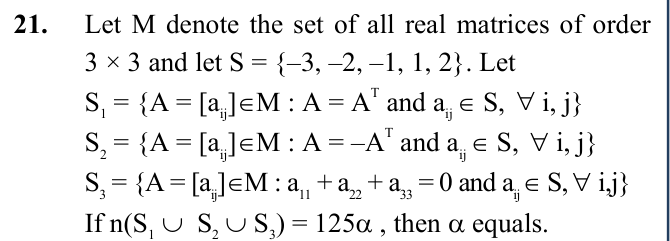
11
12
13
21
22
23
31
32
33
a
a
a
a
a
a
a
a
a
]
[
]
[
]
{
}
No. of elements in S1 : A = A
T ⇒ 5
3 × 5
3
No. of elements in S2 : A = –A
T ⇒ 0
since no zero in S2
No. of elements in S3 ⇒
a11 + a22 + a33 = 0 ⇒ (1,2,–3) ⇒ 31
or
(1,1,–2) ⇒ 3 ⇒12×5
6
or
(–1,–1,2) ⇒ 3
(
)
1
3
n S
S
= 12 × 5
3
}
(
)
1
2
3
n S
S
S
= 5
6(1+12) – 12 × 5
3
⇒5
3 × [13 × 5
3 – 12] = 125α
α = 1613
QUESTION 2
Matrices
SECTION B · NUMERICAL (+4, 0)
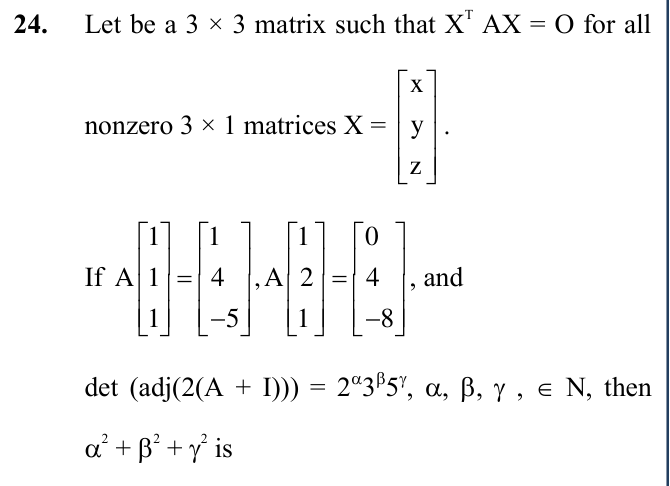
X
TAX = 0
(xyz)
) )
(
(=
(
(
(
(
[
)[)
1
2
3
1
2
3
1
2
3
a
a
a
x
b
b
b
y
0
c
c
c
z
(xyz) + +
)
( + + = (
( + +
[
)
1
2
3
1
2
3
1
2
3
a x
a y
a z
b x
b y
b z
0
c x
c y
c z
x(a1x +a2y + a3z) + y(b1x + b2y + b3z)
+ z(c1x + c2y + c3z) = 0
a1 = 0, b2 = 0 c3 = 0
a2 + b1 = 0, a3 + c1 = 0, b3 = c2 = 0
A = skew symm matrix
)
(
=-
(
( - -
[
)
0
x
y
A
x
0
z
y
z
0
;
)
)
(
( = =
(
(
(
(
[)
[
)
1
1
A
1
4
1
–5
⇒
) )
)
(
(
(
=- = (
(
(
(
(
( - - - [
)[)
[
)
0
x
y
1
1
A
x
0
z
1
4
y
z
0
1
5
x + y = 1
–x + z = 4
y + z = 5
) )
)
(
(
( - =
(
(
(
(
(
( - - - [
)[)
[
)
0
x
y
1
1
x
0
z
2
4
y
z
0
1
8
2x + y = 0 x = –1
–x + z = 4 y = 2
–y –2z = –8 z = 3
)
(
=(
( - -
[
)
0
–1
2
A
1
0
3
2
3
0
2(A+I) =
)
(
(
( - -
[
)
2
–2
4
2
2
6
2
6
2
2(A+I)=120 ⇒ det |adi(2(A+I))|
= 120
2 = 2
6.3
2.5
2
α = 6, β = 2, γ = 2
QUESTION 3
Matrices
SECTION A · MCQ (+4, -1)
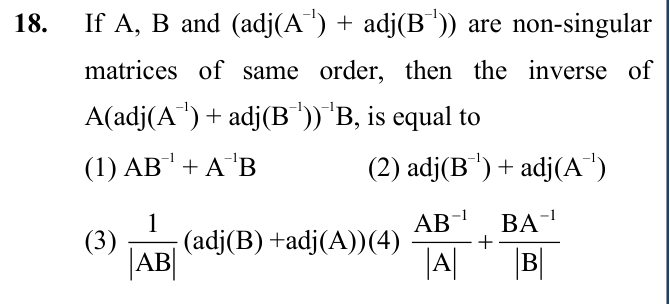
(1) AB
–1 + A
–1B
(2) adj(B
–1) + adj(A
–1)
(3) 1
AB (adj(B) +adj(A))
(4) 1
1
AB
BA
A
B - -
+
(
)
(
)
(
) - - - -
] + [
]
{
}
1
1
1
1
A adj A
adj B
.B
(
)
(
)
(
) - - - - + 1
1
1
1
B . adj A
adj B
.A
(
)
(
)
(
) - - - - - - + 1
1
1
1
1
1
B adj A
A
B
adj B
.A - - - - + 1
1
1
1
B
A
I
B
IA - - + 1
1
B
A
A
B
⇒ + adjB
adjA
B A
A B
(
) = +
1
adjB
adjA
A B
QUESTION 4
Matrices
SECTION A · MCQ (+4, -1)
If A is any square matrix, what type of matrix is A - A^T?
(1) Contradicted by boundary limit constraints under standard Cartesian mapping.
(2) Requires uniform continuity across the entire open interval $(a, b)$.
(3) A - A^T is always a skew-symmetric matrix.
(4) Valid only when elements belong strictly to the non-negative real domain $\mathbb{R}^+$.
Equating diagonal entries a_ii = -a_ii requires 2 a_ii = 0, leaving 0 as the only possible real entry.
QUESTION 5
Matrices
SECTION A · MCQ (+4, -1)
If A has order 3 with diagonal elements 4, -1, 7, what is Tr(A)?
(1) Tr(A) = 4 + (+1) + 7 = 10.
(2) [-5, 7)
(3) Undefined under standard Matrices axioms.
(4) Tr(A) = 4 + (-1) + 7 = 10.
The trace equals the sum of the eigenvalues of the matrix, making it a coordinate-free algebraic invariant.
QUESTION 6
Matrices
SECTION A · MCQ (+4, -1)
Which of the following matrices can be classified as a diagonal matrix?
(1) A matrix of order 2×3 with zeros only in the first row
(2) A matrix of order 1×4 with all entries non-zero
(3) A matrix of order 4×2 with zeros in the second column
(4) A matrix of order 3×3 with non-zero entries only on the main diagonal
Diagonal matrices must be square (equal rows and columns) with non-zero entries only on the main diagonal. The other options are non-square or have non-zero entries outside the diagonal.
QUESTION 7
Matrices
SECTION A · MCQ (+4, -1)
Can a 2 x 3 matrix be a diagonal matrix?
(1) Requires uniform continuity across the entire open interval $(a, b)$.
(2) No. Diagonal matrices must be square matrices.
(3) Valid only when elements belong strictly to the non-negative real domain $\mathbb{R}^+$.
(4) Contradicted by boundary limit constraints under standard Cartesian mapping.
Each specialization imposes stricter algebraic constraints, culminating in the identity matrix which acts as the multiplicative identity.
QUESTION 8
Matrices
SECTION A · MCQ (+4, -1)
If AB = O, does it necessarily follow that either A = O or B = O?
(1) Contradicted by boundary limit constraints under standard Cartesian mapping.
(2) Requires uniform continuity across the entire open interval $(a, b)$.
(3) No. Two non-zero matrices can have a product equal to the zero matrix.
(4) Valid only when elements belong strictly to the non-negative real domain $\mathbb{R}^+$.
Matrices represent spatial geometric operators; rotating then shearing does not produce the same result as shearing then rotating.
QUESTION 9
Matrices
SECTION A · MCQ (+4, -1)
What is the skew-symmetric component Q of a matrix A if A is already symmetric?
(1) [-5, 7)
(2) Q = (A + A^T)/2 = (A + A)/2 = O (the zero matrix).
(3) Q = (A - A^T)/2 = (A - A)/2 = O (the zero matrix).
(4) Undefined under standard Matrices axioms.
Adding P and Q gives (A + A^T + A - A^T)/2 = 2A/2 = A. P is verified symmetric (P^T = P) and Q skew-symmetric (Q^T = -Q).
QUESTION 10
Matrices
SECTION A · MCQ (+4, -1)
During Gauss-Jordan inversion, if after applying R2 → R2 - 2R1 to the matrix [[1, 2], [2, 4]], what conclusion can be drawn?
(1) Inverse exists and equals [[1, -2], [-2, 4]]
(2) Calculation must continue further
(3) Matrix is singular
(4) Matrix is invertible
The operation R2 → R2 - 2R1 yields [[1, 2], [0, 0]], confirming a zero row. This immediately proves the matrix is singular (non-invertible). Other options ignore the zero-row rule or misapply inversion steps.
QUESTION 11
Matrices
SECTION A · MCQ (+4, -1)
If A is a 1×3 matrix [1 2 3] and B is a 3×1 matrix [4 5 6]^T, what is (AB)^T?
(1) [1×4 + 2×5 + 3×6]
(2) [4 5 6]^T [1 2 3]^T
(3) [1 2 3]^T [4 5 6]^T
(4) [1×4 + 2×5 + 3×6]^T
AB is a scalar (1×1 matrix) resulting from dot product. Its transpose is the same scalar. Option B/C/D incorrectly apply transpose rules or matrix multiplication order.
QUESTION 12
Matrices
SECTION A · MCQ (+4, -1)
In the Gauss-Jordan Inversion Algorithm, if we start with [A | I] and apply row operations to convert A into I, what happens to the right-hand side matrix?
(1) It becomes zero matrix
(2) It remains I
(3) It becomes A
(4) It becomes A^(-1)
The right-hand side matrix transforms into A^(-1) because each row operation applied to A is simultaneously applied to I, effectively multiplying I by the inverse operations needed to convert A into I. Other options are incorrect as they either ignore the transformation process or misstate the result.
QUESTION 13
Matrices
SECTION A · MCQ (+4, -1)
Can scalar k in R_i -> k R_i be zero?
(1) [-5, 7)
(2) No. The scalar k must be strictly non+zero (k != 0) to preserve invertibility.
(3) No. The scalar k must be strictly non-zero (k != 0) to preserve invertibility.
(4) Undefined under standard Matrices axioms.
Each elementary row operation corresponds to multiplying on the left by an elementary matrix E; elementary column operations correspond to right multiplication.
QUESTION 14
Matrices
SECTION A · MCQ (+4, -1)
What is the inverse of an orthogonal matrix A?
(1) A^(+1) = A^T (its transpose).
(2) A^(-1) = A^T (its transpose).
(3) [-5, 7)
(4) Undefined under standard Matrices axioms.
Orthogonal matrices represent rigid spatial rotations and reflections that preserve vector lengths and dot products: |Ax| = |x|.
QUESTION 15
Matrices
SECTION A · MCQ (+4, -1)
A matrix A of order 2 × 3 is defined by a_ij = 2i + j. What is the value of the element in the 2nd row and 3rd column?
(1) 7
(2) 5
(3) 8
(4) 6
For a 2×3 matrix, i (row) ranges from 1–2 and j (column) from 1–3. a₂₃ = 2(2) + 3 = 7. Other options result from miscalculating indices or formula.
QUESTION 16
Matrices
SECTION A · MCQ (+4, -1)
If after row reductions A = I A turns into I = B A, what is matrix B?
(1) B is the unique inverse of matrix A: B = A^(-1).
(2) Undefined under standard Matrices axioms.
(3) B is the unique inverse of matrix A: B = A^(+1).
(4) [-5, 7)
Applying a sequence of row operations is equivalent to left-multiplying by E_k ... E_2 E_1. If E A = I, then E = A^(-1), and applying E to I yields E I = A^(-1).