
⚡ OFFICIAL NTA ASSESSMENT GENERATOR & WORD (.DOCX) EXPORTER
Matrices · Practice Worksheet
JEE Main Mathematics · Curated Assessment Set Print directly or export as a beautifully formatted Microsoft Word document with embedded 180-DPI mathematical prompt clips and step-by-step derivations.
EDUPROD JEE MAIN TEST SERIES · NTA PATTERN
Matrices · Practice Worksheet
JEE Main Mathematics · Curated Assessment Set · Assessment Code: JEE-101
Total Marks: 120
Marking: +4 / -1 (Sec A) · +4 / 0 (Sec B)
QUESTION 1
MATHEMATICS · Matrices
SECTION B · NUMERICAL (+4, 0)
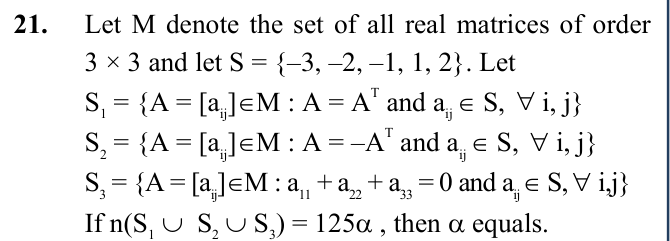
Numerical Value:
[ ]
QUESTION 2
MATHEMATICS · Matrices
SECTION B · NUMERICAL (+4, 0)
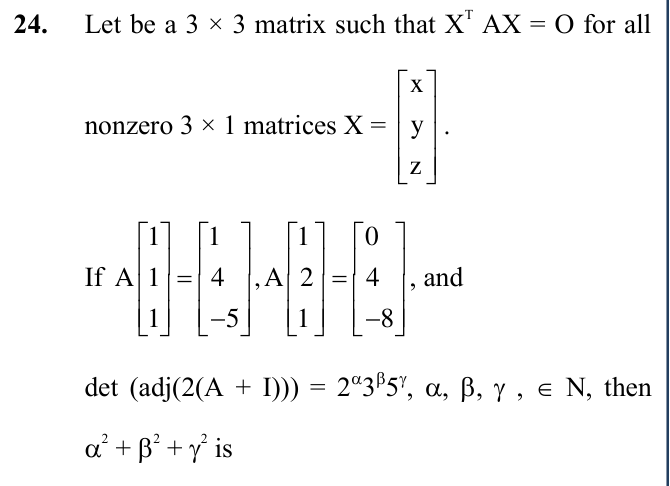
Numerical Value:
[ ]
QUESTION 3
MATHEMATICS · Matrices
SECTION A · MCQ (+4, -1)
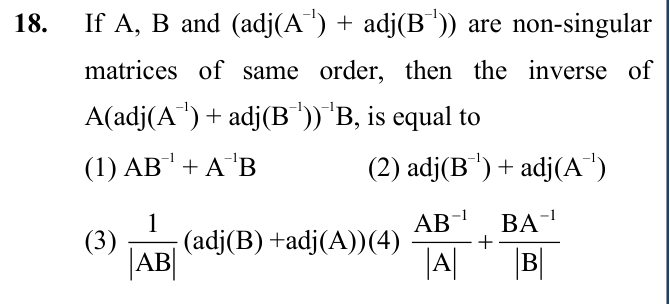
Candidate Response:
(1) (2) (3) (4)
QUESTION 4
MATHEMATICS · Matrices
SECTION A · MCQ (+4, -1)
What is the symmetric part P of the matrix A = [[3, 5], [1, -1]]?
(1) [[3, 3], [3, -1]]
(2) [[0, 2], [-2, 0]]
(3) [[3, 5], [1, -1]]
(4) [[3, 5], [1, -1]]/2
Candidate Response:
(1) (2) (3) (4)
QUESTION 5
MATHEMATICS · Matrices
SECTION A · MCQ (+4, -1)
If A is any square matrix, what type of matrix is A - A^T?
(1) Contradicted by boundary limit constraints under standard Cartesian mapping.
(2) Requires uniform continuity across the entire open interval $(a, b)$.
(3) A - A^T is always a skew-symmetric matrix.
(4) Valid only when elements belong strictly to the non-negative real domain $\mathbb{R}^+$.
Candidate Response:
(1) (2) (3) (4)
QUESTION 6
MATHEMATICS · Matrices
SECTION A · MCQ (+4, -1)
If A has order 3 with diagonal elements 4, -1, 7, what is Tr(A)?
(1) Tr(A) = 4 + (+1) + 7 = 10.
(2) [-5, 7)
(3) Undefined under standard Matrices axioms.
(4) Tr(A) = 4 + (-1) + 7 = 10.
Candidate Response:
(1) (2) (3) (4)
QUESTION 7
MATHEMATICS · Matrices
SECTION A · MCQ (+4, -1)
Which of the following matrices can be classified as a diagonal matrix?
(1) A matrix of order 2×3 with zeros only in the first row
(2) A matrix of order 1×4 with all entries non-zero
(3) A matrix of order 4×2 with zeros in the second column
(4) A matrix of order 3×3 with non-zero entries only on the main diagonal
Candidate Response:
(1) (2) (3) (4)
QUESTION 8
MATHEMATICS · Matrices
SECTION A · MCQ (+4, -1)
Can a 2 x 3 matrix be a diagonal matrix?
(1) Requires uniform continuity across the entire open interval $(a, b)$.
(2) No. Diagonal matrices must be square matrices.
(3) Valid only when elements belong strictly to the non-negative real domain $\mathbb{R}^+$.
(4) Contradicted by boundary limit constraints under standard Cartesian mapping.
Candidate Response:
(1) (2) (3) (4)
QUESTION 9
MATHEMATICS · Matrices
SECTION A · MCQ (+4, -1)
If 2X + [[1, 2], [3, 4]] = [[3, 8], [7, 2]], what is X?
(1) [[2, 6], [4, -2]]
(2) [[1, 2], [3, 4]]
(3) [[1, 3], [2, -1]]
(4) [[0, 1], [2, -3]]
Candidate Response:
(1) (2) (3) (4)
QUESTION 10
MATHEMATICS · Matrices
SECTION A · MCQ (+4, -1)
If AB = O, does it necessarily follow that either A = O or B = O?
(1) Contradicted by boundary limit constraints under standard Cartesian mapping.
(2) Requires uniform continuity across the entire open interval $(a, b)$.
(3) No. Two non-zero matrices can have a product equal to the zero matrix.
(4) Valid only when elements belong strictly to the non-negative real domain $\mathbb{R}^+$.
Candidate Response:
(1) (2) (3) (4)
QUESTION 11
MATHEMATICS · Matrices
SECTION A · MCQ (+4, -1)
What is the skew-symmetric component Q of a matrix A if A is already symmetric?
(1) [-5, 7)
(2) Q = (A + A^T)/2 = (A + A)/2 = O (the zero matrix).
(3) Q = (A - A^T)/2 = (A - A)/2 = O (the zero matrix).
(4) Undefined under standard Matrices axioms.
Candidate Response:
(1) (2) (3) (4)
QUESTION 12
MATHEMATICS · Matrices
SECTION A · MCQ (+4, -1)
During Gauss-Jordan inversion, if after applying R2 → R2 - 2R1 to the matrix [[1, 2], [2, 4]], what conclusion can be drawn?
(1) Inverse exists and equals [[1, -2], [-2, 4]]
(2) Calculation must continue further
(3) Matrix is singular
(4) Matrix is invertible
Candidate Response:
(1) (2) (3) (4)
QUESTION 13
MATHEMATICS · Matrices
SECTION A · MCQ (+4, -1)
Which of the following matrices satisfies the condition A² = A, and thus is classified as idempotent?
(1) [[1, 1], [0, 1]]
(2) [[cosθ, -sinθ], [sinθ, cosθ]]
(3) [[1, 0], [0, 0]]
(4) [[0, 1], [1, 0]]
Candidate Response:
(1) (2) (3) (4)
QUESTION 14
MATHEMATICS · Matrices
SECTION A · MCQ (+4, -1)
If A is a 1×3 matrix [1 2 3] and B is a 3×1 matrix [4 5 6]^T, what is (AB)^T?
(1) [1×4 + 2×5 + 3×6]
(2) [4 5 6]^T [1 2 3]^T
(3) [1 2 3]^T [4 5 6]^T
(4) [1×4 + 2×5 + 3×6]^T
Candidate Response:
(1) (2) (3) (4)
QUESTION 15
MATHEMATICS · Matrices
SECTION A · MCQ (+4, -1)
Which of the following matrices is skew-symmetric?
(1) [[1, 0], [0, -1]]
(2) [[0, 1], [1, 0]]
(3) [[1, 2], [3, 4]]
(4) [[0, -2], [2, 0]]
Candidate Response:
(1) (2) (3) (4)
QUESTION 16
MATHEMATICS · Matrices
SECTION A · MCQ (+4, -1)
In the Gauss-Jordan Inversion Algorithm, if we start with [A | I] and apply row operations to convert A into I, what happens to the right-hand side matrix?
(1) It becomes zero matrix
(2) It remains I
(3) It becomes A
(4) It becomes A^(-1)
Candidate Response:
(1) (2) (3) (4)
QUESTION 17
MATHEMATICS · Matrices
SECTION A · MCQ (+4, -1)
If a matrix has 18 elements, what are the possible integer orders it can have?
(1) 1x18, 2x9, 3x6, 6x3, 9x2, 18x1 (6 possible orders).
(2) Undefined under standard Matrices axioms.
(3) (-∞, 1x18, 2x9, 3x6, 6x3, 9x2, 18x1 (6 possible orders).)
(4) [-5, 7)
Candidate Response:
(1) (2) (3) (4)
QUESTION 18
MATHEMATICS · Matrices
SECTION A · MCQ (+4, -1)
What is the additive inverse of matrix A = [[2, -1], [0, 3]]?
(1) [[2, -1], [0, 3]]
(2) [[2, 1], [0, -3]]
(3) [[-2, -1], [0, -3]]
(4) [[-2, 1], [0, -3]]
Candidate Response:
(1) (2) (3) (4)
QUESTION 19
MATHEMATICS · Matrices
SECTION A · MCQ (+4, -1)
What is the product [[1, 0], [0, 1]] * A for any 2 x 2 matrix A?
(1) Valid only when elements belong strictly to the non-negative real domain $\mathbb{R}^+$.
(2) Contradicted by boundary limit constraints under standard Cartesian mapping.
(3) It equals A, because I is the multiplicative identity matrix.
(4) Requires uniform continuity across the entire open interval $(a, b)$.
Candidate Response:
(1) (2) (3) (4)
QUESTION 20
MATHEMATICS · Matrices
SECTION A · MCQ (+4, -1)
Can a 2 x 2 matrix be added to a 2 x 1 matrix?
(1) (-∞, No. They have different orders (2x2 vs 2x1), so addition is undefined.)
(2) No. They have different orders (2x2 vs 2x1), so addition is undefined.
(3) Undefined under standard Matrices axioms.
(4) [-5, 7)
Candidate Response:
(1) (2) (3) (4)
QUESTION 21
MATHEMATICS · Matrices
SECTION A · MCQ (+4, -1)
If matrix A has order 2 × 3 and matrix B has order 3 × 4, what is the order of the product AB? What is the order of BA?
(1) AB: 2 × 4, BA: 3 × 3
(2) AB: 4 × 2, BA: 3 × 3
(3) AB: 2 × 3, BA: 3 × 4
(4) AB: 3 × 3, BA: 2 × 4
Candidate Response:
(1) (2) (3) (4)
QUESTION 22
MATHEMATICS · Matrices
SECTION A · MCQ (+4, -1)
Can scalar k in R_i -> k R_i be zero?
(1) [-5, 7)
(2) No. The scalar k must be strictly non+zero (k != 0) to preserve invertibility.
(3) No. The scalar k must be strictly non-zero (k != 0) to preserve invertibility.
(4) Undefined under standard Matrices axioms.
Candidate Response:
(1) (2) (3) (4)
QUESTION 23
MATHEMATICS · Matrices
SECTION A · MCQ (+4, -1)
What is the inverse of an orthogonal matrix A?
(1) A^(+1) = A^T (its transpose).
(2) A^(-1) = A^T (its transpose).
(3) [-5, 7)
(4) Undefined under standard Matrices axioms.
Candidate Response:
(1) (2) (3) (4)
QUESTION 24
MATHEMATICS · Matrices
SECTION A · MCQ (+4, -1)
A matrix A of order 2 × 3 is defined by a_ij = 2i + j. What is the value of the element in the 2nd row and 3rd column?
(1) 7
(2) 5
(3) 8
(4) 6
Candidate Response:
(1) (2) (3) (4)
QUESTION 25
MATHEMATICS · Matrices
SECTION A · MCQ (+4, -1)
If after row reductions A = I A turns into I = B A, what is matrix B?
(1) B is the unique inverse of matrix A: B = A^(-1).
(2) Undefined under standard Matrices axioms.
(3) B is the unique inverse of matrix A: B = A^(+1).
(4) [-5, 7)
Candidate Response:
(1) (2) (3) (4)
QUESTION 26
MATHEMATICS · Matrices
SECTION A · MCQ (+4, -1)
If A is an involutory matrix, what is A^(-1)?
(1) A^(-1) = A (the matrix is its own inverse).
(2) [-5, 7)
(3) Undefined under standard Matrices axioms.
(4) A^(+1) = A (the matrix is its own inverse).
Candidate Response:
(1) (2) (3) (4)
QUESTION 27
MATHEMATICS · Matrices
SECTION A · MCQ (+4, -1)
If A is 1 x 3 and B is 3 x 1, what is the order of AB, and what is the order of BA?
(1) (-∞, AB has order 1 x 1 (a scalar), while BA has order 3 x 3.)
(2) [-5, 7)
(3) Undefined under standard Matrices axioms.
(4) AB has order 1 x 1 (a scalar), while BA has order 3 x 3.
Candidate Response:
(1) (2) (3) (4)
QUESTION 28
MATHEMATICS · Matrices
SECTION A · MCQ (+4, -1)
What is the trace of the matrix A = [[3, 2], [4, 5]]?
(1) 7
(2) 12
(3) 8
(4) 10
Candidate Response:
(1) (2) (3) (4)
QUESTION 29
MATHEMATICS · Matrices
SECTION A · MCQ (+4, -1)
Which of the following is a defining property of an orthogonal matrix?
(1) Its inverse is its transpose
(2) It satisfies A² = I
(3) Its columns are orthogonal but not necessarily unit vectors
(4) Its determinant is always 1
Candidate Response:
(1) (2) (3) (4)
QUESTION 30
MATHEMATICS · Matrices
SECTION A · MCQ (+4, -1)
Which of the following is NOT an elementary row operation on a matrix?
(1) Multiplying a row by zero (R_i → 0 × R_i)
(2) Adding a multiple of one row to another (R_i → R_i + k R_j, j ≠ i)
(3) Interchanging two rows (R_i ↔ R_j)
(4) Multiplying a row by a non-zero scalar (R_i → k R_i, k ≠ 0)
Candidate Response:
(1) (2) (3) (4)