
✎ ANSWER ONLINE · EVERY MISTAKE LINKS BACK TO THE CONCEPT
Differential Equations · Practice Worksheet
Answer each question here and it marks straight away, with the derivation and a link to the exact micro-concept to revisit.
// CONCEPT AUDIT RESULT
Everything you missed has been added to your Error Arena — retest them blind there, and a concept clears once you get it right.
QUESTION 1
Trigonometric Functions
SECTION A · MCQ (+4, -1)
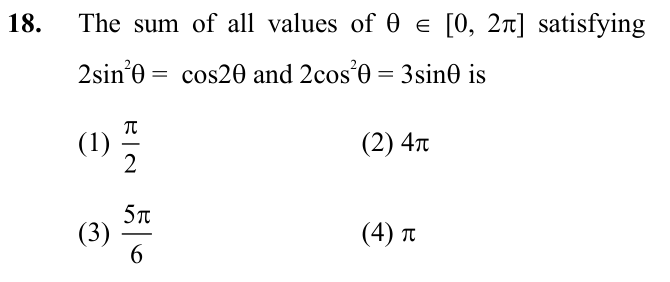
(1) 2
π
(2) 4π
(3) 5
6
π
(4) π
2sin
2θ = cos2θ
2sin
2θ = 1 – 2sin
2θ
4sin
2θ = 1
sin
2θ = 1
4
sinθ = ± 1
2
2cos
2θ = 3sinθ
2 – 2sin
2θ + 3sinθ– 2 = 0
(2sinθ – 1)(2sinθ – 2) = 0
sinθ = 1
2
so common equation which satisfy both equations
is sinθ = 1
2
5
,
6
6
π
π
θ=
(θ ∈ [0, 2π])
Sum = π
6
QUESTION 2
Trigonometric Functions
SECTION B · NUMERICAL (+4, 0)
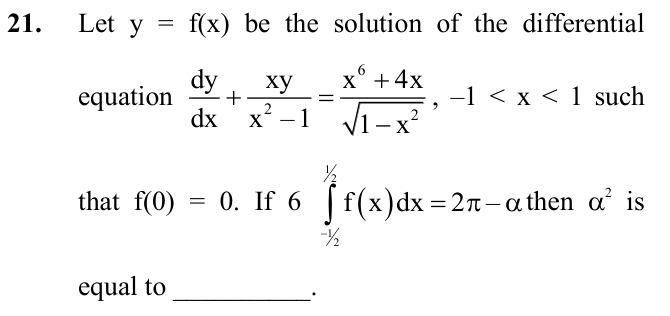
I.F.
2
2
1
2x
1
dx
n(1 x )
2
2 1 x
2
e
e
1
x - - - -
∫ = = - 7
2
6
2
x
y
1
x
(x
4x)dx
2x
c
7 × - = + = + + ∫
Given y(0) = 0 ⇒ c = 0
7
2
2
x
2x
7
y
1
x + = - Now,
7
1
1
2
2
2
2
2
2
1
1
2
2
x
2x
2x
7
6
dx
6
dx
1
x
1
x - - + = - -
∫
∫
1
2
2
2
0
x
24
dx
1
x = -
∫
Put x = sinθ
dx = cosθ dθ
2
6
0
sin
24
cos d
cos
π
θ = θθ
θ
∫
6
6
0
0
1
cos2
sin2
24
d
12
2
2
π
π - θ
θ
)
] = θ=
θ-
(
[
]
[
)
{
}
∫ = 3
12 6
4
)
π-
(
(
[
)
= 2
3 3
π-
2
2
(3 3)
27
α=
=
QUESTION 3
Trigonometric Functions
SECTION B · NUMERICAL (+4, 0)
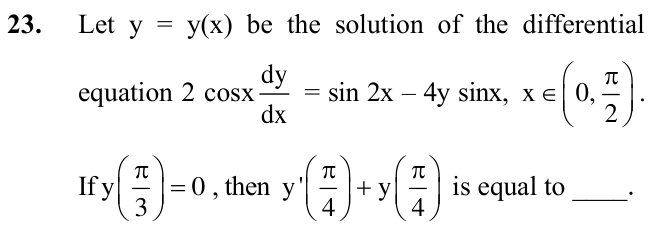
dy
2ytanx
sinx
dx + = I.F. =
2 tanx dx
2
e
sec x
∫ = ysec
2x =
2
sinx dx
cos x
∫
tanxsecx dx
=∫
= secx + C
C = –2
y = cosx – 2cos
2x
1
y
1
4
2
π
)= - (
[
)
y′ = –sinx + 4cosx sinx
1
y
2
4
2
π
)
′
=- + (
[
)
y
y
1
4
4
π
π
)
)
′ + =
(
(
[
)
[
)
QUESTION 4
Determinants
SECTION A · MCQ (+4, -1)
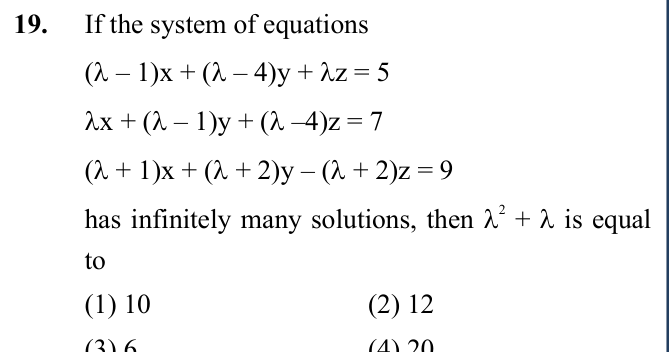
(1) 10
(2) 12
(3) 6
(4) 20
(
)
(
)
λ-
+λ-
+λ=
1 x
4 y
z
5
(
)
(
)
λ+λ-
+λ- = x
1 y
4 z
7
(
)
(
)
(
)
λ+
+λ+
-λ+ = 1 x
2 y
2 z
9
For infinitely many solutions
(
)
λ-
λ-
λ = λ
λ-
λ- = λ+
λ+
-λ+
1
4
D
1
4
0
1
2
2
(λ– 3) (2λ+ 1) = 0
(
)
λ-
λ = λ-
λ- = λ+
-λ+
x
5
4
D
7
1
4
0
9
2
2
2(3 – λ) (23 - 2λ) = 0
λ= 3
∴λ
2 + λ = 9 + 3 = 12
QUESTION 5
Binomial Theorem
SECTION A · MCQ (+4, -1)
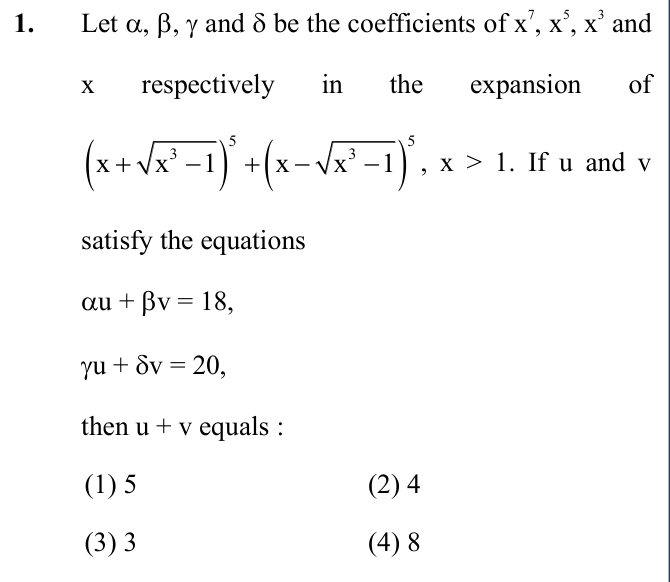
(1) 5
(2) 4
(3) 3
(4) 8
(
)
(
)
5
5
3
3
x
x
1
x
x
1 + - + - - = 2{
5C0.x
5 +
5C2.x
3(x
3 – 1) +
5C4.x(x
3 – 1)
2}
= 2{5x
7 + 10x
6 + x
5 – 10x
4 – 10x
3 + 5x}
⇒ α = 10, β = 2, γ = –20, δ = 10
Now, 10u + 2v = 18
–20u + 10v = 20
⇒u = 1, v = 4
u + v = 5
QUESTION 6
Integrals
SECTION A · MCQ (+4, -1)
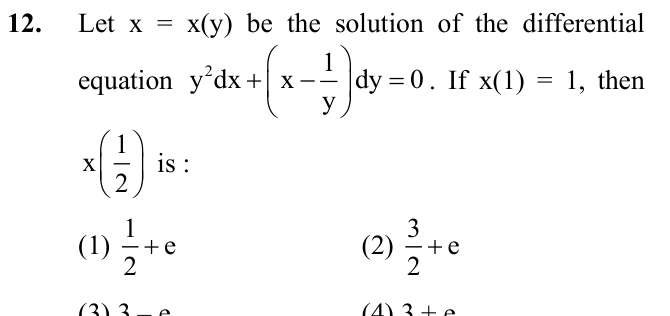
(1) +
1
e
2
(2) +
3
e
2
(3) 3 – e
(4) 3 + e
4
2
3
dx
1
1
x
dy
y
y
) + =
(
[
)
I.F. =
2
1
1
dy
y
y
e
e - ∫ = 1
1
y
t
3
1
x.e
e
.
dy
y - -
)
⇒
=(
[
)
∫
Put
1
t
y - =
2
1 dy
dt
y + =
1
t
y
x.e
t.e dt - =-∫
1
t
t
y
x.e
te
e
C - =- + +
1
1
1
y
y
y
1
x.e
e
e
C
y - - - + = + + x = 1, y = 1
1
1
1
C
e
e
e = + + ⇒
1
C
e
=-
Put y = 1
2
2
2
2
x
2
1
1
e
e
e
e = + - x = 3 – e
QUESTION 7
Complex Numbers
SECTION A · MCQ (+4, -1)
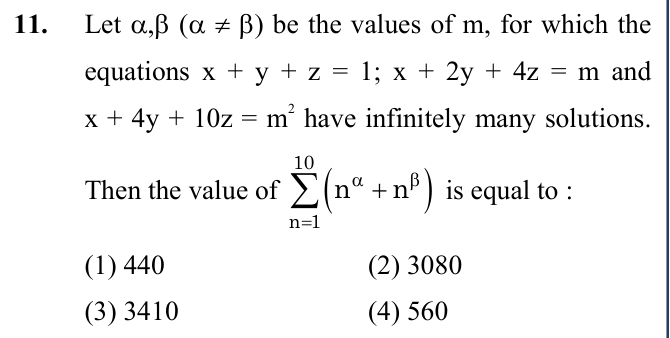
(1) 440
(2) 3080
(3) 3410
(4) 560
1
1
1
1
2
4
1
4
10
Δ=
= 1(20 – 16) – 1(10 – 4) + 1(4 – 2)
= 4 – 6 + 2 = 0
For infinite solutions
Δx = Δy = Δz = 0
m
2 – 3x + 2 = 0
m = 1, 2
α= 1, β = 2
∴
10
10
10
1
2
n 1
n 1
n 1
(n
n )
n
n
α
β = = = + = +
∑
∑
∑
= 10(11)
10(11)(21)
2
6 + = 55 + 385
= 440
QUESTION 8
Determinants
SECTION A · MCQ (+4, -1)
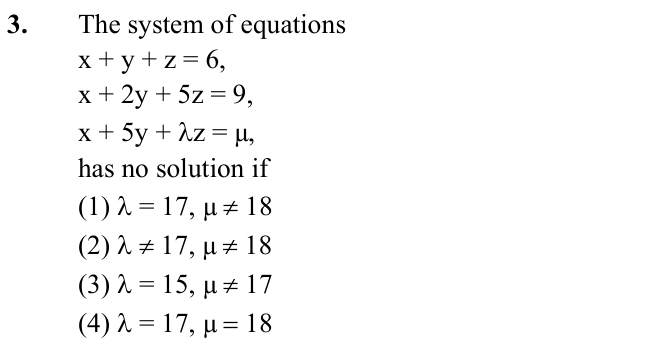
(1) λ = 17, µ ≠ 18
(2) λ ≠ 17, µ ≠ 18
(3) λ = 15, µ ≠ 17
(4) λ = 17, µ = 18
= = λ
1
1
1
D
1
2
5
0
1
5
λ= 17 = ≠
μ
z
1
1
6
D
1
2
9
0
1
5
μ≠18
QUESTION 9
Determinants
SECTION A · MCQ (+4, -1)
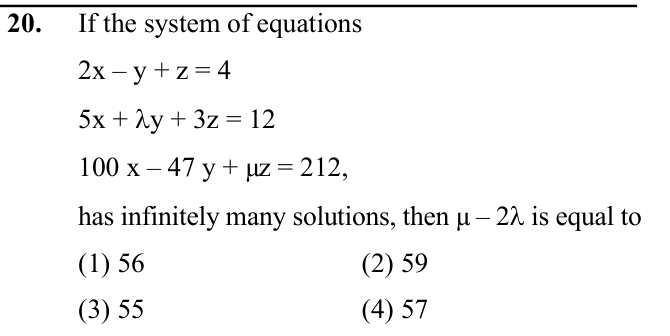
(1) 56
(2) 59
(3) 55
(4) 57
Δ = 0 ⇒ - λ = μ
2
1
1
5
3
0
100
–47
2(λμ+141) + (5μ –300) –235 –100λ = 0 …(1)
Δ3 = 0 ⇒ - λ = 2
1
4
5
12
0
100
–47
212
6λ = –12 ⇒ λ = –2
Put λ = 2 in (1)
2(–2μ + 141) + 5μ – 300 – 235 + 200 = 0
μ = 53
∴ 57
SECTION-B
QUESTION 10
Trigonometric Functions
SECTION A · MCQ (+4, -1)
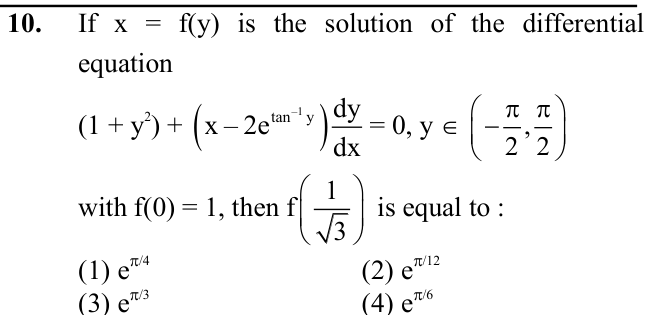
(1) eπ/4
(2) eπ/12
(3) eπ/3
(4) eπ/6
1
tan
y
2
2
dx
x
2e
dy
1
y
1
y - + = + + I.F. =
1
tan
y
e - 1
1
tan
y
2
tan
y
2
2(e
) dy
xe
1
y - - = +
∫
Put tan
–1y = t,
2
dy
dt
1
y = + 1
tan
y
2t
xe
2e dt - =∫
1
1
tan
y
2tan
y
xe
e
c - - = +
1
1
tan
y
tan
y
x
e
ce - - - = + y = 0, x = 1
1 = 1 + c ⇒ c = 0
y = 1
3
, x = eπ/6
QUESTION 11
Trigonometric Functions
SECTION A · MCQ (+4, -1)
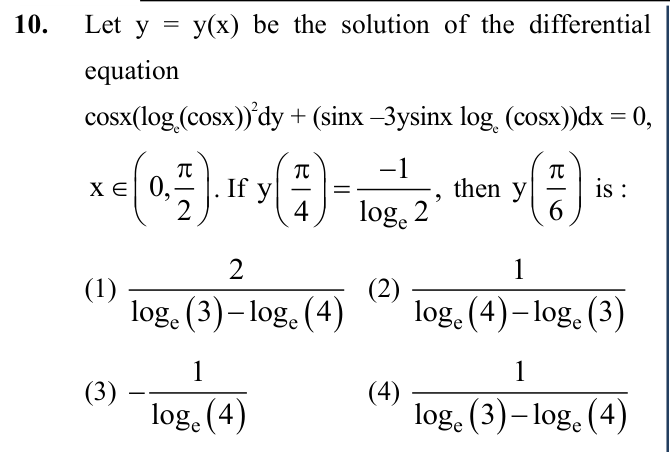
(1) ()
()
e
e
2
log
3
log
4
-
(2) ()
() - e
e
1
log
4
log
3
(3) () - e
1
log
4
(4) ()
()
e
e
1
log
3
log
4
-
(
)
(
)
(
)
(
) + - = 2
cosx ln cosx
dy
sinx
3y(sinx)ln cosx
dx
0
(
)
(
)
(
) - =-
2 dy
cosx ln cosx
3sinx.ln cosx y
sinx
dx
(
)
(
)
(
)
2
dy
3tan x
tan x
y
dx
ln cosx
ln cosx - - = (
)
(
)
(
) - + = 2
dy
3tanx
tanx
y
dx
ln secx
ln secx
(
)
(
)
(
)
∫ = =
3tanx dx
3
ln secx
I.F.
e
ln secx
(
)
(
)
(
)
(
)
(
)
(
) × =-∫
3
3
2
tanx
y
ln secx
ln secx
dx
ln secx
(
)
(
)
(
)
(
)
3
2
1
y
ln secx
ln secx
C
2 × =- + Given :
π = x
4 ,
1
y
ln 2
=-
(
)
(
)
3
2
1
1
ln
2
ln
2
C
ln 2
2 - ×
=- × +
⇒
(
)
(
) - - × = × +
3
2
1
1
1
ln2
ln2
C
8ln2
2
4
(
)
(
) - - = +
2
2
1
1
ln2
ln2
C
8
8
⇒ C = 0
∴ y (ln(secx))
3 =
1
2
-(ln(secx))
2 + 0
y =
(
)
1
2ln secx - y =
(
)
1
2ln cosx
∴ y π
)
(
[
)
6 =
π
)
(
[
)
1
2ln cos 6 = 1
3
2ln
2
)
(
[
) = ) - (
[
)
1
1
2
ln3
ln2
2 = -
1
ln3
ln4
Option (4)
QUESTION 12
Relations and Functions
SECTION A · MCQ (+4, -1)
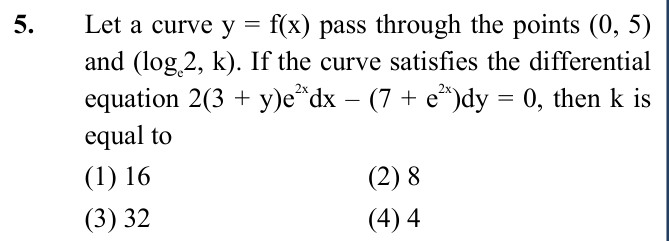
(1) 16
(2) 8
(3) 32
(4) 4
(
)
2x
2x
2 3
y .e
dy
dx
7
e + = + 2x
2x
2x
2x
dy
2y.e
6.e
dx
7
e
7
e - = + +
2x
2x
2e
dx
7 e
2x
1
I.F.
e
7
e - +
∫ = = + ∴
(
)
2x
2
2x
2x
1
6e
y.
dx
7
e
7
3 = + + ∫
2x
2x
y
3
C
7
e
7
e - = + + + (0, 5) ⇒ 5
3
C
8
8 - = + ⇒ C = 1
∴y = – 3 + 7 + e2x
y = e2x + 4
∴k = 8
QUESTION 13
Trigonometric Functions
SECTION A · MCQ (+4, -1)
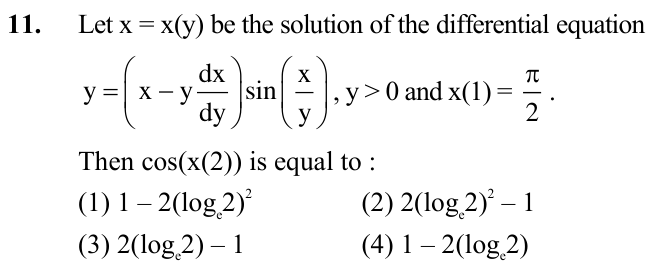
(1) 1 – 2(loge2)
2
(2) 2(loge2)
2 – 1
(3) 2(loge2) – 1
(4) 1 – 2(loge2)
ydy = (xdy – ydx) sin x
y
)
(
[
)
2
dy
xdy
ydx
x
sin
y
y
y
)
) - =(
(
[
)
[
)
dy
x
x
sin
d
y
y
y
)
) = -
(
(
[
)[
)
⇒
λny = cos x
y + C
4
x(1) = 2
π⇒0 = cos 2
π+ C ⇒ C=0
λny = cos x
y
but y = 2 ⇒ cos x
2 = λn2
cosx = 2cos
2 x
2 – 1
= 2(λn2)
2 – 1
QUESTION 14
Trigonometric Functions
SECTION B · NUMERICAL (+4, 0)
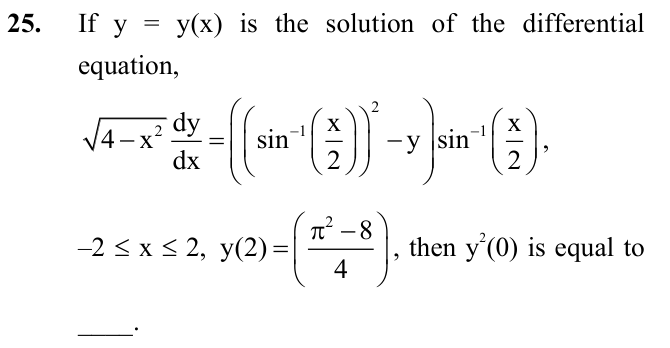
3
1
3
2
2
x
x
sin
sin
dy
2
2
y
dx
4
x
4
x - -
)
)
(
(
[
)
[
) + = - -
2
2
1
1
3
x
x
3
sin
sin
2
2
2
2
2
x
sin
2
ye
e
dx
4 – x - -
)
) - (
(
[
)
[
)
)
(
[
)
=∫
2
1x
sin
2
2
1
2
x
y
sin
2
c.e
2 - )
-(
[
) - ) = - + (
[
)
()
2
y 2
2
4
π = -
⇒ c = 0
y (0) = –2
1
JEE–MAIN EXAMINATION – JANUARY 2025
QUESTION 15
Complex Numbers
SECTION A · MCQ (+4, -1)
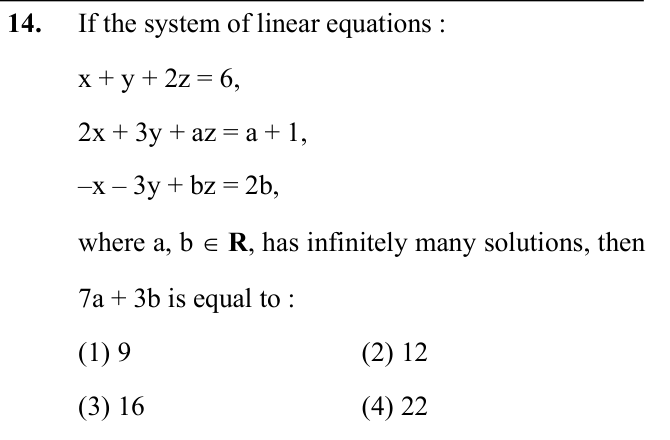
(1) 9
(2) 12
(3) 16
(4) 22
Δ =
1
1
2
2
3
a
1
3
b - -
= 0
⇒2a + b – 6 = 0
…….(1)
Δ1 =
1
1
6
2
3
a
1
1
3
2b + - - = 0
⇒a + b – 8 = 0
…….(2)
Solving (1) + (2)
a = –2, b = 10
⇒7a + 3b = 16
QUESTION 16
Determinants
SECTION A · MCQ (+4, -1)
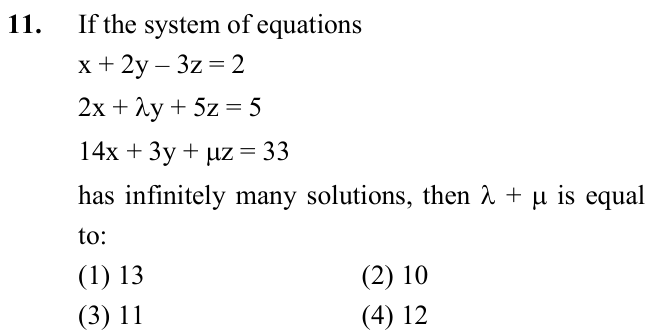
(1) 13
(2) 10
(3) 11
(4) 12
D =
1
2
3
2
5
14
3 - λ
μ
= 0, λµ + 42λ – 4µ + 107 = 0
D1 = 2λµ + 99λ – 10µ + 255
D2 = 13 – µ
D3 = 5λ + 5
D2 = 0 ⇒ µ = 13 & D3 = 0 ⇒ λ = –1
check & verify for these values D & D2 = 0
QUESTION 17
Trigonometric Functions
SECTION A · MCQ (+4, -1)
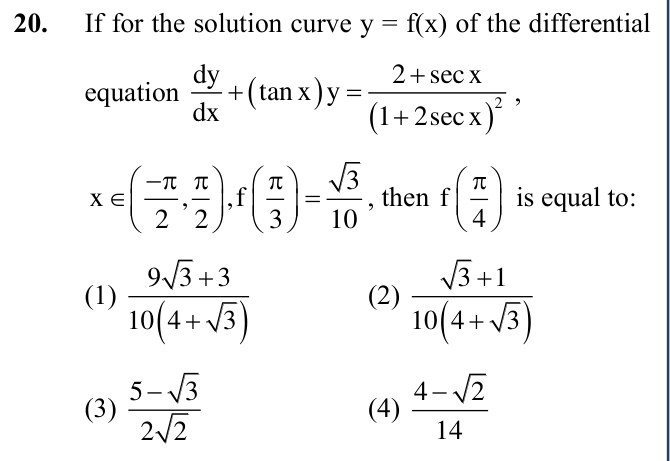
(1) (
)
9 3
3
10 4
3 + +
(2) (
)
3
1
10 4
3 + +
(3) 5
3
2 2
-
(4) 4
2
14
-
If
tan x dx
n (secx)
e
e
secx
∫ = =
∴y . sec x =
2
2
secx
(1
2secx)
{
} + {
} + ∫
sec x dx = 2
2cosx
1 dx
(cosx
2) + +
∫
Let cos x =
2
2
1
t
1
t - + = 2
2
2
2
2
1
t
2
1
1
t
2dt
1
t
2
1
t
) - +
( + [
)
) - +
( + [
)
∫ = 2
2
2
2
2
2
2t
1
t
2dt
(1
t
2
2t ) - ++ × - + +
∫ = 2
2
2
3
t
2
dt
(t
3) - +
∫
Let t + 3
t = u
2
3
1
dt
du
t
) - =
(
[
)
= – 2
2
du
u∫
y . (sec x) = 2
u + c
2
y.secx
c
3
t
t = + + .........(I)
At x = 3
π, t = tan x
2 = 1
3
3
2
2.
c
1
10
3 3
3 = + + 3
2 3
2.
c
10
10 = +
⇒ C = 0
At x = 4
π, t = tan x
2 =
2 – 1
∴
2
y. 2
3
2
1
2
1 = -+ - (
)
2
2
1
y. 2
6
2 2 - = - (
)
(
)
2
2
1
1
2 2
1
y
7
2
2 3
2 - - = = × -
= 4
2
14 - SECTION-B
QUESTION 18
Integrals
SECTION A · MCQ (+4, -1)
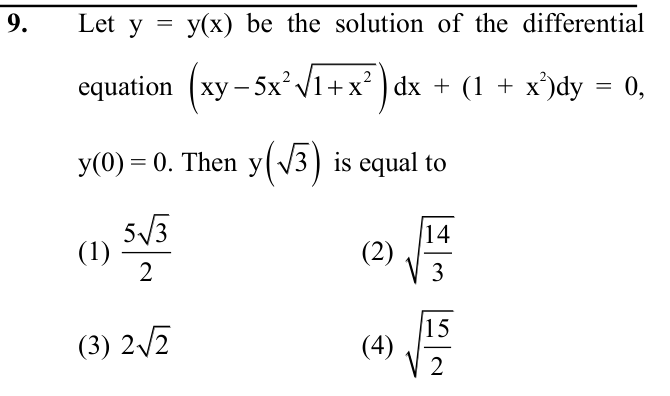
(1) 5 3
2
(2) 14
3
(3) 2 2
(4) 15
2
(
) + + = +
2
1
2
dy
1
x
xy
5x
1
x
dx + = + +
2
2
2
dy
xy
5x
dx
1
x
1
x
∴ I.F. =
(
) + +
∫ = = + 2
2
ln 1 x
x
dx
2
1 x
2
e
e
1
x
∴ + = + +
∫
2
2
2
2
5x
y 1
x
. 1
x dx
1
x
∴ + = + +
∫
2
2
2
2
5x
y 1
x
. 1
x dx
1
x + = + 3
2
5x
y 1
x
C
3
Θ y(0) = 0 ⇒ 0 = 0 + C ⇒ C = 0
∴ = +
3
2
5x
y
3 1
x
(
)=15 3
y
3
32 = 5 3
2
Option (1)
QUESTION 19
Conic Sections
SECTION A · MCQ (+4, -1)
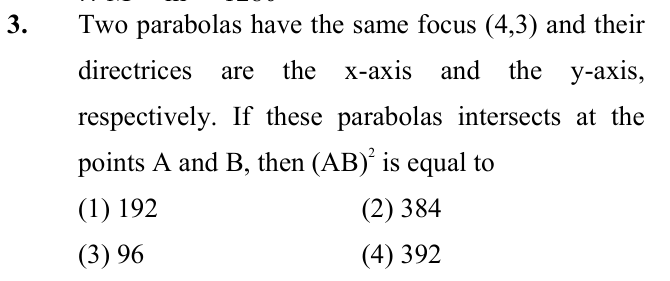
(1) 192
(2) 384
(3) 96
(4) 392
S(4, 3)
y
I
II
A(x1, y1)
B(x2, y2 )
O
x
2
Let intersection points of these two parabolas are
A(x1, y1) & B(x2,y2)
Θ equation of parabola I and II are given below
∴(x – 4)
2 + (y –3)
2 = x
2
…..(1)
& (x – 4)
2 + (y – 3)
2 = y
2 …..(2)
Here A(x1, y1) & B(x2,y2) will satisfy the equation
Also from equations (1) & (2), we get x = y ..(3)
Put x = y in equation (1)
We get x
2 – 14x + 25 = 0
x1 + x2 = 14
x1x2 = 25
∴AB
2 = (x1 – x2)
2 + (y1–y2)
2
= 2(x1 – x2)
2
= 2[(x1+x2)
2 – 4x1x2]
= 192
QUESTION 20
Differential Equations
SECTION A · MCQ (+4, -1)
What is the degree of the differential equation [1 + (dy/dx)²]^(1/2) = d²y/dx²?
(1) Undefined
(2) 3
(3) 1
(4) 2
Square both sides to eliminate the radical: 1 + (dy/dx)² = (d²y/dx²)². The highest derivative is d²y/dx², which is raised to power 2. Options 1 and 3 ignore radical clearing; 'undefined' applies only to transcendental functions, not polynomials.
QUESTION 21
Differential Equations
SECTION A · MCQ (+4, -1)
What is the number of arbitrary constants in the general solution of a third-order differential equation?
(1) 3
(2) 1
(3) 4
(4) 2
The general solution of an nth-order differential equation contains exactly n arbitrary constants. For a third-order equation, this means 3 constants. Options 1, 2, and 4 incorrectly assume a mismatch between order and constants.
QUESTION 22
Differential Equations
SECTION A · MCQ (+4, -1)
What is the order of (d^3y/dx^3)^2 + x(dy/dx)^5 = 0?
(1) Order = 3 (since d^3y/dx^3 is the highest derivative).
(2) [-5, 7)
(3) (-∞, Order = 3 (since d^3y/dx^3 is the highest derivative).)
(4) Undefined under standard Differential Equations axioms.
The order reflects the physical degrees of freedom: 1st order represents velocity laws; 2nd order represents Newton's acceleration laws.
QUESTION 23
Differential Equations
SECTION A · MCQ (+4, -1)
What is the integrating factor for the differential equation dy/dx + (3/x)y = x²?
(1) x³
(2) 3x²
(3) e^(3/x)
(4) e^(x³)
The integrating factor is e^(∫(3/x)dx) = e^(3 ln x) = x³. Options A and D incorrectly apply exponent rules, while C forgets to exponentiate the integral result.
QUESTION 24
Differential Equations
SECTION A · MCQ (+4, -1)
Solve dy/dx = 2x/y with y(1) = 2. Which is the particular solution?
(1) y² = 2x² + 2
(2) y² = x² + 2
(3) y² = x² + 1
(4) y² = 2x² + 1
Separating variables gives y dy = 2x dx. Integrating both sides: y²/2 = x² + C. Applying y(1)=2: 4/2 = 1 + C → C=1. Multiplying by 2: y² = 2x² + 2. Other options have incorrect constants or coefficients.
QUESTION 25
Differential Equations
SECTION A · MCQ (+4, -1)
Consider the differential equation (x + 2y²) dy/dx = y. After rewriting it in the form dx/dy + P₁(y)x = Q₁(y), what is the integrating factor?
(1) e^(∫(y²) dy)
(2) e^(∫(-1/y) dy)
(3) e^(∫(2y) dy)
(4) e^(∫(1/y) dy)
Rewriting the equation gives dx/dy - (1/y)x = 2y. The integrating factor depends on P₁(y) = -1/y, so it is e^(∫-1/y dy) = 1/y. Other options incorrectly use P(y) from the original dy/dx form or misapply the integral.