
✎ ANSWER ONLINE · EVERY MISTAKE LINKS BACK TO THE CONCEPT
Differential Equations · Practice Worksheet
Answer each question here and it marks straight away, with the derivation and a link to the exact micro-concept to revisit.
2 questions from this set could not be marked online — a
bonus or dual-key question, which has no single defensible answer. The print and
.docx versions still include them.
// CONCEPT AUDIT RESULT
Everything you missed has been added to your Error Arena — retest them blind there, and a concept clears once you get it right.
QUESTION 1
Trigonometric Functions
SECTION A · MCQ (+4, -1)
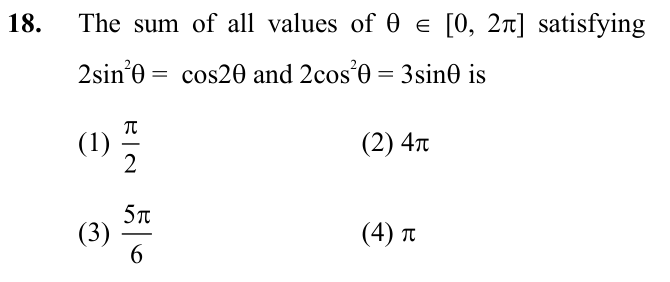
(1) 2
π
(2) 4π
(3) 5
6
π
(4) π
2sin
2θ = cos2θ
2sin
2θ = 1 – 2sin
2θ
4sin
2θ = 1
sin
2θ = 1
4
sinθ = ± 1
2
2cos
2θ = 3sinθ
2 – 2sin
2θ + 3sinθ– 2 = 0
(2sinθ – 1)(2sinθ – 2) = 0
sinθ = 1
2
so common equation which satisfy both equations
is sinθ = 1
2
5
,
6
6
π
π
θ=
(θ ∈ [0, 2π])
Sum = π
6
QUESTION 2
Trigonometric Functions
SECTION B · NUMERICAL (+4, 0)
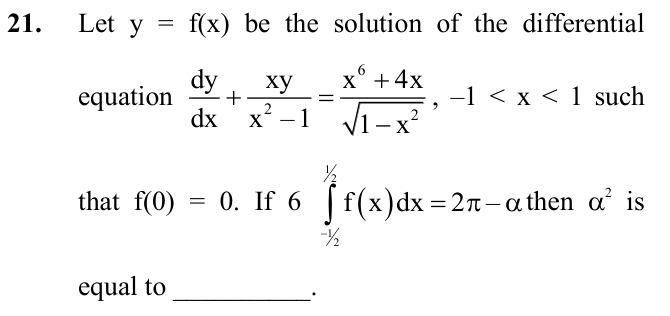
I.F.
2
2
1
2x
1
dx
n(1 x )
2
2 1 x
2
e
e
1
x - - - -
∫ = = - 7
2
6
2
x
y
1
x
(x
4x)dx
2x
c
7 × - = + = + + ∫
Given y(0) = 0 ⇒ c = 0
7
2
2
x
2x
7
y
1
x + = - Now,
7
1
1
2
2
2
2
2
2
1
1
2
2
x
2x
2x
7
6
dx
6
dx
1
x
1
x - - + = - -
∫
∫
1
2
2
2
0
x
24
dx
1
x = -
∫
Put x = sinθ
dx = cosθ dθ
2
6
0
sin
24
cos d
cos
π
θ = θθ
θ
∫
6
6
0
0
1
cos2
sin2
24
d
12
2
2
π
π - θ
θ
)
] = θ=
θ-
(
[
]
[
)
{
}
∫ = 3
12 6
4
)
π-
(
(
[
)
= 2
3 3
π-
2
2
(3 3)
27
α=
=
QUESTION 3
Trigonometric Functions
SECTION B · NUMERICAL (+4, 0)
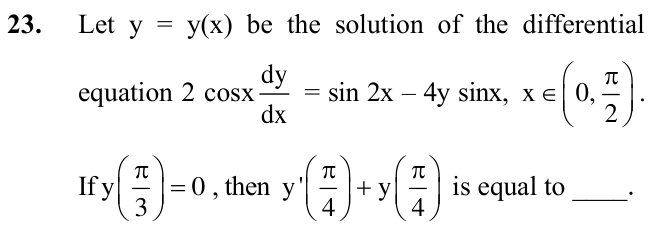
dy
2ytanx
sinx
dx + = I.F. =
2 tanx dx
2
e
sec x
∫ = ysec
2x =
2
sinx dx
cos x
∫
tanxsecx dx
=∫
= secx + C
C = –2
y = cosx – 2cos
2x
1
y
1
4
2
π
)= - (
[
)
y′ = –sinx + 4cosx sinx
1
y
2
4
2
π
)
′
=- + (
[
)
y
y
1
4
4
π
π
)
)
′ + =
(
(
[
)
[
)
QUESTION 4
Determinants
SECTION A · MCQ (+4, -1)
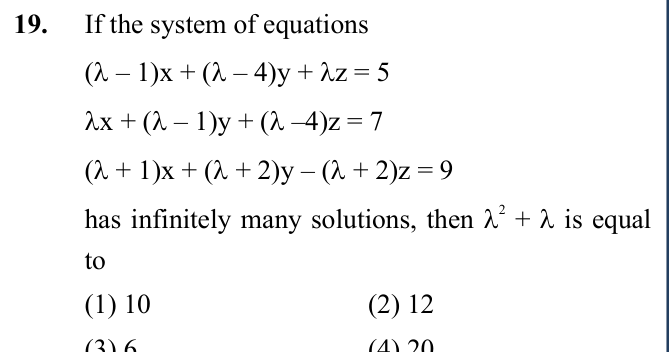
(1) 10
(2) 12
(3) 6
(4) 20
(
)
(
)
λ-
+λ-
+λ=
1 x
4 y
z
5
(
)
(
)
λ+λ-
+λ- = x
1 y
4 z
7
(
)
(
)
(
)
λ+
+λ+
-λ+ = 1 x
2 y
2 z
9
For infinitely many solutions
(
)
λ-
λ-
λ = λ
λ-
λ- = λ+
λ+
-λ+
1
4
D
1
4
0
1
2
2
(λ– 3) (2λ+ 1) = 0
(
)
λ-
λ = λ-
λ- = λ+
-λ+
x
5
4
D
7
1
4
0
9
2
2
2(3 – λ) (23 - 2λ) = 0
λ= 3
∴λ
2 + λ = 9 + 3 = 12
QUESTION 5
Binomial Theorem
SECTION A · MCQ (+4, -1)
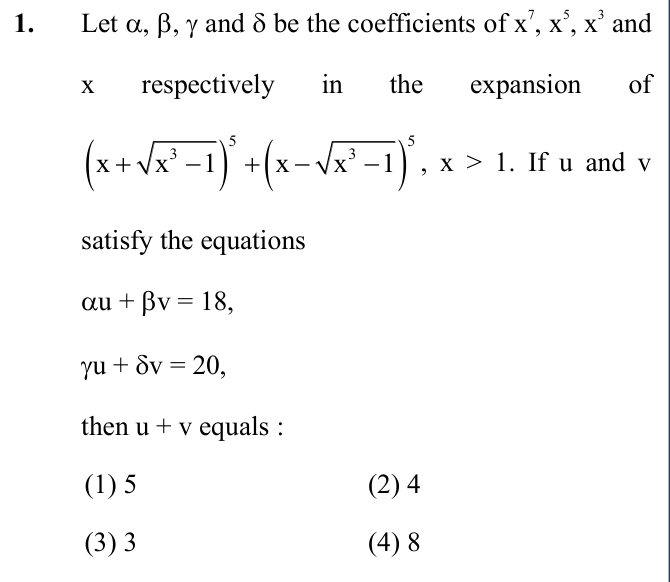
(1) 5
(2) 4
(3) 3
(4) 8
(
)
(
)
5
5
3
3
x
x
1
x
x
1 + - + - - = 2{
5C0.x
5 +
5C2.x
3(x
3 – 1) +
5C4.x(x
3 – 1)
2}
= 2{5x
7 + 10x
6 + x
5 – 10x
4 – 10x
3 + 5x}
⇒ α = 10, β = 2, γ = –20, δ = 10
Now, 10u + 2v = 18
–20u + 10v = 20
⇒u = 1, v = 4
u + v = 5
QUESTION 6
Integrals
SECTION A · MCQ (+4, -1)
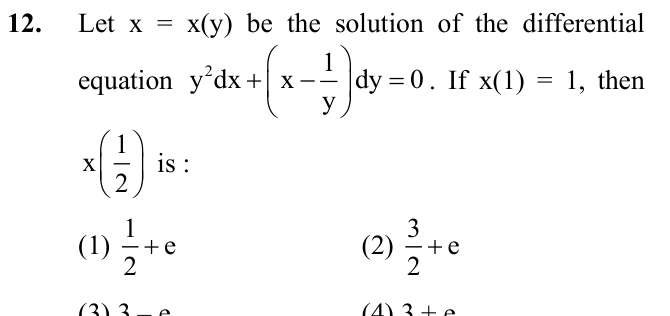
(1) +
1
e
2
(2) +
3
e
2
(3) 3 – e
(4) 3 + e
4
2
3
dx
1
1
x
dy
y
y
) + =
(
[
)
I.F. =
2
1
1
dy
y
y
e
e - ∫ = 1
1
y
t
3
1
x.e
e
.
dy
y - -
)
⇒
=(
[
)
∫
Put
1
t
y - =
2
1 dy
dt
y + =
1
t
y
x.e
t.e dt - =-∫
1
t
t
y
x.e
te
e
C - =- + +
1
1
1
y
y
y
1
x.e
e
e
C
y - - - + = + + x = 1, y = 1
1
1
1
C
e
e
e = + + ⇒
1
C
e
=-
Put y = 1
2
2
2
2
x
2
1
1
e
e
e
e = + - x = 3 – e
QUESTION 7
Complex Numbers
SECTION A · MCQ (+4, -1)
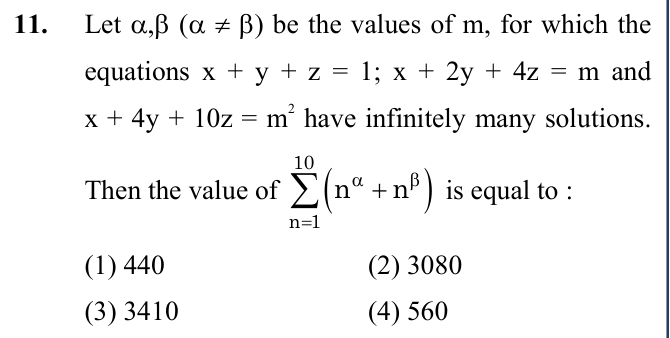
(1) 440
(2) 3080
(3) 3410
(4) 560
1
1
1
1
2
4
1
4
10
Δ=
= 1(20 – 16) – 1(10 – 4) + 1(4 – 2)
= 4 – 6 + 2 = 0
For infinite solutions
Δx = Δy = Δz = 0
m
2 – 3x + 2 = 0
m = 1, 2
α= 1, β = 2
∴
10
10
10
1
2
n 1
n 1
n 1
(n
n )
n
n
α
β = = = + = +
∑
∑
∑
= 10(11)
10(11)(21)
2
6 + = 55 + 385
= 440
QUESTION 8
Determinants
SECTION A · MCQ (+4, -1)
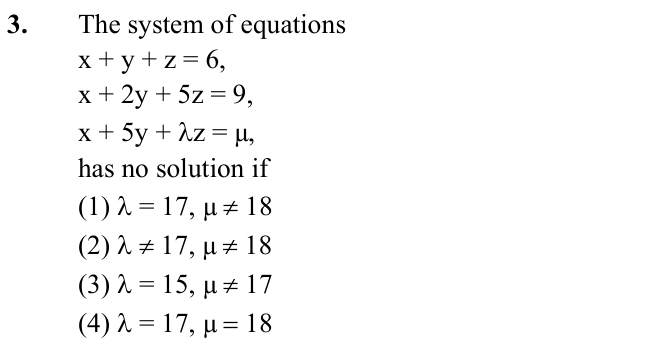
(1) λ = 17, µ ≠ 18
(2) λ ≠ 17, µ ≠ 18
(3) λ = 15, µ ≠ 17
(4) λ = 17, µ = 18
= = λ
1
1
1
D
1
2
5
0
1
5
λ= 17 = ≠
μ
z
1
1
6
D
1
2
9
0
1
5
μ≠18
QUESTION 9
Determinants
SECTION A · MCQ (+4, -1)
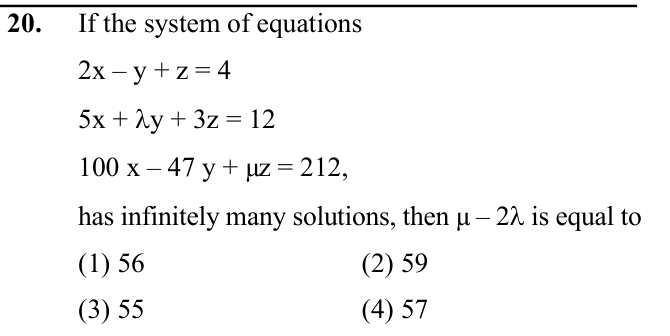
(1) 56
(2) 59
(3) 55
(4) 57
Δ = 0 ⇒ - λ = μ
2
1
1
5
3
0
100
–47
2(λμ+141) + (5μ –300) –235 –100λ = 0 …(1)
Δ3 = 0 ⇒ - λ = 2
1
4
5
12
0
100
–47
212
6λ = –12 ⇒ λ = –2
Put λ = 2 in (1)
2(–2μ + 141) + 5μ – 300 – 235 + 200 = 0
μ = 53
∴ 57
SECTION-B
QUESTION 10
Trigonometric Functions
SECTION A · MCQ (+4, -1)
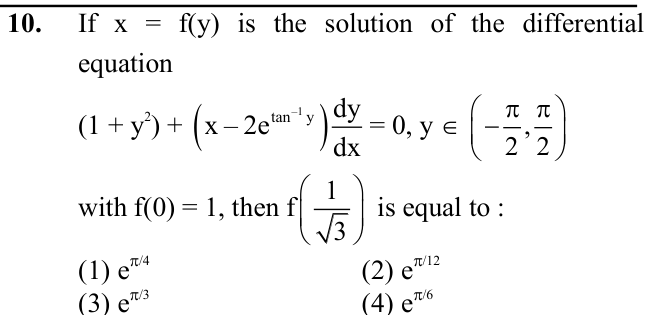
(1) eπ/4
(2) eπ/12
(3) eπ/3
(4) eπ/6
1
tan
y
2
2
dx
x
2e
dy
1
y
1
y - + = + + I.F. =
1
tan
y
e - 1
1
tan
y
2
tan
y
2
2(e
) dy
xe
1
y - - = +
∫
Put tan
–1y = t,
2
dy
dt
1
y = + 1
tan
y
2t
xe
2e dt - =∫
1
1
tan
y
2tan
y
xe
e
c - - = +
1
1
tan
y
tan
y
x
e
ce - - - = + y = 0, x = 1
1 = 1 + c ⇒ c = 0
y = 1
3
, x = eπ/6
QUESTION 11
Trigonometric Functions
SECTION A · MCQ (+4, -1)
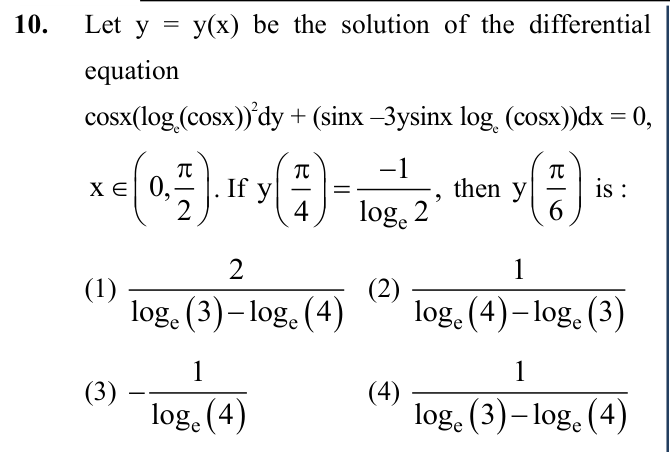
(1) ()
()
e
e
2
log
3
log
4
-
(2) ()
() - e
e
1
log
4
log
3
(3) () - e
1
log
4
(4) ()
()
e
e
1
log
3
log
4
-
(
)
(
)
(
)
(
) + - = 2
cosx ln cosx
dy
sinx
3y(sinx)ln cosx
dx
0
(
)
(
)
(
) - =-
2 dy
cosx ln cosx
3sinx.ln cosx y
sinx
dx
(
)
(
)
(
)
2
dy
3tan x
tan x
y
dx
ln cosx
ln cosx - - = (
)
(
)
(
) - + = 2
dy
3tanx
tanx
y
dx
ln secx
ln secx
(
)
(
)
(
)
∫ = =
3tanx dx
3
ln secx
I.F.
e
ln secx
(
)
(
)
(
)
(
)
(
)
(
) × =-∫
3
3
2
tanx
y
ln secx
ln secx
dx
ln secx
(
)
(
)
(
)
(
)
3
2
1
y
ln secx
ln secx
C
2 × =- + Given :
π = x
4 ,
1
y
ln 2
=-
(
)
(
)
3
2
1
1
ln
2
ln
2
C
ln 2
2 - ×
=- × +
⇒
(
)
(
) - - × = × +
3
2
1
1
1
ln2
ln2
C
8ln2
2
4
(
)
(
) - - = +
2
2
1
1
ln2
ln2
C
8
8
⇒ C = 0
∴ y (ln(secx))
3 =
1
2
-(ln(secx))
2 + 0
y =
(
)
1
2ln secx - y =
(
)
1
2ln cosx
∴ y π
)
(
[
)
6 =
π
)
(
[
)
1
2ln cos 6 = 1
3
2ln
2
)
(
[
) = ) - (
[
)
1
1
2
ln3
ln2
2 = -
1
ln3
ln4
Option (4)
QUESTION 12
Relations and Functions
SECTION A · MCQ (+4, -1)
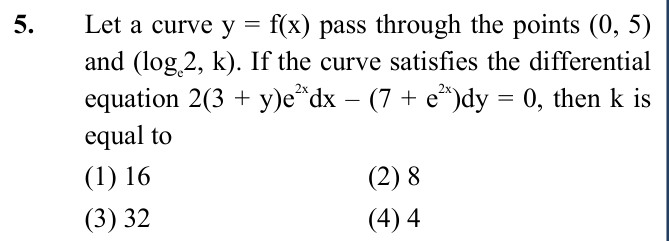
(1) 16
(2) 8
(3) 32
(4) 4
(
)
2x
2x
2 3
y .e
dy
dx
7
e + = + 2x
2x
2x
2x
dy
2y.e
6.e
dx
7
e
7
e - = + +
2x
2x
2e
dx
7 e
2x
1
I.F.
e
7
e - +
∫ = = + ∴
(
)
2x
2
2x
2x
1
6e
y.
dx
7
e
7
3 = + + ∫
2x
2x
y
3
C
7
e
7
e - = + + + (0, 5) ⇒ 5
3
C
8
8 - = + ⇒ C = 1
∴y = – 3 + 7 + e2x
y = e2x + 4
∴k = 8
QUESTION 13
Trigonometric Functions
SECTION A · MCQ (+4, -1)
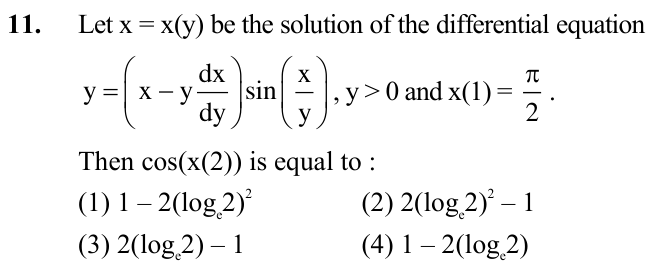
(1) 1 – 2(loge2)
2
(2) 2(loge2)
2 – 1
(3) 2(loge2) – 1
(4) 1 – 2(loge2)
ydy = (xdy – ydx) sin x
y
)
(
[
)
2
dy
xdy
ydx
x
sin
y
y
y
)
) - =(
(
[
)
[
)
dy
x
x
sin
d
y
y
y
)
) = -
(
(
[
)[
)
⇒
λny = cos x
y + C
4
x(1) = 2
π⇒0 = cos 2
π+ C ⇒ C=0
λny = cos x
y
but y = 2 ⇒ cos x
2 = λn2
cosx = 2cos
2 x
2 – 1
= 2(λn2)
2 – 1
QUESTION 14
Trigonometric Functions
SECTION B · NUMERICAL (+4, 0)
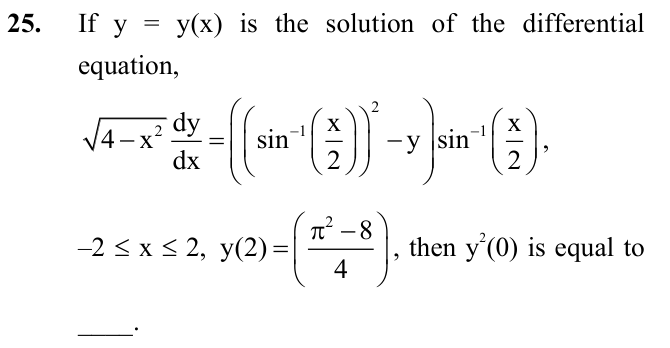
3
1
3
2
2
x
x
sin
sin
dy
2
2
y
dx
4
x
4
x - -
)
)
(
(
[
)
[
) + = - -
2
2
1
1
3
x
x
3
sin
sin
2
2
2
2
2
x
sin
2
ye
e
dx
4 – x - -
)
) - (
(
[
)
[
)
)
(
[
)
=∫
2
1x
sin
2
2
1
2
x
y
sin
2
c.e
2 - )
-(
[
) - ) = - + (
[
)
()
2
y 2
2
4
π = -
⇒ c = 0
y (0) = –2
1
JEE–MAIN EXAMINATION – JANUARY 2025
QUESTION 15
Complex Numbers
SECTION A · MCQ (+4, -1)
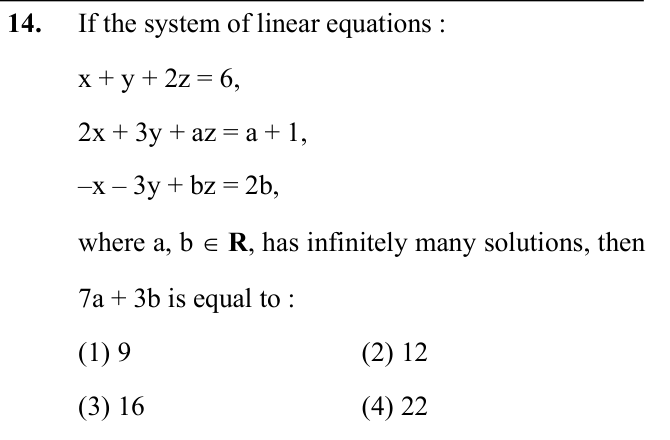
(1) 9
(2) 12
(3) 16
(4) 22
Δ =
1
1
2
2
3
a
1
3
b - -
= 0
⇒2a + b – 6 = 0
…….(1)
Δ1 =
1
1
6
2
3
a
1
1
3
2b + - - = 0
⇒a + b – 8 = 0
…….(2)
Solving (1) + (2)
a = –2, b = 10
⇒7a + 3b = 16
QUESTION 16
Determinants
SECTION A · MCQ (+4, -1)
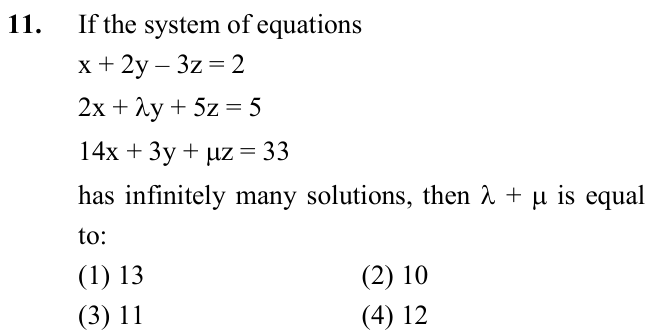
(1) 13
(2) 10
(3) 11
(4) 12
D =
1
2
3
2
5
14
3 - λ
μ
= 0, λµ + 42λ – 4µ + 107 = 0
D1 = 2λµ + 99λ – 10µ + 255
D2 = 13 – µ
D3 = 5λ + 5
D2 = 0 ⇒ µ = 13 & D3 = 0 ⇒ λ = –1
check & verify for these values D & D2 = 0
QUESTION 17
Trigonometric Functions
SECTION A · MCQ (+4, -1)
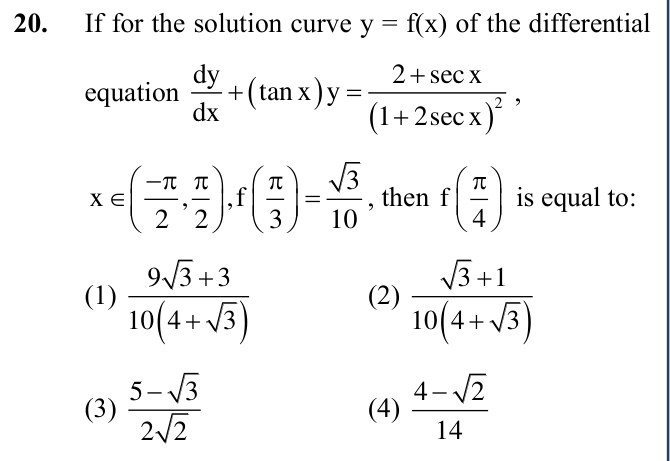
(1) (
)
9 3
3
10 4
3 + +
(2) (
)
3
1
10 4
3 + +
(3) 5
3
2 2
-
(4) 4
2
14
-
If
tan x dx
n (secx)
e
e
secx
∫ = =
∴y . sec x =
2
2
secx
(1
2secx)
{
} + {
} + ∫
sec x dx = 2
2cosx
1 dx
(cosx
2) + +
∫
Let cos x =
2
2
1
t
1
t - + = 2
2
2
2
2
1
t
2
1
1
t
2dt
1
t
2
1
t
) - +
( + [
)
) - +
( + [
)
∫ = 2
2
2
2
2
2
2t
1
t
2dt
(1
t
2
2t ) - ++ × - + +
∫ = 2
2
2
3
t
2
dt
(t
3) - +
∫
Let t + 3
t = u
2
3
1
dt
du
t
) - =
(
[
)
= – 2
2
du
u∫
y . (sec x) = 2
u + c
2
y.secx
c
3
t
t = + + .........(I)
At x = 3
π, t = tan x
2 = 1
3
3
2
2.
c
1
10
3 3
3 = + + 3
2 3
2.
c
10
10 = +
⇒ C = 0
At x = 4
π, t = tan x
2 =
2 – 1
∴
2
y. 2
3
2
1
2
1 = -+ - (
)
2
2
1
y. 2
6
2 2 - = - (
)
(
)
2
2
1
1
2 2
1
y
7
2
2 3
2 - - = = × -
= 4
2
14 - SECTION-B
QUESTION 18
Integrals
SECTION A · MCQ (+4, -1)
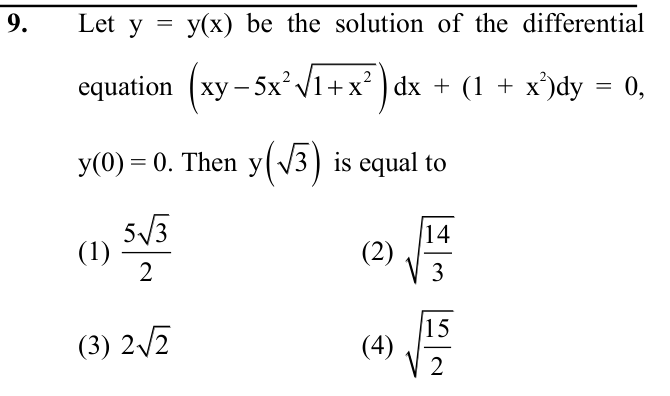
(1) 5 3
2
(2) 14
3
(3) 2 2
(4) 15
2
(
) + + = +
2
1
2
dy
1
x
xy
5x
1
x
dx + = + +
2
2
2
dy
xy
5x
dx
1
x
1
x
∴ I.F. =
(
) + +
∫ = = + 2
2
ln 1 x
x
dx
2
1 x
2
e
e
1
x
∴ + = + +
∫
2
2
2
2
5x
y 1
x
. 1
x dx
1
x
∴ + = + +
∫
2
2
2
2
5x
y 1
x
. 1
x dx
1
x + = + 3
2
5x
y 1
x
C
3
Θ y(0) = 0 ⇒ 0 = 0 + C ⇒ C = 0
∴ = +
3
2
5x
y
3 1
x
(
)=15 3
y
3
32 = 5 3
2
Option (1)
QUESTION 19
Conic Sections
SECTION A · MCQ (+4, -1)
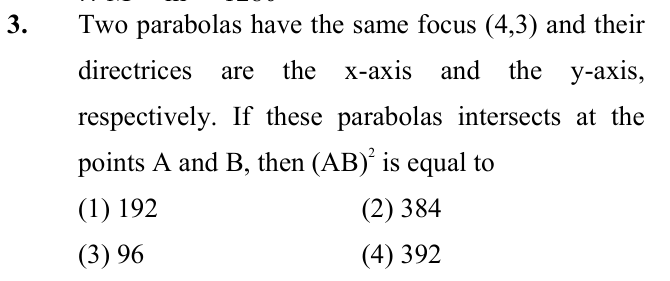
(1) 192
(2) 384
(3) 96
(4) 392
S(4, 3)
y
I
II
A(x1, y1)
B(x2, y2 )
O
x
2
Let intersection points of these two parabolas are
A(x1, y1) & B(x2,y2)
Θ equation of parabola I and II are given below
∴(x – 4)
2 + (y –3)
2 = x
2
…..(1)
& (x – 4)
2 + (y – 3)
2 = y
2 …..(2)
Here A(x1, y1) & B(x2,y2) will satisfy the equation
Also from equations (1) & (2), we get x = y ..(3)
Put x = y in equation (1)
We get x
2 – 14x + 25 = 0
x1 + x2 = 14
x1x2 = 25
∴AB
2 = (x1 – x2)
2 + (y1–y2)
2
= 2(x1 – x2)
2
= 2[(x1+x2)
2 – 4x1x2]
= 192
QUESTION 20
Differential Equations
SECTION A · MCQ (+4, -1)
What is the degree of the differential equation [1 + (dy/dx)²]^(1/2) = d²y/dx²?
(1) Undefined
(2) 3
(3) 1
(4) 2
Square both sides to eliminate the radical: 1 + (dy/dx)² = (d²y/dx²)². The highest derivative is d²y/dx², which is raised to power 2. Options 1 and 3 ignore radical clearing; 'undefined' applies only to transcendental functions, not polynomials.
QUESTION 21
Differential Equations
SECTION A · MCQ (+4, -1)
What is the number of arbitrary constants in the general solution of a third-order differential equation?
(1) 3
(2) 1
(3) 4
(4) 2
The general solution of an nth-order differential equation contains exactly n arbitrary constants. For a third-order equation, this means 3 constants. Options 1, 2, and 4 incorrectly assume a mismatch between order and constants.
QUESTION 22
Differential Equations
SECTION A · MCQ (+4, -1)
What is the order of (d^3y/dx^3)^2 + x(dy/dx)^5 = 0?
(1) Order = 3 (since d^3y/dx^3 is the highest derivative).
(2) [-5, 7)
(3) (-∞, Order = 3 (since d^3y/dx^3 is the highest derivative).)
(4) Undefined under standard Differential Equations axioms.
The order reflects the physical degrees of freedom: 1st order represents velocity laws; 2nd order represents Newton's acceleration laws.
QUESTION 23
Differential Equations
SECTION A · MCQ (+4, -1)
What is the integrating factor for the differential equation dy/dx + (3/x)y = x²?
(1) x³
(2) 3x²
(3) e^(3/x)
(4) e^(x³)
The integrating factor is e^(∫(3/x)dx) = e^(3 ln x) = x³. Options A and D incorrectly apply exponent rules, while C forgets to exponentiate the integral result.
QUESTION 24
Differential Equations
SECTION A · MCQ (+4, -1)
Solve dy/dx = 2x/y with y(1) = 2. Which is the particular solution?
(1) y² = 2x² + 2
(2) y² = x² + 2
(3) y² = x² + 1
(4) y² = 2x² + 1
Separating variables gives y dy = 2x dx. Integrating both sides: y²/2 = x² + C. Applying y(1)=2: 4/2 = 1 + C → C=1. Multiplying by 2: y² = 2x² + 2. Other options have incorrect constants or coefficients.
QUESTION 25
Differential Equations
SECTION A · MCQ (+4, -1)
Consider the differential equation (x + 2y²) dy/dx = y. After rewriting it in the form dx/dy + P₁(y)x = Q₁(y), what is the integrating factor?
(1) e^(∫(y²) dy)
(2) e^(∫(-1/y) dy)
(3) e^(∫(2y) dy)
(4) e^(∫(1/y) dy)
Rewriting the equation gives dx/dy - (1/y)x = 2y. The integrating factor depends on P₁(y) = -1/y, so it is e^(∫-1/y dy) = 1/y. Other options incorrectly use P(y) from the original dy/dx form or misapply the integral.
QUESTION 26
Differential Equations
SECTION A · MCQ (+4, -1)
What is the differential equation of the family of parabolas with vertex at the origin and axis along the x-axis?
(1) y = x² y'
(2) y = 2x y'
(3) y = 4x y'
(4) y = x y'
Differentiating y² = 4ax gives 2y y' = 4a. Solving for a = y²/(4x) and substituting into the original equation leads to y = 2x y'. Other options arise from miscalculating the derivative or misidentifying the parabola's axis.
QUESTION 27
Differential Equations
SECTION A · MCQ (+4, -1)
The general solution of a first-order differential equation contains one arbitrary constant. When initial conditions are applied to obtain a particular solution, how many arbitrary constants remain?
(1) 1
(2) 2
(3) 0
(4) Equal to the order of the equation
A particular solution is derived by assigning specific values to the arbitrary constants in the general solution. This process eliminates all arbitrary constants, leaving zero in the particular solution. The other options incorrectly assume the number of constants depends on the order or retains them in the particular solution.
QUESTION 28
Differential Equations
SECTION A · MCQ (+4, -1)
Consider the differential equation dy/dx = (y/x) + tan(y/x). After substituting y = vx, which of the following equations is obtained?
(1) v + x dv/dx = tan(v)
(2) v + x dv/dx = v + tan(v)
(3) x dv/dx = tan(v)
(4) x dv/dx = v + tan(v)
The substitution y = vx gives dy/dx = v + x dv/dx. Substituting into the equation retains the v term. Other options omit the v term or misapply the product rule.