
⚡ OFFICIAL NTA ASSESSMENT GENERATOR & WORD (.DOCX) EXPORTER
Differential Equations · Practice Worksheet
JEE Main Mathematics · Curated Assessment Set Print directly or export as a beautifully formatted Microsoft Word document with embedded 180-DPI mathematical prompt clips and step-by-step derivations.
EDUPROD JEE MAIN TEST SERIES · NTA PATTERN
Differential Equations · Practice Worksheet
JEE Main Mathematics · Curated Assessment Set · Assessment Code: JEE-101
Total Marks: 200
Marking: +4 / -1 (Sec A) · +4 / 0 (Sec B)
QUESTION 1
MATHEMATICS · Trigonometric Functions
SECTION A · MCQ (+4, -1)
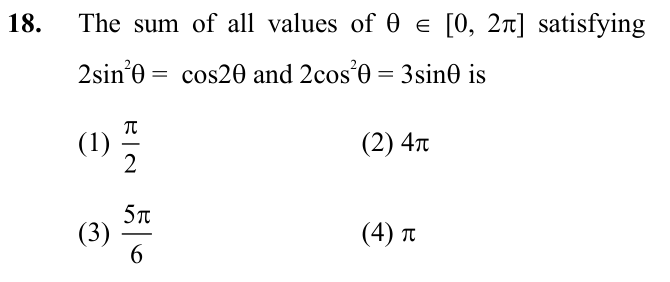
Candidate Response:
(1) (2) (3) (4)
QUESTION 2
MATHEMATICS · Trigonometric Functions
SECTION B · NUMERICAL (+4, 0)
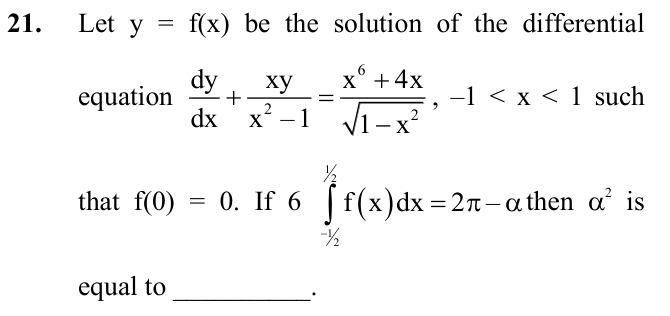
Numerical Value:
[ ]
QUESTION 3
MATHEMATICS · Trigonometric Functions
SECTION B · NUMERICAL (+4, 0)
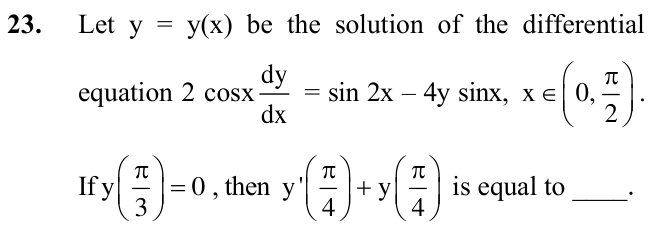
Numerical Value:
[ ]
QUESTION 4
MATHEMATICS · Determinants
SECTION A · MCQ (+4, -1)
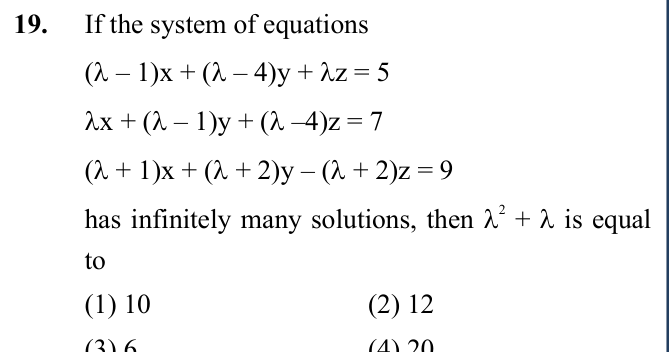
Candidate Response:
(1) (2) (3) (4)
QUESTION 5
MATHEMATICS · Binomial Theorem
SECTION A · MCQ (+4, -1)
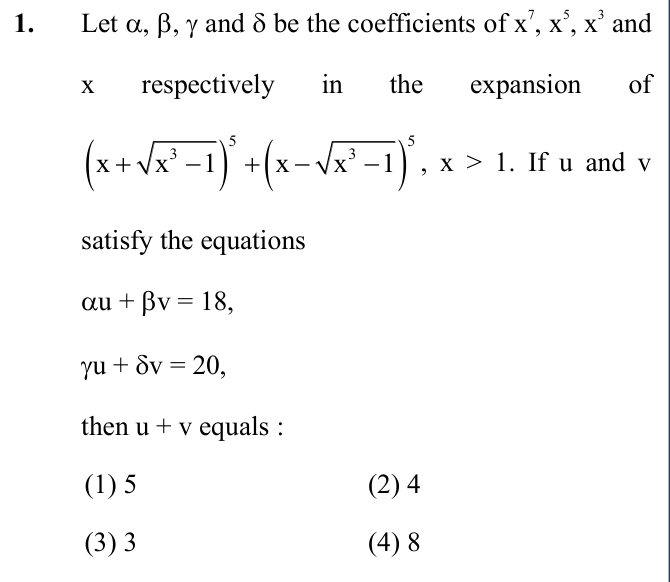
Candidate Response:
(1) (2) (3) (4)
QUESTION 6
MATHEMATICS · Integrals
SECTION A · MCQ (+4, -1)
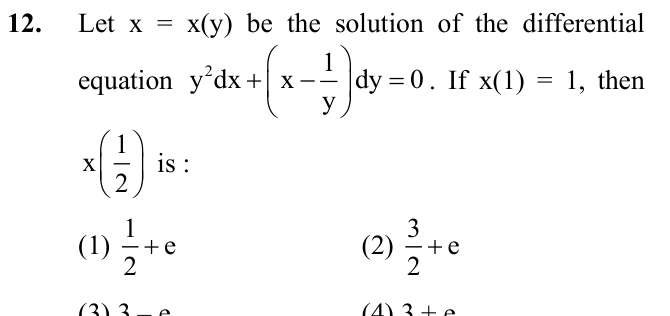
Candidate Response:
(1) (2) (3) (4)
QUESTION 7
MATHEMATICS · Complex Numbers
SECTION A · MCQ (+4, -1)
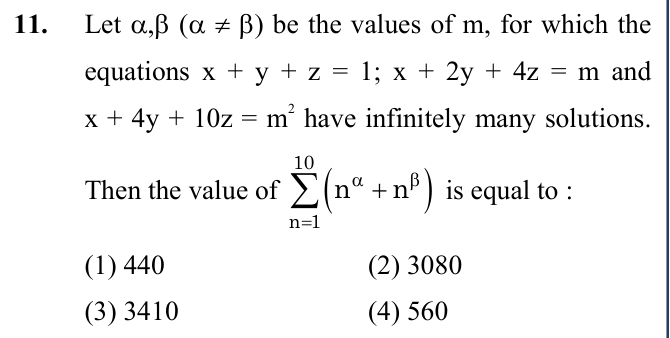
Candidate Response:
(1) (2) (3) (4)
QUESTION 8
MATHEMATICS · Determinants
SECTION A · MCQ (+4, -1)
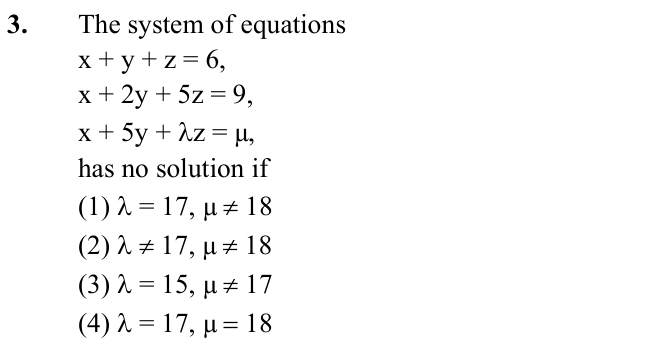
Candidate Response:
(1) (2) (3) (4)
QUESTION 9
MATHEMATICS · Determinants
SECTION A · MCQ (+4, -1)
Candidate Response:
(1) (2) (3) (4)
QUESTION 10
MATHEMATICS · Trigonometric Functions
SECTION A · MCQ (+4, -1)
Candidate Response:
(1) (2) (3) (4)
QUESTION 11
MATHEMATICS · Trigonometric Functions
SECTION A · MCQ (+4, -1)
Candidate Response:
(1) (2) (3) (4)
QUESTION 12
MATHEMATICS · Relations and Functions
SECTION A · MCQ (+4, -1)
Candidate Response:
(1) (2) (3) (4)
QUESTION 13
MATHEMATICS · Trigonometric Functions
SECTION A · MCQ (+4, -1)
Candidate Response:
(1) (2) (3) (4)
QUESTION 14
MATHEMATICS · Trigonometric Functions
SECTION B · NUMERICAL (+4, 0)
Numerical Value:
[ ]
QUESTION 15
MATHEMATICS · Complex Numbers
SECTION A · MCQ (+4, -1)
Candidate Response:
(1) (2) (3) (4)
QUESTION 16
MATHEMATICS · Determinants
SECTION A · MCQ (+4, -1)
Candidate Response:
(1) (2) (3) (4)
QUESTION 17
MATHEMATICS · Trigonometric Functions
SECTION A · MCQ (+4, -1)
Candidate Response:
(1) (2) (3) (4)
QUESTION 18
MATHEMATICS · Integrals
SECTION A · MCQ (+4, -1)
Candidate Response:
(1) (2) (3) (4)
QUESTION 19
MATHEMATICS · Conic Sections
SECTION A · MCQ (+4, -1)
Candidate Response:
(1) (2) (3) (4)
QUESTION 20
MATHEMATICS · Differential Equations
SECTION A · MCQ (+4, -1)
What is the degree of the differential equation [1 + (dy/dx)²]^(1/2) = d²y/dx²?
(1) Undefined
(2) 3
(3) 1
(4) 2
Candidate Response:
(1) (2) (3) (4)
QUESTION 21
MATHEMATICS · Differential Equations
SECTION A · MCQ (+4, -1)
What is the number of arbitrary constants in the general solution of a third-order differential equation?
(1) 3
(2) 1
(3) 4
(4) 2
Candidate Response:
(1) (2) (3) (4)
QUESTION 22
MATHEMATICS · Differential Equations
SECTION A · MCQ (+4, -1)
What is the order of (d^3y/dx^3)^2 + x(dy/dx)^5 = 0?
(1) Order = 3 (since d^3y/dx^3 is the highest derivative).
(2) [-5, 7)
(3) (-∞, Order = 3 (since d^3y/dx^3 is the highest derivative).)
(4) Undefined under standard Differential Equations axioms.
Candidate Response:
(1) (2) (3) (4)
QUESTION 23
MATHEMATICS · Differential Equations
SECTION A · MCQ (+4, -1)
What is the integrating factor for the differential equation dy/dx + (3/x)y = x²?
(1) x³
(2) 3x²
(3) e^(3/x)
(4) e^(x³)
Candidate Response:
(1) (2) (3) (4)
QUESTION 24
MATHEMATICS · Differential Equations
SECTION A · MCQ (+4, -1)
Solve dy/dx = 2x/y with y(1) = 2. Which is the particular solution?
(1) y² = 2x² + 2
(2) y² = x² + 2
(3) y² = x² + 1
(4) y² = 2x² + 1
Candidate Response:
(1) (2) (3) (4)
QUESTION 25
MATHEMATICS · Differential Equations
SECTION A · MCQ (+4, -1)
Consider the differential equation (x + 2y²) dy/dx = y. After rewriting it in the form dx/dy + P₁(y)x = Q₁(y), what is the integrating factor?
(1) e^(∫(y²) dy)
(2) e^(∫(-1/y) dy)
(3) e^(∫(2y) dy)
(4) e^(∫(1/y) dy)
Candidate Response:
(1) (2) (3) (4)
QUESTION 26
MATHEMATICS · Differential Equations
SECTION A · MCQ (+4, -1)
What is the differential equation of the family of parabolas with vertex at the origin and axis along the x-axis?
(1) y = x² y'
(2) y = 2x y'
(3) y = 4x y'
(4) y = x y'
Candidate Response:
(1) (2) (3) (4)
QUESTION 27
MATHEMATICS · Differential Equations
SECTION A · MCQ (+4, -1)
If y dy = x dx and y(0) = 3, what is the particular solution?
(1) Undefined under standard Differential Equations axioms.
(2) y^2/2 = x^2/2 + C => y^2 - x^2 = 2C. At (0, 3): 9 - 0 = 2C => y^2 - x^2 = 9.
(3) [-5, 7)
(4) y^2/2 = x^2/2 + C => y^2 + x^2 = 2C. At (0, 3): 9 + 0 = 2C => y^2 + x^2 = 9.
Candidate Response:
(1) (2) (3) (4)
QUESTION 28
MATHEMATICS · Differential Equations
SECTION A · MCQ (+4, -1)
The general solution of a first-order differential equation contains one arbitrary constant. When initial conditions are applied to obtain a particular solution, how many arbitrary constants remain?
(1) 1
(2) 2
(3) 0
(4) Equal to the order of the equation
Candidate Response:
(1) (2) (3) (4)
QUESTION 29
MATHEMATICS · Differential Equations
SECTION A · MCQ (+4, -1)
Consider the differential equation dy/dx = (y/x) + tan(y/x). After substituting y = vx, which of the following equations is obtained?
(1) v + x dv/dx = tan(v)
(2) v + x dv/dx = v + tan(v)
(3) x dv/dx = tan(v)
(4) x dv/dx = v + tan(v)
Candidate Response:
(1) (2) (3) (4)
QUESTION 30
MATHEMATICS · Differential Equations
SECTION A · MCQ (+4, -1)
What differential equation represents y = A e^(2x) + B e^(-2x)?
(1) y'' + 4y = 0 (since Sum = 0, Product = +4).
(2) [-5, 7)
(3) Undefined under standard Differential Equations axioms.
(4) y'' - 4y = 0 (since Sum = 0, Product = -4).
Candidate Response:
(1) (2) (3) (4)
QUESTION 31
MATHEMATICS · Differential Equations
SECTION A · MCQ (+4, -1)
What is the integrating factor for dy/dx + (tan x) y = cos x?
(1) I.F. = e^(integral tan x dx) = e^(ln|sec x|) = sec x.
(2) [-5, 7)
(3) Undefined under standard Differential Equations axioms.
(4) (-∞, I.F. = e^(integral tan x dx) = e^(ln|sec x|) = sec x.)
Candidate Response:
(1) (2) (3) (4)
QUESTION 32
MATHEMATICS · Differential Equations
SECTION A · MCQ (+4, -1)
Is dy/dx = (x^3 + y^3) / (x y^2) homogeneous?
(1) Yes, both numerator and denominator are homogeneous polynomials of degree 3.
(2) Requires uniform continuity across the entire open interval $(a, b)$.
(3) Valid only when elements belong strictly to the non-negative real domain $\mathbb{R}^+$.
(4) Contradicted by boundary limit constraints under standard Cartesian mapping.
Candidate Response:
(1) (2) (3) (4)
QUESTION 33
MATHEMATICS · Differential Equations
SECTION A · MCQ (+4, -1)
What substitution solves dy/dx = cos(x + y)?
(1) [-5, 7)
(2) u = x + y (giving du/dx + 1 = cos u => du/(1 + cos u) = dx).
(3) Undefined under standard Differential Equations axioms.
(4) u = x + y (giving du/dx - 1 = cos u => du/(1 + cos u) = dx).
Candidate Response:
(1) (2) (3) (4)
QUESTION 34
MATHEMATICS · Differential Equations
SECTION A · MCQ (+4, -1)
What is the separated form of v + x(dv/dx) = v^2 + v?
(1) [-5, 7)
(2) x(dv/dx) = v^2 => dv/v^2 = dx/x.
(3) (-∞, x(dv/dx) = v^2 => dv/v^2 = dx/x.)
(4) Undefined under standard Differential Equations axioms.
Candidate Response:
(1) (2) (3) (4)
QUESTION 35
MATHEMATICS · Differential Equations
SECTION A · MCQ (+4, -1)
Solve dy/dx = e^(x - y).
(1) Contradicted by boundary limit constraints under standard Cartesian mapping.
(2) Requires uniform continuity across the entire open interval $(a, b)$.
(3) Valid only when elements belong strictly to the non-negative real domain $\mathbb{R}^+$.
(4) e^y dy = e^x dx => e^y = e^x + C.
Candidate Response:
(1) (2) (3) (4)
QUESTION 36
MATHEMATICS · Differential Equations
SECTION A · MCQ (+4, -1)
Verify if y = e^(2x) is a solution of y'' - 3y' + 2y = 0. Compute y' and y'' and substitute into the equation.
(1) Yes, LHS = 4e^(2x)
(2) No, LHS = -2e^(2x)
(3) Yes, LHS = 0
(4) No, LHS = 2e^(2x)
Candidate Response:
(1) (2) (3) (4)
QUESTION 37
MATHEMATICS · Differential Equations
SECTION A · MCQ (+4, -1)
What is the order of the differential equation (d³y/dx³)² + x(d²y/dx²)⁴ + y = 0?
(1) 3
(2) 2
(3) 1
(4) 4
Candidate Response:
(1) (2) (3) (4)
QUESTION 38
MATHEMATICS · Differential Equations
SECTION A · MCQ (+4, -1)
Which substitution is most appropriate for solving the differential equation [1 + e^(x/y)] dx + e^(x/y)(1 - x/y) dy = 0?
(1) x = v + y
(2) y = v x
(3) x = v y
(4) y = v + x
Candidate Response:
(1) (2) (3) (4)
QUESTION 39
MATHEMATICS · Differential Equations
SECTION A · MCQ (+4, -1)
What is the integrating factor of dx/dy + 2y x = y?
(1) I.F. = e^(integral 2y dy) = e^(y^2).
(2) (-∞, I.F. = e^(integral 2y dy) = e^(y^2).)
(3) Undefined under standard Differential Equations axioms.
(4) [-5, 7)
Candidate Response:
(1) (2) (3) (4)
QUESTION 40
MATHEMATICS · Differential Equations
SECTION A · MCQ (+4, -1)
Is the degree of e^x (dy/dx) + y = 0 defined?
(1) [-5, 7)
(2) (-∞, Yes, Degree = 1 (e^x is a coefficient in x; the derivative dy/dx is strictly polynomial).)
(3) Yes, Degree = 1 (e^x is a coefficient in x; the derivative dy/dx is strictly polynomial).
(4) Undefined under standard Differential Equations axioms.
Candidate Response:
(1) (2) (3) (4)
QUESTION 41
MATHEMATICS · Differential Equations
SECTION A · MCQ (+4, -1)
Solve the differential equation dy/dx = (x²)/(y²). Which of the following is the correct general solution?
(1) y³ = x³ + 3C
(2) y³ = (x³)/3 + 3C
(3) y³ = x³ + C
(4) y³ = (x³)/3 + C
Candidate Response:
(1) (2) (3) (4)
QUESTION 42
MATHEMATICS · Differential Equations
SECTION A · MCQ (+4, -1)
Consider the family of curves y = m x, where m is an arbitrary constant. What is the differential equation representing this family?
(1) y = m x
(2) y'' = 0
(3) x y' - y = 0
(4) y' = m
Candidate Response:
(1) (2) (3) (4)
QUESTION 43
MATHEMATICS · Differential Equations
SECTION A · MCQ (+4, -1)
Which of the following differential equations is homogeneous? (Test: All terms in numerator and denominator must have equal degree)
(1) dy/dx = (x² + y²)/(xy²)
(2) dy/dx = (x³ + y³)/(x²y)
(3) dy/dx = (x + y²)/x³
(4) dy/dx = (x² + y)/x
Candidate Response:
(1) (2) (3) (4)
QUESTION 44
MATHEMATICS · Differential Equations
SECTION A · MCQ (+4, -1)
If I.F. = x and integral Q * I.F. dx = x^3 + C, what is y?
(1) y * x = x^3 + C => y = x^2 + C/x.
(2) Requires uniform continuity across the entire open interval $(a, b)$.
(3) Contradicted by boundary limit constraints under standard Cartesian mapping.
(4) Valid only when elements belong strictly to the non-negative real domain $\mathbb{R}^+$.
Candidate Response:
(1) (2) (3) (4)
QUESTION 45
MATHEMATICS · Differential Equations
SECTION A · MCQ (+4, -1)
What is the degree of y'' + 3(y')^2 + y = 0?
(1) (-∞, Degree = 1 (the power of the highest derivative y'' is 1).)
(2) Degree = 1 (the power of the highest derivative y'' is 1).
(3) [-5, 7)
(4) Undefined under standard Differential Equations axioms.
Candidate Response:
(1) (2) (3) (4)
QUESTION 46
MATHEMATICS · Differential Equations
SECTION A · MCQ (+4, -1)
When is the substitution x = v y preferred over y = v x?
(1) When the differential equation is written in terms of dx/dy and contains terms of the form (x/y).
(2) Undefined under standard Differential Equations axioms.
(3) [-5, 7)
(4) (-∞, When the differential equation is written in terms of dx/dy and contains terms of the form (x/y).)
Candidate Response:
(1) (2) (3) (4)
QUESTION 47
MATHEMATICS · Differential Equations
SECTION A · MCQ (+4, -1)
What is the differential equation representing the family of curves y = A e^(2x) + B e^(-x)?
(1) y'' - y' - 2y = 0
(2) y'' + y' - 2y = 0
(3) y'' + y' + 2y = 0
(4) y'' - y' + 2y = 0
Candidate Response:
(1) (2) (3) (4)
QUESTION 48
MATHEMATICS · Differential Equations
SECTION A · MCQ (+4, -1)
How many arbitrary constants exist in the particular solution of a 2nd-order differential equation?
(1) [-5, 7)
(2) Zero (all constants are replaced by numerical values).
(3) (-∞, Zero (all constants are replaced by numerical values).)
(4) Undefined under standard Differential Equations axioms.
Candidate Response:
(1) (2) (3) (4)
QUESTION 49
MATHEMATICS · Differential Equations
SECTION A · MCQ (+4, -1)
Consider the differential equation: cos(dy/dx) + y = 0. What is the degree of this equation?
(1) Not defined
(2) Cannot be determined
(3) 1
(4) 2
Candidate Response:
(1) (2) (3) (4)
QUESTION 50
MATHEMATICS · Differential Equations
SECTION A · MCQ (+4, -1)
What substitution reduces the differential equation dy/dx = (2x + 3y + 1)² to a variable-separable form?
(1) u = 2x + 3y + 1
(2) u = x + y
(3) u = 3x + 2y + 1
(4) u = 2x + 3y
Candidate Response:
(1) (2) (3) (4)