
⚡ OFFICIAL NTA ASSESSMENT GENERATOR & WORD (.DOCX) EXPORTER
Linear Programming · Practice Worksheet
JEE Main Mathematics · Curated Assessment Set Print directly or export as a beautifully formatted Microsoft Word document with embedded 180-DPI mathematical prompt clips and step-by-step derivations.
EDUPROD JEE MAIN TEST SERIES · NTA PATTERN
Linear Programming · Practice Worksheet
JEE Main Mathematics · Curated Assessment Set · Assessment Code: JEE-101
Total Marks: 100
Marking: +4 / -1 (Sec A) · +4 / 0 (Sec B)
QUESTION 1
MATHEMATICS · Complex Numbers
SECTION A · MCQ (+4, -1)
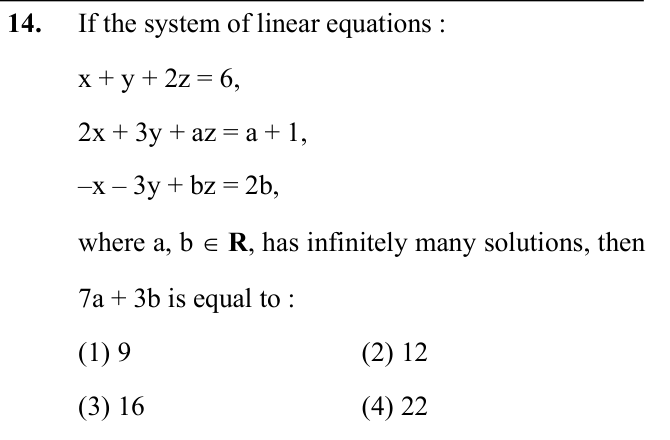
Candidate Response:
(1) (2) (3) (4)
⚡ OFFICIAL KEY: 3
Step-by-Step Derivation
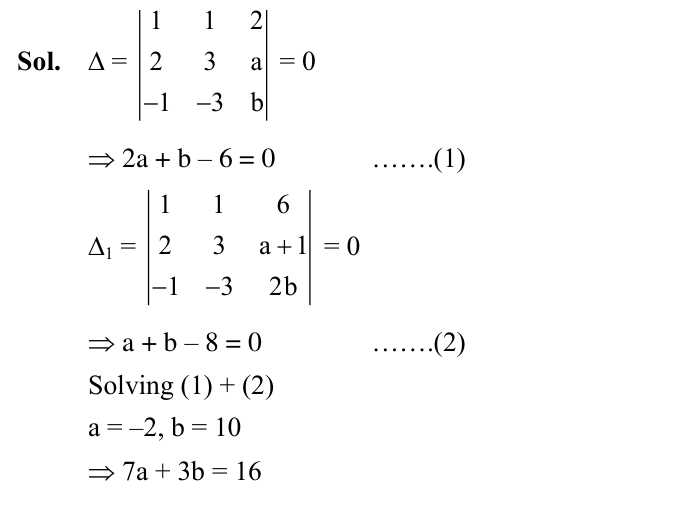
QUESTION 2
MATHEMATICS · Linear Programming
SECTION A · MCQ (+4, -1)
Which of the following systems of constraints defines an infeasible solution (empty feasible region)?
(1) x + y ≤ 2, x + y ≥ 1, x ≥ 0, y ≥ 0
(2) 2x + 3y ≤ 6, x ≥ 0, y ≥ 0
(3) 3x + 4y ≥ 12, 3x + 4y ≤ 8, x ≥ 0, y ≥ 0
(4) x ≥ 1, x ≤ 0, x ≥ 0, y ≥ 0
Candidate Response:
(1) (2) (3) (4)
⚡ OFFICIAL KEY: x ≥ 1, x ≤ 0, x ≥ 0, y ≥ 0
Step-by-Step Derivation
The third option has x ≥ 1 and x ≤ 0, which cannot be satisfied simultaneously. Other options have overlapping feasible regions.
QUESTION 3
MATHEMATICS · Linear Programming
SECTION A · MCQ (+4, -1)
Can a feasible region defined by linear inequalities be non-convex?
(1) No. The intersection of linear half-planes is always a convex set.
(2) Contradicted by boundary limit constraints under standard Cartesian mapping.
(3) Valid only when elements belong strictly to the non-negative real domain $\mathbb{R}^+$.
(4) Requires uniform continuity across the entire open interval $(a, b)$.
Candidate Response:
(1) (2) (3) (4)
⚡ OFFICIAL KEY: No. The intersection of linear half-planes is always a convex set.
Step-by-Step Derivation
Linear combinations of linear inequalities preserve convexity: if a P + b <= c and a Q + b <= c, then a(t P + (1-t)Q) + b <= c for all t in [0, 1].
QUESTION 4
MATHEMATICS · Linear Programming
SECTION A · MCQ (+4, -1)
Can an unbounded feasible region have a unique finite minimum value?
(1) [-5, 7)
(2) Yes! Unbounded minimization problems (e.g. diet problems) frequently have well-defined finite minimums.
(3) Yes! Unbounded minimization problems (e.g. diet problems) frequently have well+defined finite minimums.
(4) Undefined under standard Linear Programming axioms.
Candidate Response:
(1) (2) (3) (4)
⚡ OFFICIAL KEY: Yes! Unbounded minimization problems (e.g. diet problems) frequently have well-defined finite minimums.
Step-by-Step Derivation
Distinguishing between structural inconsistency (no solution possible) and lack of resource caps (infinite profit possible).
QUESTION 5
MATHEMATICS · Linear Programming
SECTION A · MCQ (+4, -1)
Consider the constraints x ≤ 3, x ≤ 6, and x ≥ 0. Which constraint is redundant?
(1) x ≥ 0
(2) All are active
(3) x ≤ 3
(4) x ≤ 6
Candidate Response:
(1) (2) (3) (4)
⚡ OFFICIAL KEY: x ≤ 6
Step-by-Step Derivation
x ≤ 6 is redundant because any x satisfying x ≤ 3 automatically satisfies x ≤ 6. x ≥ 0 is active as it defines the lower bound. The other options are incorrect as they either misidentify the stricter constraint or assume all are active.
QUESTION 6
MATHEMATICS · Linear Programming
SECTION A · MCQ (+4, -1)
Consider the objective function Z = x + y with feasible region defined by x - y ≥ 0, x ≤ 4, y ≥ 0. If the maximum value of Z is found to be 8 at the corner point (4, 4), which of the following must be true?
(1) The open half-plane x + y > 8 has no points in common with the feasible region.
(2) The value 8 is not the maximum since the region is unbounded.
(3) The value 8 is the minimum, not the maximum.
(4) The open half-plane x + y > 8 intersects the feasible region.
Candidate Response:
(1) (2) (3) (4)
⚡ OFFICIAL KEY: The open half-plane x + y > 8 has no points in common with the feasible region.
Step-by-Step Derivation
If the open half-plane x + y > 8 has no points in common with the feasible region, then 8 is the true maximum. Other options contradict the open half-plane criterion or misinterpret the problem.
QUESTION 7
MATHEMATICS · Linear Programming
SECTION A · MCQ (+4, -1)
For the objective function Z = 3x + 2y with vertices (0, 0), (4, 0), (2, 3), and (0, 5), which vertex gives the maximum value of Z?
(1) (4, 0): Z = 12
(2) (0, 5): Z = 10
(3) (0, 0): Z = 0
(4) (2, 3): Z = 12
Candidate Response:
(1) (2) (3) (4)
⚡ OFFICIAL KEY: (0, 5): Z = 10
Step-by-Step Derivation
The maximum Z is 10 at (0, 5). Other options are correct for their respective points but not the maximum. (2, 3) and (4, 0) both give Z = 12, but (0, 5) gives the highest value.
QUESTION 8
MATHEMATICS · Linear Programming
SECTION A · MCQ (+4, -1)
If a diet must contain at least 80 units of vitamin A, and foods X and Y provide 2 and 4 units per kg, what is the constraint?
(1) Requires uniform continuity across the entire open interval $(a, b)$.
(2) Contradicted by boundary limit constraints under standard Cartesian mapping.
(3) 2x + 4y >= 80.
(4) Valid only when elements belong strictly to the non-negative real domain $\mathbb{R}^+$.
Candidate Response:
(1) (2) (3) (4)
⚡ OFFICIAL KEY: 2x + 4y >= 80.
Step-by-Step Derivation
Inequalities model boundary limits; you cannot consume more raw materials than exist in inventory, but you can consume less.
QUESTION 9
MATHEMATICS · Linear Programming
SECTION A · MCQ (+4, -1)
In an unbounded region, what happens if ax + by > M intersects the feasible region?
(1) Valid only when elements belong strictly to the non-negative real domain $\mathbb{R}^+$.
(2) Z has no maximum value.
(3) Contradicted by boundary limit constraints under standard Cartesian mapping.
(4) Requires uniform continuity across the entire open interval $(a, b)$.
Candidate Response:
(1) (2) (3) (4)
⚡ OFFICIAL KEY: Z has no maximum value.
Step-by-Step Derivation
Any point in the feasible region falling inside ax + by > M would yield a Z value strictly greater than M, contradicting that M is the maximum.
QUESTION 10
MATHEMATICS · Linear Programming
SECTION A · MCQ (+4, -1)
Why is the feasible region always restricted to the first quadrant in standard LPP?
(1) Contradicted by boundary limit constraints under standard Cartesian mapping.
(2) Requires uniform continuity across the entire open interval $(a, b)$.
(3) Due to the non-negativity constraints x >= 0 and y >= 0.
(4) Valid only when elements belong strictly to the non-negative real domain $\mathbb{R}^+$.
Candidate Response:
(1) (2) (3) (4)
⚡ OFFICIAL KEY: Due to the non-negativity constraints x >= 0 and y >= 0.
Step-by-Step Derivation
Physical goods, hours, and inventory can never take negative values in realistic operational settings.
QUESTION 11
MATHEMATICS · Linear Programming
SECTION A · MCQ (+4, -1)
Find the intersection point of the lines 2x + y = 10 and x + 3y = 15. Use algebraic elimination to solve.
(1) (0, 5)
(2) (3, 4)
(3) (4, 2)
(4) (5, 0)
Candidate Response:
(1) (2) (3) (4)
⚡ OFFICIAL KEY: (3, 4)
Step-by-Step Derivation
Multiply the first equation by 3: 6x + 3y = 30. Subtract the second equation: 5x = 15 → x = 3. Substitute x = 3 into 2x + y = 10: y = 4. Other options are incorrect as they do not satisfy both equations.
QUESTION 12
MATHEMATICS · Linear Programming
SECTION A · MCQ (+4, -1)
A factory produces tables (x) and chairs (y). If the profit per table is Rs 250 and per chair is Rs 75, which of these is the correct objective function for maximizing profit?
(1) Maximize Z = 250x² + 75y
(2) Maximize Z = 250x + 75y
(3) Maximize Z = 250x + 75y ≤ 5000
(4) Maximize Z = 250x + 75y + 100
Candidate Response:
(1) (2) (3) (4)
⚡ OFFICIAL KEY: Maximize Z = 250x + 75y
Step-by-Step Derivation
The objective function must be linear (no exponents or inequalities). Option A is correct. Option B adds a non-linear term (x²). Option C adds an extra constant (100). Option D incorrectly uses an inequality instead of a scalar objective.
QUESTION 13
MATHEMATICS · Linear Programming
SECTION A · MCQ (+4, -1)
Is the region defined by x + y <= 10, x >= 0, y >= 0 bounded or unbounded?
(1) Valid only when elements belong strictly to the non-negative real domain $\mathbb{R}^+$.
(2) Bounded, because all points satisfy x <= 10, y <= 10 and are trapped in a finite triangle.
(3) Contradicted by boundary limit constraints under standard Cartesian mapping.
(4) Requires uniform continuity across the entire open interval $(a, b)$.
Candidate Response:
(1) (2) (3) (4)
⚡ OFFICIAL KEY: Bounded, because all points satisfy x <= 10, y <= 10 and are trapped in a finite triangle.
Step-by-Step Derivation
A continuous linear function on a compact (closed and bounded) domain attains its supremum and infimum by the Weierstrass Extreme Value Theorem.
QUESTION 14
MATHEMATICS · Linear Programming
SECTION A · MCQ (+4, -1)
Which test point should you use if the boundary line is x - y = 0?
(1) (-∞, Use a point not on the line, such as (1, 0) or (0, 1).)
(2) [-5, 7)
(3) Undefined under standard Linear Programming axioms.
(4) Use a point not on the line, such as (1, 0) or (0, 1).
Candidate Response:
(1) (2) (3) (4)
⚡ OFFICIAL KEY: Use a point not on the line, such as (1, 0) or (0, 1).
Step-by-Step Derivation
A straight line divides the 2D plane into two open half-planes; evaluating any single test point not on the line determines the sign of the entire half-plane.
QUESTION 15
MATHEMATICS · Linear Programming
SECTION A · MCQ (+4, -1)
If machine A is available for at most 42 hours, what type of inequality constraint represents this limit?
(1) Valid only when elements belong strictly to the non-negative real domain $\mathbb{R}^+$.
(2) Contradicted by boundary limit constraints under standard Cartesian mapping.
(3) A less than or equal to inequality: a1 x + b1 y <= 42.
(4) Requires uniform continuity across the entire open interval $(a, b)$.
Candidate Response:
(1) (2) (3) (4)
⚡ OFFICIAL KEY: A less than or equal to inequality: a1 x + b1 y <= 42.
Step-by-Step Derivation
Firms operate under short-run fixed capital constraints, requiring mathematical allocation to maximize economic return.
QUESTION 16
MATHEMATICS · Linear Programming
SECTION A · MCQ (+4, -1)
Can an objective function in a Linear Programming Problem contain non-linear terms like x^2 or x*y?
(1) Contradicted by boundary limit constraints under standard Cartesian mapping.
(2) No. In LPP, the objective function and all constraints must be strictly linear.
(3) Valid only when elements belong strictly to the non-negative real domain $\mathbb{R}^+$.
(4) Requires uniform continuity across the entire open interval $(a, b)$.
Candidate Response:
(1) (2) (3) (4)
⚡ OFFICIAL KEY: No. In LPP, the objective function and all constraints must be strictly linear.
Step-by-Step Derivation
Linears models assume constant marginal returns: each additional unit of x adds exactly 'a' to the objective value Z regardless of scale.
QUESTION 17
MATHEMATICS · Linear Programming
SECTION A · MCQ (+4, -1)
Find the intersection point of x + 2y = 8 and 2x + y = 7.
(1) Undefined under standard Linear Programming axioms.
(2) Multiply second by 2: 4x + 2y = 14. Subtract: 3x = 6 => x = 2, y = 3. Point is (2, 3).
(3) [-5, 7)
(4) (-∞, Multiply second by 2: 4x + 2y = 14. Subtract: 3x = 6 => x = 2, y = 3. Point is (2, 3).)
Candidate Response:
(1) (2) (3) (4)
⚡ OFFICIAL KEY: Multiply second by 2: 4x + 2y = 14. Subtract: 3x = 6 => x = 2, y = 3. Point is (2, 3).
Step-by-Step Derivation
Graphing lines by hand has inherent pencil-width inaccuracies; exact algebraic solutions guarantee correct vertex coordinates.
QUESTION 18
MATHEMATICS · Linear Programming
SECTION A · MCQ (+4, -1)
According to the Corner Point Theorem, where must the optimal value of a linear objective function Z = ax + by occur in a bounded feasible region?
(1) At the vertices of the feasible region
(2) At the centroid of the feasible region
(3) At any interior point of the feasible region
(4) Along the edges of the feasible region
Candidate Response:
(1) (2) (3) (4)
⚡ OFFICIAL KEY: At the vertices of the feasible region
Step-by-Step Derivation
The Corner Point Theorem states that for a bounded feasible region, the optimal value occurs at vertices. Interior points and edges are not sufficient because the gradient of Z pushes values toward vertices.
QUESTION 19
MATHEMATICS · Linear Programming
SECTION A · MCQ (+4, -1)
Consider the problem: Maximize Z = 3x + 2y subject to x ≥ 1, y ≥ 1. What is the nature of the solution?
(1) Redundant constraint
(2) Infeasible solution
(3) Unbounded solution
(4) Unique optimal solution
Candidate Response:
(1) (2) (3) (4)
⚡ OFFICIAL KEY: Unbounded solution
Step-by-Step Derivation
The feasible region is the area where x ≥ 1 and y ≥ 1, which extends infinitely in the positive direction. Since Z = 3x + 2y can increase indefinitely, the solution is unbounded. Infeasible would require no feasible points, which is not the case here.
QUESTION 20
MATHEMATICS · Linear Programming
SECTION A · MCQ (+4, -1)
Consider the objective function Z = 3x + 3y with maximum values at points (2, 4) and (4, 2), both yielding Z = 18. How many optimal solutions exist for this problem?
(1) No solutions
(2) Exactly two solutions
(3) Only one solution at (3, 3)
(4) Infinite solutions along the line segment joining (2, 4) and (4, 2)
Candidate Response:
(1) (2) (3) (4)
⚡ OFFICIAL KEY: Infinite solutions along the line segment joining (2, 4) and (4, 2)
Step-by-Step Derivation
When the objective function has the same value at two adjacent corner points, all points on the line segment between them are also optimal. This results in infinite solutions. Other options incorrectly assume finiteness or misidentify the midpoint as the only solution.
QUESTION 21
MATHEMATICS · Linear Programming
SECTION A · MCQ (+4, -1)
If constraints are x <= 3 and x <= 6 (with x >= 0), which constraint is redundant?
(1) Valid only when elements belong strictly to the non-negative real domain $\mathbb{R}^+$.
(2) Contradicted by boundary limit constraints under standard Cartesian mapping.
(3) x <= 6 is redundant because x <= 3 already guarantees x <= 6.
(4) Requires uniform continuity across the entire open interval $(a, b)$.
Candidate Response:
(1) (2) (3) (4)
⚡ OFFICIAL KEY: x <= 6 is redundant because x <= 3 already guarantees x <= 6.
Step-by-Step Derivation
If x <= 5 and x <= 10, any point satisfying x <= 5 automatically satisfies x <= 10, making x <= 10 mathematically redundant.
QUESTION 22
MATHEMATICS · Linear Programming
SECTION A · MCQ (+4, -1)
To graph the inequality 2x + 3y ≤ 6, a student draws the boundary line and tests the origin (0, 0). What is the correct next step?
(1) Shade the region above the line since 0 ≤ 6 is true
(2) Shade the region below the line since 0 ≤ 6 is true
(3) Shade the region above the line since 0 ≤ 6 is false
(4) Shade the region below the line since 0 ≤ 6 is false
Candidate Response:
(1) (2) (3) (4)
⚡ OFFICIAL KEY: Shade the region below the line since 0 ≤ 6 is true
Step-by-Step Derivation
The origin test confirms the inequality holds for (0, 0), so the half-plane containing the origin (below the line) is shaded. Other options misinterpret the direction of shading or the inequality's truth value.
QUESTION 23
MATHEMATICS · Linear Programming
SECTION A · MCQ (+4, -1)
A diet problem requires minimizing the cost of food items while meeting minimum nutrient requirements. If Food A provides 2 units of nutrient X per kg at Rs 50/kg, and Food B provides 3 units of nutrient X per kg at Rs 70/kg, with a daily requirement of at least 18 units, which statement is correct?
(1) The feasible region is bounded, and the minimum cost occurs at (0,6).
(2) The feasible region is unbounded, and the minimum cost occurs at (9,0).
(3) The feasible region is unbounded, and the minimum cost occurs at (0,6).
(4) The feasible region is bounded, and the minimum cost occurs at (6,0).
Candidate Response:
(1) (2) (3) (4)
⚡ OFFICIAL KEY: The feasible region is unbounded, and the minimum cost occurs at (0,6).
Step-by-Step Derivation
The constraint 2x + 3y ≥ 18 defines an unbounded feasible region. The minimum cost occurs at (0,6) because moving along the line 2x + 3y = 18 towards higher x or y increases the cost. Options A and D incorrectly assume a bounded region, while B incorrectly identifies the corner point.
QUESTION 24
MATHEMATICS · Linear Programming
SECTION A · MCQ (+4, -1)
A factory produces two products, X and Y. Each unit of X requires 2 kg of raw material and each unit of Y requires 3 kg. The total raw material available is 60 kg. Which inequality correctly represents this constraint?
(1) 2x + 3y >= 60
(2) 2x + 3y = 60
(3) 2x + 3y <= 60
(4) 3x + 2y <= 60
Candidate Response:
(1) (2) (3) (4)
⚡ OFFICIAL KEY: 2x + 3y <= 60
Step-by-Step Derivation
The constraint uses <= because the total raw material consumed (2x + 3y) cannot exceed the available 60 kg. The other options either reverse the inequality (>=) or use incorrect coefficients.
QUESTION 25
MATHEMATICS · Linear Programming
SECTION A · MCQ (+4, -1)
If the open half-plane ax + by < m shares a common point with the feasible region, what is the conclusion?
(1) Requires uniform continuity across the entire open interval $(a, b)$.
(2) The objective function Z has no minimum value in that region.
(3) Valid only when elements belong strictly to the non-negative real domain $\mathbb{R}^+$.
(4) Contradicted by boundary limit constraints under standard Cartesian mapping.
Candidate Response:
(1) (2) (3) (4)
⚡ OFFICIAL KEY: The objective function Z has no minimum value in that region.
Step-by-Step Derivation
If any point (x0, y0) in the feasible region satisfies ax0 + by0 < m, then m is not the minimum because a strictly smaller value exists.