
⚡ OFFICIAL NTA ASSESSMENT GENERATOR & WORD (.DOCX) EXPORTER
Probability · Practice Worksheet
JEE Main Mathematics · Curated Assessment Set Print directly or export as a beautifully formatted Microsoft Word document with embedded 180-DPI mathematical prompt clips and step-by-step derivations.
EDUPROD JEE MAIN TEST SERIES · NTA PATTERN
Probability · Practice Worksheet
JEE Main Mathematics · Curated Assessment Set · Assessment Code: JEE-101
Total Marks: 100
Marking: +4 / -1 (Sec A) · +4 / 0 (Sec B)
QUESTION 1
MATHEMATICS · Probability
SECTION A · MCQ (+4, -1)
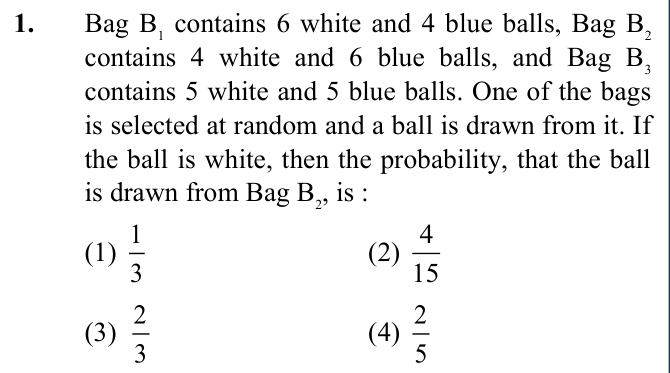
Candidate Response:
(1) (2) (3) (4)
QUESTION 2
MATHEMATICS · Probability
SECTION A · MCQ (+4, -1)
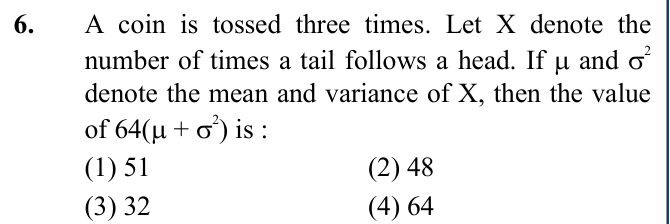
Candidate Response:
(1) (2) (3) (4)
QUESTION 3
MATHEMATICS · Probability
SECTION A · MCQ (+4, -1)
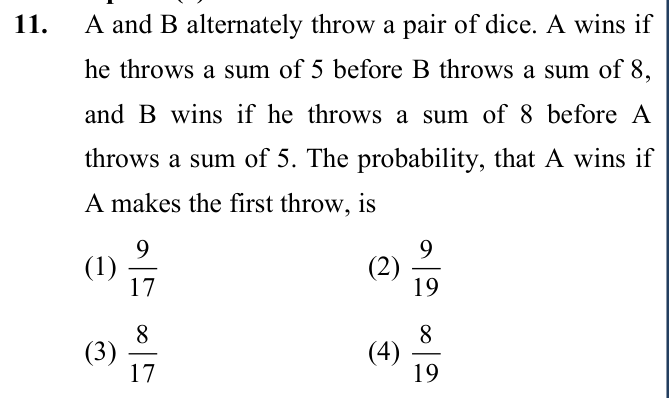
Candidate Response:
(1) (2) (3) (4)
QUESTION 4
MATHEMATICS · Probability
SECTION A · MCQ (+4, -1)
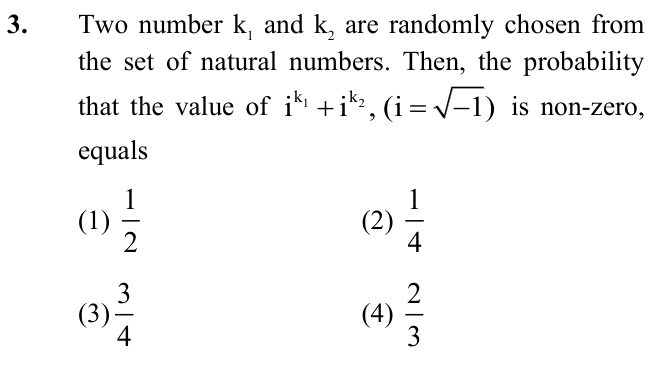
Candidate Response:
(1) (2) (3) (4)
QUESTION 5
MATHEMATICS · Probability
SECTION A · MCQ (+4, -1)
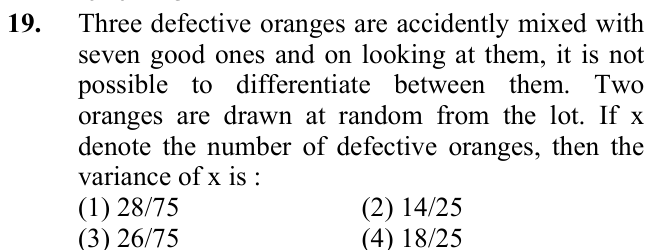
Candidate Response:
(1) (2) (3) (4)
QUESTION 6
MATHEMATICS · Probability
SECTION A · MCQ (+4, -1)
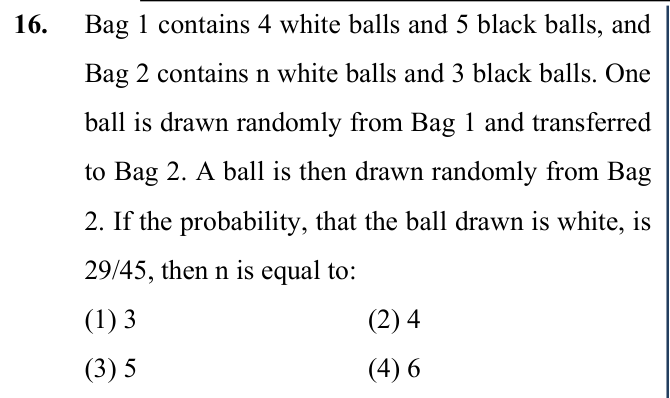
Candidate Response:
(1) (2) (3) (4)
QUESTION 7
MATHEMATICS · Probability
SECTION A · MCQ (+4, -1)
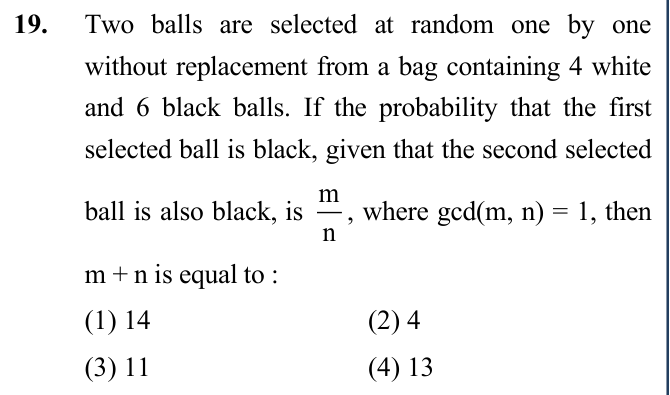
Candidate Response:
(1) (2) (3) (4)
QUESTION 8
MATHEMATICS · Probability
SECTION A · MCQ (+4, -1)
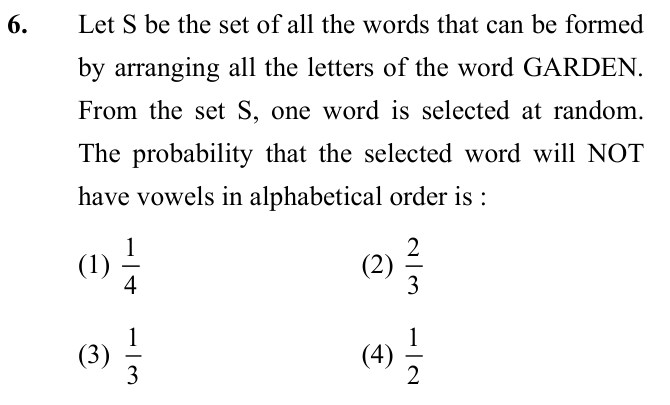
Candidate Response:
(1) (2) (3) (4)
QUESTION 9
MATHEMATICS · Probability
SECTION A · MCQ (+4, -1)
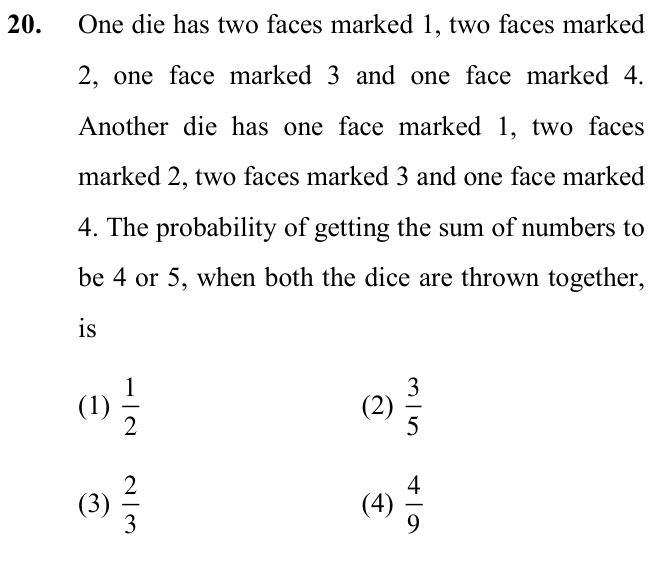
Candidate Response:
(1) (2) (3) (4)
QUESTION 10
MATHEMATICS · Probability
SECTION A · MCQ (+4, -1)
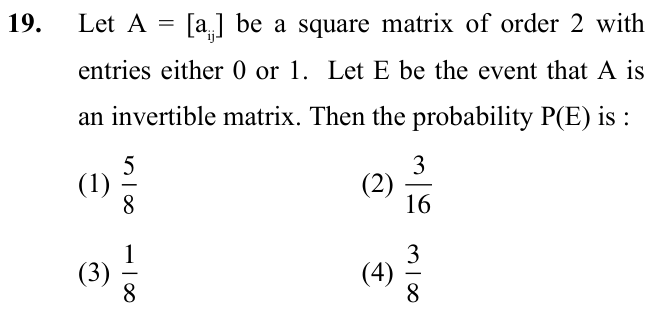
Candidate Response:
(1) (2) (3) (4)
QUESTION 11
MATHEMATICS · Probability
SECTION A · MCQ (+4, -1)
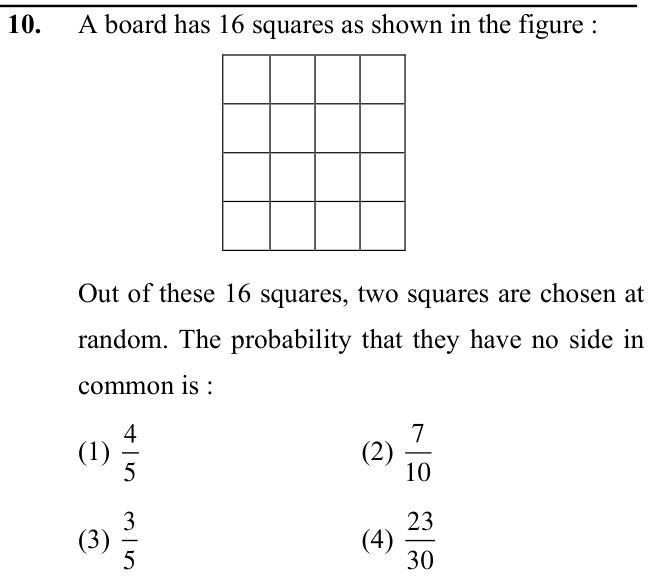
Candidate Response:
(1) (2) (3) (4)
QUESTION 12
MATHEMATICS · Probability
SECTION A · MCQ (+4, -1)
A bag contains 2 white and 3 black balls. Another bag contains 3 white and 4 black balls. One bag is selected at random and a ball is drawn. If the ball is white, what is the probability it came from the first bag? Use Bayes' theorem to calculate.
(1) (1/2) × (2/5) / [(1/2)(2/5) × (1/2)(3/7)]
(2) (1/2) × (2/5) / [(1/2)(2/5) + (1/2)(3/7)]
(3) (2/5) / [(2/5) + (3/7)]
(4) (1/2) × (3/7) / [(1/2)(2/5) + (1/2)(3/7)]
Candidate Response:
(1) (2) (3) (4)
QUESTION 13
MATHEMATICS · Probability
SECTION A · MCQ (+4, -1)
Which of the following sets of events forms a valid partition of the sample space S = {1, 2, 3, 4, 5, 6}?
(1) E1 = {1, 2}, E2 = {2, 3}, E3 = {4, 5, 6}
(2) E1 = {1, 2, 3}, E2 = {4, 5}, E3 = {6}
(3) E1 = {1, 2}, E2 = {3, 4}, E3 = {5, 6}
(4) E1 = {1, 3, 5}, E2 = {2, 4, 6}
Candidate Response:
(1) (2) (3) (4)
QUESTION 14
MATHEMATICS · Probability
SECTION A · MCQ (+4, -1)
A bag is chosen at random from two bags: Bag A (probability 1/2) containing 2 white and 5 black balls, and Bag B (probability 1/2) containing 3 white and 6 black balls. What is the total probability of drawing a white ball?
(1) (1/2 × 2/7) + (1/2 × 3/9)
(2) (1/2 + 2/7) + (1/2 + 3/9)
(3) (1/2 + 2/7) × (1/2 + 3/9)
(4) (1/2 × 2/7) × (1/2 × 3/9)
Candidate Response:
(1) (2) (3) (4)
QUESTION 15
MATHEMATICS · Probability
SECTION A · MCQ (+4, -1)
A factory has two machines, M1 and M2. M1 produces 60% of items with a 2% defective rate, and M2 produces 40% with a 1% defective rate. What is the total probability of a randomly selected item being defective?
(1) 0.02
(2) 0.01
(3) 0.03
(4) 0.016
Candidate Response:
(1) (2) (3) (4)
QUESTION 16
MATHEMATICS · Probability
SECTION A · MCQ (+4, -1)
Do events E1 = {number is prime} and E2 = {number is composite} form a partition of the numbers from 1 to 10?
(1) No, because the number 1 is neither prime nor composite, leaving an uncovered gap in S.
(2) Contradicted by boundary limit constraints under standard Cartesian mapping.
(3) Requires uniform continuity across the entire open interval $(a, b)$.
(4) Valid only when elements belong strictly to the non-negative real domain $\mathbb{R}^+$.
Candidate Response:
(1) (2) (3) (4)
QUESTION 17
MATHEMATICS · Probability
SECTION A · MCQ (+4, -1)
If X takes values 0 and 1 with probabilities 0.4 and 0.6 respectively, what is E(X)?
(1) E(X) = 0*(0.4) + 1*(0.6) = 0.6.
(2) (-∞, E(X) = 0*(0.4) + 1*(0.6) = 0.6.)
(3) [-5, 7)
(4) Undefined under standard Probability axioms.
Candidate Response:
(1) (2) (3) (4)
QUESTION 18
MATHEMATICS · Probability
SECTION A · MCQ (+4, -1)
An urn contains 5 red and 5 blue balls. Two balls are drawn without replacement. What is the probability both are red?
(1) (5/10) × (4/9)
(2) (5/10) × (4/10)
(3) (5/10) × (5/10)
(4) (5/10) × (5/9)
Candidate Response:
(1) (2) (3) (4)
QUESTION 19
MATHEMATICS · Probability
SECTION A · MCQ (+4, -1)
In medical screening for a rare disease, why is the posterior probability often much lower than the test's sensitivity?
(1) Valid only when elements belong strictly to the non-negative real domain $\mathbb{R}^+$.
(2) Requires uniform continuity across the entire open interval $(a, b)$.
(3) Contradicted by boundary limit constraints under standard Cartesian mapping.
(4) Because the rare base rate means the small percentage of false positives from the large healthy majority outnumbers the true positives.
Candidate Response:
(1) (2) (3) (4)
QUESTION 20
MATHEMATICS · Probability
SECTION A · MCQ (+4, -1)
Can two events with non-zero probabilities be both mutually exclusive and independent simultaneously?
(1) Undefined under standard Probability axioms.
(2) [-5, 7)
(3) No. Mutually exclusive implies P(A cap B) = 0, while independence requires P(A cap B) = P(A)*P(B) > 0.
(4) (-∞, No. Mutually exclusive implies P(A cap B) = 0, while independence requires P(A cap B) = P(A)*P(B) > 0.)
Candidate Response:
(1) (2) (3) (4)
QUESTION 21
MATHEMATICS · Probability
SECTION A · MCQ (+4, -1)
If events A and B are independent, with P(A) = 0.5 and P(B) = 0.6, what is P(A ∩ B)?
(1) 0.3
(2) 0.5
(3) 0.6
(4) 0.1
Candidate Response:
(1) (2) (3) (4)
QUESTION 22
MATHEMATICS · Probability
SECTION A · MCQ (+4, -1)
Are 5 draws of cards from a deck WITHOUT replacement Bernoulli trials?
(1) Requires uniform continuity across the entire open interval $(a, b)$.
(2) Valid only when elements belong strictly to the non-negative real domain $\mathbb{R}^+$.
(3) Contradicted by boundary limit constraints under standard Cartesian mapping.
(4) No, because without replacement the probability of success changes after each draw.
Candidate Response:
(1) (2) (3) (4)
QUESTION 23
MATHEMATICS · Probability
SECTION A · MCQ (+4, -1)
If evidence A is equally likely under all hypotheses, how do posterior probabilities relate to prior probabilities?
(1) Undefined under standard Probability axioms.
(2) Posterior probabilities will be exactly proportional to prior probabilities (no update occurs).
(3) [-5, 7)
(4) (-∞, Posterior probabilities will be exactly proportional to prior probabilities (no update occurs).)
Candidate Response:
(1) (2) (3) (4)
QUESTION 24
MATHEMATICS · Probability
SECTION A · MCQ (+4, -1)
An urn has 10 black and 5 white balls. Two balls are drawn without replacement. What is the probability both are black?
(1) [-5, 7)
(2) (-∞, P(B1 cap B2) = (10/15) * (9/14) = (2/3) * (9/14) = 18/42 = 3/7.)
(3) P(B1 cap B2) = (10/15) * (9/14) = (2/3) * (9/14) = 18/42 = 3/7.
(4) Undefined under standard Probability axioms.
Candidate Response:
(1) (2) (3) (4)
QUESTION 25
MATHEMATICS · Probability
SECTION A · MCQ (+4, -1)
If P(X=1) = k, P(X=2) = 2k, P(X=3) = 3k, and these are all possible values, what is k?
(1) Requires uniform continuity across the entire open interval $(a, b)$.
(2) Contradicted by boundary limit constraints under standard Cartesian mapping.
(3) Valid only when elements belong strictly to the non-negative real domain $\mathbb{R}^+$.
(4) k + 2k + 3k = 1 => 6k = 1 => k = 1/6.
Candidate Response:
(1) (2) (3) (4)