
⚡ OFFICIAL NTA ASSESSMENT GENERATOR & WORD (.DOCX) EXPORTER
Probability · Practice Worksheet
JEE Main Mathematics · Curated Assessment Set Print directly or export as a beautifully formatted Microsoft Word document with embedded 180-DPI mathematical prompt clips and step-by-step derivations.
EDUPROD JEE MAIN TEST SERIES · NTA PATTERN
Probability · Practice Worksheet
JEE Main Mathematics · Curated Assessment Set · Assessment Code: JEE-101
Total Marks: 60
Marking: +4 / -1 (Sec A) · +4 / 0 (Sec B)
QUESTION 1
MATHEMATICS · Probability
SECTION A · MCQ (+4, -1)
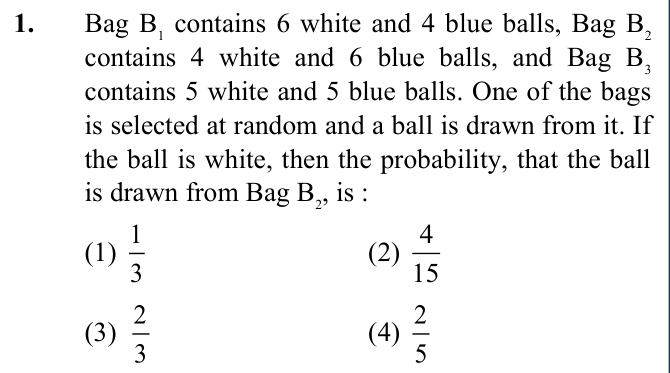
Candidate Response:
(1) (2) (3) (4)
⚡ OFFICIAL KEY: 2
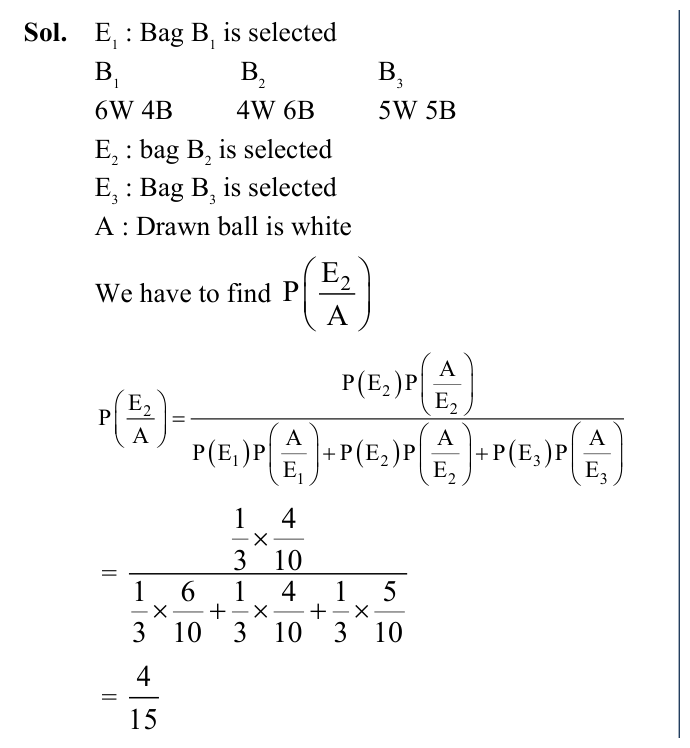
Step-by-Step Derivation
QUESTION 2
MATHEMATICS · Probability
SECTION A · MCQ (+4, -1)
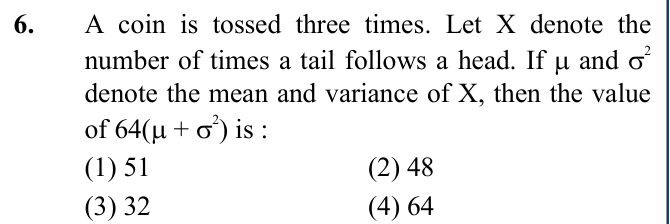
Candidate Response:
(1) (2) (3) (4)
⚡ OFFICIAL KEY: 2
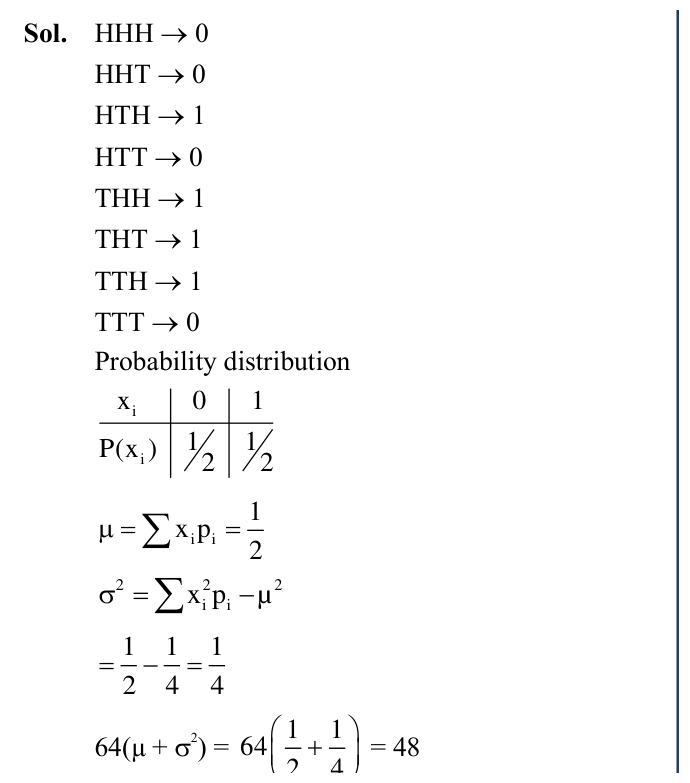
Step-by-Step Derivation
QUESTION 3
MATHEMATICS · Probability
SECTION A · MCQ (+4, -1)
Candidate Response:
(1) (2) (3) (4)
⚡ OFFICIAL KEY: 2
Step-by-Step Derivation
QUESTION 4
MATHEMATICS · Probability
SECTION A · MCQ (+4, -1)
Candidate Response:
(1) (2) (3) (4)
⚡ OFFICIAL KEY: 3
Step-by-Step Derivation
QUESTION 5
MATHEMATICS · Probability
SECTION A · MCQ (+4, -1)
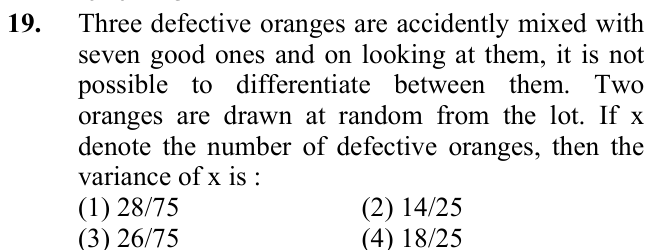
Candidate Response:
(1) (2) (3) (4)
⚡ OFFICIAL KEY: 1
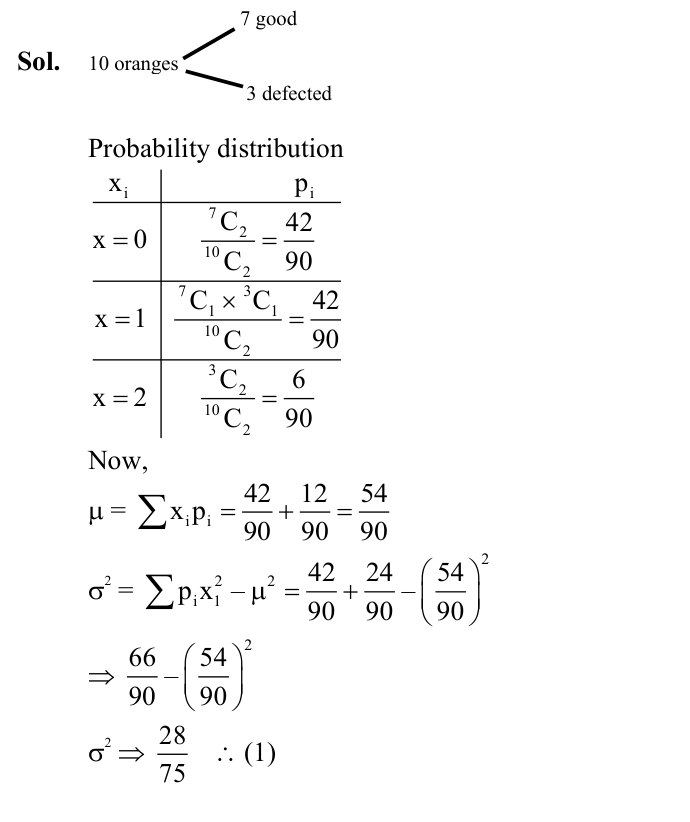
Step-by-Step Derivation
QUESTION 6
MATHEMATICS · Probability
SECTION A · MCQ (+4, -1)
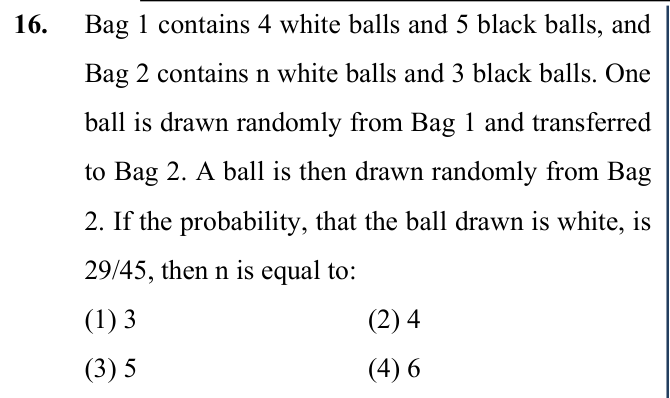
Candidate Response:
(1) (2) (3) (4)
⚡ OFFICIAL KEY: 4
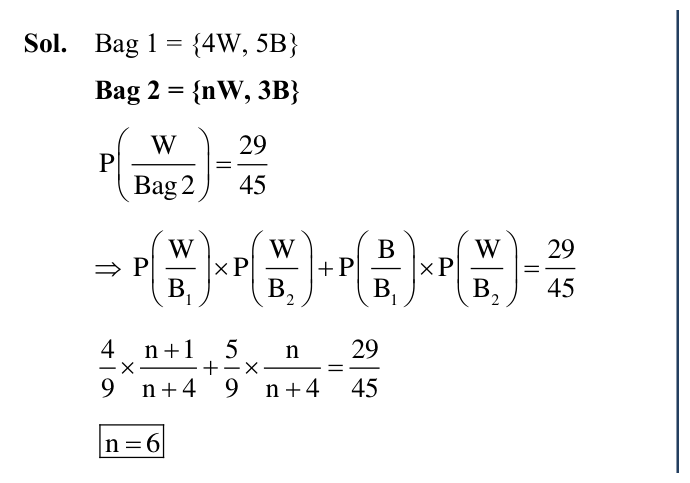
Step-by-Step Derivation
QUESTION 7
MATHEMATICS · Probability
SECTION A · MCQ (+4, -1)
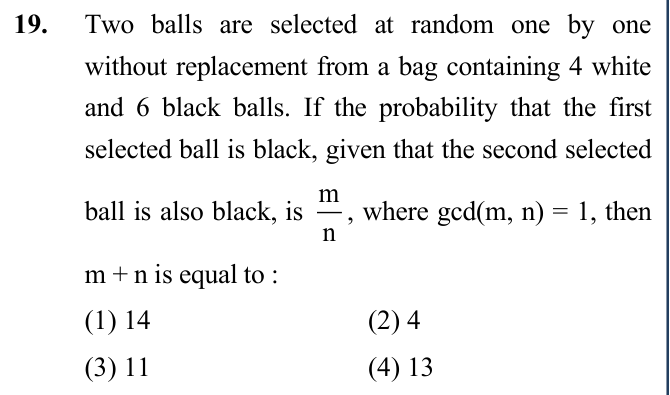
Candidate Response:
(1) (2) (3) (4)
⚡ OFFICIAL KEY: 1
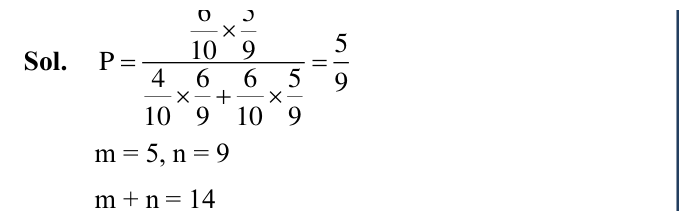
Step-by-Step Derivation
QUESTION 8
MATHEMATICS · Probability
SECTION A · MCQ (+4, -1)
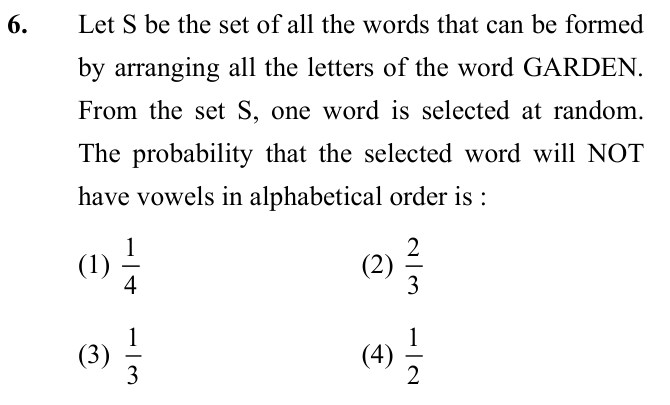
Candidate Response:
(1) (2) (3) (4)
⚡ OFFICIAL KEY: 4
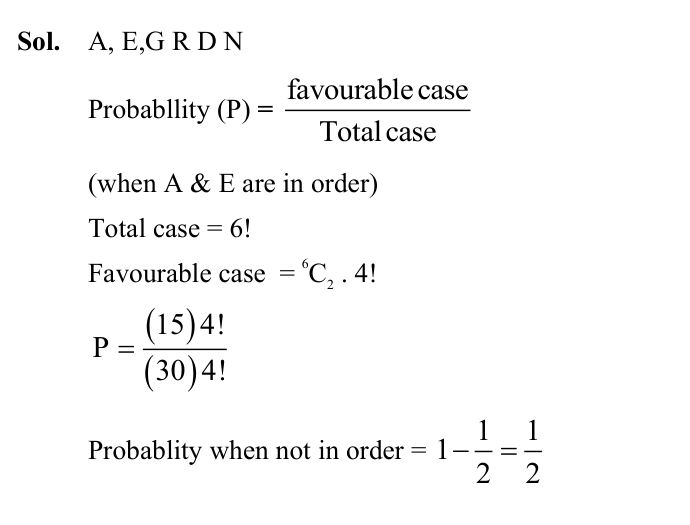
Step-by-Step Derivation
QUESTION 9
MATHEMATICS · Probability
SECTION A · MCQ (+4, -1)
Candidate Response:
(1) (2) (3) (4)
⚡ OFFICIAL KEY: 1
Step-by-Step Derivation
QUESTION 10
MATHEMATICS · Probability
SECTION A · MCQ (+4, -1)
Candidate Response:
(1) (2) (3) (4)
⚡ OFFICIAL KEY: 4
Step-by-Step Derivation
QUESTION 11
MATHEMATICS · Probability
SECTION A · MCQ (+4, -1)
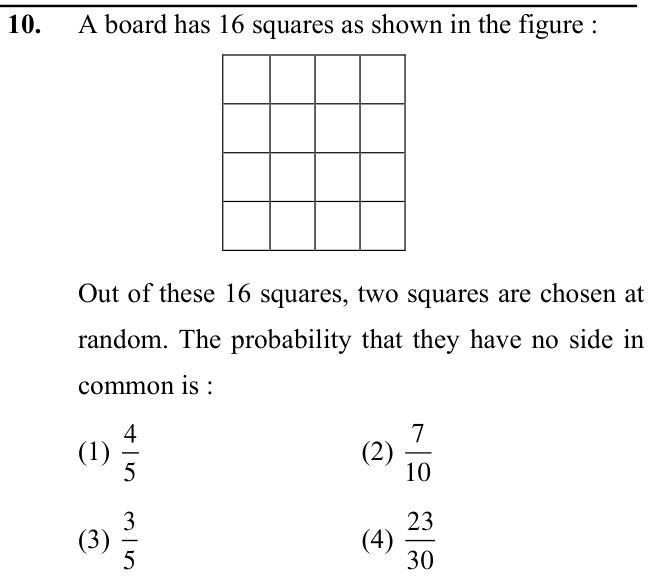
Candidate Response:
(1) (2) (3) (4)
⚡ OFFICIAL KEY: 1
Step-by-Step Derivation
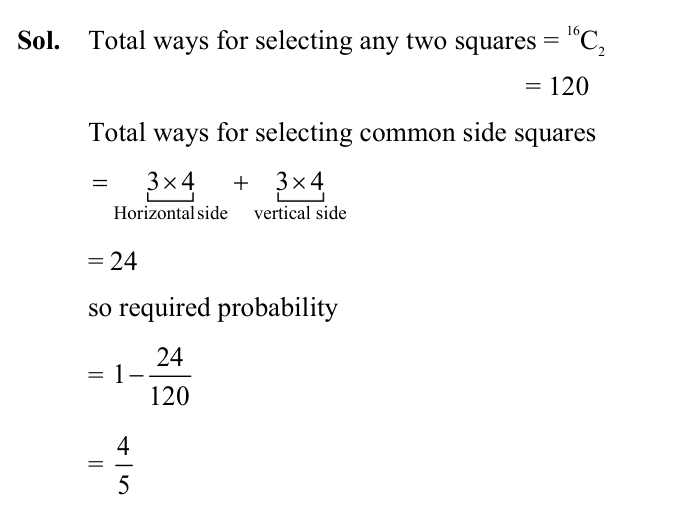
QUESTION 12
MATHEMATICS · Probability
SECTION A · MCQ (+4, -1)
A bag contains 2 white and 3 black balls. Another bag contains 3 white and 4 black balls. One bag is selected at random and a ball is drawn. If the ball is white, what is the probability it came from the first bag? Use Bayes' theorem to calculate.
(1) (1/2) × (2/5) / [(1/2)(2/5) × (1/2)(3/7)]
(2) (1/2) × (2/5) / [(1/2)(2/5) + (1/2)(3/7)]
(3) (2/5) / [(2/5) + (3/7)]
(4) (1/2) × (3/7) / [(1/2)(2/5) + (1/2)(3/7)]
Candidate Response:
(1) (2) (3) (4)
⚡ OFFICIAL KEY: (1/2) × (2/5) / [(1/2)(2/5) + (1/2)(3/7)]
Step-by-Step Derivation
The correct option uses Bayes' theorem with prior probability (1/2) for selecting the bag, likelihood (2/5) for white from first bag, and denominator as total probability of white. Other options omit prior probabilities or miscalculate the denominator.
QUESTION 13
MATHEMATICS · Probability
SECTION A · MCQ (+4, -1)
Which of the following sets of events forms a valid partition of the sample space S = {1, 2, 3, 4, 5, 6}?
(1) E1 = {1, 2}, E2 = {2, 3}, E3 = {4, 5, 6}
(2) E1 = {1, 2, 3}, E2 = {4, 5}, E3 = {6}
(3) E1 = {1, 2}, E2 = {3, 4}, E3 = {5, 6}
(4) E1 = {1, 3, 5}, E2 = {2, 4, 6}
Candidate Response:
(1) (2) (3) (4)
⚡ OFFICIAL KEY: E1 = {1, 2}, E2 = {3, 4}, E3 = {5, 6}
Step-by-Step Derivation
The correct option has disjoint, exhaustive events with no overlaps and full coverage of S. Other options either overlap (e.g., E1 and E2 in option D) or leave gaps (e.g., option C misses 6 in E3).
QUESTION 14
MATHEMATICS · Probability
SECTION A · MCQ (+4, -1)
A bag is chosen at random from two bags: Bag A (probability 1/2) containing 2 white and 5 black balls, and Bag B (probability 1/2) containing 3 white and 6 black balls. What is the total probability of drawing a white ball?
(1) (1/2 × 2/7) + (1/2 × 3/9)
(2) (1/2 + 2/7) + (1/2 + 3/9)
(3) (1/2 + 2/7) × (1/2 + 3/9)
(4) (1/2 × 2/7) × (1/2 × 3/9)
Candidate Response:
(1) (2) (3) (4)
⚡ OFFICIAL KEY: (1/2 × 2/7) + (1/2 × 3/9)
Step-by-Step Derivation
Correct answer multiplies along each branch (1/2 × 2/7 for Bag A, 1/2 × 3/9 for Bag B) and adds results. Other options incorrectly add or multiply probabilities instead of following the tree diagram rules.
QUESTION 15
MATHEMATICS · Probability
SECTION A · MCQ (+4, -1)
A factory has two machines, M1 and M2. M1 produces 60% of items with a 2% defective rate, and M2 produces 40% with a 1% defective rate. What is the total probability of a randomly selected item being defective?
(1) 0.02
(2) 0.01
(3) 0.03
(4) 0.016
Candidate Response:
(1) (2) (3) (4)
⚡ OFFICIAL KEY: 0.016
Step-by-Step Derivation
The correct answer uses the Law of Total Probability: P(Defective) = P(M1)P(D|M1) + P(M2)P(D|M2) = 0.6×0.02 + 0.4×0.01 = 0.016. Other options ignore multiplication or use incorrect rates.