
⚡ OFFICIAL NTA ASSESSMENT GENERATOR & WORD (.DOCX) EXPORTER
Probability · Practice Worksheet
JEE Main Mathematics · Curated Assessment Set Print directly or export as a beautifully formatted Microsoft Word document with embedded 180-DPI mathematical prompt clips and step-by-step derivations.
EDUPROD JEE MAIN TEST SERIES · NTA PATTERN
Probability · Practice Worksheet
JEE Main Mathematics · Curated Assessment Set · Assessment Code: JEE-101
Total Marks: 120
Marking: +4 / -1 (Sec A) · +4 / 0 (Sec B)
QUESTION 1
MATHEMATICS · Probability
SECTION A · MCQ (+4, -1)
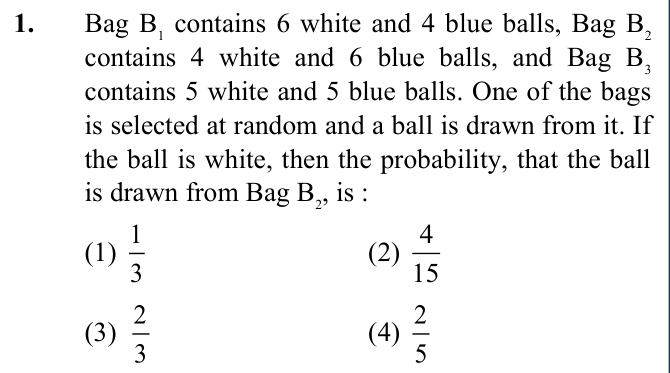
Candidate Response:
(1) (2) (3) (4)
⚡ OFFICIAL KEY: 2
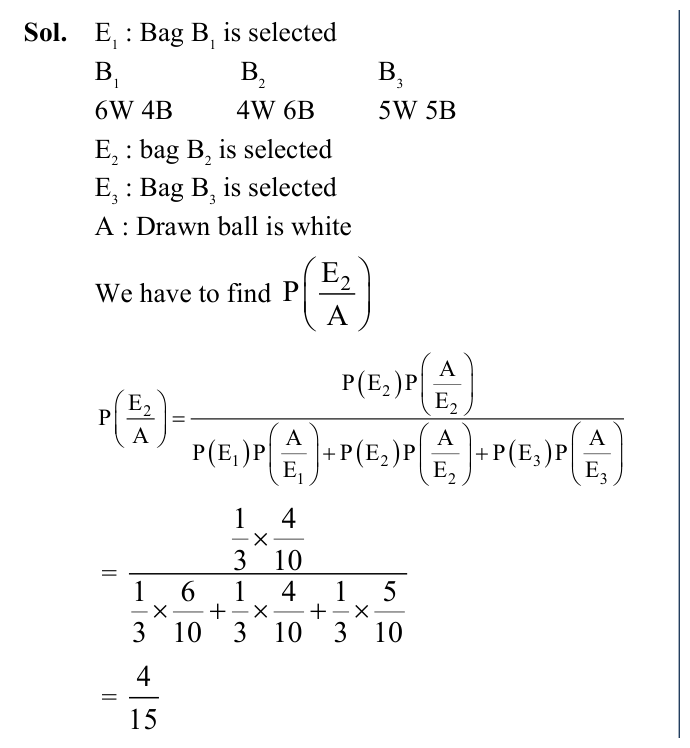
Step-by-Step Derivation
QUESTION 2
MATHEMATICS · Probability
SECTION A · MCQ (+4, -1)
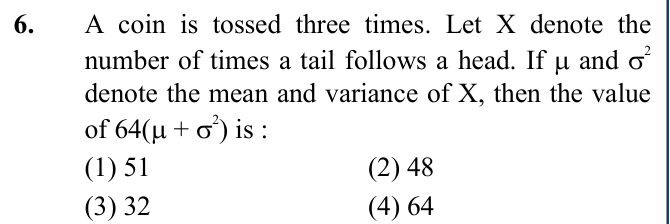
Candidate Response:
(1) (2) (3) (4)
⚡ OFFICIAL KEY: 2
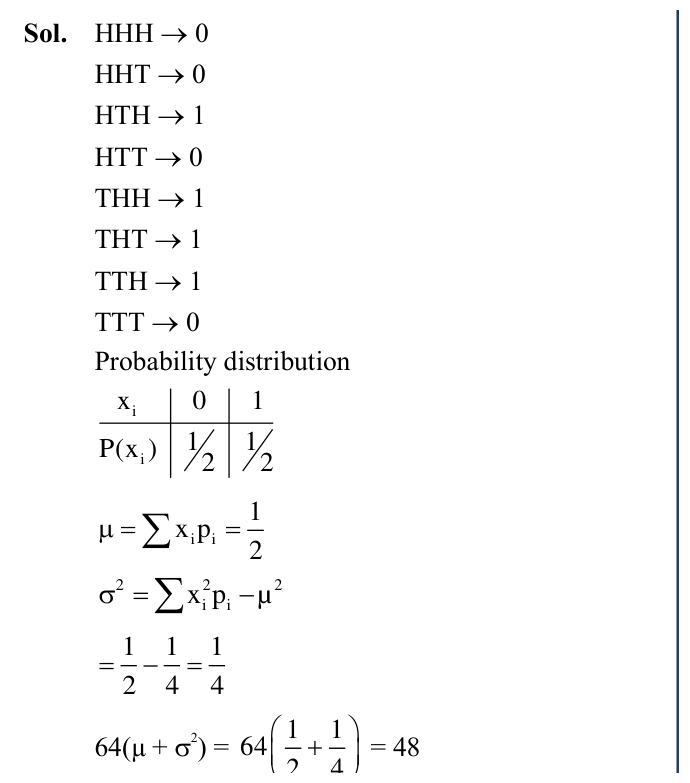
Step-by-Step Derivation
QUESTION 3
MATHEMATICS · Probability
SECTION A · MCQ (+4, -1)
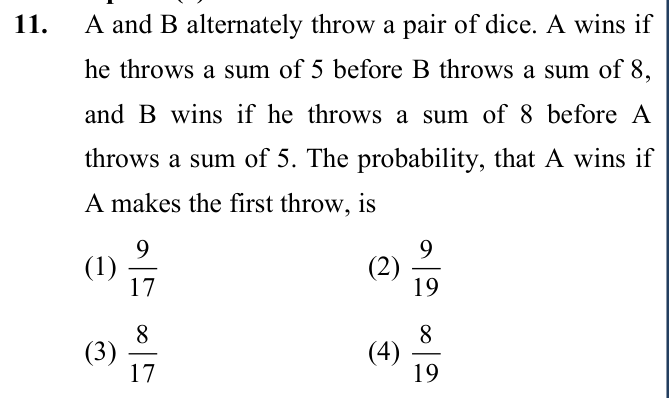
Candidate Response:
(1) (2) (3) (4)
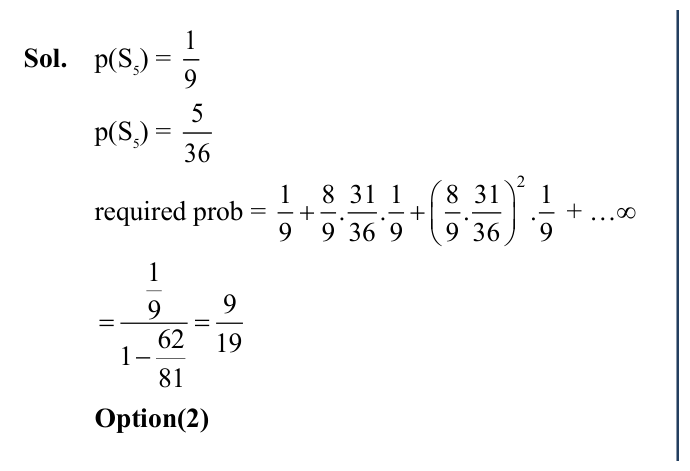
⚡ OFFICIAL KEY: 2
Step-by-Step Derivation
QUESTION 4
MATHEMATICS · Probability
SECTION A · MCQ (+4, -1)
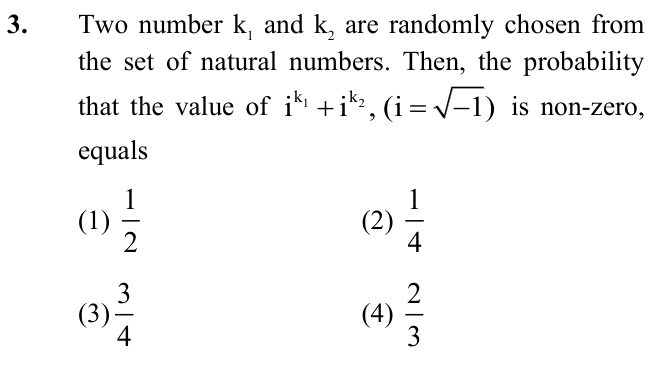
Candidate Response:
(1) (2) (3) (4)
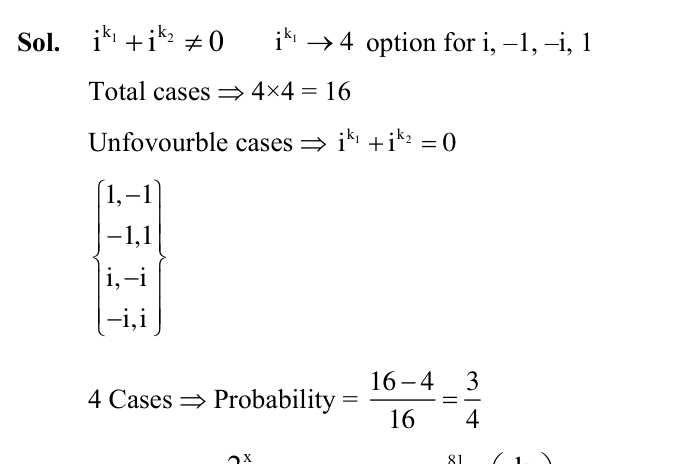
⚡ OFFICIAL KEY: 3
Step-by-Step Derivation
QUESTION 5
MATHEMATICS · Probability
SECTION A · MCQ (+4, -1)
Candidate Response:
(1) (2) (3) (4)
⚡ OFFICIAL KEY: 1
Step-by-Step Derivation
QUESTION 6
MATHEMATICS · Probability
SECTION A · MCQ (+4, -1)
Candidate Response:
(1) (2) (3) (4)
⚡ OFFICIAL KEY: 4
Step-by-Step Derivation
QUESTION 7
MATHEMATICS · Probability
SECTION A · MCQ (+4, -1)
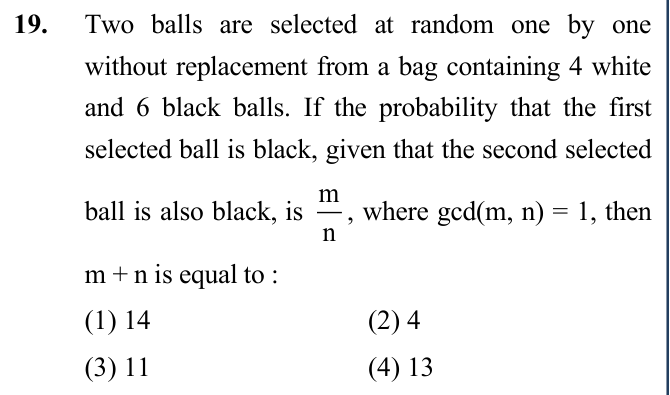
Candidate Response:
(1) (2) (3) (4)
⚡ OFFICIAL KEY: 1
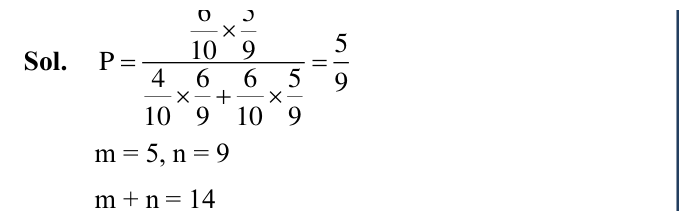
Step-by-Step Derivation
QUESTION 8
MATHEMATICS · Probability
SECTION A · MCQ (+4, -1)
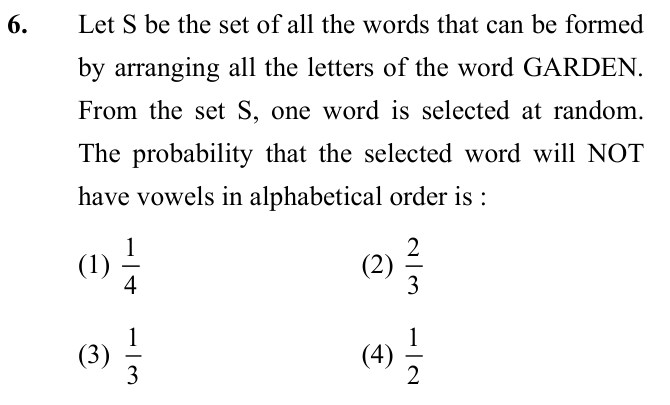
Candidate Response:
(1) (2) (3) (4)
⚡ OFFICIAL KEY: 4
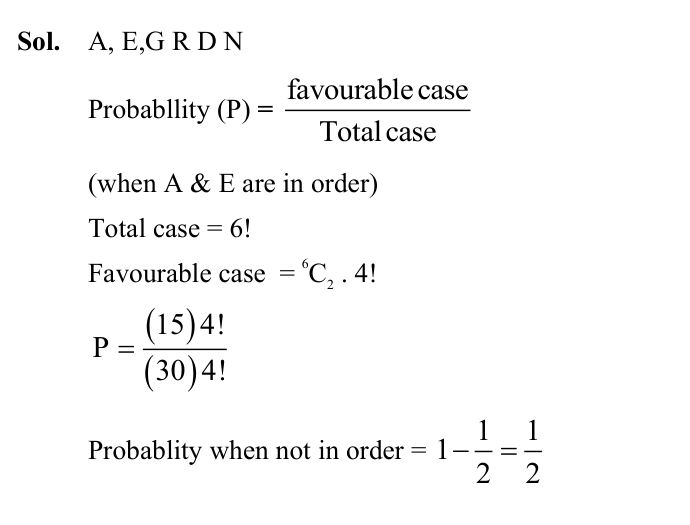
Step-by-Step Derivation
QUESTION 9
MATHEMATICS · Probability
SECTION A · MCQ (+4, -1)
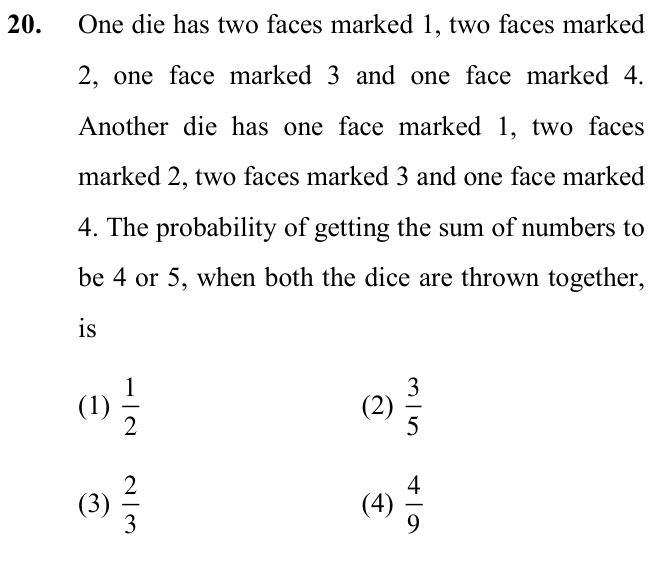
Candidate Response:
(1) (2) (3) (4)
⚡ OFFICIAL KEY: 1
Step-by-Step Derivation
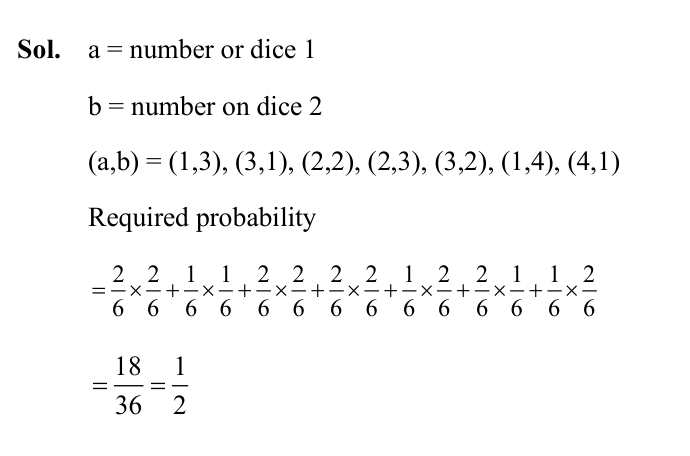
QUESTION 10
MATHEMATICS · Probability
SECTION A · MCQ (+4, -1)
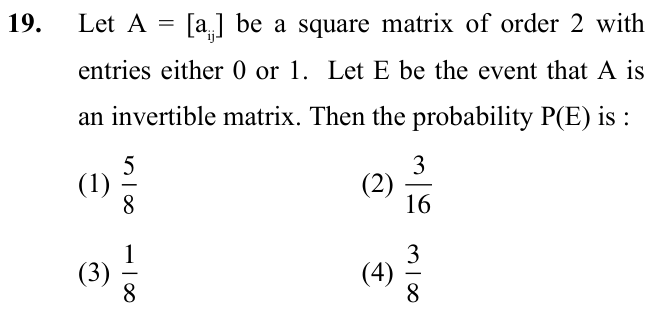
Candidate Response:
(1) (2) (3) (4)
⚡ OFFICIAL KEY: 4
Step-by-Step Derivation
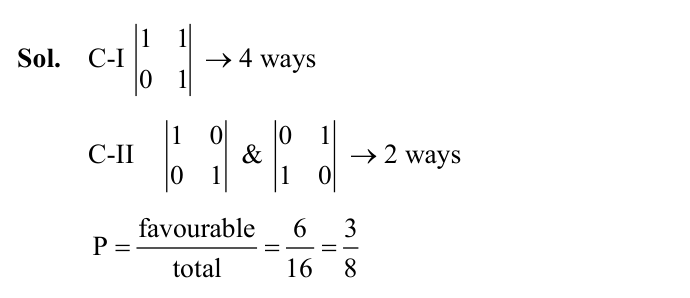
QUESTION 11
MATHEMATICS · Probability
SECTION A · MCQ (+4, -1)
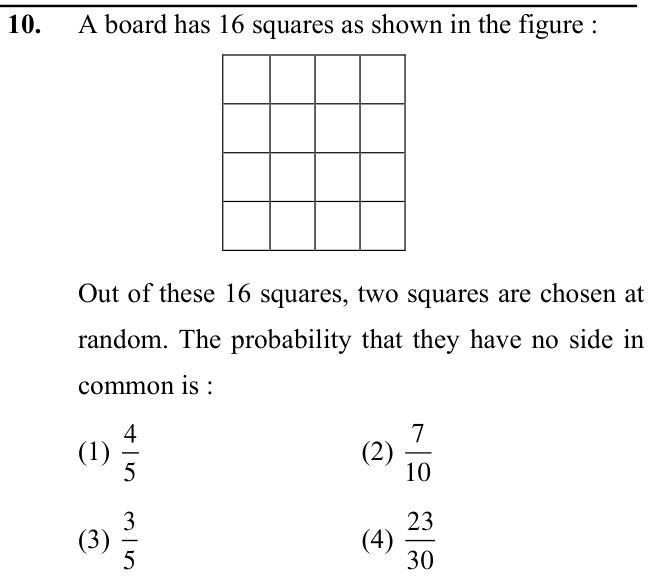
Candidate Response:
(1) (2) (3) (4)
⚡ OFFICIAL KEY: 1
Step-by-Step Derivation
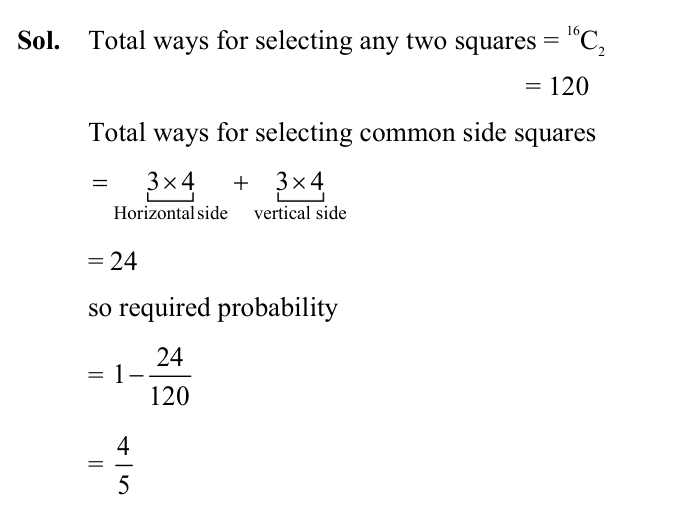
QUESTION 12
MATHEMATICS · Probability
SECTION A · MCQ (+4, -1)
A bag contains 2 white and 3 black balls. Another bag contains 3 white and 4 black balls. One bag is selected at random and a ball is drawn. If the ball is white, what is the probability it came from the first bag? Use Bayes' theorem to calculate.
(1) (1/2) × (2/5) / [(1/2)(2/5) × (1/2)(3/7)]
(2) (1/2) × (2/5) / [(1/2)(2/5) + (1/2)(3/7)]
(3) (2/5) / [(2/5) + (3/7)]
(4) (1/2) × (3/7) / [(1/2)(2/5) + (1/2)(3/7)]
Candidate Response:
(1) (2) (3) (4)
⚡ OFFICIAL KEY: (1/2) × (2/5) / [(1/2)(2/5) + (1/2)(3/7)]
Step-by-Step Derivation
The correct option uses Bayes' theorem with prior probability (1/2) for selecting the bag, likelihood (2/5) for white from first bag, and denominator as total probability of white. Other options omit prior probabilities or miscalculate the denominator.
QUESTION 13
MATHEMATICS · Probability
SECTION A · MCQ (+4, -1)
Which of the following sets of events forms a valid partition of the sample space S = {1, 2, 3, 4, 5, 6}?
(1) E1 = {1, 2}, E2 = {2, 3}, E3 = {4, 5, 6}
(2) E1 = {1, 2, 3}, E2 = {4, 5}, E3 = {6}
(3) E1 = {1, 2}, E2 = {3, 4}, E3 = {5, 6}
(4) E1 = {1, 3, 5}, E2 = {2, 4, 6}
Candidate Response:
(1) (2) (3) (4)
⚡ OFFICIAL KEY: E1 = {1, 2}, E2 = {3, 4}, E3 = {5, 6}
Step-by-Step Derivation
The correct option has disjoint, exhaustive events with no overlaps and full coverage of S. Other options either overlap (e.g., E1 and E2 in option D) or leave gaps (e.g., option C misses 6 in E3).
QUESTION 14
MATHEMATICS · Probability
SECTION A · MCQ (+4, -1)
A bag is chosen at random from two bags: Bag A (probability 1/2) containing 2 white and 5 black balls, and Bag B (probability 1/2) containing 3 white and 6 black balls. What is the total probability of drawing a white ball?
(1) (1/2 × 2/7) + (1/2 × 3/9)
(2) (1/2 + 2/7) + (1/2 + 3/9)
(3) (1/2 + 2/7) × (1/2 + 3/9)
(4) (1/2 × 2/7) × (1/2 × 3/9)
Candidate Response:
(1) (2) (3) (4)
⚡ OFFICIAL KEY: (1/2 × 2/7) + (1/2 × 3/9)
Step-by-Step Derivation
Correct answer multiplies along each branch (1/2 × 2/7 for Bag A, 1/2 × 3/9 for Bag B) and adds results. Other options incorrectly add or multiply probabilities instead of following the tree diagram rules.
QUESTION 15
MATHEMATICS · Probability
SECTION A · MCQ (+4, -1)
A factory has two machines, M1 and M2. M1 produces 60% of items with a 2% defective rate, and M2 produces 40% with a 1% defective rate. What is the total probability of a randomly selected item being defective?
(1) 0.02
(2) 0.01
(3) 0.03
(4) 0.016
Candidate Response:
(1) (2) (3) (4)
⚡ OFFICIAL KEY: 0.016
Step-by-Step Derivation
The correct answer uses the Law of Total Probability: P(Defective) = P(M1)P(D|M1) + P(M2)P(D|M2) = 0.6×0.02 + 0.4×0.01 = 0.016. Other options ignore multiplication or use incorrect rates.
QUESTION 16
MATHEMATICS · Probability
SECTION A · MCQ (+4, -1)
Do events E1 = {number is prime} and E2 = {number is composite} form a partition of the numbers from 1 to 10?
(1) No, because the number 1 is neither prime nor composite, leaving an uncovered gap in S.
(2) Contradicted by boundary limit constraints under standard Cartesian mapping.
(3) Requires uniform continuity across the entire open interval $(a, b)$.
(4) Valid only when elements belong strictly to the non-negative real domain $\mathbb{R}^+$.
Candidate Response:
(1) (2) (3) (4)
⚡ OFFICIAL KEY: No, because the number 1 is neither prime nor composite, leaving an uncovered gap in S.
Step-by-Step Derivation
A partition decomposes the entire probability space into isolated, non-overlapping scenarios that sum to 1.
QUESTION 17
MATHEMATICS · Probability
SECTION A · MCQ (+4, -1)
If X takes values 0 and 1 with probabilities 0.4 and 0.6 respectively, what is E(X)?
(1) E(X) = 0*(0.4) + 1*(0.6) = 0.6.
(2) (-∞, E(X) = 0*(0.4) + 1*(0.6) = 0.6.)
(3) [-5, 7)
(4) Undefined under standard Probability axioms.
Candidate Response:
(1) (2) (3) (4)
⚡ OFFICIAL KEY: E(X) = 0*(0.4) + 1*(0.6) = 0.6.
Step-by-Step Derivation
Weighting each numerical value x_i by its relative frequency of occurrence p_i computes the expected center of mass of the distribution.
QUESTION 18
MATHEMATICS · Probability
SECTION A · MCQ (+4, -1)
An urn contains 5 red and 5 blue balls. Two balls are drawn without replacement. What is the probability both are red?
(1) (5/10) × (4/9)
(2) (5/10) × (4/10)
(3) (5/10) × (5/10)
(4) (5/10) × (5/9)
Candidate Response:
(1) (2) (3) (4)
⚡ OFFICIAL KEY: (5/10) × (4/9)
Step-by-Step Derivation
The correct answer uses the multiplication rule with conditional probability. The first draw has 5 red out of 10, but the second draw has 4 red left out of 9. Other options incorrectly use the same denominator or wrong numerators.
QUESTION 19
MATHEMATICS · Probability
SECTION A · MCQ (+4, -1)
In medical screening for a rare disease, why is the posterior probability often much lower than the test's sensitivity?
(1) Valid only when elements belong strictly to the non-negative real domain $\mathbb{R}^+$.
(2) Requires uniform continuity across the entire open interval $(a, b)$.
(3) Contradicted by boundary limit constraints under standard Cartesian mapping.
(4) Because the rare base rate means the small percentage of false positives from the large healthy majority outnumbers the true positives.
Candidate Response:
(1) (2) (3) (4)
⚡ OFFICIAL KEY: Because the rare base rate means the small percentage of false positives from the large healthy majority outnumbers the true positives.
Step-by-Step Derivation
The false positive pool P(E2)*P(A|E2) can easily dwarf the true positive pool P(E1)*P(A|E1) because healthy people E2 are vastly more numerous.
QUESTION 20
MATHEMATICS · Probability
SECTION A · MCQ (+4, -1)
Can two events with non-zero probabilities be both mutually exclusive and independent simultaneously?
(1) Undefined under standard Probability axioms.
(2) [-5, 7)
(3) No. Mutually exclusive implies P(A cap B) = 0, while independence requires P(A cap B) = P(A)*P(B) > 0.
(4) (-∞, No. Mutually exclusive implies P(A cap B) = 0, while independence requires P(A cap B) = P(A)*P(B) > 0.)
Candidate Response:
(1) (2) (3) (4)
⚡ OFFICIAL KEY: No. Mutually exclusive implies P(A cap B) = 0, while independence requires P(A cap B) = P(A)*P(B) > 0.
Step-by-Step Derivation
If two non-zero events are mutually exclusive, the occurrence of one guarantees the other CANNOT occur (P(A|B) = 0 != P(A)), making them highly dependent!
QUESTION 21
MATHEMATICS · Probability
SECTION A · MCQ (+4, -1)
If events A and B are independent, with P(A) = 0.5 and P(B) = 0.6, what is P(A ∩ B)?
(1) 0.3
(2) 0.5
(3) 0.6
(4) 0.1
Candidate Response:
(1) (2) (3) (4)
⚡ OFFICIAL KEY: 0.3
Step-by-Step Derivation
For independent events, P(A ∩ B) = P(A) × P(B) = 0.5 × 0.6 = 0.3. Other options incorrectly assume addition or conditional probability rules.
QUESTION 22
MATHEMATICS · Probability
SECTION A · MCQ (+4, -1)
Are 5 draws of cards from a deck WITHOUT replacement Bernoulli trials?
(1) Requires uniform continuity across the entire open interval $(a, b)$.
(2) Valid only when elements belong strictly to the non-negative real domain $\mathbb{R}^+$.
(3) Contradicted by boundary limit constraints under standard Cartesian mapping.
(4) No, because without replacement the probability of success changes after each draw.
Candidate Response:
(1) (2) (3) (4)
⚡ OFFICIAL KEY: No, because without replacement the probability of success changes after each draw.
Step-by-Step Derivation
Without replacement, the composition of the population changes on each draw, changing p and coupling the trials.
QUESTION 23
MATHEMATICS · Probability
SECTION A · MCQ (+4, -1)
If evidence A is equally likely under all hypotheses, how do posterior probabilities relate to prior probabilities?
(1) Undefined under standard Probability axioms.
(2) Posterior probabilities will be exactly proportional to prior probabilities (no update occurs).
(3) [-5, 7)
(4) (-∞, Posterior probabilities will be exactly proportional to prior probabilities (no update occurs).)
Candidate Response:
(1) (2) (3) (4)
⚡ OFFICIAL KEY: Posterior probabilities will be exactly proportional to prior probabilities (no update occurs).
Step-by-Step Derivation
Evidence selectively boosts hypotheses that predict that evidence with high likelihood, weighted by their initial plausibility.
QUESTION 24
MATHEMATICS · Probability
SECTION A · MCQ (+4, -1)
An urn has 10 black and 5 white balls. Two balls are drawn without replacement. What is the probability both are black?
(1) [-5, 7)
(2) (-∞, P(B1 cap B2) = (10/15) * (9/14) = (2/3) * (9/14) = 18/42 = 3/7.)
(3) P(B1 cap B2) = (10/15) * (9/14) = (2/3) * (9/14) = 18/42 = 3/7.
(4) Undefined under standard Probability axioms.
Candidate Response:
(1) (2) (3) (4)
⚡ OFFICIAL KEY: P(B1 cap B2) = (10/15) * (9/14) = (2/3) * (9/14) = 18/42 = 3/7.
Step-by-Step Derivation
Directly algebraic from P(B|A) = P(A cap B)/P(A); clearing the denominator yields the multiplication theorem.
QUESTION 25
MATHEMATICS · Probability
SECTION A · MCQ (+4, -1)
If P(X=1) = k, P(X=2) = 2k, P(X=3) = 3k, and these are all possible values, what is k?
(1) Requires uniform continuity across the entire open interval $(a, b)$.
(2) Contradicted by boundary limit constraints under standard Cartesian mapping.
(3) Valid only when elements belong strictly to the non-negative real domain $\mathbb{R}^+$.
(4) k + 2k + 3k = 1 => 6k = 1 => k = 1/6.
Candidate Response:
(1) (2) (3) (4)
⚡ OFFICIAL KEY: k + 2k + 3k = 1 => 6k = 1 => k = 1/6.
Step-by-Step Derivation
Probabilities represent proportions of the total universal probability 1; negative probabilities or sums != 1 violate Kolmogorov axioms.
QUESTION 26
MATHEMATICS · Probability
SECTION A · MCQ (+4, -1)
A fair die is rolled. Given that the outcome is even, what is the probability that the outcome is 2?
(1) 1/6
(2) 1/4
(3) 1/3
(4) 1/2
Candidate Response:
(1) (2) (3) (4)
⚡ OFFICIAL KEY: 1/3
Step-by-Step Derivation
The sample space reduces to {2, 4, 6} (3 outcomes). Only one of these is 2, so P = 1/3. Other options ignore sample space reduction or miscalculate counts.
QUESTION 27
MATHEMATICS · Probability
SECTION A · MCQ (+4, -1)
A random variable X takes values 1, 2, and 3 with probabilities k, 2k, and 3k respectively. What is the value of k?
(1) 1/3
(2) 1/5
(3) 1/6
(4) 1/4
Candidate Response:
(1) (2) (3) (4)
⚡ OFFICIAL KEY: 1/6
Step-by-Step Derivation
The sum of probabilities must equal 1. So, k + 2k + 3k = 6k = 1 → k = 1/6. Other options fail to satisfy the sum-to-1 condition.
QUESTION 28
MATHEMATICS · Probability
SECTION A · MCQ (+4, -1)
If P(A) = 1/2, P(B) = 1/3, and P(A cap B) = 1/6, are A and B independent?
(1) Undefined under standard Probability axioms.
(2) (-∞, P(A)*P(B) = (1/2)*(1/3) = 1/6 = P(A cap B). Yes, they are independent.)
(3) [-5, 7)
(4) P(A)*P(B) = (1/2)*(1/3) = 1/6 = P(A cap B). Yes, they are independent.
Candidate Response:
(1) (2) (3) (4)
⚡ OFFICIAL KEY: P(A)*P(B) = (1/2)*(1/3) = 1/6 = P(A cap B). Yes, they are independent.
Step-by-Step Derivation
Substitute P(A|B) = P(A) into P(A cap B) = P(B) * P(A|B) to immediately obtain P(A cap B) = P(A) * P(B).
QUESTION 29
MATHEMATICS · Probability
SECTION A · MCQ (+4, -1)
If P(A|B) = 0.35, what is the probability that A does NOT occur given that B has occurred?
(1) 0.35²
(2) 1 - 0.35
(3) 0.35
(4) 0.65
Candidate Response:
(1) (2) (3) (4)
⚡ OFFICIAL KEY: 0.65
Step-by-Step Derivation
The complement rule states P(A’|B) = 1 - P(A|B). Option A is the original probability, not its complement. Option C is a restatement of the rule but not the numeric answer. Option D incorrectly squares the probability.
QUESTION 30
MATHEMATICS · Probability
SECTION A · MCQ (+4, -1)
In a tree diagram, what must the sum of probabilities of all branches departing from a single node equal?
(1) The sum must equal exactly 1.
(2) Requires uniform continuity across the entire open interval $(a, b)$.
(3) Valid only when elements belong strictly to the non-negative real domain $\mathbb{R}^+$.
(4) Contradicted by boundary limit constraints under standard Cartesian mapping.
Candidate Response:
(1) (2) (3) (4)
⚡ OFFICIAL KEY: The sum must equal exactly 1.
Step-by-Step Derivation
Tree structures enforce the multiplication rule along paths and the addition rule across mutually disjoint branches.