
✎ ANSWER ONLINE · EVERY MISTAKE LINKS BACK TO THE CONCEPT
Probability · Practice Worksheet
Answer each question here and it marks straight away, with the derivation and a link to the exact micro-concept to revisit.
1 question from this set could not be marked online — a
bonus or dual-key question, which has no single defensible answer. The print and
.docx versions still include it.
// CONCEPT AUDIT RESULT
Everything you missed has been added to your Error Arena — retest them blind there, and a concept clears once you get it right.
QUESTION 1
Probability
SECTION A · MCQ (+4, -1)
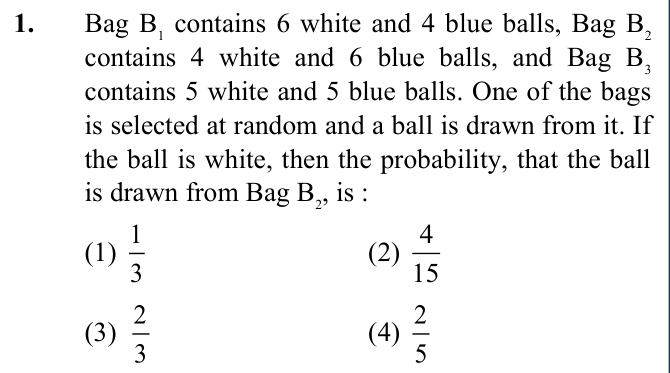
(1) 1
3
(2) 4
15
(3) 2
3
(4) 2
5
E1 : Bag B1 is selected
B1
B2
B3
6W 4B
4W 6B
5W 5B
E2 : bag B2 is selected
E3 : Bag B3 is selected
A : Drawn ball is white
We have to find
2
E
P
A
)
(
[
)
(
)
(
)
(
)
(
)
2
2
2
1
2
3
1
2
3
A
P E
P E
E
P
A
A
A
A
P E
P
P E
P
P E
P
E
E
E
)
(
)
[
) = (
)
)
)
[
) + +
(
(
(
[
)
[
)
[
) = 1
4
3
10
1
6
1
4
1
5
3
10
3
10
3
10 × × + × + ×
= 4
15
QUESTION 2
Probability
SECTION A · MCQ (+4, -1)
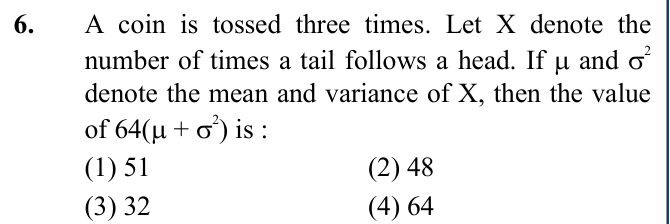
(1) 51
(2) 48
(3) 32
(4) 64
HHH → 0
HHT → 0
HTH → 1
HTT → 0
THH → 1
THT → 1
TTH → 1
TTT → 0
Probability distribution
i
i
x
0
1
1
1
P(x )
2
2
i
i
1
x p
2
μ= = ∑
2
2
2
i
i
x p
µ
σ= - ∑
1
1
1
2
4
4 = - = 64(µ + σ
2) =
1
1
64 2
4
) + (
[
)
= 48
QUESTION 3
Probability
SECTION A · MCQ (+4, -1)
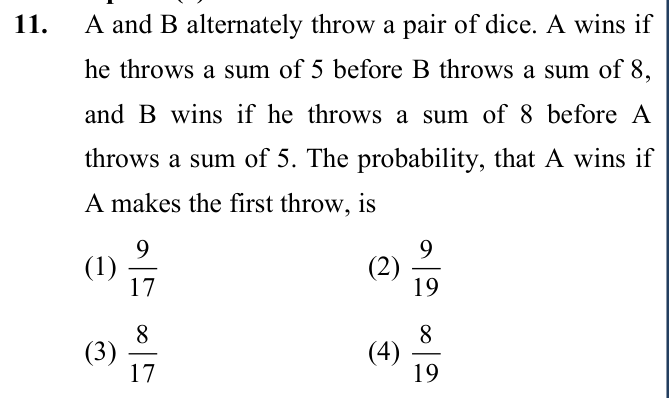
(1) 9
17
(2) 9
19
(3) 8
17
(4) 8
19
p(S5) = 1
9
p(S5) = 5
36
required prob =
) + +(
[
)
2
1
8 31 1
8 31
1
.
.
.
.
9
9 36 9
9 36
9 + …∞ = = - 1
9
9
62
19
1
81
Option(2)
QUESTION 4
Probability
SECTION A · MCQ (+4, -1)
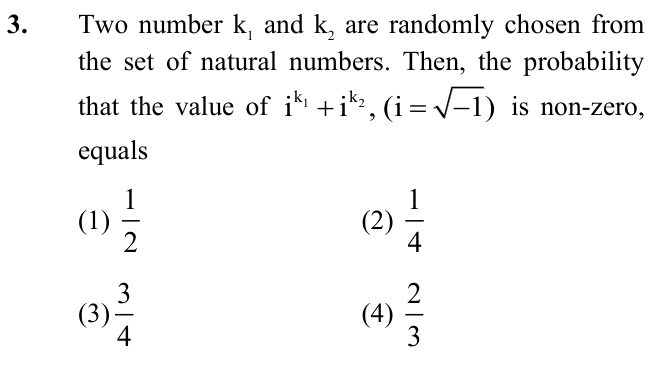
(1) 1
2
(2) 1
4
(3) 3
4
(4) 2
3
+ ≠ 1
2
k
k
i
i
0
1
ki
4
→
option for i, –1, –i, 1
Total cases ⇒ 4×4 = 16
Unfovourble cases ⇒
1
2
k
k
i
i
0 + =
1, 1
1,1
i, i
i,i - {
} - {
} - -
4 Cases ⇒ Probability = 16
4
3
16
4 - =
QUESTION 5
Probability
SECTION A · MCQ (+4, -1)
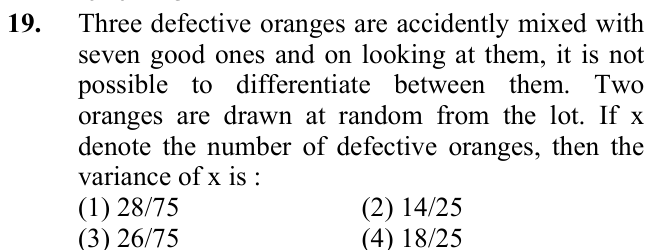
(1) 28/75
(2) 14/25
(3) 26/75
(4) 18/25
10 oranges
7 good
3 defected
Probability distribution
i
i
7
2
10
2
7
3
1
1
10
2
3
2
10
2
x
p
C
42
x
0
90
C
C
C
42
x
1
90
C
C
6
x
2
90
C = = × = = = = Now,
μ=
i
i
42
12
54
x p
90
90
90 = + = ∑
σ
2 =
2
2
2
i
1
42
24
54
p x –
–
90
90
90
)
μ= + (
[
)
∑
⇒
2
66
54
–
90
90
)
(
[
)
σ
2 ⇒ 28
75
∴(1)
7
QUESTION 6
Probability
SECTION A · MCQ (+4, -1)
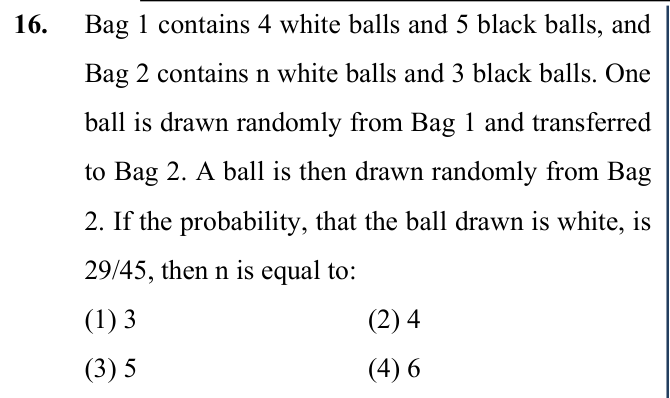
(1) 3
(2) 4
(3) 5
(4) 6
Bag 1 = {4W, 5B}
Bag 2 = {nW, 3B}
W
29
P Bag2
45
)=
(
[
)
⇒
1
2
1
2
W
W
B
W
29
P
P
P
P
B
B
B
B
45
)
)
)
) × + × =
(
(
(
(
[
)
[
)
[
)
[
)
4
n
1
5
n
29
9
n
4
9
n
4
45 + × + × = + + n
6
=
QUESTION 7
Probability
SECTION A · MCQ (+4, -1)
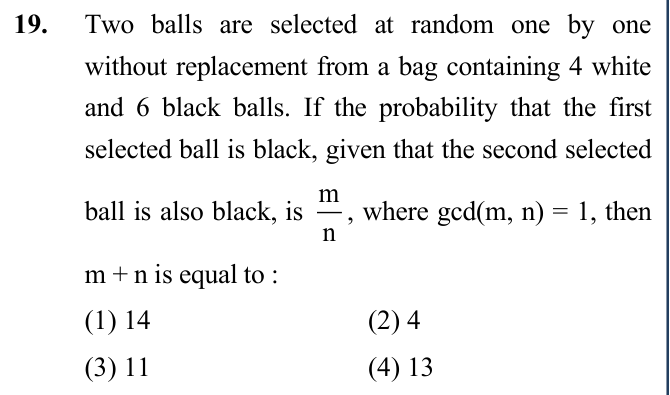
(1) 14
(2) 4
(3) 11
(4) 13
6
5
5
10
9
P
4
6
6
5
9
10
9
10
9 × = = × + ×
m = 5, n = 9
m + n = 14
QUESTION 8
Probability
SECTION A · MCQ (+4, -1)
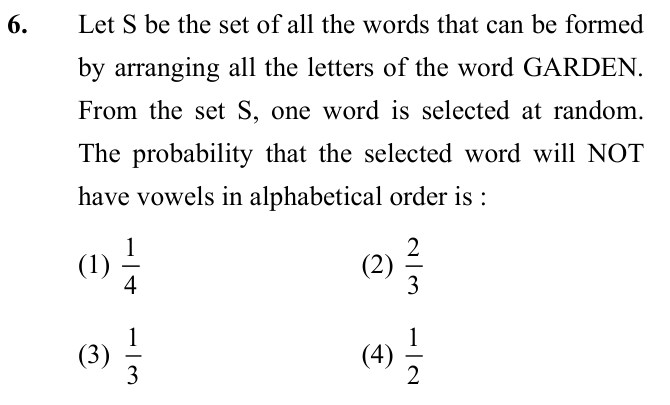
(1) 1
4
(2) 2
3
(3) 1
3
(4) 1
2
A, E,G R D N
Probabllity (P) = favourablecase
Totalcase
(when A & E are in order)
Total case = 6!
Favourable case =
6C2 . 4!
(
)
(
)
15 4!
P
30 4! = Probablity when not in order =
1
1
1
2
2 - =
3
QUESTION 9
Probability
SECTION A · MCQ (+4, -1)
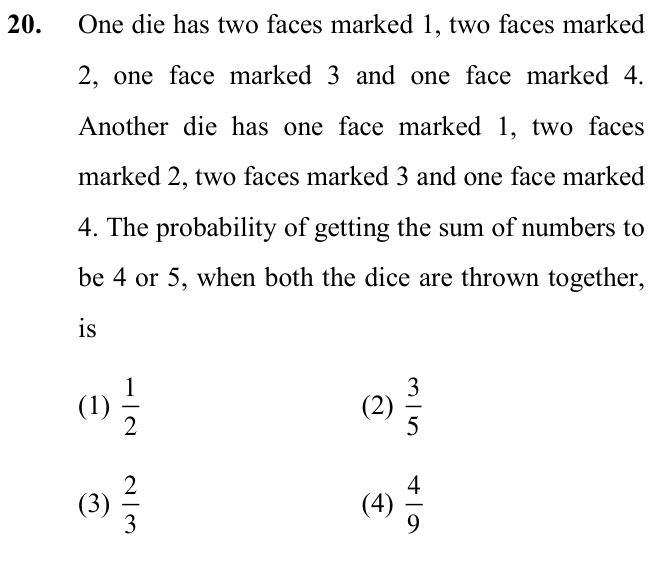
(1) 1
2
(2) 3
5
(3) 2
3
(4) 4
9
a = number or dice 1
b = number on dice 2
(a,b) = (1,3), (3,1), (2,2), (2,3), (3,2), (1,4), (4,1)
Required probability = × + × + × + × + × + × + ×
2
2
1
1
2
2
2
2
1
2
2
1
1
2
6
6
6
6
6
6
6
6
6
6
6
6
6
6 = =
18
1
36
2
7
SECTION-B
QUESTION 10
Probability
SECTION A · MCQ (+4, -1)
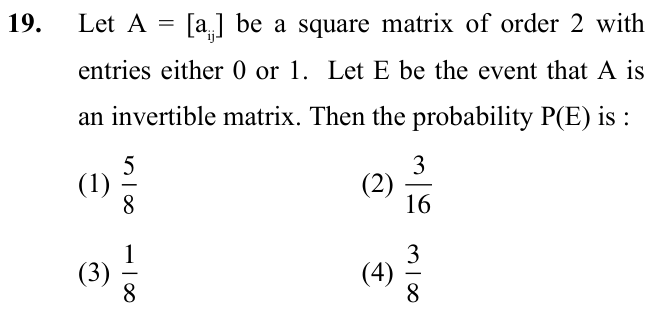
(1) 5
8
(2) 3
16
(3) 1
8
(4) 3
8
C-I 1
1
0
1 →4 ways
C-II
1
0
0
1 & 0
1
1
0 →2 ways
favourable
6
3
P
total
16
8 = =
=
QUESTION 11
Probability
SECTION A · MCQ (+4, -1)
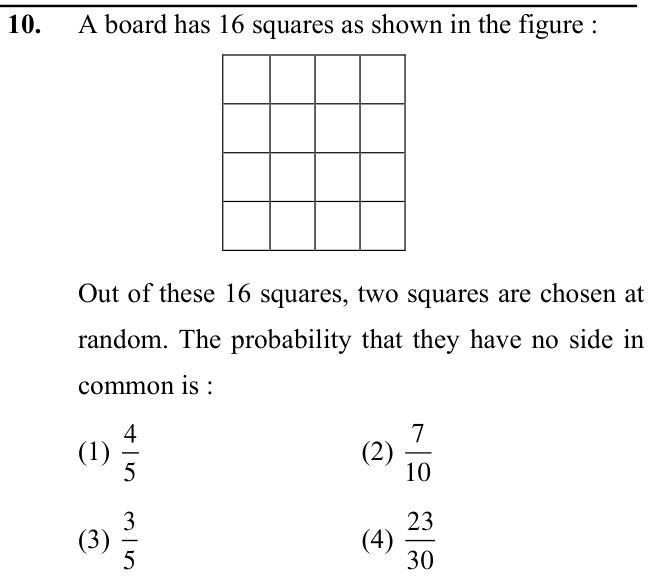
(1) 4
5
(2) 7
10
(3) 3
5
(4) 23
30
Total ways for selecting any two squares =
16C2
= 120
Total ways for selecting common side squares = × + ×
Horizontalside
vertical side
3 4
3 4
= 24
so required probability
= -24
1
120
= 4
5
QUESTION 12
Probability
SECTION A · MCQ (+4, -1)
A bag contains 2 white and 3 black balls. Another bag contains 3 white and 4 black balls. One bag is selected at random and a ball is drawn. If the ball is white, what is the probability it came from the first bag? Use Bayes' theorem to calculate.
(1) (1/2) × (2/5) / [(1/2)(2/5) × (1/2)(3/7)]
(2) (1/2) × (2/5) / [(1/2)(2/5) + (1/2)(3/7)]
(3) (2/5) / [(2/5) + (3/7)]
(4) (1/2) × (3/7) / [(1/2)(2/5) + (1/2)(3/7)]
The correct option uses Bayes' theorem with prior probability (1/2) for selecting the bag, likelihood (2/5) for white from first bag, and denominator as total probability of white. Other options omit prior probabilities or miscalculate the denominator.
QUESTION 13
Probability
SECTION A · MCQ (+4, -1)
A bag is chosen at random from two bags: Bag A (probability 1/2) containing 2 white and 5 black balls, and Bag B (probability 1/2) containing 3 white and 6 black balls. What is the total probability of drawing a white ball?
(1) (1/2 × 2/7) + (1/2 × 3/9)
(2) (1/2 + 2/7) + (1/2 + 3/9)
(3) (1/2 + 2/7) × (1/2 + 3/9)
(4) (1/2 × 2/7) × (1/2 × 3/9)
Correct answer multiplies along each branch (1/2 × 2/7 for Bag A, 1/2 × 3/9 for Bag B) and adds results. Other options incorrectly add or multiply probabilities instead of following the tree diagram rules.
QUESTION 14
Probability
SECTION A · MCQ (+4, -1)
A factory has two machines, M1 and M2. M1 produces 60% of items with a 2% defective rate, and M2 produces 40% with a 1% defective rate. What is the total probability of a randomly selected item being defective?
(1) 0.02
(2) 0.01
(3) 0.03
(4) 0.016
The correct answer uses the Law of Total Probability: P(Defective) = P(M1)P(D|M1) + P(M2)P(D|M2) = 0.6×0.02 + 0.4×0.01 = 0.016. Other options ignore multiplication or use incorrect rates.