
✎ ANSWER ONLINE · EVERY MISTAKE LINKS BACK TO THE CONCEPT
Probability · Practice Worksheet
Answer each question here and it marks straight away, with the derivation and a link to the exact micro-concept to revisit.
4 questions from this set could not be marked online — a
bonus or dual-key question, which has no single defensible answer. The print and
.docx versions still include them.
// CONCEPT AUDIT RESULT
Everything you missed has been added to your Error Arena — retest them blind there, and a concept clears once you get it right.
QUESTION 1
Probability
SECTION A · MCQ (+4, -1)
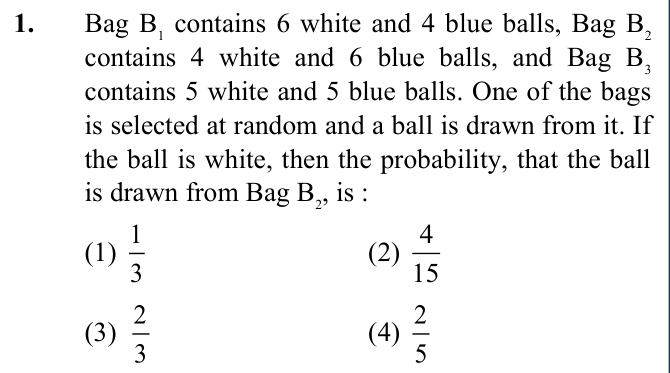
(1) 1
3
(2) 4
15
(3) 2
3
(4) 2
5
E1 : Bag B1 is selected
B1
B2
B3
6W 4B
4W 6B
5W 5B
E2 : bag B2 is selected
E3 : Bag B3 is selected
A : Drawn ball is white
We have to find
2
E
P
A
)
(
[
)
(
)
(
)
(
)
(
)
2
2
2
1
2
3
1
2
3
A
P E
P E
E
P
A
A
A
A
P E
P
P E
P
P E
P
E
E
E
)
(
)
[
) = (
)
)
)
[
) + +
(
(
(
[
)
[
)
[
) = 1
4
3
10
1
6
1
4
1
5
3
10
3
10
3
10 × × + × + ×
= 4
15
QUESTION 2
Probability
SECTION A · MCQ (+4, -1)
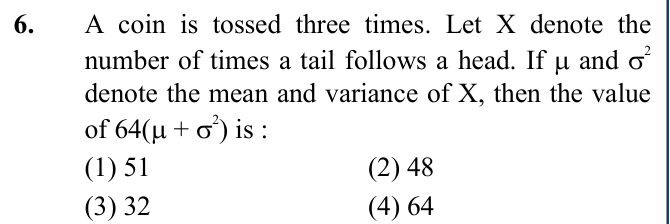
(1) 51
(2) 48
(3) 32
(4) 64
HHH → 0
HHT → 0
HTH → 1
HTT → 0
THH → 1
THT → 1
TTH → 1
TTT → 0
Probability distribution
i
i
x
0
1
1
1
P(x )
2
2
i
i
1
x p
2
μ= = ∑
2
2
2
i
i
x p
µ
σ= - ∑
1
1
1
2
4
4 = - = 64(µ + σ
2) =
1
1
64 2
4
) + (
[
)
= 48
QUESTION 3
Probability
SECTION A · MCQ (+4, -1)
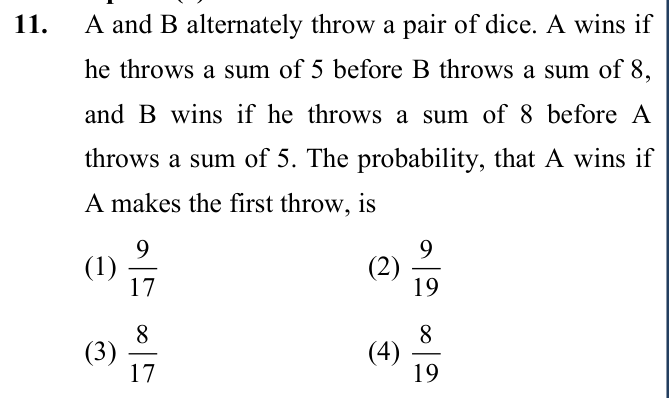
(1) 9
17
(2) 9
19
(3) 8
17
(4) 8
19
p(S5) = 1
9
p(S5) = 5
36
required prob =
) + +(
[
)
2
1
8 31 1
8 31
1
.
.
.
.
9
9 36 9
9 36
9 + …∞ = = - 1
9
9
62
19
1
81
Option(2)
QUESTION 4
Probability
SECTION A · MCQ (+4, -1)
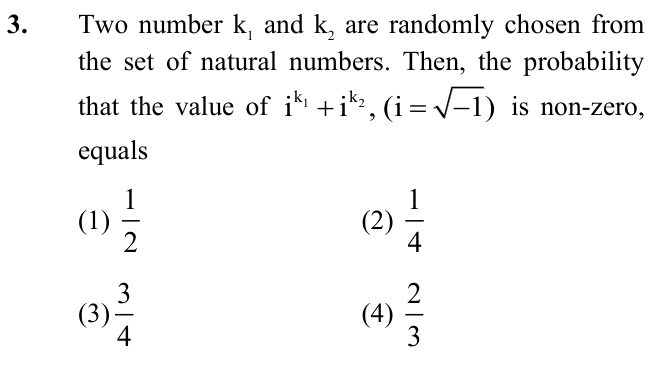
(1) 1
2
(2) 1
4
(3) 3
4
(4) 2
3
+ ≠ 1
2
k
k
i
i
0
1
ki
4
→
option for i, –1, –i, 1
Total cases ⇒ 4×4 = 16
Unfovourble cases ⇒
1
2
k
k
i
i
0 + =
1, 1
1,1
i, i
i,i - {
} - {
} - -
4 Cases ⇒ Probability = 16
4
3
16
4 - =
QUESTION 5
Probability
SECTION A · MCQ (+4, -1)
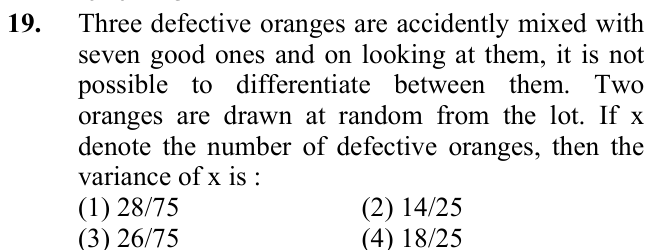
(1) 28/75
(2) 14/25
(3) 26/75
(4) 18/25
10 oranges
7 good
3 defected
Probability distribution
i
i
7
2
10
2
7
3
1
1
10
2
3
2
10
2
x
p
C
42
x
0
90
C
C
C
42
x
1
90
C
C
6
x
2
90
C = = × = = = = Now,
μ=
i
i
42
12
54
x p
90
90
90 = + = ∑
σ
2 =
2
2
2
i
1
42
24
54
p x –
–
90
90
90
)
μ= + (
[
)
∑
⇒
2
66
54
–
90
90
)
(
[
)
σ
2 ⇒ 28
75
∴(1)
7
QUESTION 6
Probability
SECTION A · MCQ (+4, -1)
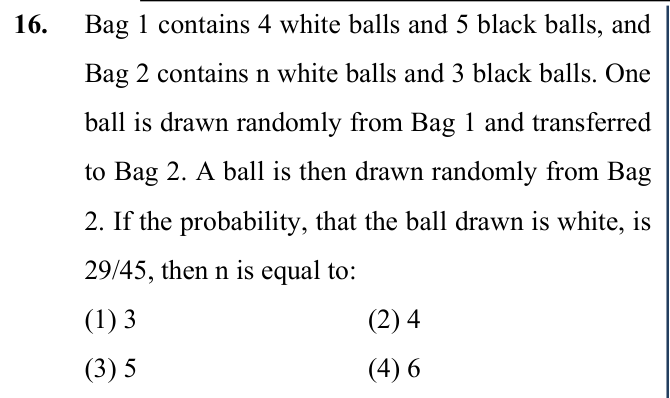
(1) 3
(2) 4
(3) 5
(4) 6
Bag 1 = {4W, 5B}
Bag 2 = {nW, 3B}
W
29
P Bag2
45
)=
(
[
)
⇒
1
2
1
2
W
W
B
W
29
P
P
P
P
B
B
B
B
45
)
)
)
) × + × =
(
(
(
(
[
)
[
)
[
)
[
)
4
n
1
5
n
29
9
n
4
9
n
4
45 + × + × = + + n
6
=
QUESTION 7
Probability
SECTION A · MCQ (+4, -1)
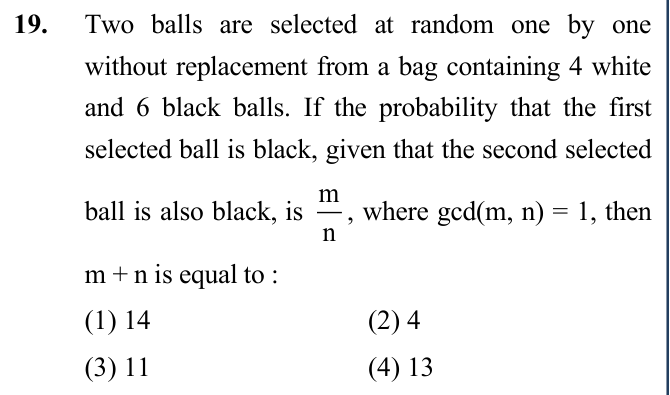
(1) 14
(2) 4
(3) 11
(4) 13
6
5
5
10
9
P
4
6
6
5
9
10
9
10
9 × = = × + ×
m = 5, n = 9
m + n = 14
QUESTION 8
Probability
SECTION A · MCQ (+4, -1)
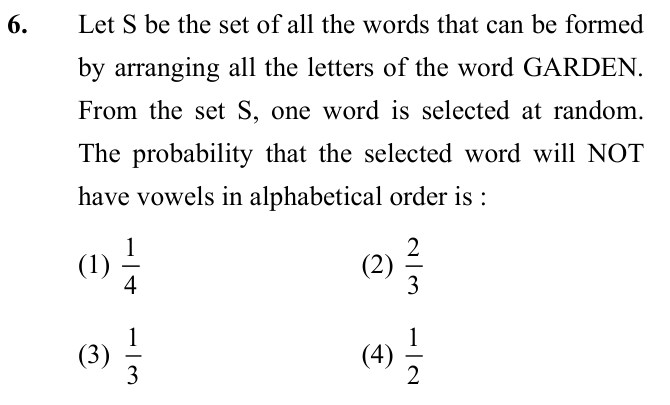
(1) 1
4
(2) 2
3
(3) 1
3
(4) 1
2
A, E,G R D N
Probabllity (P) = favourablecase
Totalcase
(when A & E are in order)
Total case = 6!
Favourable case =
6C2 . 4!
(
)
(
)
15 4!
P
30 4! = Probablity when not in order =
1
1
1
2
2 - =
3
QUESTION 9
Probability
SECTION A · MCQ (+4, -1)
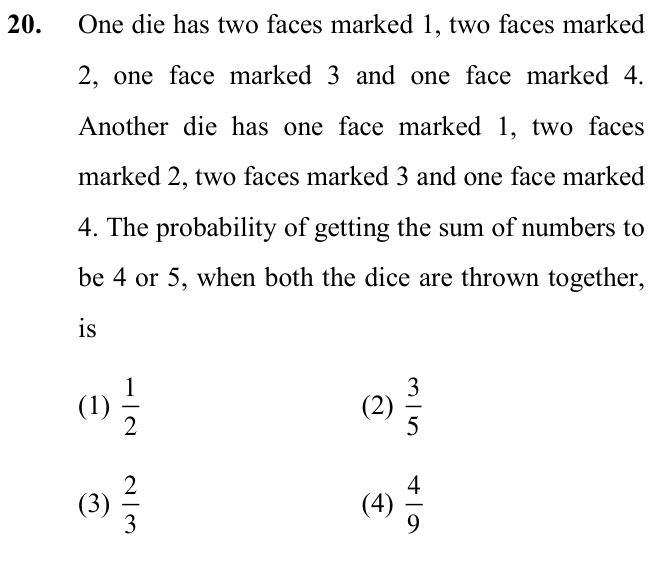
(1) 1
2
(2) 3
5
(3) 2
3
(4) 4
9
a = number or dice 1
b = number on dice 2
(a,b) = (1,3), (3,1), (2,2), (2,3), (3,2), (1,4), (4,1)
Required probability = × + × + × + × + × + × + ×
2
2
1
1
2
2
2
2
1
2
2
1
1
2
6
6
6
6
6
6
6
6
6
6
6
6
6
6 = =
18
1
36
2
7
SECTION-B
QUESTION 10
Probability
SECTION A · MCQ (+4, -1)
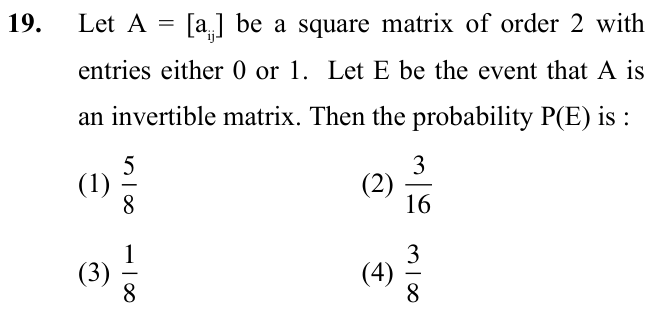
(1) 5
8
(2) 3
16
(3) 1
8
(4) 3
8
C-I 1
1
0
1 →4 ways
C-II
1
0
0
1 & 0
1
1
0 →2 ways
favourable
6
3
P
total
16
8 = =
=
QUESTION 11
Probability
SECTION A · MCQ (+4, -1)
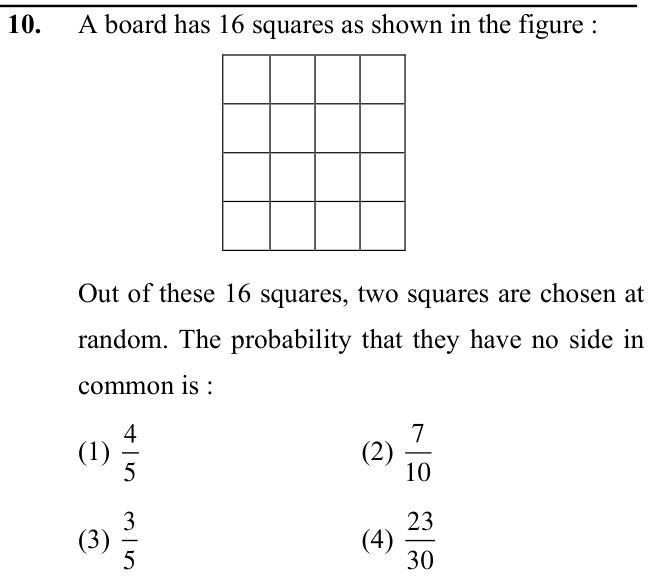
(1) 4
5
(2) 7
10
(3) 3
5
(4) 23
30
Total ways for selecting any two squares =
16C2
= 120
Total ways for selecting common side squares = × + ×
Horizontalside
vertical side
3 4
3 4
= 24
so required probability
= -24
1
120
= 4
5
QUESTION 12
Probability
SECTION A · MCQ (+4, -1)
A bag contains 2 white and 3 black balls. Another bag contains 3 white and 4 black balls. One bag is selected at random and a ball is drawn. If the ball is white, what is the probability it came from the first bag? Use Bayes' theorem to calculate.
(1) (1/2) × (2/5) / [(1/2)(2/5) × (1/2)(3/7)]
(2) (1/2) × (2/5) / [(1/2)(2/5) + (1/2)(3/7)]
(3) (2/5) / [(2/5) + (3/7)]
(4) (1/2) × (3/7) / [(1/2)(2/5) + (1/2)(3/7)]
The correct option uses Bayes' theorem with prior probability (1/2) for selecting the bag, likelihood (2/5) for white from first bag, and denominator as total probability of white. Other options omit prior probabilities or miscalculate the denominator.
QUESTION 13
Probability
SECTION A · MCQ (+4, -1)
A bag is chosen at random from two bags: Bag A (probability 1/2) containing 2 white and 5 black balls, and Bag B (probability 1/2) containing 3 white and 6 black balls. What is the total probability of drawing a white ball?
(1) (1/2 × 2/7) + (1/2 × 3/9)
(2) (1/2 + 2/7) + (1/2 + 3/9)
(3) (1/2 + 2/7) × (1/2 + 3/9)
(4) (1/2 × 2/7) × (1/2 × 3/9)
Correct answer multiplies along each branch (1/2 × 2/7 for Bag A, 1/2 × 3/9 for Bag B) and adds results. Other options incorrectly add or multiply probabilities instead of following the tree diagram rules.
QUESTION 14
Probability
SECTION A · MCQ (+4, -1)
A factory has two machines, M1 and M2. M1 produces 60% of items with a 2% defective rate, and M2 produces 40% with a 1% defective rate. What is the total probability of a randomly selected item being defective?
(1) 0.02
(2) 0.01
(3) 0.03
(4) 0.016
The correct answer uses the Law of Total Probability: P(Defective) = P(M1)P(D|M1) + P(M2)P(D|M2) = 0.6×0.02 + 0.4×0.01 = 0.016. Other options ignore multiplication or use incorrect rates.
QUESTION 15
Probability
SECTION A · MCQ (+4, -1)
If X takes values 0 and 1 with probabilities 0.4 and 0.6 respectively, what is E(X)?
(1) E(X) = 0*(0.4) + 1*(0.6) = 0.6.
(2) (-∞, E(X) = 0*(0.4) + 1*(0.6) = 0.6.)
(3) [-5, 7)
(4) Undefined under standard Probability axioms.
Weighting each numerical value x_i by its relative frequency of occurrence p_i computes the expected center of mass of the distribution.
QUESTION 16
Probability
SECTION A · MCQ (+4, -1)
An urn contains 5 red and 5 blue balls. Two balls are drawn without replacement. What is the probability both are red?
(1) (5/10) × (4/9)
(2) (5/10) × (4/10)
(3) (5/10) × (5/10)
(4) (5/10) × (5/9)
The correct answer uses the multiplication rule with conditional probability. The first draw has 5 red out of 10, but the second draw has 4 red left out of 9. Other options incorrectly use the same denominator or wrong numerators.
QUESTION 17
Probability
SECTION A · MCQ (+4, -1)
In medical screening for a rare disease, why is the posterior probability often much lower than the test's sensitivity?
(1) Valid only when elements belong strictly to the non-negative real domain $\mathbb{R}^+$.
(2) Requires uniform continuity across the entire open interval $(a, b)$.
(3) Contradicted by boundary limit constraints under standard Cartesian mapping.
(4) Because the rare base rate means the small percentage of false positives from the large healthy majority outnumbers the true positives.
The false positive pool P(E2)*P(A|E2) can easily dwarf the true positive pool P(E1)*P(A|E1) because healthy people E2 are vastly more numerous.
QUESTION 18
Probability
SECTION A · MCQ (+4, -1)
If events A and B are independent, with P(A) = 0.5 and P(B) = 0.6, what is P(A ∩ B)?
(1) 0.3
(2) 0.5
(3) 0.6
(4) 0.1
For independent events, P(A ∩ B) = P(A) × P(B) = 0.5 × 0.6 = 0.3. Other options incorrectly assume addition or conditional probability rules.
QUESTION 19
Probability
SECTION A · MCQ (+4, -1)
If evidence A is equally likely under all hypotheses, how do posterior probabilities relate to prior probabilities?
(1) Undefined under standard Probability axioms.
(2) Posterior probabilities will be exactly proportional to prior probabilities (no update occurs).
(3) [-5, 7)
(4) (-∞, Posterior probabilities will be exactly proportional to prior probabilities (no update occurs).)
Evidence selectively boosts hypotheses that predict that evidence with high likelihood, weighted by their initial plausibility.
QUESTION 20
Probability
SECTION A · MCQ (+4, -1)
An urn has 10 black and 5 white balls. Two balls are drawn without replacement. What is the probability both are black?
(1) [-5, 7)
(2) (-∞, P(B1 cap B2) = (10/15) * (9/14) = (2/3) * (9/14) = 18/42 = 3/7.)
(3) P(B1 cap B2) = (10/15) * (9/14) = (2/3) * (9/14) = 18/42 = 3/7.
(4) Undefined under standard Probability axioms.
Directly algebraic from P(B|A) = P(A cap B)/P(A); clearing the denominator yields the multiplication theorem.
QUESTION 21
Probability
SECTION A · MCQ (+4, -1)
If P(X=1) = k, P(X=2) = 2k, P(X=3) = 3k, and these are all possible values, what is k?
(1) Requires uniform continuity across the entire open interval $(a, b)$.
(2) Contradicted by boundary limit constraints under standard Cartesian mapping.
(3) Valid only when elements belong strictly to the non-negative real domain $\mathbb{R}^+$.
(4) k + 2k + 3k = 1 => 6k = 1 => k = 1/6.
Probabilities represent proportions of the total universal probability 1; negative probabilities or sums != 1 violate Kolmogorov axioms.