
⚡ OFFICIAL NTA ASSESSMENT GENERATOR & WORD (.DOCX) EXPORTER
Gravitation · Practice Worksheet
JEE Main Physics · Curated Assessment Set Print directly or export as a beautifully formatted Microsoft Word document with embedded 180-DPI mathematical prompt clips and step-by-step derivations.
EDUPROD JEE MAIN TEST SERIES · NTA PATTERN
Gravitation · Practice Worksheet
JEE Main Physics · Curated Assessment Set · Assessment Code: JEE-101
Total Marks: 100
Marking: +4 / -1 (Sec A) · +4 / 0 (Sec B)
QUESTION 1
PHYSICS · Gravitation
SECTION A · MCQ (+4, -1)
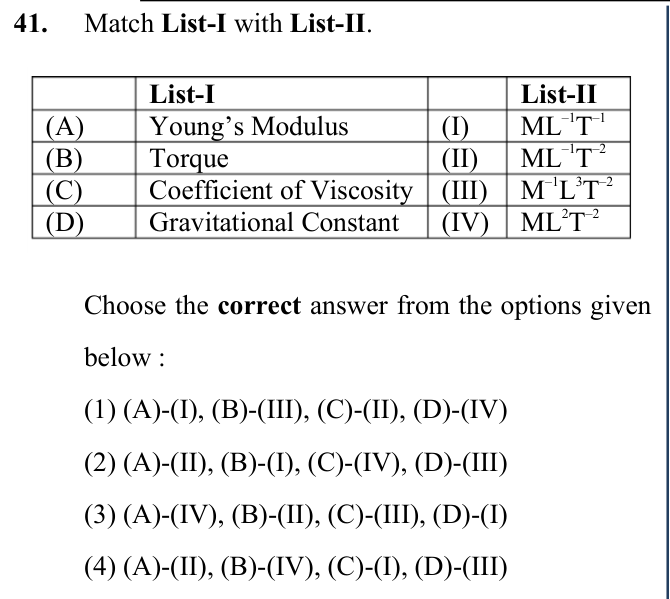
Candidate Response:
(1) (2) (3) (4)
QUESTION 2
PHYSICS · Gravitation
SECTION B · NUMERICAL (+4, 0)
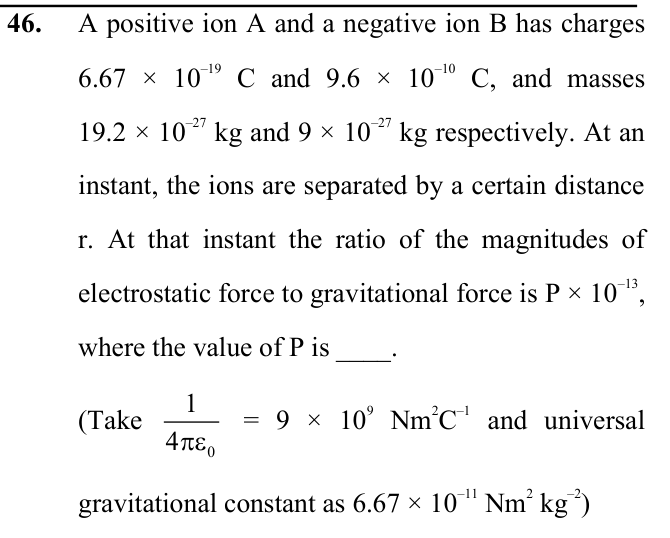
Numerical Value:
[ ]
QUESTION 3
PHYSICS · Gravitation
SECTION A · MCQ (+4, -1)
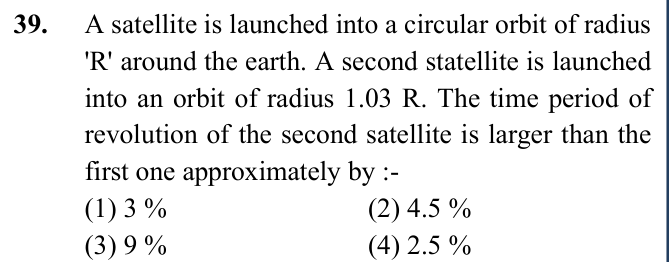
Candidate Response:
(1) (2) (3) (4)
QUESTION 4
PHYSICS · Gravitation
SECTION B · NUMERICAL (+4, 0)
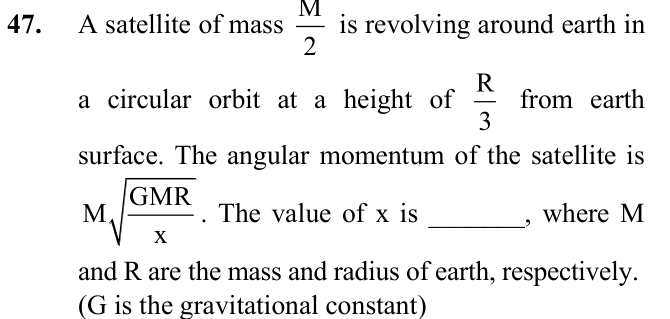
Numerical Value:
[ ]
QUESTION 5
PHYSICS · Gravitation
SECTION A · MCQ (+4, -1)
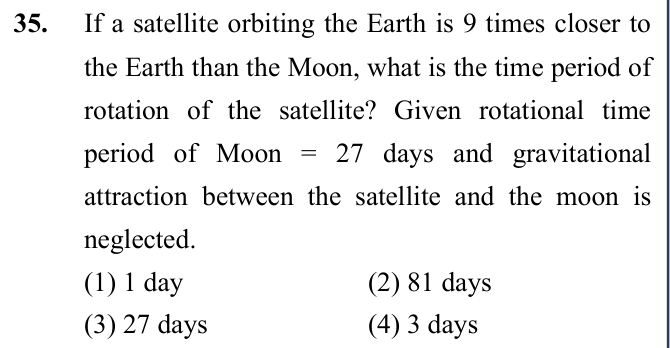
Candidate Response:
(1) (2) (3) (4)
QUESTION 6
PHYSICS · Gravitation
SECTION A · MCQ (+4, -1)
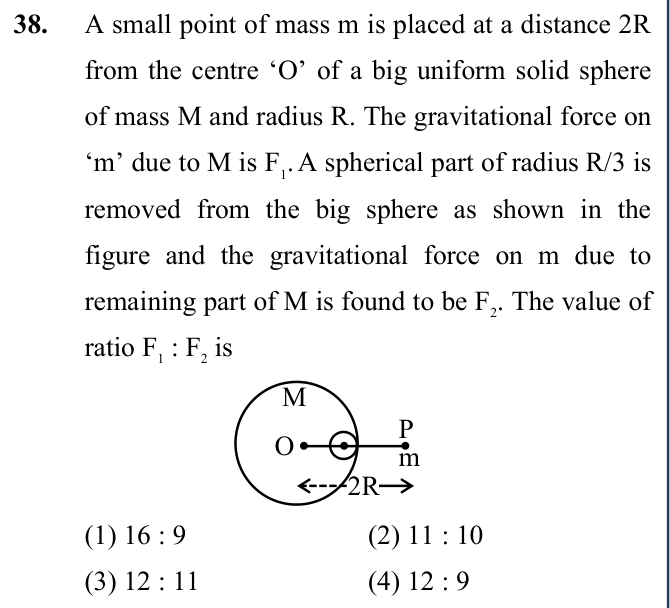
Candidate Response:
(1) (2) (3) (4)
QUESTION 7
PHYSICS · Gravitation
SECTION A · MCQ (+4, -1)
Taking g₀ = 9.8 m/s² and the Earth's radius R = 6.4 × 10⁶ m, the orbital speed of a satellite in a very low circular orbit (h ≈ 0) is approximately
(1) 7.9 km/s
(2) 3.1 km/s
(3) 5.6 km/s
(4) 11.2 km/s
Candidate Response:
(1) (2) (3) (4)
QUESTION 8
PHYSICS · Gravitation
SECTION A · MCQ (+4, -1)
The minimum speed with which a body must be projected from the surface of a planet so that it escapes the planet's gravitational pull is called the
(1) escape speed
(2) critical velocity of flow
(3) orbital speed
(4) terminal velocity
Candidate Response:
(1) (2) (3) (4)
QUESTION 9
PHYSICS · Gravitation
SECTION A · MCQ (+4, -1)
The orbital period of a geostationary satellite is approximately
(1) 90 minutes
(2) 365 days
(3) 24 hours
(4) 12 hours
Candidate Response:
(1) (2) (3) (4)
QUESTION 10
PHYSICS · Gravitation
SECTION A · MCQ (+4, -1)
A satellite that revolves around the Earth in the equatorial plane with a period equal to Earth's rotation period and appears fixed in the sky is called a
(1) polar satellite
(2) space probe
(3) artificial moon
(4) geostationary satellite
Candidate Response:
(1) (2) (3) (4)
QUESTION 11
PHYSICS · Gravitation
SECTION A · MCQ (+4, -1)
The acceleration due to gravity at the Earth's surface is g₀ = GM/R². A planet has the same mass as Earth but twice its radius. The surface gravity on this planet is
(1) g₀
(2) g₀/4
(3) g₀/2
(4) 2 g₀
Candidate Response:
(1) (2) (3) (4)
QUESTION 12
PHYSICS · Gravitation
SECTION A · MCQ (+4, -1)
At a depth d below the Earth's surface (R = Earth's radius), the acceleration due to gravity is given by
(1) g(d) = g₀(1 − d/R)
(2) g(d) = g₀(1 + d/R)
(3) g(d) = g₀(1 − d/R)²
(4) g(d) = g₀ d/R
Candidate Response:
(1) (2) (3) (4)
QUESTION 13
PHYSICS · Gravitation
SECTION A · MCQ (+4, -1)
At a given place on the Earth's surface, the acceleration due to gravity is the same for all bodies regardless of their
(1) mass
(2) distance from the axis
(3) position
(4) height
Candidate Response:
(1) (2) (3) (4)
QUESTION 14
PHYSICS · Gravitation
SECTION A · MCQ (+4, -1)
The standard value of acceleration due to gravity at the Earth's surface is approximately
(1) 6.67 m/s²
(2) 11.2 m/s²
(3) 3 × 10⁸ m/s²
(4) 9.8 m/s²
Candidate Response:
(1) (2) (3) (4)
QUESTION 15
PHYSICS · Gravitation
SECTION A · MCQ (+4, -1)
For a satellite in a circular orbit, if its kinetic energy is K and its gravitational potential energy is U, which relationship holds?
(1) U = K
(2) U = 2K
(3) U = −K
(4) U = −2K
Candidate Response:
(1) (2) (3) (4)
QUESTION 16
PHYSICS · Gravitation
SECTION A · MCQ (+4, -1)
A satellite in a circular orbit has kinetic energy 4 × 10⁹ J; its total mechanical energy is
(1) 8 × 10⁹ J
(2) −4 × 10⁹ J
(3) −8 × 10⁹ J
(4) 4 × 10⁹ J
Candidate Response:
(1) (2) (3) (4)
QUESTION 17
PHYSICS · Gravitation
SECTION A · MCQ (+4, -1)
For a satellite in a circular orbit, its total mechanical energy is equal to the
(1) negative of its kinetic energy
(2) its kinetic energy
(3) negative of its potential energy
(4) sum of kinetic and twice potential energy
Candidate Response:
(1) (2) (3) (4)
QUESTION 18
PHYSICS · Gravitation
SECTION A · MCQ (+4, -1)
Two lead spheres of mass 100 kg each are kept with their centres 1.0 m apart. Taking G = 6.67 × 10⁻¹¹ N m² kg⁻², the gravitational force of attraction between them is
(1) 6.67 × 10⁻⁷ N
(2) 6.67 × 10⁻⁹ N
(3) 6.67 × 10⁻¹¹ N
(4) 6.67 × 10⁻⁵ N
Candidate Response:
(1) (2) (3) (4)
QUESTION 19
PHYSICS · Gravitation
SECTION A · MCQ (+4, -1)
A satellite of mass m is in a circular orbit of radius r around the Earth (mass M). Its total mechanical energy is
(1) zero
(2) +GMm/2r
(3) −GMm/2r
(4) −GMm/r
Candidate Response:
(1) (2) (3) (4)
QUESTION 20
PHYSICS · Gravitation
SECTION A · MCQ (+4, -1)
According to Newton's law of universal gravitation, the gravitational force between two point masses separated by a distance r varies as F ∝ 1/rⁿ. What is the value of n?
(1) n = 3
(2) n = 1
(3) n = 2
(4) n = 1/2
Candidate Response:
(1) (2) (3) (4)
QUESTION 21
PHYSICS · Gravitation
SECTION A · MCQ (+4, -1)
At a depth d below the Earth's surface the acceleration due to gravity is g' = g(1 − d/R), so as depth increases the value of g'
(1) first increases then decreases
(2) remains constant
(3) decreases linearly
(4) increases linearly
Candidate Response:
(1) (2) (3) (4)
QUESTION 22
PHYSICS · Gravitation
SECTION A · MCQ (+4, -1)
At the centre of the Earth (depth d = R), the acceleration due to gravity is
(1) g
(2) g/2
(3) zero
(4) infinite
Candidate Response:
(1) (2) (3) (4)
QUESTION 23
PHYSICS · Gravitation
SECTION A · MCQ (+4, -1)
The approximate value of the universal gravitational constant G is
(1) 6.02 × 10²³ N m² kg⁻²
(2) 9.8 N m² kg⁻²
(3) 6.67 × 10⁻¹¹ N m kg⁻¹
(4) 6.67 × 10⁻¹¹ N m² kg⁻²
Candidate Response:
(1) (2) (3) (4)
QUESTION 24
PHYSICS · Gravitation
SECTION A · MCQ (+4, -1)
The escape speed from the Earth's surface is approximately
(1) 7.9 km/s
(2) 3.0 × 10⁸ m/s
(3) 9.8 km/s
(4) 11.2 km/s
Candidate Response:
(1) (2) (3) (4)
QUESTION 25
PHYSICS · Gravitation
SECTION A · MCQ (+4, -1)
For a satellite in a circular orbit around the Earth, the centripetal force is provided by
(1) gravitational attraction between the satellite and Earth
(2) the satellite's own weight in free space
(3) the frictional drag of the atmosphere
(4) the rocket thrust from the satellite's engine
Candidate Response:
(1) (2) (3) (4)