
✎ ANSWER ONLINE · EVERY MISTAKE LINKS BACK TO THE CONCEPT
Gravitation · Practice Worksheet
Answer each question here and it marks straight away, with the derivation and a link to the exact micro-concept to revisit.
1 question from this set could not be marked online — a
bonus or dual-key question, which has no single defensible answer. The print and
.docx versions still include it.
// CONCEPT AUDIT RESULT
Everything you missed has been added to your Error Arena — retest them blind there, and a concept clears once you get it right.
QUESTION 1
Gravitation
SECTION A · MCQ (+4, -1)
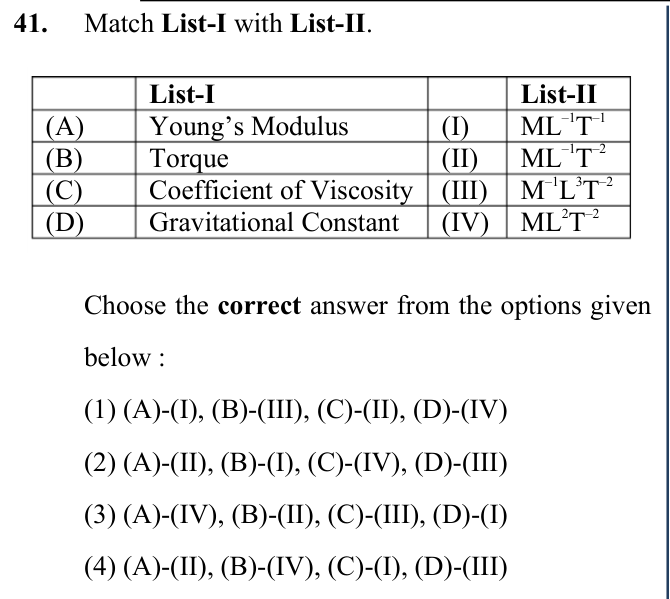
(1) (A)-(I), (B)-(III), (C)-(II), (D)-(IV)
(2) (A)-(II), (B)-(I), (C)-(IV), (D)-(III)
(3) (A)-(IV), (B)-(II), (C)-(III), (D)-(I)
(4) (A)-(II), (B)-(IV), (C)-(I), (D)-(III)
(A) []
2
1
2
2
F
MLT
Y
ML T
L
A - - - =
⇒ = Δ
)
(
[
)
(II)
(B) Torque ()
r
F
τ=×
()
2
2
2
L MLT
ML T - -
τ= × =
(IV)
(C) Coefficient of viscosity ⇒
dV
F
A dt
=η
η →Pa·sec
[]
2
1
1
2
MLT
T
ML T
L - - - η= × =
(I)
(D) Gravitational constant (G)
1
2
2
GM M
F
r = []
2
2
2
1
3
2
2
1
2
F r
MLT
L
G
M L T
m m
M - - - ⋅ × = = =
(III)
QUESTION 2
Gravitation
SECTION A · MCQ (+4, -1)
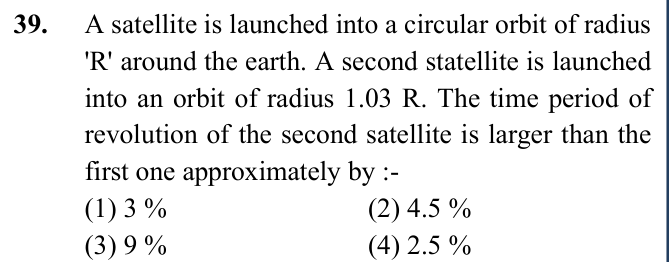
(1) 3 %
(2) 4.5 %
(3) 9 %
(4) 2.5 %
T
2 = KR
3
2 T
3 R
T
R
Δ
Δ = 2 T
3 0.03R
T
R
Δ × =
T
3 0.03 100
4.5%
T
2
Δ × = × =
QUESTION 3
Gravitation
SECTION B · NUMERICAL (+4, 0)
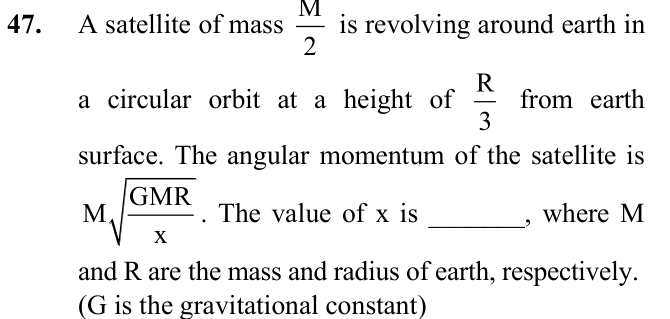
(i) If earth is assumed to be stationary
M/2
V0
R/3
M
orbital velocity = 0
GM
v
4R / 3 =
3GM
4R
Angular momentum of satellite =
0
M
4R
v
2
3
= M
3GM 4R
·
·
2
4R
3 = GMR
M
3
x = 3
(ii) Since mass of satellite is comparable to the
mass of earth.
M/2
M
COM
4R/3
ω
8R/9
)
(
[
)
2
M
G.M. 2
4R
3 = ω2
M
8R
·
2
9
ω=
3
81GM
128R
Angular momentum of satellite about common
centre of mass,
) = ω
(
[
)
2
M
8R
L
·
·
2
9
) = (
[
)
8
L
M GMR 81
=81
x
10
8
6
QUESTION 4
Gravitation
SECTION A · MCQ (+4, -1)
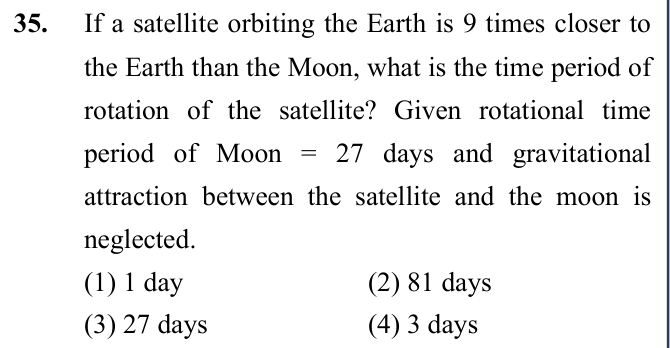
(1) 1 day
(2) 81 days
(3) 27 days
(4) 3 days
T
2 ∝ R
3
)
) = (
(
[
)
[
)
2
3
m
s
T
R
T
R / 9
m
s
T
T = (3)
3
⇒Ts =
)
(
[
)
27
27 = 1 day
QUESTION 5
Gravitation
SECTION A · MCQ (+4, -1)
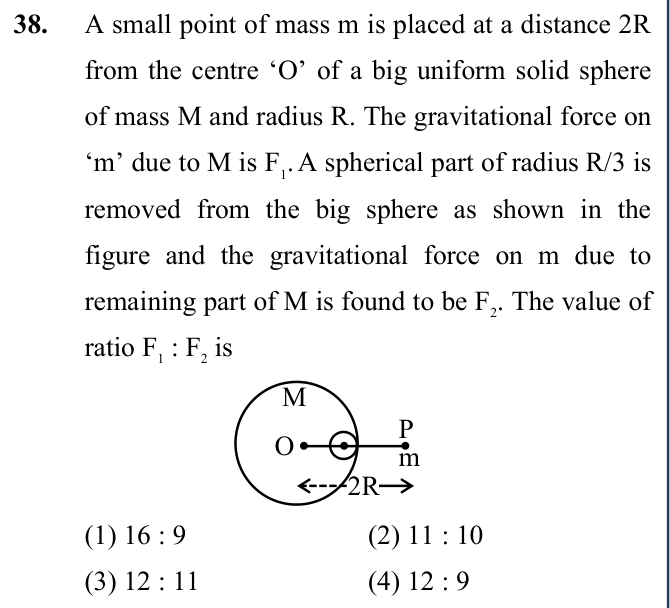
(1) 16 : 9
(2) 11 : 10
(3) 12 : 11
(4) 12 : 9
1
2
GMm
F
(2R) = …(1)
2
2
2
M
G
m
GMm
27
F
(2R)
4R
3
)
)
(
(
[
)
( = -(
)
(
(
[
)
[
)
2
2
11 GMm
F
48
R = …(2)
F1 : F2 = 12 : 11
QUESTION 6
Gravitation
SECTION A · MCQ (+4, -1)
Taking g₀ = 9.8 m/s² and the Earth's radius R = 6.4 × 10⁶ m, the orbital speed of a satellite in a very low circular orbit (h ≈ 0) is approximately
(1) 7.9 km/s
(2) 3.1 km/s
(3) 5.6 km/s
(4) 11.2 km/s
For a low orbit, vₒ = √(g₀R) = √(9.8 × 6.4 × 10⁶) = √(6.27 × 10⁷) ≈ 7.9 × 10³ m/s = 7.9 km/s.
QUESTION 7
Gravitation
SECTION A · MCQ (+4, -1)
The minimum speed with which a body must be projected from the surface of a planet so that it escapes the planet's gravitational pull is called the
(1) escape speed
(2) critical velocity of flow
(3) orbital speed
(4) terminal velocity
Escape speed is the minimum speed to overcome a planet's gravity.
QUESTION 8
Gravitation
SECTION A · MCQ (+4, -1)
The orbital period of a geostationary satellite is approximately
(1) 90 minutes
(2) 365 days
(3) 24 hours
(4) 12 hours
A geostationary satellite's period equals Earth's rotation, about 24 h.
QUESTION 9
Gravitation
SECTION A · MCQ (+4, -1)
A satellite that revolves around the Earth in the equatorial plane with a period equal to Earth's rotation period and appears fixed in the sky is called a
(1) polar satellite
(2) space probe
(3) artificial moon
(4) geostationary satellite
A geostationary satellite stays fixed above a point on the equator.