
⚡ OFFICIAL NTA ASSESSMENT GENERATOR & WORD (.DOCX) EXPORTER
Oscillations · Practice Worksheet
JEE Main Physics · Curated Assessment Set Print directly or export as a beautifully formatted Microsoft Word document with embedded 180-DPI mathematical prompt clips and step-by-step derivations.
EDUPROD JEE MAIN TEST SERIES · NTA PATTERN
Oscillations · Practice Worksheet
JEE Main Physics · Curated Assessment Set · Assessment Code: JEE-101
Total Marks: 120
Marking: +4 / -1 (Sec A) · +4 / 0 (Sec B)
QUESTION 1
PHYSICS · Oscillations
SECTION A · MCQ (+4, -1)
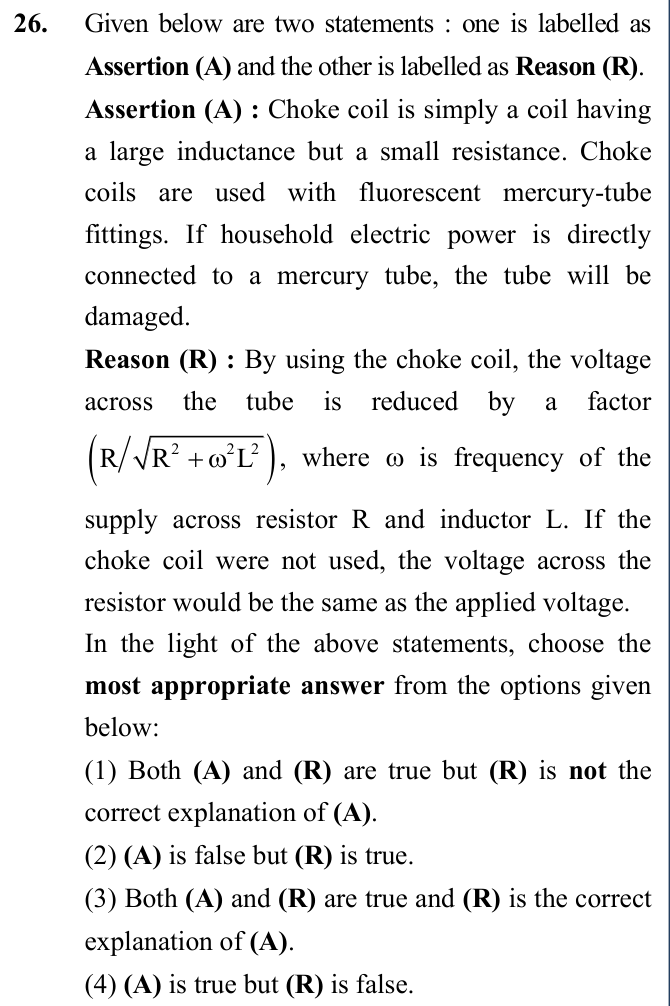
Candidate Response:
(1) (2) (3) (4)
⚡ OFFICIAL KEY: 3
Step-by-Step Derivation

QUESTION 2
PHYSICS · Oscillations
SECTION A · MCQ (+4, -1)
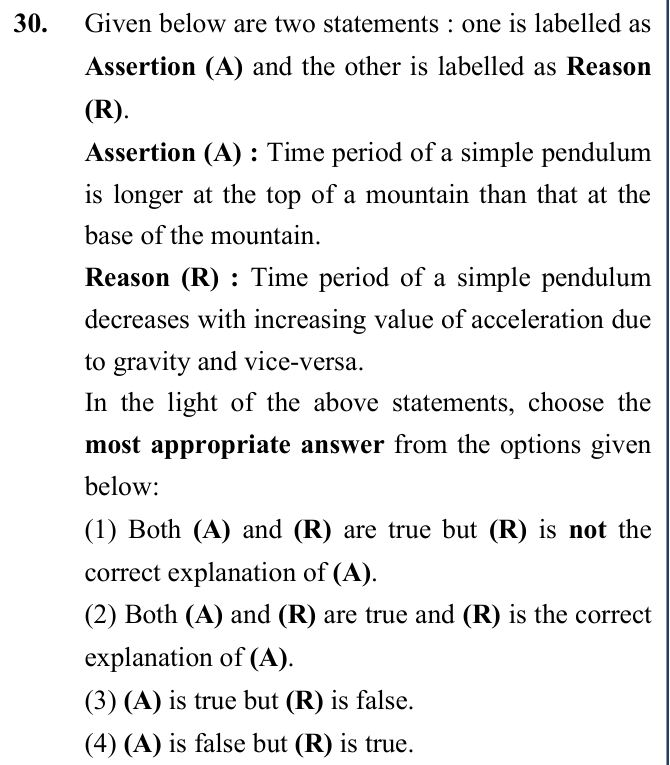
Candidate Response:
(1) (2) (3) (4)
⚡ OFFICIAL KEY: 2
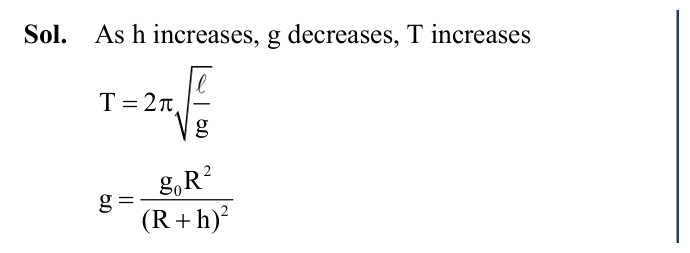
Step-by-Step Derivation
QUESTION 3
PHYSICS · Oscillations
SECTION A · MCQ (+4, -1)
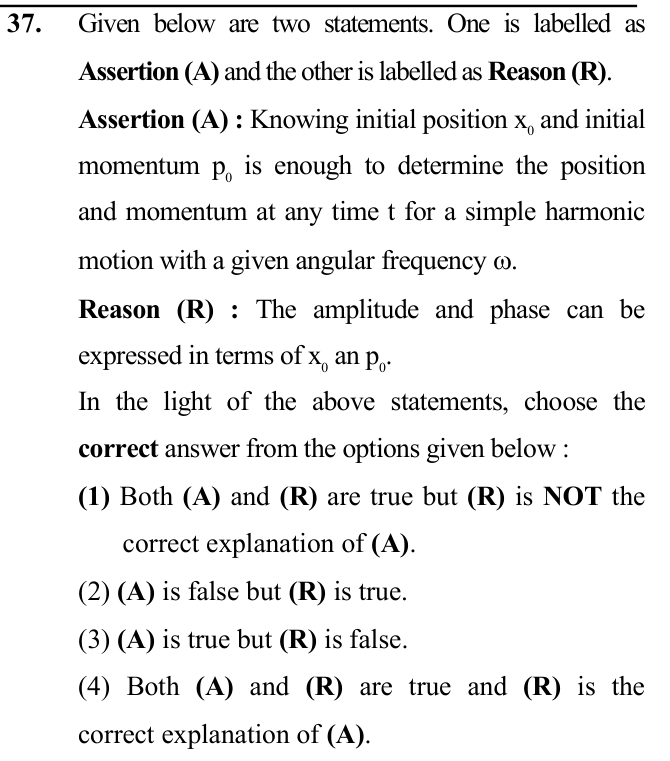
Candidate Response:
(1) (2) (3) (4)
⚡ OFFICIAL KEY: 4
Step-by-Step Derivation
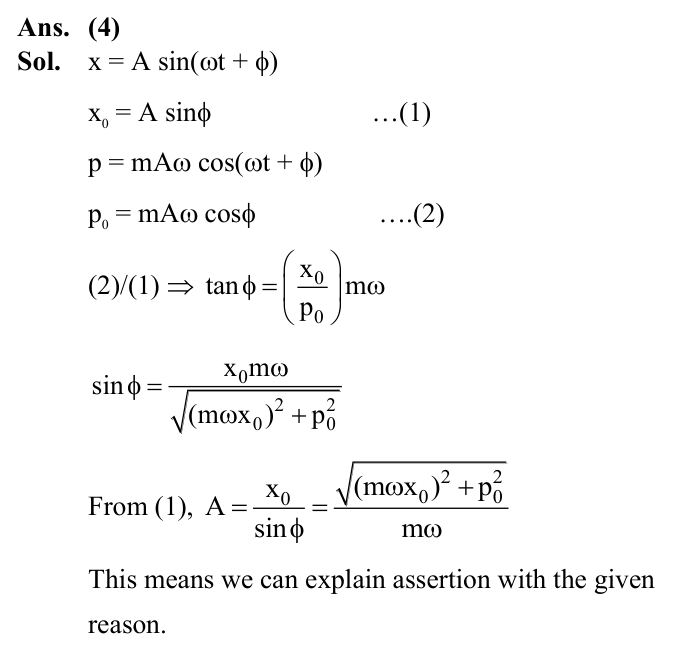
QUESTION 4
PHYSICS · Oscillations
SECTION A · MCQ (+4, -1)
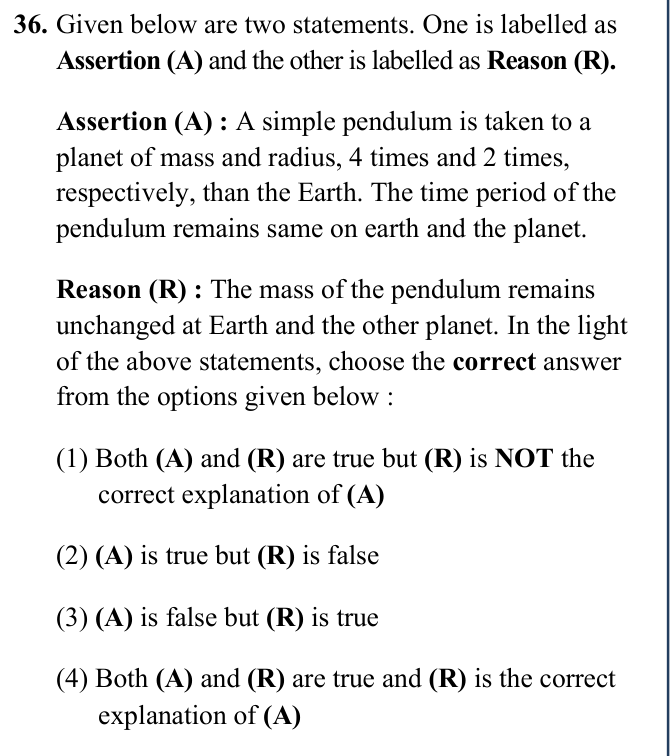
Candidate Response:
(1) (2) (3) (4)
⚡ OFFICIAL KEY: 1
Step-by-Step Derivation
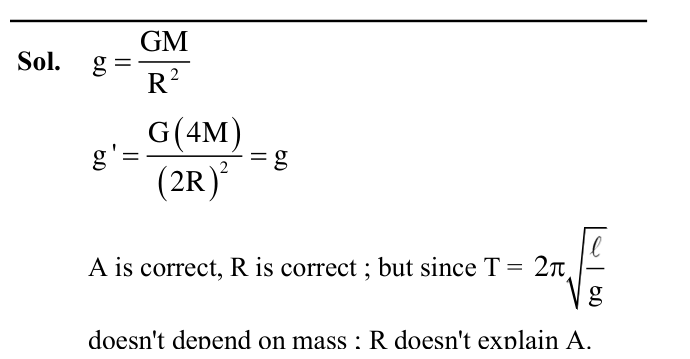
QUESTION 5
PHYSICS · Oscillations
SECTION A · MCQ (+4, -1)
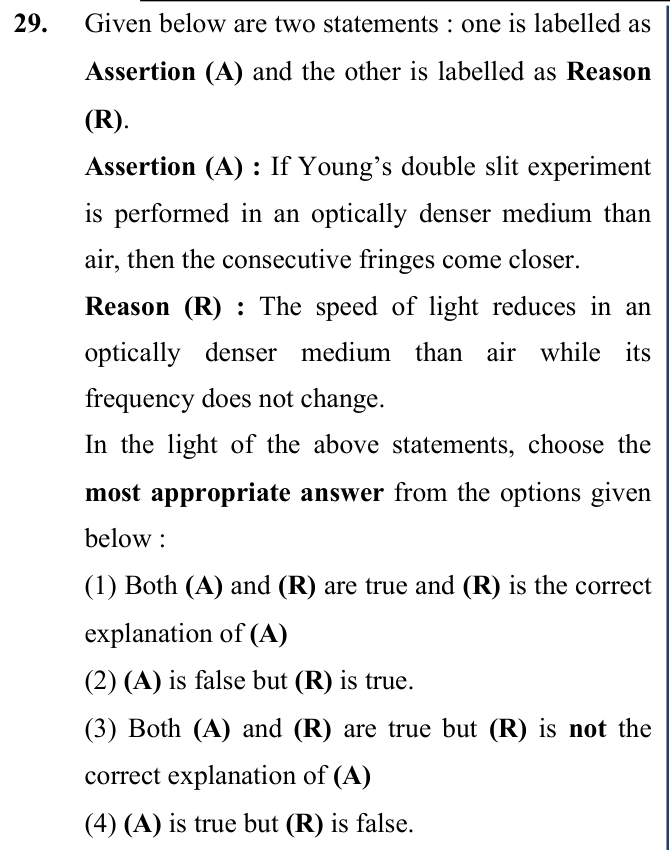
Candidate Response:
(1) (2) (3) (4)
⚡ OFFICIAL KEY: 1
Step-by-Step Derivation
QUESTION 6
PHYSICS · Oscillations
SECTION A · MCQ (+4, -1)
Candidate Response:
(1) (2) (3) (4)
⚡ OFFICIAL KEY: 4
Step-by-Step Derivation

QUESTION 7
PHYSICS · Oscillations
SECTION A · MCQ (+4, -1)
Candidate Response:
(1) (2) (3) (4)
⚡ OFFICIAL KEY: 4
Step-by-Step Derivation

QUESTION 8
PHYSICS · Oscillations
SECTION A · MCQ (+4, -1)
Candidate Response:
(1) (2) (3) (4)
⚡ OFFICIAL KEY: 1
Step-by-Step Derivation
QUESTION 9
PHYSICS · Oscillations
SECTION A · MCQ (+4, -1)
Candidate Response:
(1) (2) (3) (4)
⚡ OFFICIAL KEY: 2
Step-by-Step Derivation

QUESTION 10
PHYSICS · Oscillations
SECTION A · MCQ (+4, -1)
Candidate Response:
(1) (2) (3) (4)
⚡ OFFICIAL KEY: 2
Step-by-Step Derivation
QUESTION 11
PHYSICS · Oscillations
SECTION A · MCQ (+4, -1)
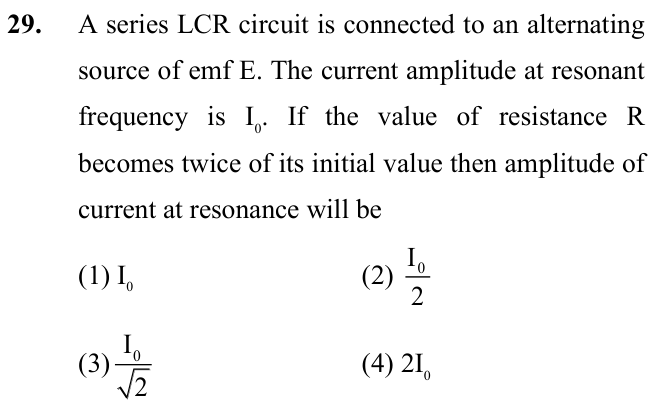
Candidate Response:
(1) (2) (3) (4)
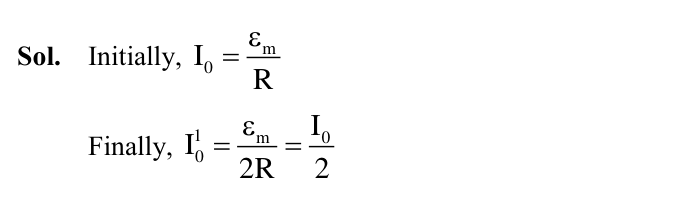
⚡ OFFICIAL KEY: 2
Step-by-Step Derivation
QUESTION 12
PHYSICS · Oscillations
SECTION B · NUMERICAL (+4, 0)
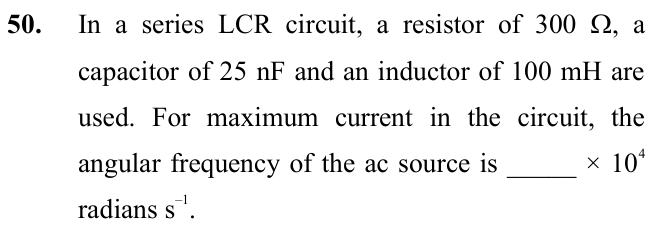
Numerical Value:
[ ]
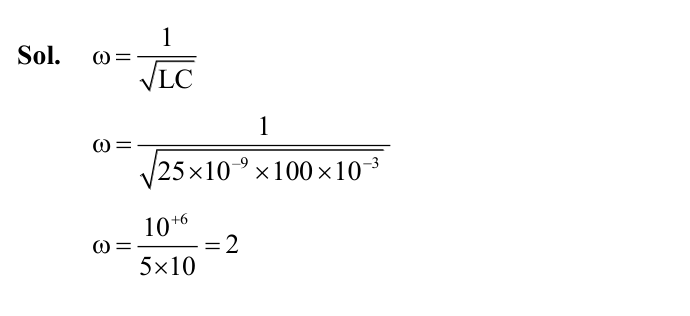
⚡ OFFICIAL KEY: 2
Step-by-Step Derivation
QUESTION 13
PHYSICS · Oscillations
SECTION A · MCQ (+4, -1)
A particle in SHM has maximum speed v_max and maximum acceleration a_max. The angular frequency ω and amplitude A are given by
(1) ω = a_max/v_max and A = v_max²/a_max
(2) ω = a_max/v_max and A = a_max²/v_max
(3) ω = a_max·v_max and A = v_max/a_max
(4) ω = v_max/a_max and A = a_max/v_max
Candidate Response:
(1) (2) (3) (4)
⚡ OFFICIAL KEY: ω = a_max/v_max and A = v_max²/a_max
Step-by-Step Derivation
Since v_max = ωA and a_max = ω²A, dividing gives ω = a_max/v_max, and then A = v_max²/a_max.
QUESTION 14
PHYSICS · Oscillations
SECTION A · MCQ (+4, -1)
Two springs of force constants k₁ and k₂ are connected in series to a block. The equivalent spring constant k_eq is
(1) k_eq = k₁ + k₂
(2) k_eq = (k₁ + k₂)/2
(3) k_eq = k₁k₂/(k₁ + k₂) only if k₁ = k₂
(4) 1/k_eq = 1/k₁ + 1/k₂
Candidate Response:
(1) (2) (3) (4)
⚡ OFFICIAL KEY: 1/k_eq = 1/k₁ + 1/k₂
Step-by-Step Derivation
Springs in series share the same force and their extensions add, so 1/k_eq = 1/k₁ + 1/k₂ (equivalently k_eq = k₁k₂/(k₁ + k₂)). The period then follows T = 2π√(m/k_eq).
QUESTION 15
PHYSICS · Oscillations
SECTION A · MCQ (+4, -1)
A particle performs SHM and is released from rest at x = +A at t = 0. Which equation correctly describes its displacement?
(1) x = A cos(ωt)
(2) x = A sin(ωt)
(3) x = A cos(ωt + π/2)
(4) x = -A cos(ωt)
Candidate Response:
(1) (2) (3) (4)
⚡ OFFICIAL KEY: x = A cos(ωt)
Step-by-Step Derivation
Starting at x = +A with zero velocity at t = 0 means the initial phase φ₀ = 0 in x = A cos(ωt + φ₀), giving x = A cos(ωt).
QUESTION 16
PHYSICS · Oscillations
SECTION A · MCQ (+4, -1)
If a pendulum completes 10 oscillations in 5 seconds, its frequency is
(1) 10 Hz
(2) 5 Hz
(3) 2 Hz
(4) 0.5 Hz
Candidate Response:
(1) (2) (3) (4)
⚡ OFFICIAL KEY: 2 Hz
Step-by-Step Derivation
Frequency equals oscillations per second, 10/5 = 2 Hz.
QUESTION 17
PHYSICS · Oscillations
SECTION A · MCQ (+4, -1)
Which statement correctly distinguishes oscillatory motion from merely periodic motion?
(1) Oscillatory motion and periodic motion are two completely unrelated classifications.
(2) Uniform circular motion is an example of oscillatory motion.
(3) Every periodic motion is necessarily oscillatory.
(4) All oscillatory motions are periodic, but not every periodic motion is oscillatory.
Candidate Response:
(1) (2) (3) (4)
⚡ OFFICIAL KEY: All oscillatory motions are periodic, but not every periodic motion is oscillatory.
Step-by-Step Derivation
Oscillatory (to-and-fro about a mean position) motion is a special case of periodic (repeating in equal time intervals) motion. Planetary orbits and uniform circular motion repeat periodically but never move to and fro about a fixed point, so they are periodic without being oscillatory.
QUESTION 18
PHYSICS · Oscillations
SECTION A · MCQ (+4, -1)
If a particle executes one complete oscillation in time T, which relation correctly links its frequency ν and angular frequency ω?
(1) ω = ν/2π
(2) ω = ν = 1/T
(3) ω = 2πν = 2π/T
(4) ω = 2π/T and ν = T
Candidate Response:
(1) (2) (3) (4)
⚡ OFFICIAL KEY: ω = 2πν = 2π/T
Step-by-Step Derivation
Frequency is ν = 1/T (in hertz). Angular frequency is ω = 2πν = 2π/T (in rad/s), giving the phase advance per unit time.
QUESTION 19
PHYSICS · Oscillations
SECTION A · MCQ (+4, -1)
The potential energy of a particle moving along the x-axis is U(x). For the particle to be in stable equilibrium at a point x₀, which condition must hold?
(1) dU/dx > 0 at x = x₀
(2) d²U/dx² = 0 at x = x₀
(3) dU/dx = 0 and d²U/dx² > 0 at x = x₀
(4) dU/dx = 0 and d²U/dx² < 0 at x = x₀
Candidate Response:
(1) (2) (3) (4)
⚡ OFFICIAL KEY: dU/dx = 0 and d²U/dx² > 0 at x = x₀
Step-by-Step Derivation
Equilibrium requires zero net force F = -dU/dx = 0, i.e. dU/dx = 0. It is stable when a small displacement produces a restoring force, which happens when the potential energy is a minimum (d²U/dx² > 0). A maximum (d²U/dx² < 0) is unstable, and d²U/dx² = 0 is neutral.
QUESTION 20
PHYSICS · Oscillations
SECTION A · MCQ (+4, -1)
The time period of a periodic motion whose frequency is 5 Hz is
(1) 2 s
(2) 0.5 s
(3) 5 s
(4) 0.2 s
Candidate Response:
(1) (2) (3) (4)
⚡ OFFICIAL KEY: 0.2 s
Step-by-Step Derivation
Time period T = 1/f = 1/5 = 0.2 s.
QUESTION 21
PHYSICS · Oscillations
SECTION A · MCQ (+4, -1)
In simple harmonic motion, the restoring force acting on the particle is directly proportional to its
(1) Displacement from the mean position
(2) Acceleration
(3) Velocity
(4) Square of the displacement
Candidate Response:
(1) (2) (3) (4)
⚡ OFFICIAL KEY: Displacement from the mean position
Step-by-Step Derivation
SHM is defined by a restoring force proportional to displacement from the mean position.
QUESTION 22
PHYSICS · Oscillations
SECTION A · MCQ (+4, -1)
In SHM of amplitude A, the kinetic energy equals the potential energy (K = U) at displacement
(1) x = ±A/2
(2) x = ±A
(3) x = ±A/√2
(4) x = 0
Candidate Response:
(1) (2) (3) (4)
⚡ OFFICIAL KEY: x = ±A/√2
Step-by-Step Derivation
K = U means ½k(A² - x²) = ½kx², giving A² - x² = x², so x² = A²/2 and x = ±A/√2.
QUESTION 23
PHYSICS · Oscillations
SECTION A · MCQ (+4, -1)
The projection of uniform circular motion (radius A, angular speed ω) onto any diameter executes
(1) simple harmonic motion of amplitude 2A and angular frequency 2ω
(2) simple harmonic motion of amplitude A and angular frequency ω
(3) motion with constant acceleration
(4) uniform linear motion
Candidate Response:
(1) (2) (3) (4)
⚡ OFFICIAL KEY: simple harmonic motion of amplitude A and angular frequency ω
Step-by-Step Derivation
The projection of a point moving uniformly around a reference circle of radius A onto a diameter is x = A cos(ωt + φ), which is SHM with amplitude A and angular frequency ω.
QUESTION 24
PHYSICS · Oscillations
SECTION A · MCQ (+4, -1)
According to the force law for SHM, the restoring force F on a particle displaced by x is
(1) k/x
(2) −kx
(3) −kx²
(4) kx²
Candidate Response:
(1) (2) (3) (4)
⚡ OFFICIAL KEY: −kx
Step-by-Step Derivation
SHM obeys F = −kx, proportional to displacement and opposite in direction.
QUESTION 25
PHYSICS · Oscillations
SECTION A · MCQ (+4, -1)
For a particle executing SHM with angular frequency ω, its time period T equals
(1) 2ω/π
(2) ω/2π
(3) 2π/ω
(4) π/ω
Candidate Response:
(1) (2) (3) (4)
⚡ OFFICIAL KEY: 2π/ω
Step-by-Step Derivation
The time period of SHM is T = 2π/ω.
QUESTION 26
PHYSICS · Oscillations
SECTION A · MCQ (+4, -1)
For a particle of mass m oscillating with amplitude A and angular frequency ω in SHM, the total mechanical energy is
(1) E = ½ mω²A²
(2) E = mω²A
(3) E = ½ mω²A
(4) E = ½ mωA²
Candidate Response:
(1) (2) (3) (4)
⚡ OFFICIAL KEY: E = ½ mω²A²
Step-by-Step Derivation
The total energy E = ½kA² = ½mω²A² (using k = mω²), and it stays constant throughout the motion, converting between kinetic and potential forms.
QUESTION 27
PHYSICS · Oscillations
SECTION A · MCQ (+4, -1)
Which of the following is a periodic motion but not an oscillatory motion?
(1) Vibration of a tuning fork
(2) Uniform circular motion
(3) Motion of a simple pendulum
(4) Motion of a mass on a spring
Candidate Response:
(1) (2) (3) (4)
⚡ OFFICIAL KEY: Uniform circular motion
Step-by-Step Derivation
Uniform circular motion repeats in time but has no to-and-fro about a mean position.
QUESTION 28
PHYSICS · Oscillations
SECTION A · MCQ (+4, -1)
According to Fourier's theorem, any periodic (but non-harmonic) function can be
(1) expressed only as a single pure cosine function
(2) never decomposed into simpler harmonic components
(3) expressed only as a single pure sine function
(4) expressed as a superposition of simple harmonic sine and cosine functions
Candidate Response:
(1) (2) (3) (4)
⚡ OFFICIAL KEY: expressed as a superposition of simple harmonic sine and cosine functions
Step-by-Step Derivation
Fourier's theorem states that any periodic waveform, however complex, can be built up from a sum of simple harmonic sine and cosine terms (a Fourier series).
QUESTION 29
PHYSICS · Oscillations
SECTION A · MCQ (+4, -1)
The time period of a block of mass m attached to a spring of force constant k executing SHM is
(1) √(m/k)
(2) 2π√(m/k)
(3) 2π(m/k)
(4) 2π√(k/m)
Candidate Response:
(1) (2) (3) (4)
⚡ OFFICIAL KEY: 2π√(m/k)
Step-by-Step Derivation
For a spring-block system, T = 2π√(m/k).
QUESTION 30
PHYSICS · Oscillations
SECTION A · MCQ (+4, -1)
The maximum velocity of a particle in SHM of amplitude A and angular frequency ω is
(1) Aω²
(2) Aω
(3) A/ω
(4) ω/A
Candidate Response:
(1) (2) (3) (4)
⚡ OFFICIAL KEY: Aω
Step-by-Step Derivation
Maximum velocity in SHM is v_max = Aω.