
✎ ANSWER ONLINE · EVERY MISTAKE LINKS BACK TO THE CONCEPT
Oscillations · Practice Worksheet
Answer each question here and it marks straight away, with the derivation and a link to the exact micro-concept to revisit.
// CONCEPT AUDIT RESULT
Everything you missed has been added to your Error Arena — retest them blind there, and a concept clears once you get it right.
QUESTION 1
Oscillations
SECTION A · MCQ (+4, -1)
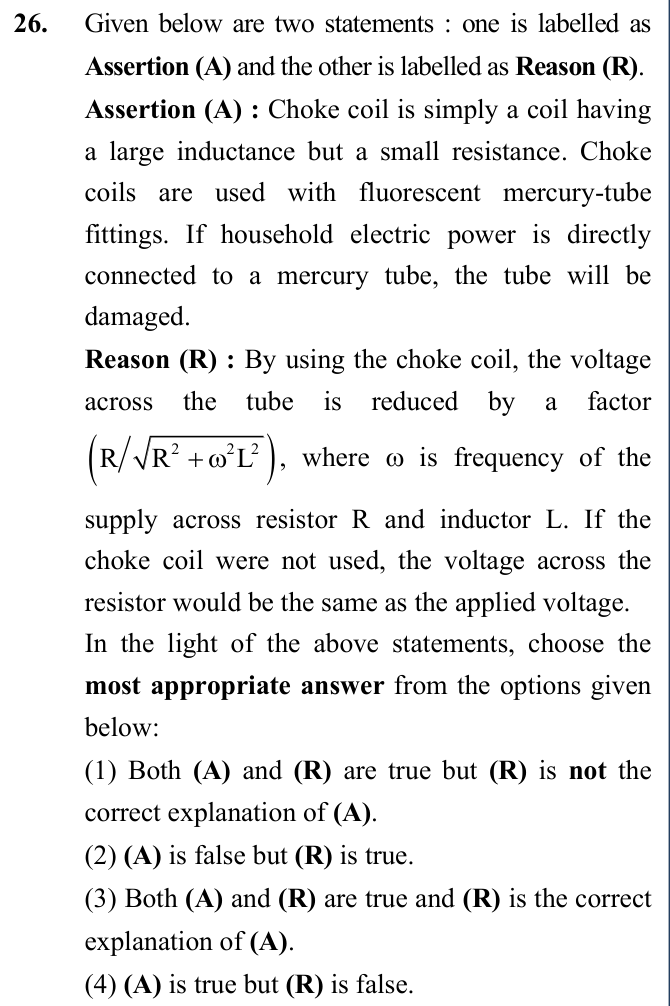
(1) Both (A) and (R) are true but (R) is not the
correct explanation of (A).
(2) (A) is false but (R) is true.
(3) Both (A) and (R) are true and (R) is the correct
explanation of (A).
(4) (A) is true but (R) is false.
A: Correct
B : Correct with correct explanation
QUESTION 2
Oscillations
SECTION A · MCQ (+4, -1)
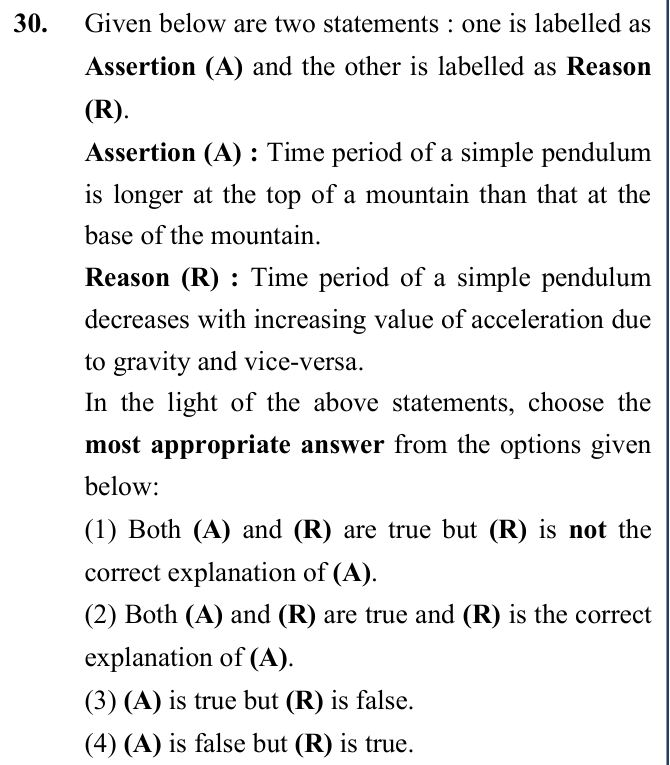
(1) Both (A) and (R) are true but (R) is not the
correct explanation of (A).
(2) Both (A) and (R) are true and (R) is the correct
explanation of (A).
(3) (A) is true but (R) is false.
(4) (A) is false but (R) is true.
As h increases, g decreases, T increases
=π
T
2
g = +
2
0
2
g R
g
(R
h)
QUESTION 3
Oscillations
SECTION A · MCQ (+4, -1)
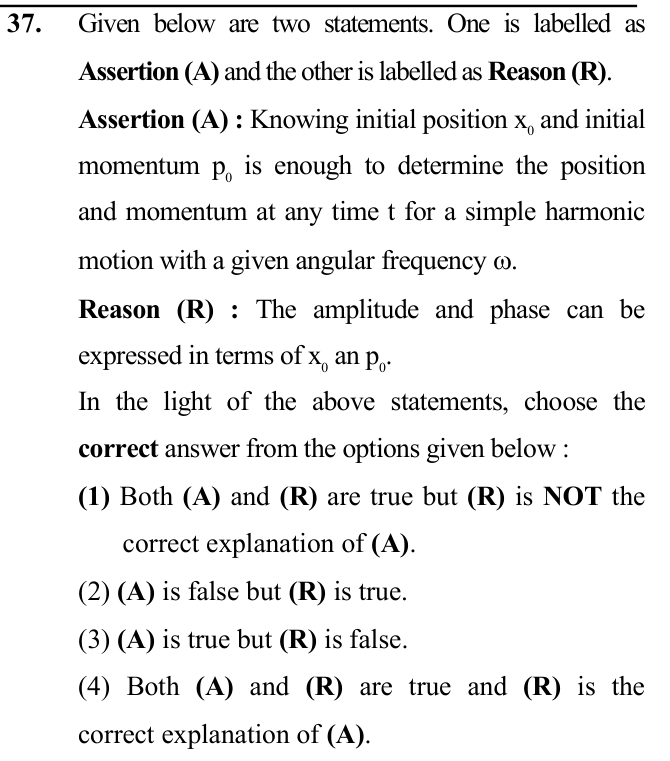
(1) Both (A) and (R) are true but (R) is NOT the
correct explanation of (A).
(2) (A) is false but (R) is true.
(3) (A) is true but (R) is false.
(4) Both (A) and (R) are true and (R) is the
correct explanation of (A).
x = A sin(ωt + φ)
x0 = A sinφ
…(1)
p = mAω cos(ωt + φ)
p0 = mAω cosφ
….(2)
(2)/(1) ⇒
0
0
x
tan
m
p
)
φ=
ω
(
[
)
0
2
2
0
0
x m
sin
(m x )
p
ω
φ=
ω + From (1),
2
2
0
0
0
(m x )
p
x
A
sin
m
ω + = = φ
ω
This means we can explain assertion with the given
reason.
QUESTION 4
Oscillations
SECTION A · MCQ (+4, -1)
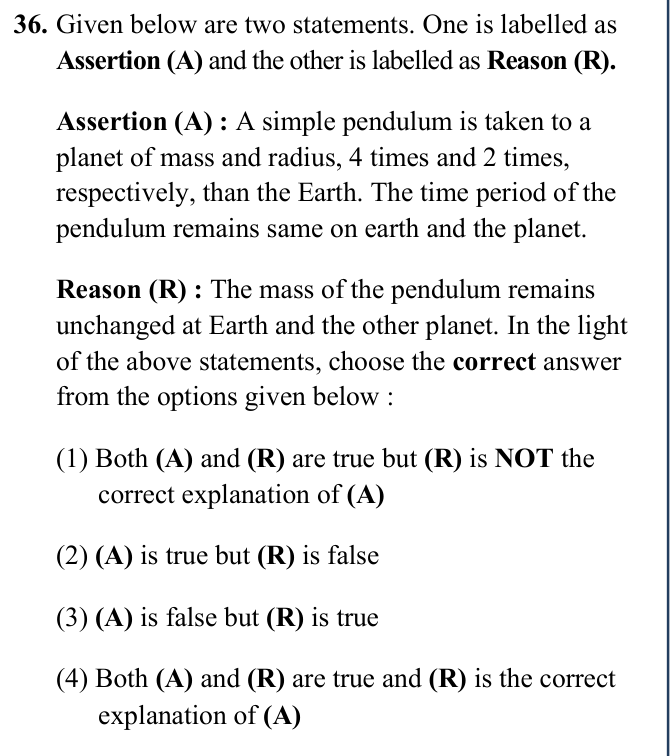
(1) Both (A) and (R) are true but (R) is NOT the
correct explanation of (A)
(2) (A) is true but (R) is false
(3) (A) is false but (R) is true
(4) Both (A) and (R) are true and (R) is the correct
explanation of (A)
2
GM
g
R = (
)
(
)
2
G 4M
g'
g
2R = =
A is correct, R is correct ; but since T = 2
g
π
doesn't depend on mass ; R doesn't explain A.
QUESTION 5
Oscillations
SECTION A · MCQ (+4, -1)
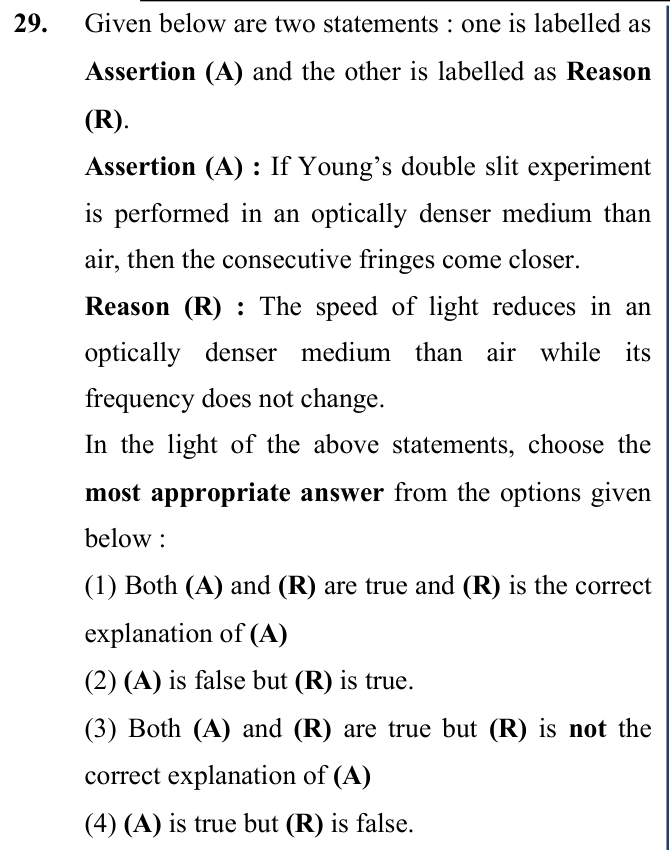
(1) Both (A) and (R) are true and (R) is the correct
explanation of (A)
(2) (A) is false but (R) is true.
(3) Both (A) and (R) are true but (R) is not the
correct explanation of (A)
(4) (A) is true but (R) is false.
β(fringe width)
D
d
λ = In denser medium, λ↓⇒β↓
⇒fringe come closer
Also,
c
c
µ
V
V
µ = ⇒ = Frequency remains same,
vac.
vac.
med
med
f
µ
f
µ
λ
λ
⇒ = ⇒λ = λ
QUESTION 6
Oscillations
SECTION A · MCQ (+4, -1)
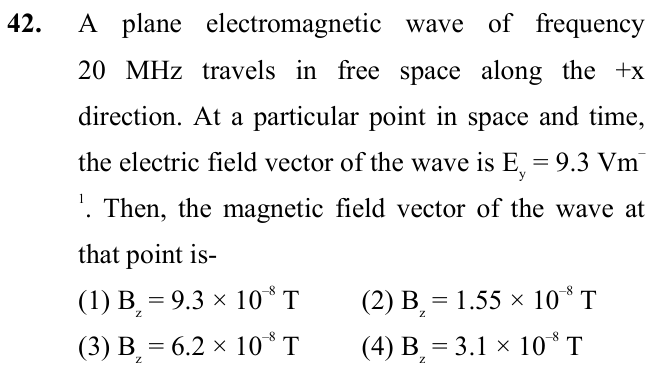
(1) Bz = 9.3 × 10
–8 T
(2) Bz = 1.55 × 10
–8 T
(3) Bz = 6.2 × 10
–8 T
(4) Bz = 3.1 × 10
–8 T
E = BC
9.3 = B × 3 × 10
8 = ×
8
9.3
B
3 10 = 3.1 × 10
–8 T
QUESTION 7
Oscillations
SECTION A · MCQ (+4, -1)
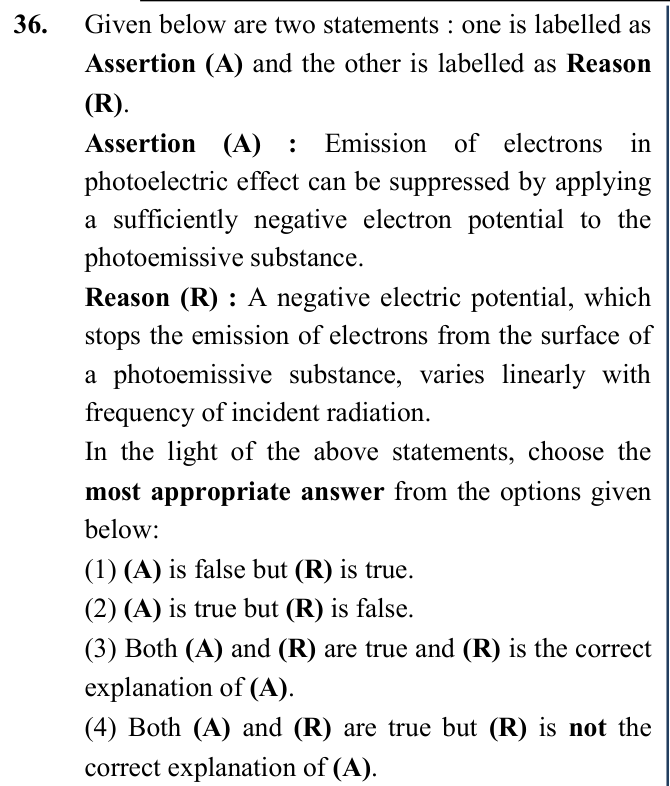
(1) (A) is false but (R) is true.
(2) (A) is true but (R) is false.
(3) Both (A) and (R) are true and (R) is the correct
explanation of (A).
(4) Both (A) and (R) are true but (R) is not the
correct explanation of (A).
(A) : True
(B) : True but not correct explanation
QUESTION 8
Oscillations
SECTION A · MCQ (+4, -1)
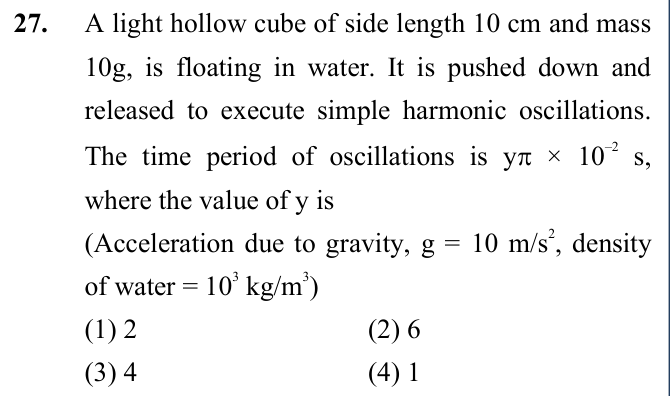
(1) 2
(2) 6
(3) 4
(4) 1
a2x ρg = manet
ρ = 2
net
L g x
a
m
T = 2π
ρ
2
m
L
g
where m = 10g, L = 10 cm, ρ = 1000 kg/m
3
QUESTION 9
Oscillations
SECTION A · MCQ (+4, -1)
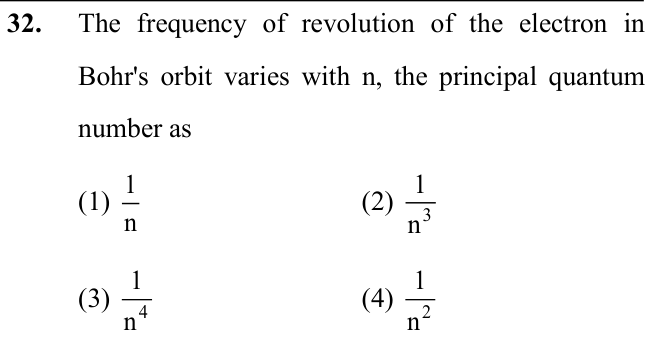
(1) 1
n
(2) 3
1
n
(3) 4
1
n
(4) 2
1
n
Frequency of revolution ∝
3
1
n
QUESTION 10
Oscillations
SECTION A · MCQ (+4, -1)
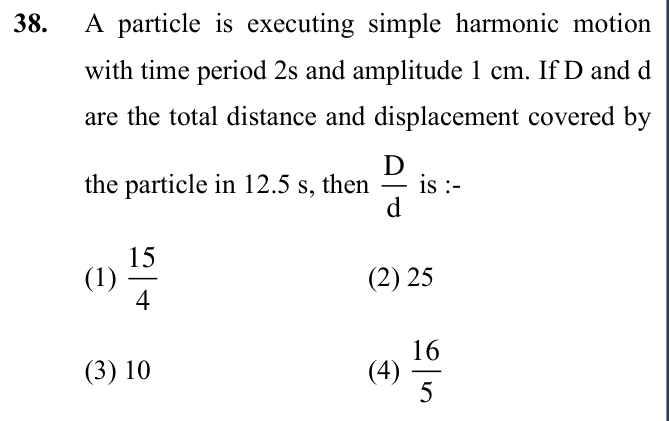
(1) 15
4
(2) 25
(3) 10
(4) 16
5
A = 1 cm
–A
A
12.5
n
6.25cycles
2 = =
∴ D = 4 × 6 + 1 = 25
d = 1
D
25
d =